
大语言模型(LLM)极其擅长生成文本。我们用它们来回答问题、编写代码、对问题进行推理,以及完成更多工作。但并非所有问题都需要生成文本。
设想一个客户支持系统收到了以下消息:
“我的订阅被扣了两次费。我今天就需要退款。”
系统需要确定应该由哪个团队处理该请求、紧急程度如何,以及客户是否在要求退款。
我们可以让大语言模型返回一个包含这些答案的 JSON 对象。
llama cli -hf ggml-org/gemma-4-e4b-it-GGUF:Q4_0
> We have the following customer support ticket, "I was charged twice for my subscription. I need a refund today.", which team should handle the request, how urgent it is, and whether the customer is requesting a refund. Give the answers in JSON.
[Start thinking]...[end thinking]```json{  "team_to_handle": "Billing",  "urgency": "High",  "request_refund": true}
但如果模型可以直接评估可用选项,并返回这些选项的概率分布,而_无需生成任何文本_呢?
from transformers import pipeline
decide = pipeline("decision", model="autotrust/GEV-26B-Decide")decision = decide(    {        "state": "I was charged twice for my order and want a refund.",        "questions": {            "department": {                "type": "choice",                "instructions": "Which team should handle this?",                "criteria": {                    "billing": "Payments and refunds",                    "technical": "Bugs and technical issues",                    "sales": "Pricing and subscriptions"                }            },        }    })
# {#   'department': {#       'type': 'choice',#       'choice': 'billing',#       'confidence': 0.9974000453948975,#       'probabilities': {#         'billing': 0.9982666969299316,#         'technical': 0.0010246571619063616,#         'sales': 0.0007087149424478412#       }#     }# }
这就是**决策模型(decision models)**背后的核心理念。
什么是决策模型?
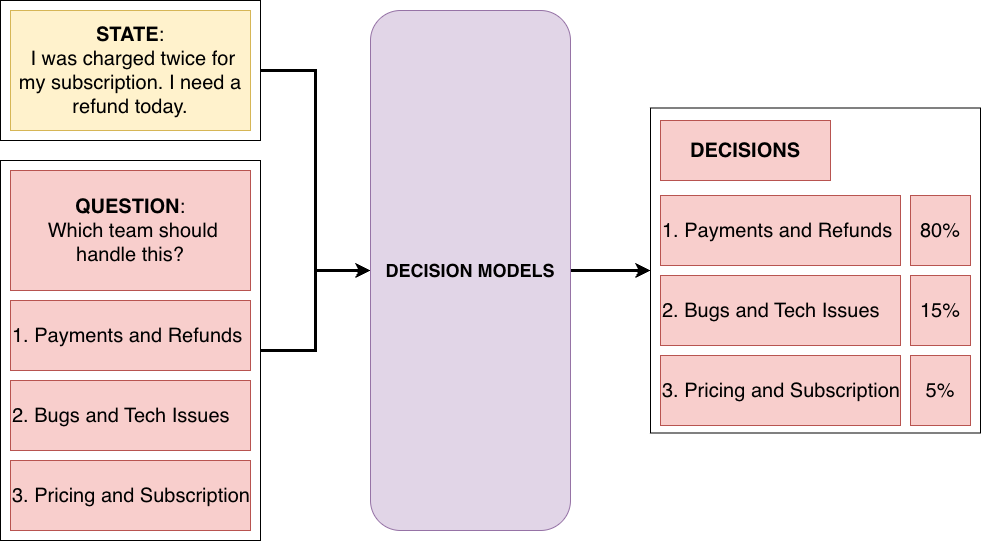
决策模型接收一些输入上下文(状态,state),结合一组预定义的可能答案(原语,primitives)来评估问题,并返回带有概率的结构化决策。我们不再要求模型逐个词元(token)地生成答案,而是要求它为我们应用程序已经理解的答案分配概率。
[ ](https://huggingface.co/datasets/huggingface/documentation-images/resolve/main/blog/de