
Taught by a Shanghai Jiao Tong University AI Professor: Unlocking the Underlying Logic of Agents in Half a Day
Offline event in Beijing this Sunday
Yunzhong report, Aofeisi
QbitAI | WeChat Official Account QbitAI
In the era of large models, is your company still thinking of AI as just a “chatbot” or a “writing assistant”?
No need to panic. The real technological turning point has already arrived.
While your competitors are already beginning to deploy 24/7 “digital employee teams,” if you are still trying to figure out how to break through the technical fog and find the intersection between AI and your own business, this half-day practical masterclass, personally led by a professor from the School of Artificial Intelligence at Shanghai Jiao Tong University, may be the breakthrough you have been waiting for.
At this AI Talk Beijing event, there will be no armchair theorizing—only hardcore logic.
Focusing on the frontier of generative AI, the program condenses the essence of six major modules. Combined with clear explanations and industry insights, it will help you systematically understand the underlying logic of AI Agents (智能体).
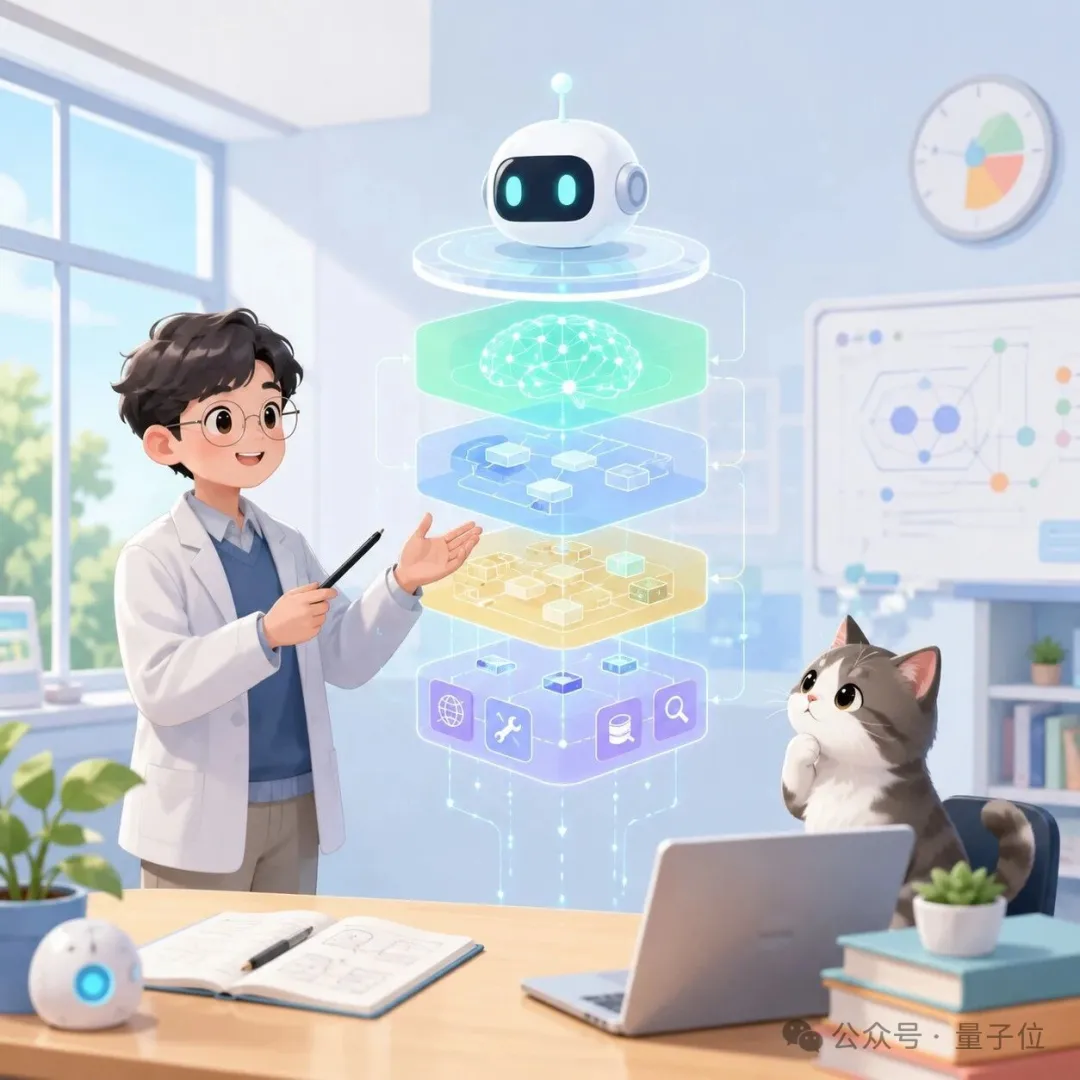
△Image generated by AI
Why now? The second half of AI belongs to Agents
If large models are the “brain” of AI, then Agents are intelligent agents with “hands and feet” that can think and remember.
They are no longer just passive tools that answer questions; they are “digital employees” that can break tasks down on their own, call tools, and collaborate.
From vector databases and RAG to CoT (chain-of-thought) reasoning and multi-agent coordination—these once intimidating technical terms are now the keys to enterprise implementation.
Led by a Shanghai Jiao Tong University AI Professor, this half-day session thoroughly breaks down 6 hardcore modules
This public lecture is deeply planned and delivered by a professor from the School of Artificial Intelligence at Shanghai Jiao Tong University, directly addressing the core challenges of enterprise AI adoption and building a systematic framework for understanding AI.
- Foundations of large models: Move beyond the misconception of “chat” and understand the capabilities, limits, and potential of LLMs.
- Core Agent architecture: Break down the “brain,” “memory,” and “action” systems of intelligent agents.
- Vector databases and RAG: Give AI “long-term memory” and understand how to solve hallucination issues.
- CoT reasoning explained: Learn how to make AI think step by step like a human expert.
- Tool calling and multi-agent coordination: Build a 24/7 “digital employee team.”
- Safety baseline and future outlook: The guardrails enterprises must follow when adopting AI, and the trends ahead.
Who is this for?
- Business leaders deeply building in their industries: Those looking to connect AI with business and find a second growth curve.
- DX leaders and managers: Those who need an actionable AI implementation roadmap.
- Practitioners of cutting-edge technology: Those who want to quickly grasp industry trends and build a systematic understanding.
Clear the fog around AI and get ahead in growth.
Venue: Shanghai Jiao Tong University Shanghai Advanced Institute of Finance Beijing Campus (5F, West Building, Global Financial Center, No. 1 East 3rd Ring Middle Road, Chaoyang District, Beijing)
Time: Sunday, May 24, 2026, 9:00-12:00

Professor Profile:

Xia Renqiu
Assistant Professor, School of Artificial Intelligence, Shanghai Jiao Tong University
He received his PhD from the Department of Computer Science at Shanghai Jiao Tong University. His research focuses on large language models, multi-agent systems, and AI for Science.
In recent years, as a core member, he has been involved in multiple major national and provincial strategic projects, including key initiatives on large model technology under the Ministry of Science and Technology and the National Development and Reform Commission, robot foundation pretraining under the Ministry of Industry and Information Technology, and controllable fusion intelligent agents under Shanghai’s “Hundred Groups, Hundred Projects” program.
He has published more than 20 papers in top international conferences and journals such as TPAMI, TIP, ICLR, NeurIPS, and CVPR. He has led the development and open-sourcing of high-performance foundation models and ultra-large-scale datasets for formal mathematical reasoning and multimodal document understanding.
In education and the integration of industry, academia, and research, he teaches Agent-related courses both on and off campus at the School of Artificial Intelligence, Shanghai Jiao Tong University. He also actively promotes entrepreneurship and innovation projects in the field of AI for Education. He has consistently worked to deeply apply cutting-edge large model technologies to scientific research, educational innovation, and major national strategic needs.