
AIDC Construction Is Evolving from “General Standards” to “Application-Driven Efficiency”
SenseTime’s Large-Scale Infrastructure Chief Lin Hai on AIDC
Recently, the 2026 Global AIDC Industry Forum was grandly held in Dongguan.
Lin Hai, General Manager of SenseTime Technology’s Large-Scale Infrastructure Business Group and Intelligent Computing Center, was invited to attend and delivered a keynote speech titled “The Evolution of SenseTime AIDC from General Standards to Application-Driven Efficiency Principles.” In his talk, he systematically introduced the construction philosophy, long-term operational practices, and achievements of SenseTime’s large-scale infrastructure in the AIDC (intelligent computing center) field.
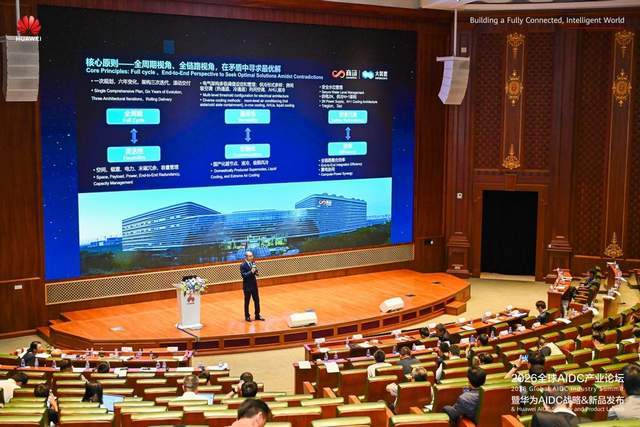
Lin Hai said, “In the AI era, intelligent computing center construction is moving from general standards toward high-efficiency, application-driven design.”
Building on this understanding, Lin Hai highlighted several innovative practices in SenseTime’s intelligent computing center construction, such as “modular delivery,” “downward migration of redundancy,” and “coordinated compute and power planning,” offering new evolutionary ideas and practical approaches for intelligent computing center development in the AI-native era.
01. How Does SenseTime’s Large-Scale Infrastructure Address the Three Core Contradictions of AIDC?
As early as 2019, SenseTime recognized that large-scale AI deployment would require centralized and systematic infrastructure support. This forward-looking insight led the company to begin building the Lingang AIDC, which officially went into operation in 2022.
Today, SenseTime Shanghai Lingang AIDC has grown into one of the largest intelligent computing centers in Asia and is also China’s first 5A-grade intelligent computing center.
In his speech, Lin Hai noted, “When we first designed our AI infrastructure, our philosophy was not simply a traditional IDC. Instead, we envisioned a full-chain AI system for the AI-native era, covering everything from computing resources and scheduling to models and applications.”
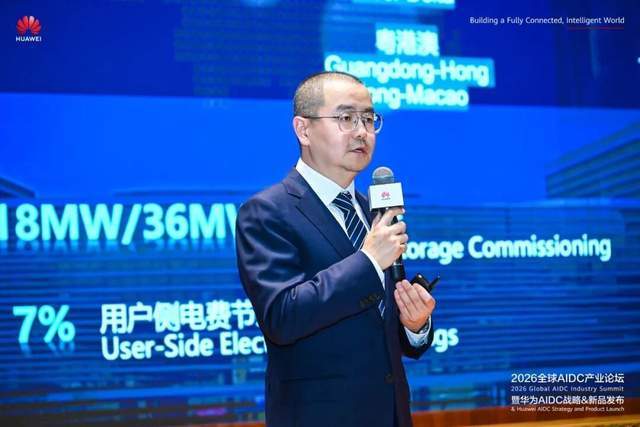
Based on this construction logic, over nearly six years of AIDC operations, SenseTime’s large-scale infrastructure has continuously evolved its architecture. By seeking optimal solutions amid various trade-offs, it has explored a balanced evolutionary path for intelligent computing center construction in the AI-native era.
Over the years, intelligent computing center construction has required trade-offs across three competing dimensions: full-cycle planning vs. flexible scalability, general standards vs. customization, and safety redundancy vs. ultimate efficiency. These involve many decision points, including time, space, architecture, and power capacity.
From the perspective of “full-cycle planning and flexible scalability,” SenseTime’s large-scale infrastructure has, from the very beginning of park planning, comprehensively considered the power supply architecture, building load-bearing capacity, HVAC systems, redundancy in space and power capacity, and energy-efficiency optimization. This ensures full-cycle planning while also enabling flexibility for subsequent phased construction.
From the perspective of general standards and customization, the core logic of the infrastructure architecture is to support multiple cooling methods within the park, quickly and efficiently meet the customization needs of different clusters, and provide elastic support across different layers within the power architecture. Today, the park supports as many as five cooling methods and has also established a multi-level threshold control system for power capacity management.
As for safety redundancy and efficiency optimization, Lin Hai specifically highlighted the “compute-power coordination platform.”
SenseTime’s large-scale infrastructure has linked together the IDC infrastructure layer, AI cluster layer, and model task scheduling layer to achieve full-chain coordinated optimization, thereby building a “compute-power coordination” platform. It also performs high-frequency prediction at 15-minute intervals and automatically generates the optimal scheduling strategy.
At the same time, as GPU power consumption continues to evolve rapidly, SenseTime’s large-scale infrastructure has gradually formed the architectural principle of “downward migration of redundancy.” In other words, it maintains higher redundancy at the rack and row levels, while reducing the overall redundancy ratio at the park level through economies of scale, thereby ensuring safety while improving overall resource utilization efficiency.
02. When AI Reshapes AIDC: A Triple Impact on Compute Resources, the Supply Chain, and Architecture
With the rapid development of large models and AI Agents, industry demand for compute resources continues to rise. At the same time, multiple factors such as supply chain volatility and policy changes have further increased uncertainty in compute resource supply.
Meanwhile, as domestic server and domestic chip ecosystems evolve rapidly, the architecture of AI infrastructure has become increasingly complex. The traditional IDC model is no longer sufficient; it is being rapidly replaced, and the pace of evolution is exceeding expectations.
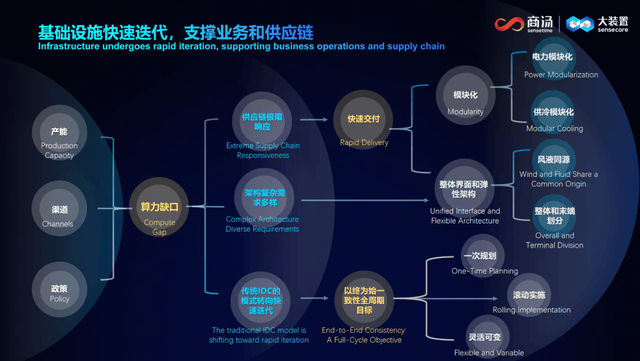
To respond to industry changes and ensure rapid delivery, Lin Hai proposed the construction concepts of “modular delivery” and a “unified interface and elastic framework.”
The core idea behind the “unified interface and elastic framework” is not to follow traditional cost-based divisions, but to push the delivery “front line” as far forward as possible—moving delivery capabilities closer to the front line of business requirements—and completing infrastructure delivery with the fastest possible response.
As for modular delivery, in the collaboration between SenseTime’s large-scale infrastructure and Huawei, the two sides first achieved “modular delivery of power.” In the future, this will further evolve into functional modularization, using a more flexible and standardized architectural design to improve the scalability and responsiveness of AI infrastructure.
03. Modular Deployment Enabled an 18MW Capacity Expansion in 1.5 Months
In his speech, Lin Hai also shared details of a recent 18MW intelligent computing center capacity expansion project.
At the end of 2025, SenseTime’s large-scale infrastructure faced external compute resource leasing demand at a scale of about 20MW. After a comprehensive cost assessment, the team decided to make full use of existing on-site resources and complete an 18MW expansion based on four existing warehouses, increasing the power density per rack to 48kW.
During project implementation, SenseTime’s large-scale infrastructure worked with the Huawei team and completed energization and validation testing in just one and a half months—two months earlier than the traditional approach.
The project was completed without affecting the stable operation of the existing park. It also achieved outdoor modular deployment, upgrading the existing warehouses into a true AI machine room in a short period of time. This reduced auxiliary area by about 70%, achieved an efficiency of 97.8%, and lowered power CAPEX by 13%.
Lin Hai said that the greatest value of this project was not only its delivery speed, but also the validation of a new model for upgrading from a traditional IDC to an intelligent computing center: rapidly scaling power supply, cooling, and compute resource systems through a modular architecture, while reducing Capex and improving overall resource utilization efficiency.
As AI enters the stage of large-scale inference and industrial deployment, intelligent computing centers are also evolving further—from traditional IDC forms into new infrastructure for the AI-native era. Going forward, SenseTime’s large-scale infrastructure will continue advancing the evolution of AI infrastructure in terms of efficiency, flexibility, and intelligent coordination, accelerating the smart transformation of industries.
Reprinted from: SenseTime Technology
This article is reprinted with permission from QbitAI, and the views expressed are those of the author.