
Advancing content-source traceability for a safer, more transparent AI ecosystem
Content Credentials, SynthID, and early preview verification tools help people understand the origins of AI-generated content.
Every day, people use OpenAI tools to create and edit images and audio, making communication more expressive, more useful, and more accessible. As these tools become part of how people build, imagine, and share, it is important that people can understand and verify where media came from so they can interpret it with greater confidence. Traceability signals help by providing context about where content came from, how it was generated or edited, and whether it is what it claims to be.
Today, we strengthened our work on content traceability with a layered, ecosystem-led trust model. Through alignment with C2PA, we are making our traceability signals more recognizable to other tools and platforms, and through our collaboration with Google, we are adding persistent, cross-platform SynthID watermarks to images. We are also sharing a preview of a public tool that lets people verify whether an image was generated by OpenAI.
All of these updates build on our previous work. They support open standards, make OpenAI-generated content easier to identify, and encourage collaboration across the industry to support a more trustworthy information ecosystem.
Building a trust ecosystem with C2PA compliance
Since 2024, OpenAI has participated in the development and adoption of traceability standards. We initially added Content Credentials to images generated by DALL·E 3, and later expanded that to ImageGen and Sora. We also joined the steering committee of the Coalition for Content Provenance and Authenticity (C2PA), an industry-wide group developing open technical standards for content traceability. C2PA’s technical approach uses metadata and cryptographic signatures to securely carry information about media along with the media itself. That includes context that helps journalists assess sources, platforms make integrity decisions, and users understand what they are seeing online.
We recently took a step toward becoming a C2PA Conforming Generator Product. Meeting C2PA compliance ensures that the traceability information we attach to content can be read, retained, and passed along by platforms in a reliable way. That matters because traceability information is only truly useful if it survives beyond the platform that created the content in the first place. Compliance helps make that possible.
A layered traceability approach combined with Google SynthID for images
C2PA metadata is an important foundation for traceability. It helps attach information to content about where it came from, how it was generated or edited, and who signed off on that information. But metadata is not foolproof. It can be removed or lost during uploads and downloads, and it can be damaged by transformations such as format changes, resizing, or screenshots.
To make traceability more robust, we are taking a layered approach. Starting with images generated in ChatGPT, Codex, or the OpenAI API, we are integrating Google DeepMind’s SynthID watermarking technology. SynthID embeds an invisible watermark layer that complements C2PA metadata-based methods.
We have been building toward this for some time. In Sora, we use visible watermarks, and in Voice Engine, we use audio watermarks, while continuing to test and research their accuracy and reliability in deployment.
These two systems complement each other. C2PA provides detailed context about content, while SynthID helps preserve a signal if metadata is not retained. Watermarks are more likely to survive transformations such as screenshots, while metadata can provide more information than a watermark alone. Together, they make traceability more resilient than either approach on its own.
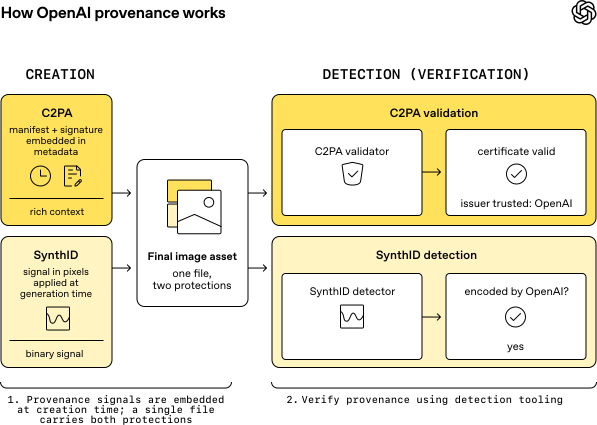
Detection and a preview of a public verification tool
Trusted metadata and watermarks that can withstand many kinds of modification help traceability signals last longer. Still, people need a way to detect those signals. We are now releasing a preview of a public verification tool that checks whether uploaded images contain traceability signals — including Content Credentials and SynthID — and helps people verify whether an image was generated by ChatGPT, the OpenAI API, or Codex.
We believe traceability should be easier for people to verify and understand. This tool combines multiple signals to help answer the question: “Was this generated by AI?” It builds on the findings from our 2024 research preview of image detection classifiers, with the ability to reliably detect OpenAI-origin SynthID watermarks in media and display C2PA metadata when it is found.
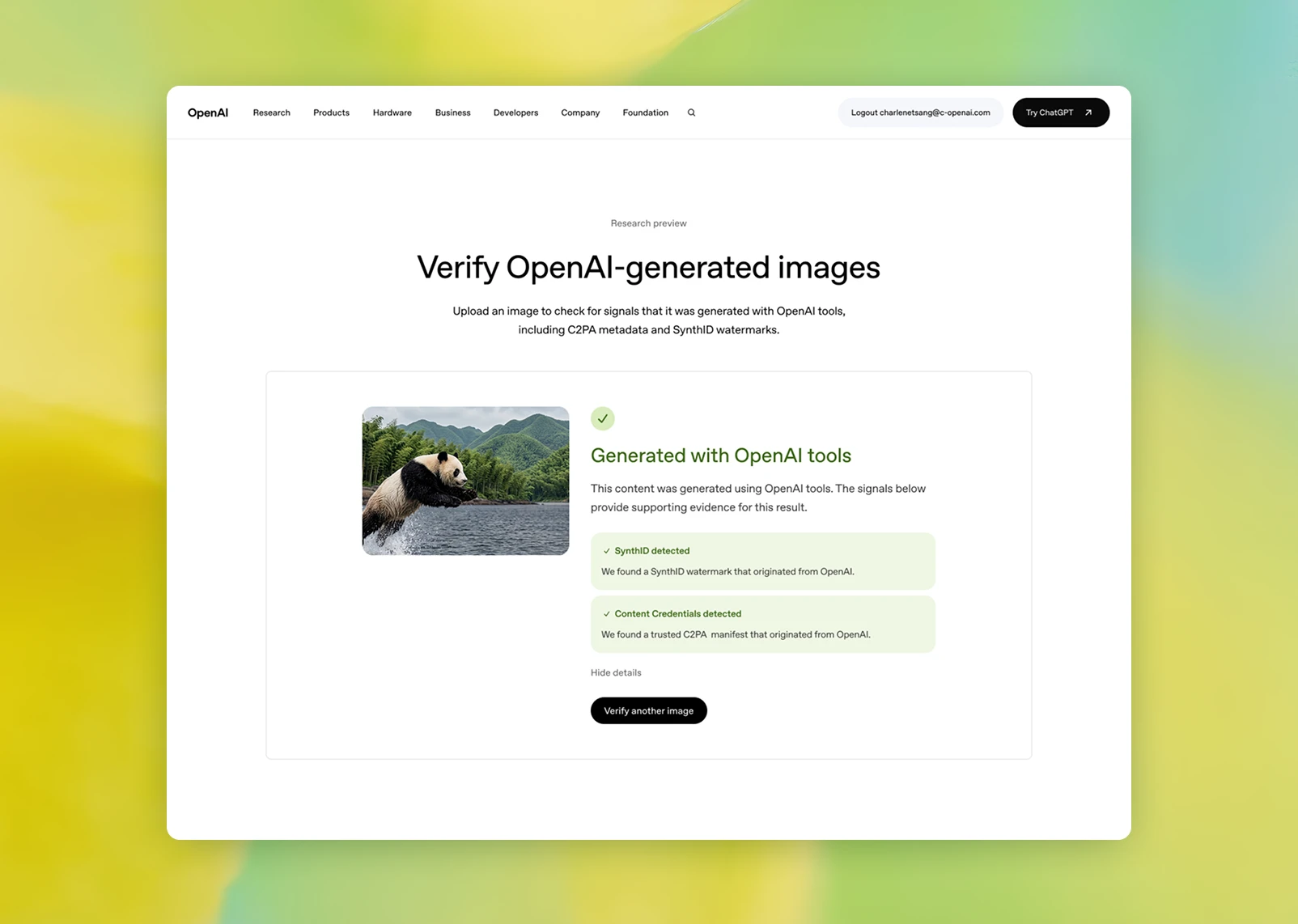
No detection method is perfect. That’s why we are careful when detection fails. For example, if no metadata or watermark is detected, the tool does not make a definitive claim about whether the image was generated by OpenAI tools. Because traceability signals…