The underlying paradigm has changed
Yunzong, from Aofeisi
Quantum Bit | QbitAI Official Account
Just now, openJiuwen, the Huawei-backed open-source AI Agent platform community, released and open-sourced JiuwenSwarm, a swarm-based agent system.
From “a lobster” to “a swarm of bees,” what changed was not just the name, but the underlying paradigm.
Multiple AI agents collaborate with the high efficiency of a swarm and evolve autonomously, officially stepping on the accelerator of “collective intelligence” and opening the era of AI “beekeeping.”
Behind this is the full implementation of the next paradigm proposed by openJiuwen: Coordination Engineering.
To understand this upgrade, we need to answer one question first:
Why move from Harness to Coordination now?
Looking back over a slightly longer time horizon, the engineering paradigm in the AI Agent space has continuously evolved, from Prompt Engineering to Context Engineering, and then to Harness Engineering at the beginning of this year.
- Prompt Engineering: tuning prompts so the model can understand the task;
- Context Engineering: organizing the agent’s context, memory, tools, and state;
- Harness Engineering: the keyword that has swept the industry this year. It centers on a single agent and pushes systematic engineering, trajectory management, error recovery, and long-running execution to the extreme.
And now, the next engineering question has emerged:
How do you get multiple agents to collaborate like a highly capable team?
Truly complex real-world tasks — such as cross-domain deep research, delivering large-scale software projects, multi-role collaborative decision-making, and orchestrating complicated business workflows — are never something “one person” can handle alone; they require a team.
Software needs product, development, testing, and SRE. Education needs teachers from multiple subjects, parents, and the student themselves. Healthcare needs triage staff and specialists from multiple departments…
This is exactly the next paradigm openJiuwen is putting forward: Coordination Engineering — an engineering paradigm centered on multi-agent collaboration.
And this time, openJiuwen has turned this idea of “coordination” into something that is not just a concept, but an engineering outcome that is ready to run, ready to deploy, ready to co-develop, and fully open source.
JiuwenSwarm.
The Core Design Philosophy of Coordination Engineering
To make an agent team truly work, you need to solve the following challenges step by step:
- How do multiple agents autonomously divide roles and negotiate dynamically? This is the starting point of “coordination”;
- How do you turn best practices and role combinations that work well in collaboration into reusable assets? Coordination should not start from scratch every time;
- How do you circulate, reuse, and remix accumulated capabilities among developers? Experience only creates value when it can be shared;
- How do you make the whole system stronger the more it is used — rather than more rigid? Otherwise, it is just a static framework, unable to support “collective intelligence.”
These four questions are closely connected, and each is a natural extension of the one before it.
JiuwenSwarm’s answer is a corresponding full-stack technical system.
Agent Swarm, Swarm Skills, Swarm Skills Hub, and the continuous self-evolution of Swarm Skills.
Full-stack technical system
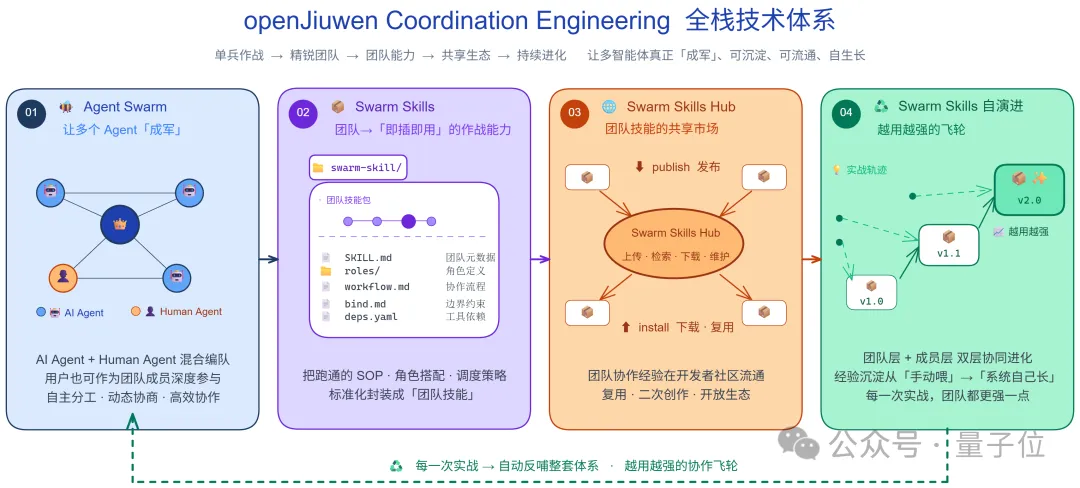
The four core components are tightly interlinked.
Agent Swarm — turning multiple agents into a “first-rate team”
This is the core of the entire system.
Agent Swarm provides the collaboration mechanism for multi-agent teams, enabling multiple agents to autonomously divide roles, negotiate dynamically, and collaborate with high efficiency, making the leap from individual work to an elite team.
JiuwenSwarm supports routing different members to different models, assigning the most suitable model to each role to balance load, place the right talent in the right position, and improve overall performance.
Swarm Skills — turning “one team” into “one operational capability”
Agent Swarm solves the question of “how to collaborate,” while Swarm Skills solves “how to accumulate.”
Best practices, SOPs, role combinations, and dispatch strategies that work well in team collaboration are standardized and packaged into reusable, team-level skills.
This turns “an excellent agent team” into “an operational capability that can be dropped into any scenario.”
Swarm Skills Hub — a sharing marketplace for team skills
Once capabilities can be accumulated, the next step is distribution.
Swarm Skills Hub connects an open sharing ecosystem, allowing team-level collaborative experience to be circulated, reused, and remixed within the developer community.
URL: https://swarmskills.openjiuwen.com/
Self-evolution of Swarm Skills — a flywheel that gets stronger the more it is used
The most imaginative part is the final step in this loop.
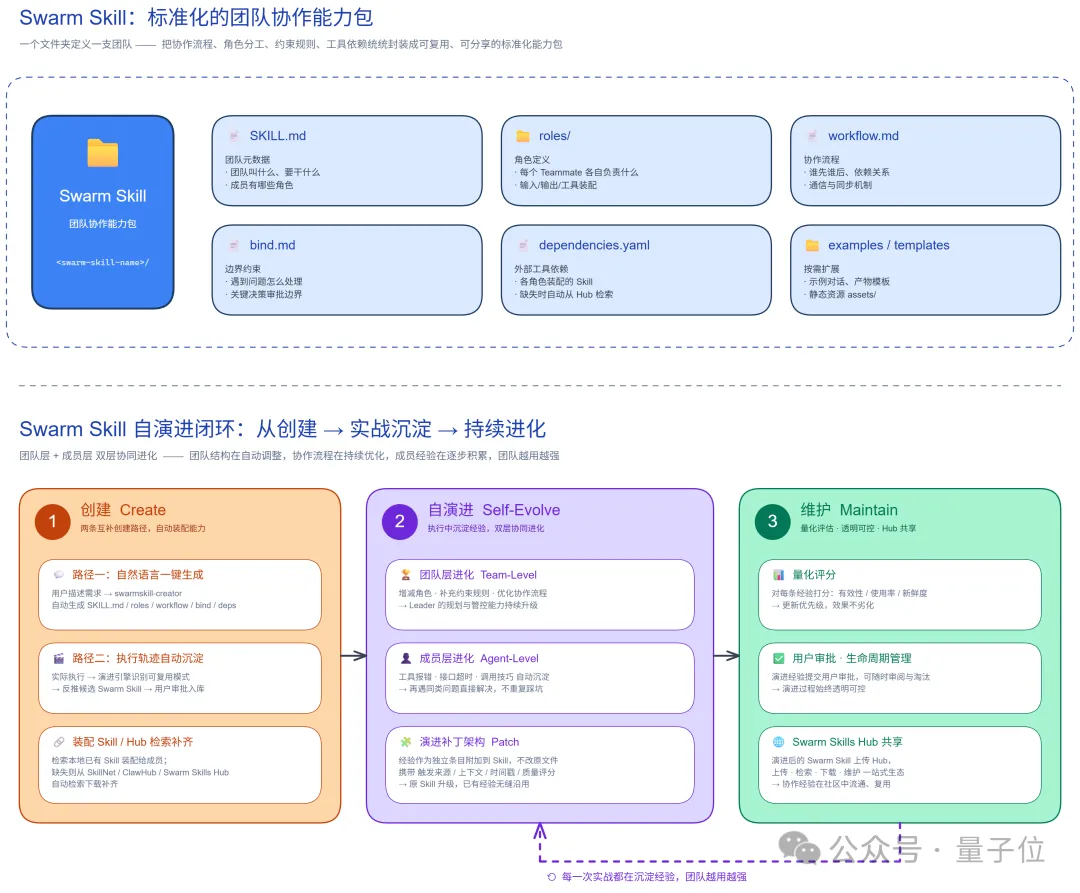
As the team executes real tasks, JiuwenSwarm’s evolution engine continuously observes the full trajectory of task decomposition, role dispatch, and message exchange, and automatically extracts reusable Swarm Skills from the trajectory. With user approval, they can be registered directly.
Self-evolution happens simultaneously at two levels:
- Team level: based on task execution trajectories, the system automatically adjusts role composition, supplements constraint rules, and optimizes collaboration flows, continuously improving the Leader’s planning and control capabilities;
- Member level: each Teammate accumulates tool errors, API timeouts, and usage tips encountered in real tasks, so that when the same kind of issue appears again, it can be solved immediately and the team does not keep stepping into the same traps. The team improves, and each member grows as well.
How do humans participate in coordination: HOTS & HITS
From team collaboration to capability accumulation, from skill sharing to continuous evolution, these four core capabilities form a complete loop.
But on top of this structural foundation, there is a more fundamental and practical question: How do humans work with this agent team?
JiuwenSwarm offers two modes: HOTS (Human on the Swarm) and HITS (Human in the Swarm).
1. HOTS (Human on the Swarm): humans command the agent team
Humans monitor the entire agent team’s operating status in real time from a higher level: task progress, workload by role, collaboration bottlenecks…
They can intervene whenever needed. Whether it is adjusting task priorities, switching an agent’s role, or changing direction midway, the level of command can be as fine-grained as a single instruction or as broad as simply saying, “Let’s change direction.”
2. HITS (Human in the Swarm): humans are part of the team
Humans are no longer directing from outside, but collaborating and reasoning in real time with the agents in the same team, the same scene, and the same flow —
Humans move like a single “bee” inside the swarm, alongside the other agents.
A helpful analogy is a player in a werewolf game.

HITS means immersive participation; HOTS means global coordination. These are the two most important modes for human-agent collaboration.
JiuwenSwarm in Real-World Scenarios
Now let’s look at JiuwenSwarm’s practical performance in fields such as healthcare, education, content creation, and gaming, and experience the impressive results brought by Coordination Engineering.
JiuwenSwarm enables multi-agent collaboration and improves intelligence
Case 1: Multi-agent collaborative operator development improves Ascend operator generation quality
JiuwenSwarm provides a TUI mode for coding scenarios. In Ascend operator generation, each expert takes on roles such as algorithm design, Kernel implementation, and performance optimization, moving from paper to implementation through collaboration.
The collaboration process is visualized in real time. Because each expert shares the workload and pushes optimization forward in parallel, compared with single-agent generation, it can greatly improve both the development efficiency and the output quality of complex operators.
Download the “Ascend Operator Development & Optimization Team” skill at: [Swarm Skills Hub]
https://swarmskills.openjiuwen.com/skills/1202fde89266474dbcdf0218b33ba422
Case 2: Joint consultation by a team of medical experts across multiple specialties improves diagnostic accuracy
In this case, a medical team composed of 23 AI medical experts from different specialties is formed. Depending on the user’s condition, multiple specialist members are created dynamically to carry out joint consultations.
Each “expert” analyzes the cause from their own domain, exchanging diagnostic results in real time, identifying common ground while preserving differences, and ultimately arriving at an accurate diagnosis and recommendation.
The collaboration process is visualized in real time. By dividing roles and working together to identify common ground while handling differences, it effectively raises the quality of the joint consultation compared with diagnosis by a single expert.
Download the “Ascend Operator Development & Optimization Team” skill at: Swarm Skills Hub
https://swarmskills.openjiuwen.com/skills/1202fde89266474dbcdf0218b33ba422
Swarm Skills accumulates team experience, evolves as a collective, and gets better the more it is used
Case: short-video production accumulates experience and evolves as a collective
When a user launches a short-video production task for the first time, the Leader forms a temporary team to complete the production. JiuwenSwarm’s evolution engine detects reusable collaboration patterns, automatically generates a Swarm Skill for short-video production, and sends it to the user for approval.
When the same skill is used again for another production task, the evolution engine detects signals such as mismatches between role images and visual style, or the user’s intent to publish to a video platform. Based on those signals, it generates improvements and optimizes the skill by adding a role for producing high-click-rate title copy.
When executed again with the optimized Swarm Skill, the video performs even better, and high-click-rate title copy suitable for multiple major short-video platforms is generated at the same time.
The more you use it, the more experience it accumulates, and the stronger the team becomes.
Download the “Short-Video Production Team” skill at: [Swarm Skills Hub]
https://swarmskills.openjiuwen.com/skills/8b6ef486bdc14c8784cc06a64da20927
JiuwenSwarm supports routing different models and configuring human roles (HOTS/HITS)
Case 1: Werewolf game strategy with multiple models participating
In this case, different models are routed to different roles in the werewolf game.
At the same time, the Human can operate the whole game from a “god’s-eye view,” which is the HOTS (Human on the Swarm) mode.
Case 2: Humans experience the werewolf game in an immersive way
Want to participate in multi-agent collaboration immersively?
JiuwenSwarm provides HITS (Human in the Swarm) mode.
Humans can join as players, whether as a werewolf, a prophet, or an ordinary villager.
Together with AI teammates, you can discuss, vote, speak, bluff, and shape the game. Other agents will read your statements, infer your identity, and decide whether to “help” you win or “vote” you out.
Download the “Werewolf Game” team skill at: [Swarm Skills Hub]
https://swarmskills.openjiuwen.com/skills/3877dbc05fba498b8ae6e50f24a0dd7b
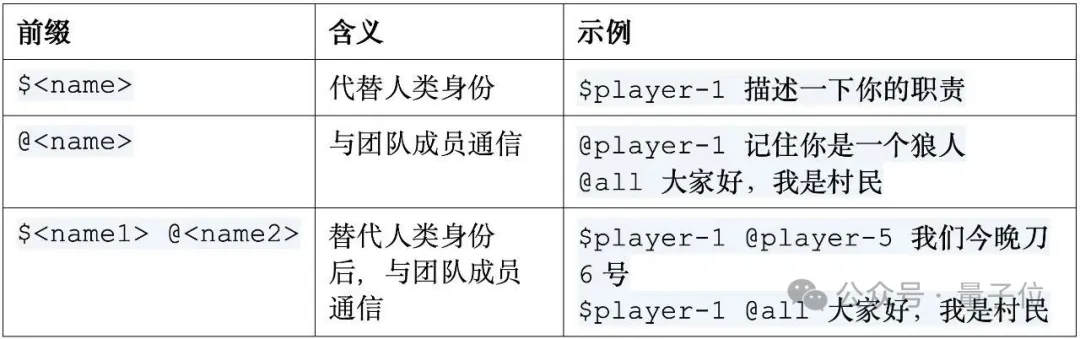
Tip: To switch freely between HOTS and HITS, refer to the following command.
Case 3: Immersive multi-disciplinary learning support
Children and parents can participate “as stakeholders,” engaging deeply with teacher agents from other subjects to provide professional support for the student’s learning.
When the Human switches to the student role, they can converse with the teachers, and the teachers can assess the student’s understanding of the subject based on the student’s questions and answers, then provide learning advice.
When the Human switches to the parent role, they can understand the child’s learning status from each teacher and discuss supervision and motivation mechanisms.
Download the “Academic Growth Coach Team” skill at: [Swarm Skills Hub]
https://swarmskills.openjiuwen.com/skills/ff43cba292574a2dadc5f2b0ee9d80ad
Behind the collaboration: the strength provided by openJiuwen Harness
JiuwenSwarm’s swarm collaboration capabilities are impressive, but the foundation beneath each individual agent is openJiuwen Harness, which is also the source of its strength.
Without strong execution capability in a single agent, no matter how sophisticated the collaboration mechanism is, it cannot be implemented.
This point is directly reflected in the authoritative benchmark PinchBench.
PinchBench is a comprehensive agent capability evaluation benchmark released by the Kilo.ai team. Its tasks cover a wide range of areas, including code development, creative writing, document processing, meeting management, content transformation, and file operations.
Because its task design is close to real-world scenarios and its evaluation dimensions are comprehensive, it has become an important measure of an agent’s execution capability.
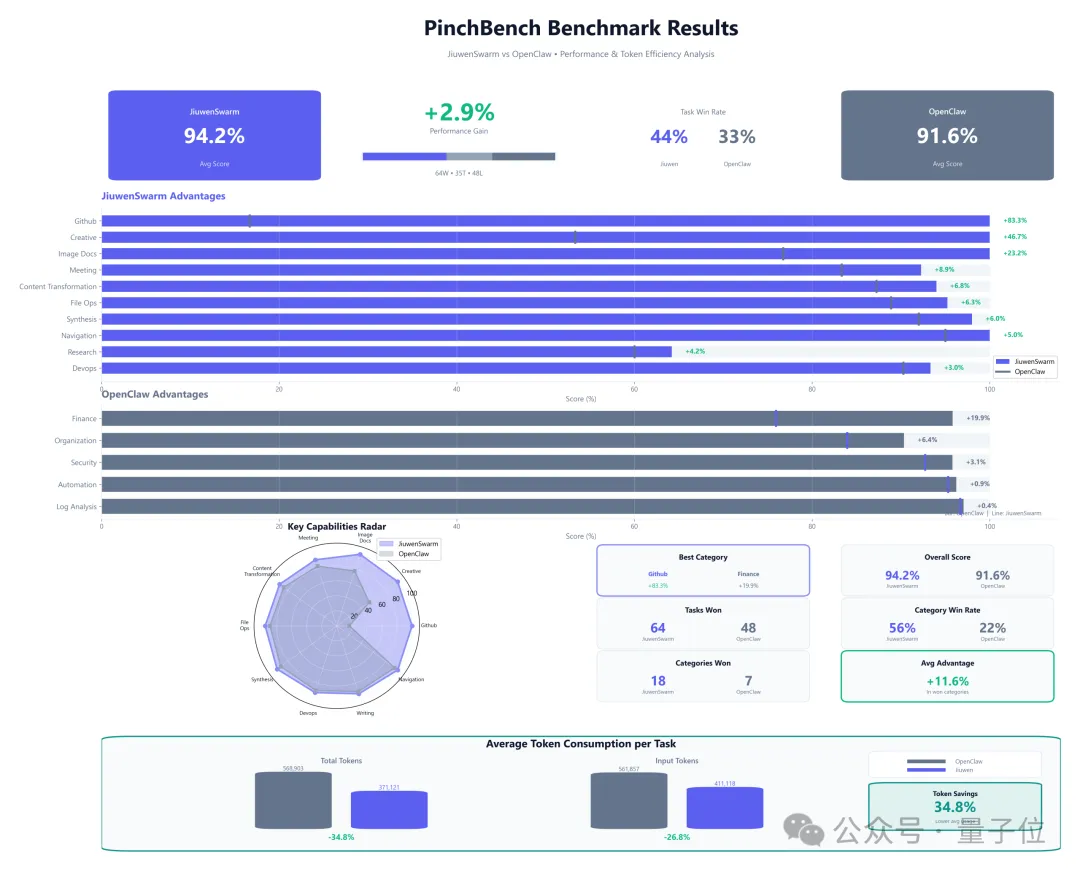
According to the PinchBench results, JiuwenSwarm achieved a 94.2% overall score, reaching industry SOTA and outperforming OpenClaw (91.6%) by about 3 points. It also has a clear advantage in token usage, with average token consumption reduced by 34.8%.
Higher accuracy, lower cost.
In addition, openJiuwen also performs very well in memory mechanisms. In the authoritative benchmark LOCOMO for long-term dialogue, it achieved 85% memory accuracy (using an 8B large model to perform memory processing, QA, and result judging), surpassing leading memory systems in the industry.
These results are no accident. Thanks to the mature capabilities that openJiuwen Harness has continuously refined in areas such as the DeepAgent architecture, context engineering, and long-term memory mechanisms, each “member” of JiuwenSwarm has solid task execution ability.
Conclusion: all open source, and become a “beekeeper” in the AI era
Looking back, from Harness Engineering to Coordination Engineering and now to today’s JiuwenSwarm, the openJiuwen community has done something highly forward-looking.
Just as the industry was beginning to shift its attention from “stronger single agents” to “stronger agent teams,” openJiuwen had already brought together the key pieces of that path in one go.
One conceptual statement (Coordination Engineering)
One full-stack technical system (Agent Swarm / Swarm Skills / Swarm Skills Hub / Swarm Skills self-evolution)
One benchmark agent (JiuwenSwarm)
And all of it is fully open source.
Multi-agent collaboration is already a shared consensus. What is still rare is packaging that consensus into a full-stack open-source artifact that is fast to deploy, easy to implement, and ready for co-development.
The vast frontier of AI agents will not be opened by a “super individual” that can do everything. It is destined to be opened by collective intelligence, where each member has its own specialty, collaborates with others, and keeps evolving.
And JiuwenSwarm has planted the first flag on that path, making it easy for every user to “grow” their own agent swarm.
About openJiuwen
openJiuwen is a Huawei-backed open-source AI Agent platform community jointly built by Huawei’s 2012 Research Institute and the Huawei Cloud AgentArts team. Its benchmark agent, JiuwenSwarm, embodies the capabilities the openJiuwen platform has accumulated in key areas such as Harness engineering, multi-agent collaboration, and self-evolution.
JiuwenSwarm is fully open source. Contributions are welcome
JiuwenSwarm (AtomGit): https://atomgit.com/openJiuwen/jiuwenswarm
JiuwenSwarm (GitHub): https://github.com/openJiuwen-ai/jiuwenswarm
Swarm Skills Hub: https://swarmskills.openjiuwen.com/
Feel free to upload your own team skills to Swarm Skills Hub and let the swarm’s experience circulate within the community.