
How Amplitude Ships Product Improvements in 1–2 Days with OpenAI
November 12, 2026
Amplitude’s proactive product agent, Wave, is built primarily on OpenAI models to identify what to build, help teams ship changes with coding agents, and measure the impact.
-
Region: North America
-
Industry: Technology
-
Product: Codex
-
Company Size: Mid-Market
-
160%: Increase in agent engagement after one day compared to the control group
-
1–2 days: Estimated time to ship product improvements using Wave
-
51%: Reduction in average model cost per dispatch for GPT‑6.1 Sol in Amplitude’s Data Science Agent evaluations
-
$1.34: Model cost for GPT‑6.1 Sol in Amplitude’s Opportunity Investigator evaluations
Amplitude has long helped teams understand how users actually interact with their products. Now, its proactive product agent, Wave, helps teams turn those insights into shipped product improvements. According to Amplitude, roughly 80% of Wave is powered by OpenAI models, including GPT‑6.1 Sol, GPT‑6 Luna, and GPT‑Image‑2.5 Flare. Wave translates product insights into implementation plans that teams can hand off to coding agents—including Codex—and then measures the resulting impact.
Amplitude estimates that Wave helps teams cut the time required to ship product improvements from roughly a month down to just 1–2 days. On Amplitude’s own homepage, Wave helped personalize suggestion cards, driving a 160% increase in messages sent through those cards.
“AI can now surface valuable work we wouldn’t have thought to assign it. OpenAI’s models can investigate problems, write and run code, and use the results to decide what to try next.”
— Spenser Skates, CEO of Amplitude
From Product Data to Shipped Improvements
Wave is Amplitude’s proactive product agent. Teams simply point it toward a product area along with the goals and metrics they want to improve. Wave then synthesizes Amplitude data, session replays, customer feedback, and code to identify and prioritize opportunities, formulate solutions, and coordinate humans and coding agents to implement them. Afterward, it tracks the outcomes and uses those learnings to inform the next cycle of improvements.
Behind this workflow, Amplitude uses different OpenAI models tailored to specific tasks. GPT‑6.1 Sol powers the opportunity manager and conducts deep research across code and data. GPT‑6 Luna handles high-frequency, low-cost tasks, such as scanning code and running lightweight evaluation checks. Meanwhile, GPT‑Image‑2.5 Flare uses screenshots from session replays as visual references to generate product mockups.
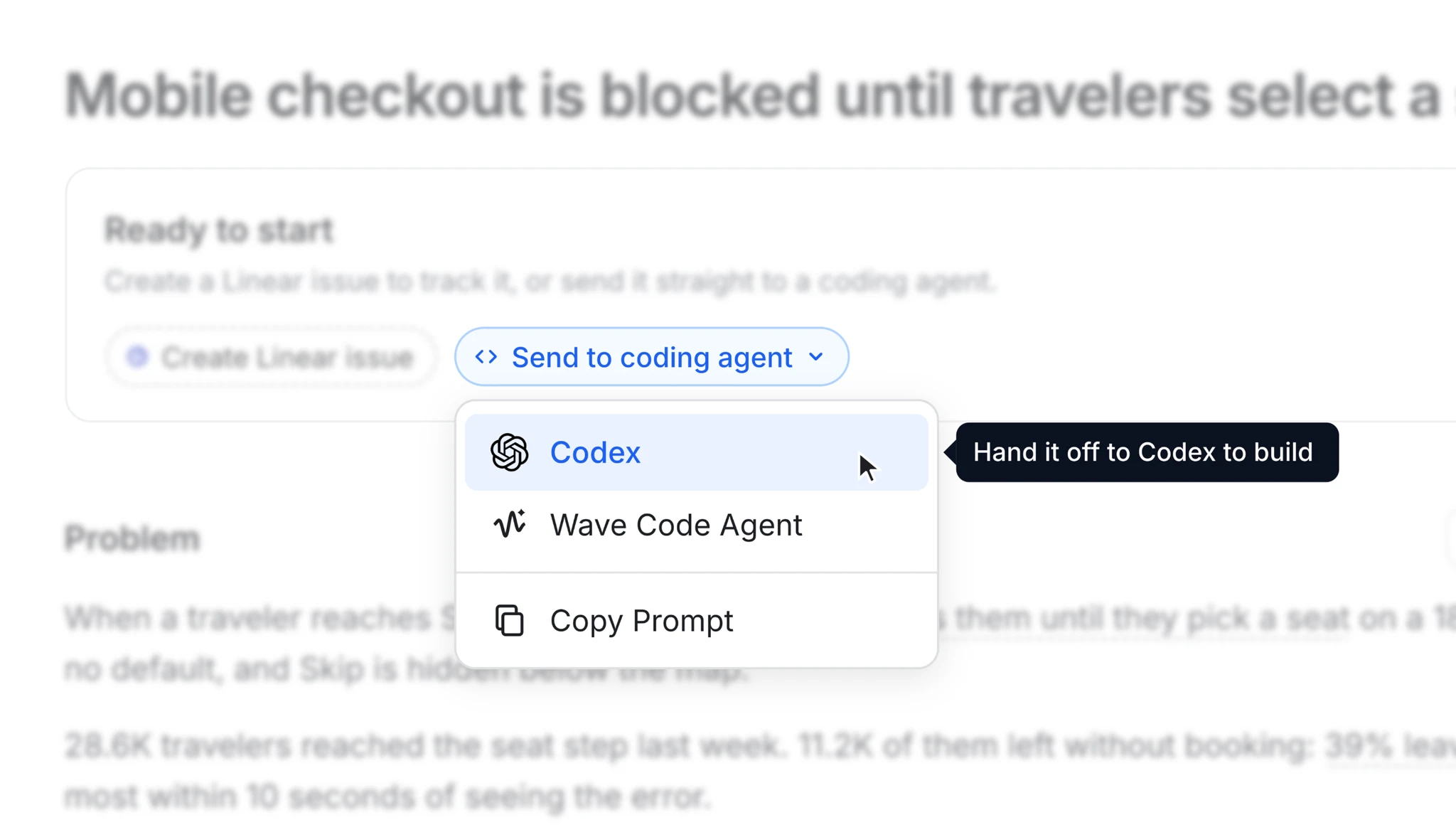
When an opportunity is ready to be built, teams can send it directly from Wave to coding agents, including Codex, complete with a technical plan and acceptance criteria to guide the implementation.
How Wave Drove a 160% Increase in Agent Engagement
“The idea behind Wave is to have a unified place where agents comb through mountains of session replays, analytics data, and code to find opportunities to improve the product,” explains Jacob Newman, Principal AI Product Manager at Amplitude.
Amplitude tested Wave on its own homepage, which originally featured generic suggestion cards designed to help users start conversations with its AI agent. Wave discovered that people were largely ignoring these cards: across a sample of 100 session replays, 80 users typed their own questions while only 12 clicked a suggestion card.
Wave proposed personalizing the cards based on the charts, dashboards, or referring pages a user had recently viewed. It mocked up what the change would look like and generated a technical plan, which included keeping the free-form input option and falling back to generic suggestions when personalized context wasn’t available. After a brief review, the team handed the work off to a coding agent and A/B tested the change.
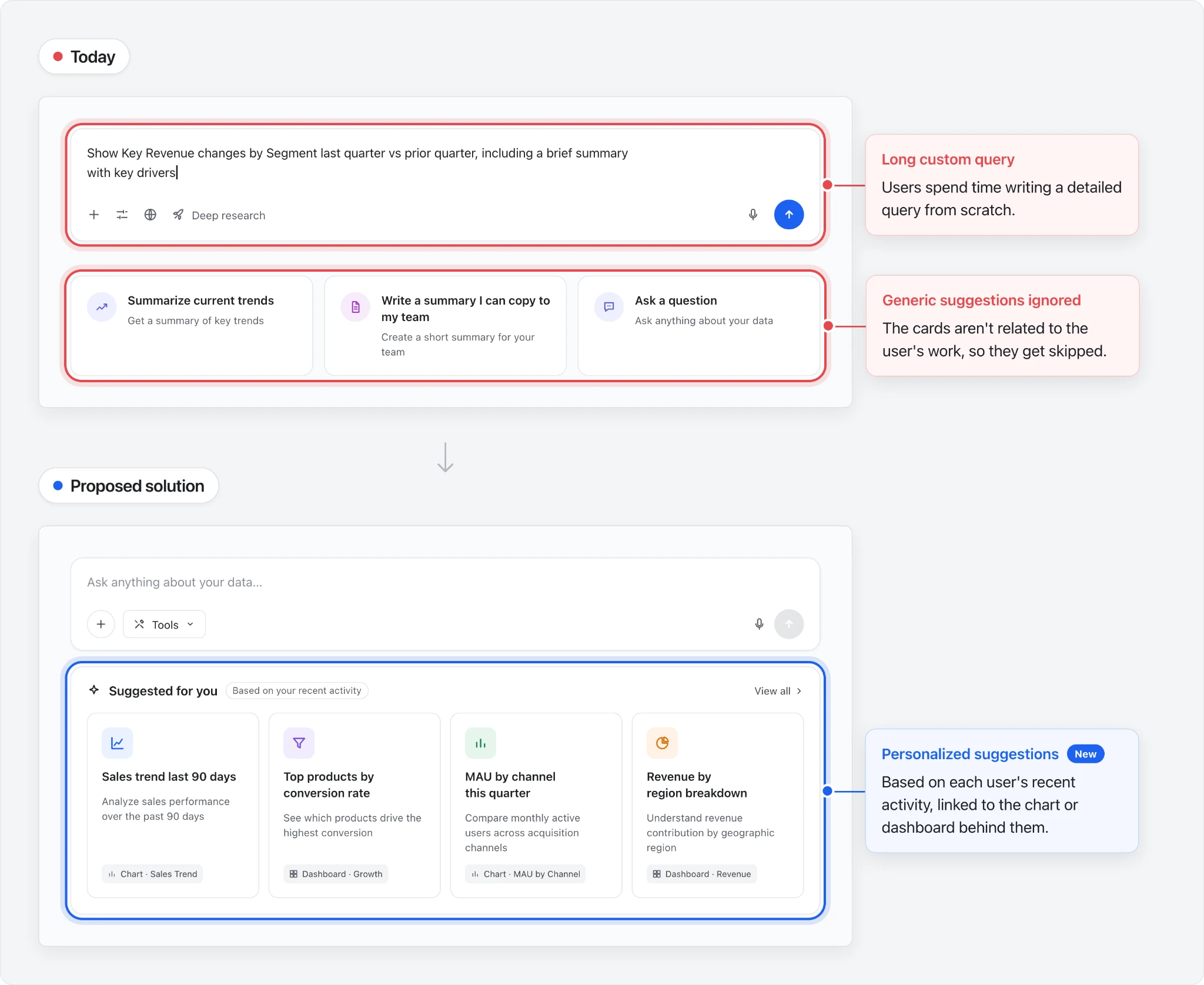
In the experiment results shared by Amplitude, messages sent via the homepage suggestion cards increased by 160% compared to the control group just one day after launch. “It’s a great example of how small, non-earth-shattering details that usually fall through the cracks can drive feature adoption in unexpected ways,” explains Eric Carlson, Senior Principal AI Engineer at Amplitude.
Choosing the Right OpenAI Model for Each Task
Different tasks within Wave place different demands on models. Deep research requires strong reasoning capabilities and well-substantiated conclusions, whereas small checks repeated hundreds of times need to be fast and cost-effective. Amplitude evaluates the quality, latency, and cost requirements for each task and assigns models accordingly.
“OpenAI gives us both powerful reasoning models and smaller, faster ones, allowing us to balance quality, latency, and inference costs across our entire product.”
— Spenser Skates, CEO of Amplitude
For Wave’s Opportunity Investigator, Amplitude evaluated whether models could substantiate findings, avoid false positives, incorporate evaluator feedback, recover from tool failures, and keep conclusions aligned with evidence. GPT‑6.1 Sol scored 4.06 out of 5.