
Baidu just dropped a new model, and the demos have already sent users on X into a frenzy.
Is Baidu finally stepping up its game??
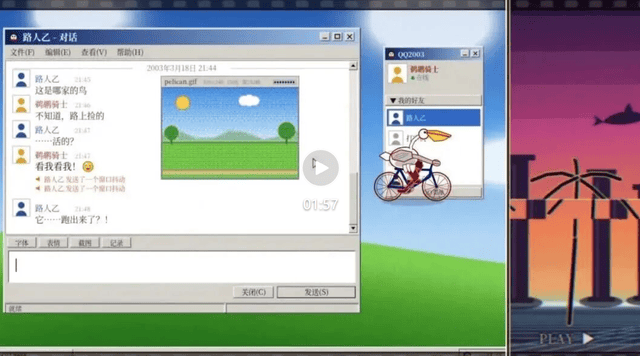
Everyone says the “pelican riding a bicycle” prompt is old news, but have you ever seen a version like this?
 Video link: https://mp.weixin.qq.com/s/Rj-T8unLFnHUk6R89rt02Q
△ Concept design by Bilibili creator @近步抱告_
A pelican rides a bicycle straight out of 4000 BC Saharan rock art and right into a modern LLM-era code editor.
116 seconds, 20 art styles, animated entirely via Python code.
It’s the same old pelican, alright—just operating in a completely different dimension…
And that’s just the appetizer.
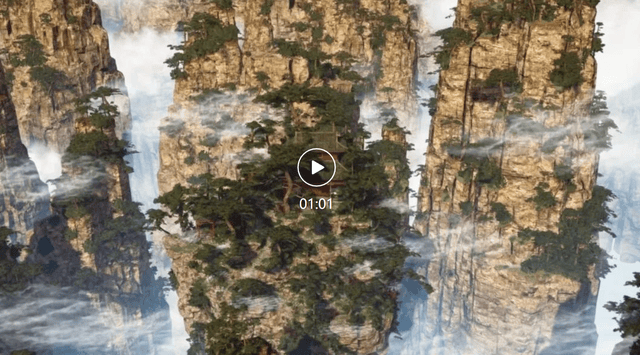
Right after wrapping up the animation, the underlying model dived straight into Unreal Engine 5.8, grinding for 11 hours straight to build an Eastern martial arts game from scratch: Yunxiu Xing (Journey to the Cloud-Capped Peaks).
 Video link: https://mp.weixin.qq.com/s/Rj-T8unLFnHUk6R89rt02Q
Towering Zhangjiajie stone pillars, an ancient cliffside temple, character animations, game logic… it somehow put the whole thing together.
Hold on—first it’s directing animations with code, and the next minute it’s building video games from scratch? What kind of secret weapon has Baidu been cooking up this time??
Here’s the answer:
ERNIE 5.5 Flash Preview.
Just one day before the Baidu World conference, this new model made its official debut alongside an announcement that it will soon be open-sourced.
It packs 280 billion total parameters, activates just 14 billion parameters per inference, supports a 1-million-token context window, and generates over 200 tokens per second.
This time around, ERNIE has poured its skill points into one core area:
Coding.
Mind you, “coding” here goes way beyond building web pages or autocompleting snippets. Game development, 3D modeling, video orchestration—complex tasks that require continuous tool calling and iterative testing and debugging—are things the model can now tackle hands-on.
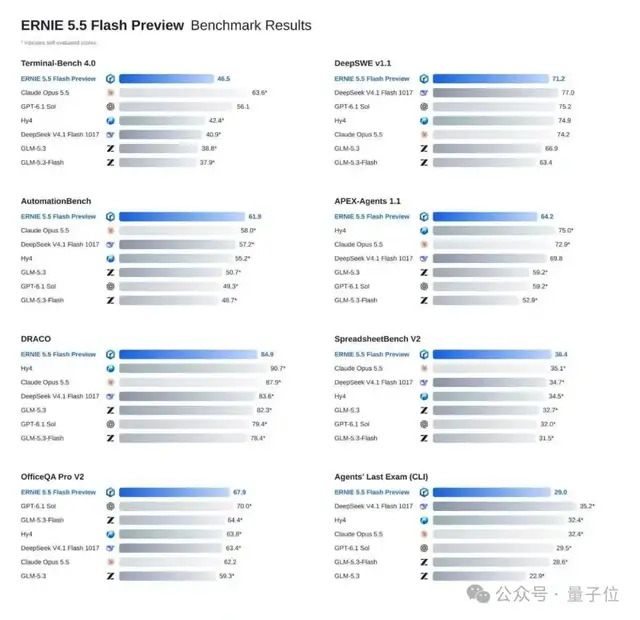
In coding and Agent benchmarks like Terminal-Bench and AutomationBench, ERNIE 5.5 Flash Preview is already going toe-to-toe with flagship models like Claude Opus 5.5 and GPT-6.1 Sol.
With the hype built up this high, it’s time to put it to the test.
3D, gaming, web dev… ERNIE 5.5 Flash Preview, show us what you’ve got. (doge)
Hands-On with ERNIE 5.5 Flash Preview
The model is currently available to try via both the web interface and the API.

For Test #1, let’s start with a heavy hitter from the Classic of Mountains and Seas (Shan Hai Jing).
The Nine-Tailed Fox.
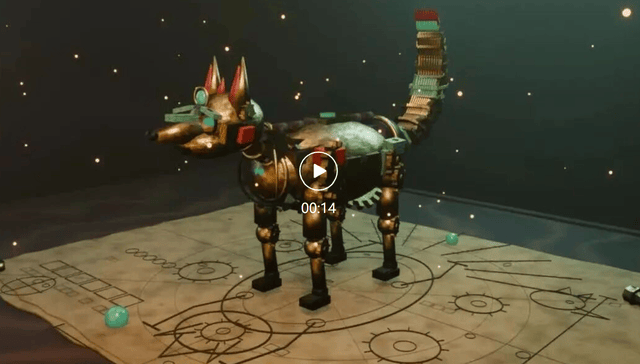
This time, though, I wanted ERNIE to use code to orchestrate an animation of an “Awakening Bronze Mechanical Beast.”
Starting from an ancient manuscript, gears, armor plates, and skeletal frames needed to lift off on their own and assemble into a mechanical nine-tailed fox.
No external assets allowed—modeling, animation, and rendering all had to be done purely in Python.
Then the result came out.
Good grief, that’s no ordinary nine-tailed fox—that’s a full-blown cyber-mechanical beast straight out of ancient mythology!
 Video link: https://mp.weixin.qq.com/s/Rj-T8unLFnHUk6R89rt02Q
Okay, so it can direct videos. What about games?
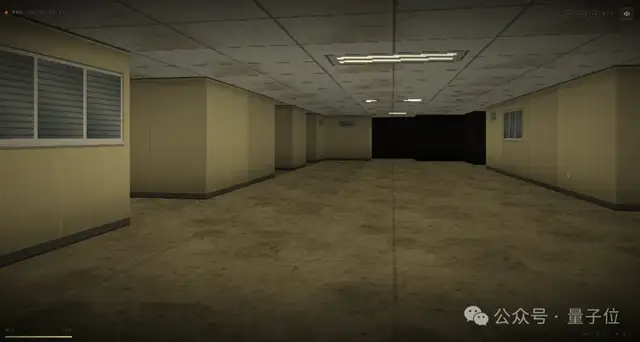
For Test #2, I decided to crank up the difficulty: build a playable Backrooms game from scratch.
And it couldn’t just throw together a single yellow hallway and call it a day. ERNIE had to build a complete item-collection and escape loop—
Players needed to find three VHS tapes inside a maze while evading a pursuing entity, complete with stamina, game-over, and exit mechanics. Plus, the final deliverable had to be a single webpage that opens directly in a browser.
Sure enough, ERNIE handed me a complete, single-file HTML game.
No game engine installation, no environment setup—just click and play.
Yellowed wallpaper, damp carpet, buzzing fluorescent lights, topped off with a vintage VHS filter—it nailed the vibe instantly.
At first, I was taking it pretty easy.
Just wandering down corridors and keeping an eye out for tapes, right?
And then…
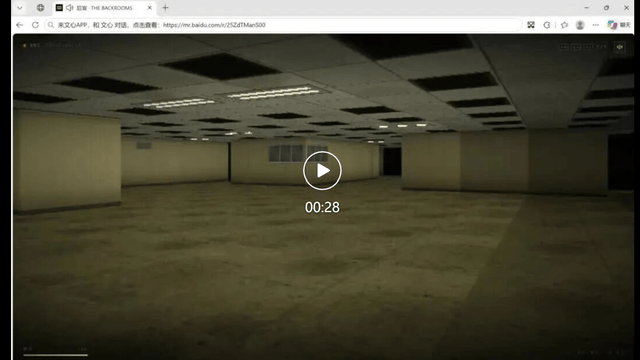
Midway through one run, I got caught dead to rights out of nowhere.
Man, that jump scare actually got me.
 Video link: https://mp.weixin.qq.com/s/Rj-T8unLFnHUk6R89rt02Q
With my heart rate spiking from all the creepy vibes, I figured it was time to bring things back to the beauty of the mortal world.
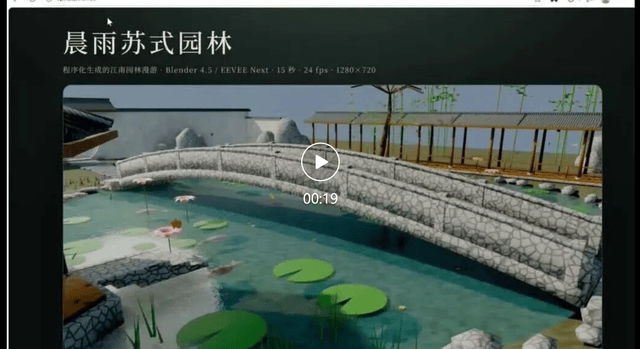
For Test #3, I threw ERNIE straight into Blender and told it to build a traditional Suzhou garden from scratch.
Every building, plant, water surface, and camera animation had to be constructed piece by piece using Python to call the Blender API.
And just like that, ERNIE got to work landscaping inside Blender.
About half an hour later, the model returned this “one-shot” result.
Honestly, the outcome blew me away a little…
 Video link: https://mp.weixin.qq.com/s/Rj-T8unLFnHUk6R89rt02Q
Anyway, this hands-on session really just scratches the surface.
Those complex official demos that run for ten-plus hours undoubtedly rely on much more granular task design, tool coordination, and iterative debugging behind the scenes.
Finding the true ceiling of ERNIE 5.5 Flash Preview will take a lot more testing.
After putting it through its paces, though, I was left wondering about something else entirely:
Everyone is doing AI coding, so how did ERNIE manage to bridge the full “end-to-end pipeline” from understanding requirements all the way to project delivery?
The answer might lie in a capability that even Jeff Dean once underestimated.
The “Coding” Factor Jeff Dean Admitted He Underestimated—And How ERNIE Doubled Down on It
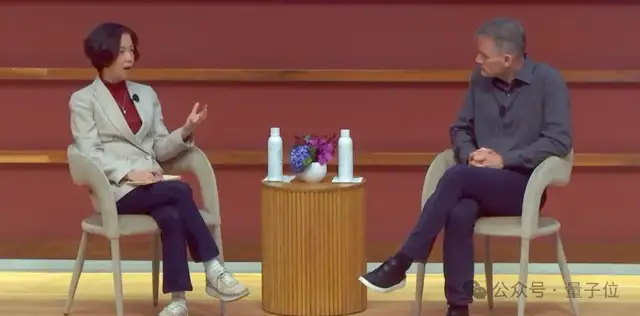
Not long ago, in a conversation with Fei-Fei Li, Jeff Dean openly admitted that there was one thing he had misjudged—
Coding.
In its early days, Gemini trained on coding too, but didn’t treat it as the absolute centerpiece. Only later did he realize that coding proficiency impacts a model’s ability to solve general problems far more deeply than anyone imagined.
Put simply, coding is like giving the chat box a pair of hands. With it, a model can finally move beyond mere armchair theorizing.
As time goes on, however, expectations for AI coding have skyrocketed.
△ Source: YouTube @stanfordhai
AI is already pretty slick at writing code—spinning up a webpage or squashing a bug takes just minutes.
The real trouble starts when you ask it to finish an entire project independently.
Breaking down requirements, configuring environments, running tests, debugging—every single step still requires a human babysitter.
So much for “AI writing the code” when humans still have to hold its hand the entire way…
Ideally, AI coding should work like this:
Requirements go in, finished product comes out.
You simply tell the AI what you want to build, and it handles task breakdown, coding, tool use, testing, and bug fixing step by step on its own.
That is true “end-to-end” execution—and it’s the exact capability ERNIE focused on shoring up this time.
How did they do it? Let’s start with a number:
14 million.
That’s the number of executable coding tasks Baidu prepared to train ERNIE 5.5 Flash Preview.
The scale is massive, but the operative word here is “executable.”
Every piece of code has to be thrown into a real environment and run, with task completion judged strictly by the execution results.
No matter how pretty the code looks, it’s worthless if it doesn’t run.
Thinking of turning in the assignment right after writing the code?
Sorry, it’s not that easy.
As for how the model spots issues and iterates once the code is running, Baidu incorporated diverse Agent execution trajectories—teaching the model when to invoke tools, how to interpret feedback, and how to fix things when they break.
Looking at the Yunxiu Xing game demo makes this much easier to grasp.
During development, the model ran into issues like floating characters, inverted running directions, and glitched camera angles.
However, ERNIE 5.5 Flash Preview is a text-only model—it can’t just stare at the game screen to hunt for visual bugs.
So how did it manage?
Baidu translated those visual glitches into code-inspectable data, allowing the model to keep iterating based on automated test results.
Run it, check for issues, patch the code, and run it again.
The debugging loop that normally requires a developer glued to a monitor was folded directly into the model’s own workflow.

Of course, mastering that feedback loop doesn’t automatically mean the model can tackle any job out of the box.
Web dev, game dev, 3D modeling, and video production all look like “writing code” on the surface, but the domain-specific nuances are worlds apart.
So Baidu gave the model targeted tutoring across specific scenarios.
For game development, it had to learn gameplay mechanics and runtime states while adapting to engines like Unreal Engine, Unity, and Godot.
For Blender and CAD, it had to learn how to call specialized tools to execute an entire modeling pipeline from start to finish.
Video creation is even trickier.
Going from scriptwriting and storyboarding to voiceovers and editing requires passing the baton across a whole relay of tools—for which Baidu prepared over 1,000 creative Skills.
Once the model finally learned how to use the tools, a new hurdle emerged:
Memory.
When an Agent works continuously for hours, it’s all too easy for it to forget what it did at the start by the time it reaches the end.
To counter this, ERNIE 5.5 Flash Preview expanded its context window to 1 million tokens, giving it room to hold far more project files, codebases, and tool-call logs.
Remembering a lot isn’t enough, though—you also have to find the right needle in the haystack when it counts.
ERNIE uses hybrid sparse attention to help the model quickly surface the exact information it needs right now from a massive pile of historical logs.
Combined with Multi-Router MoE, ECHO multi-token prediction, and FP4 expert weights, Baidu pushed generation speeds past 200 tokens per second.
Notably, AI itself played a role in these optimizations. According to Baidu:
ERNIE 5.5 Flash Preview introduces Baidu’s proprietary RSI technology for the first time, with ERNIE Evolve participating in model inference optimization—exploring a new path where AI helps research and optimize AI.
At the end of the day, getting an AI to deliver a project end-to-end boils down to overcoming two main challenges:
First, minimizing the need for humans to step in mid-way.
Second, having the stamina to go the distance. The longer a task runs, the harder it tests a model’s memory, context handling, and generation speed.
ERNIE 5.5 Flash Preview’s coding upgrades are aimed squarely at these two bottlenecks.
Going from a snippet of readable code to a genuinely usable project—and walking that entire road on its own—is the true measure of “end-to-end” capability.
One More Thing
Come to think of it, following Baidu’s ERNIE lately gives off a distinct impression:
This team feels a bit different now.
And it’s not because of some flashy keynote or a new benchmark leaderboard.
What sparked this realization was actually pretty random.
A few days ago while scrolling through Xiaohongshu, I saw a handmade video posted by Junyuan Shang from Baidu’s ERNIE pre-training team.
The cover had a simple six-character phrase—
“Returning, Still Young at Heart.”
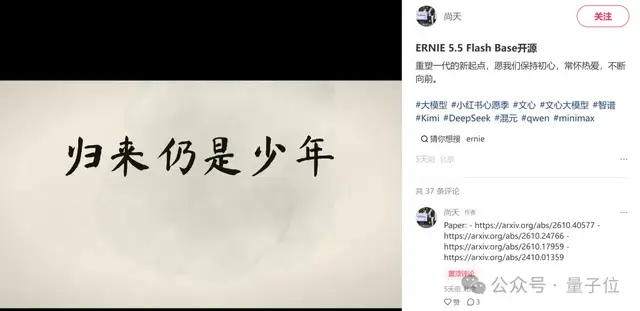
At first glance, it comes off as a bit dramatic.
Yet paired with the caption—“A new starting point to reshape a generation; may we stay true to our original aspiration, keep our passion alive, and keep moving forward”—and reflecting on everything the ERNIE team has been through over the years, it suddenly hits a little differently.
Baidu was among the very first companies in China to jump into the LLM race, starting early with deep technical reserves.
Yet through generation after generation of model updates, outside skepticism never really let up.
Especially that recurring jab about “waking up early only to arrive late to the market”—the team has probably heard it enough times to develop calluses.
Somewhere along the line, though, the team’s vibe started shifting…
ERNIE researchers began stepping out from behind the curtain, actively engaging with users on Xiaohongshu and X.
They even started leaning into past controversies and memes head-on.

This sudden wave of public engagement even left netizens scratching their heads:
Why is the entire ERNIE team suddenly on X? Did they get handed a social media KPI or something?

Who knows if there’s a KPI involved.
What’s clear is that from one person to a whole group, researchers who used to stay hidden behind a model’s name are now stepping into the spotlight.
They aren’t shying away from criticism, and they’re willing to address issues directly.
Beneath these changes, you can sense a distinct drive:
This group of people clearly has a chip on their shoulder and something to prove.
Still, attitude is one thing—actions speak louder than words, and people need to see concrete moves.
Sure enough, Baidu actually delivered on that front this time.
Two concrete moves, specifically:
One is an open-source commitment, and the other is a limited-time price cut.
The model weights for ERNIE 5.5 Flash Preview are slated for release soon under the Apache 2.0 license, with day-one support for SGLang and vLLM deployment.
Nothing left to hide behind now.
Whether developers want to self-host, fine-tune, or pull the weights just to poke holes in it, the door is wide open.
On the pricing side, the model API went live simultaneously on Baidu AI Cloud’s Qianfan platform at 50% off for a limited time (1 RMB / 1M input tokens, 4 RMB / 1M output tokens during off-peak hours; 2x during peak hours).
That part is actually crucial.
Heavy-duty tasks like game dev, 3D modeling, and video generation burn through tokens fast—no matter how capable a model is, it’s a non-starter if it’s too expensive to actually run.
Between opening up the weights and slashing API prices, the stage is set. The rest is up to the developers—
Whether the model truly holds up in the wild is something the community will soon decide for itself.
Looking at it that way, that line from the video—“Returning, still young at Heart”—feels pretty fitting after all.
They set out so early back then, only to get mocked for “arriving late to the party.”
Today, that same group of model builders is back, driven by a refusal to settle and determined to close the gap.
As for whether they can actually catch up this time and build something truly different?
Well… let’s wait and see.
Links:
https://ernie.baidu.com/web/new-chat
https://console.bce.baidu.com/qianfan/modelcenter/model/buildIn/list