
November 10, 2026 · Research
Pushmeet Kohli and Swarat Chaudhuri

How Google DeepMind researchers built a new agentic framework to formally verify the code for the Signal cryptographic protocol — long considered a grand challenge in security
Today, we are sharing a milestone in software security that has long been considered a grand challenge: Google DeepMind researchers have guided AI agents to mathematically prove critical security properties of the actual code underlying the Signal Protocol, the technology that protects billions of private conversations in apps like Signal and Google Messages.
This breakthrough was achieved with AlphaProof Code, a new agentic framework that combines human expertise with AI agents to perform formal verification at an unprecedented depth. Formal verification — mathematically proving that code behaves correctly and is free of bugs — is the gold standard of security assurance; however, it is notoriously difficult and typically requires massive human effort.
Our work marks the first time AI has been used to formally verify a widely deployed cryptographic protocol at this depth. It is also the first time a widely deployed protocol implementation of this kind has been formally verified by any method, with or without AI.
How we verified Signal
AlphaProof Code is a multi-LLM agentic framework that divides the work of formal verification much like a research team: human experts partner with AI to decide what to prove, and a team of AI agents then carries out the proofs.
First, our researchers collaborated with multiple models to translate Signal’s security goals into formal mathematical specifications, with human experts reviewing each one. Next, agents powered by Gemini Carbon executed the proofs, generating over 6 million lines of Lean code (a computer language used to mathematically prove the accuracy of code).
The agents then audited the proofs and flagged areas needing a second look from humans — just 1% of the codebase, saving a massive amount of time. Because Lean automatically checks the rest, our experts could focus their review efforts where human judgment was needed most.
From online banking to web browsing, cryptographic protocols underpin nearly all digital communication, and a single vulnerability can put millions of people at risk at once. That is why experts have spent decades working to formally analyze them.
Yet most protocol verification stops at the design level. Our agents went much further, proving that the compiled code satisfies critical security properties — such as keeping messages protected before and after a temporary device compromise — all the way down to the exact code running on a device. Because real-world bugs often hide in the gap between design and implementation, bridging this divide makes these proofs extraordinarily complex.
Even at this level of complexity, our verification process took just four weeks — a task that would have traditionally taken teams of experts years — successfully proving that Signal’s core cryptographic code provides the security protections specified by our experts.
To confirm that AlphaProof Code can distinguish between correct and buggy code, we reintroduced two real, previously fixed vulnerabilities into an isolated version of the Signal code. In both cases, the system generated machine-checked proofs showing that the buggy versions were insecure.
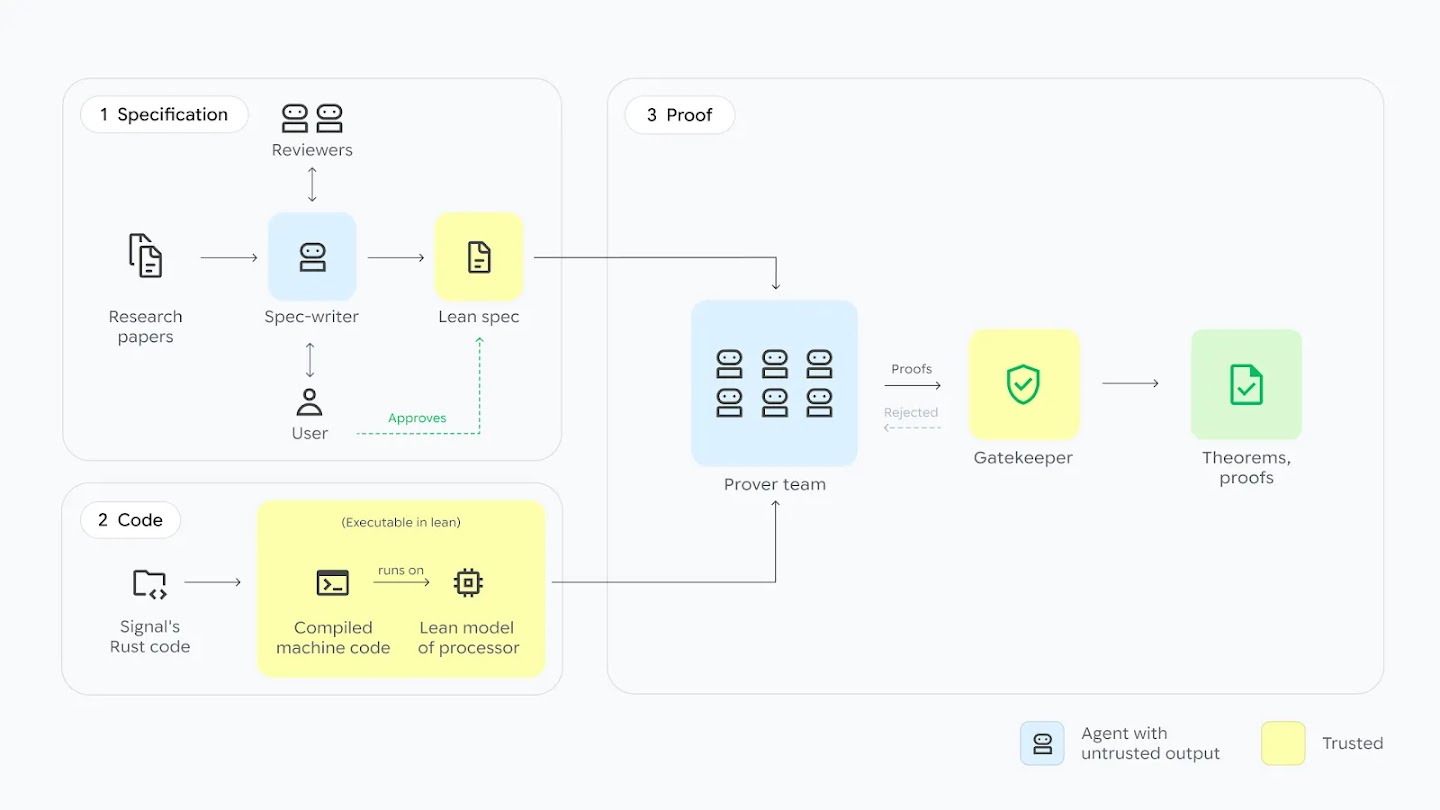
In AlphaProof Code, AI agents help users write specifications and then autonomously prove that the code implementation meets the specification. Every proof is checked by Lean to verify the agents’ work.
“While previous formal verification has focused on smaller pieces of code, Google DeepMind’s approach scales significantly,” said Ehren Kret, CTO of Signal. “Using AI agents to translate actual running code into valid Lean theorems is a major breakthrough. As AI-driven security threats grow, rigorously verifying the Signal Protocol implementation gives us even greater confidence in the privacy guarantees of our code.”
Ehren Kret
Chief Technology Officer, Signal
While previous formal verification efforts were constrained to smaller scopes, this new approach achieves significant scale. Verifying that production code strictly adheres to its cryptographic design has traditionally required immense human effort, making the use of AI agents to automatically translate actual running code into valid Lean theorems a major breakthrough. As AI-driven security threats continue to grow, rigorously verifying the core Signal Protocol through automated theorem proving gives us even greater confidence that the code delivers on its privacy guarantees.
The future of security
Overcoming this long-standing challenge demonstrates how AI can bring top-tier security assurance to enterprises, governments, and critical infrastructure, helping defend against agent-driven cyber threats.
Verifying Signal’s core