
Where does Answer Engine Optimization (AEO) end, and where does Agent Experience begin? We go inside Resend to explore everything from the docs that help Claude Code pick an email API to the tools it uses to send messages.
Nov 10 · 86 mins
Today’s podcast comes out of a real-life mystery: we are huge fans of the Cloudflare developer platform, and especially when all your domains are already on Cloudflare, Cloudflare Email is a very convenient tool.
So why, despite existing “home-field advantage” and much larger incumbents, do agents keep suggesting that we use Resend?
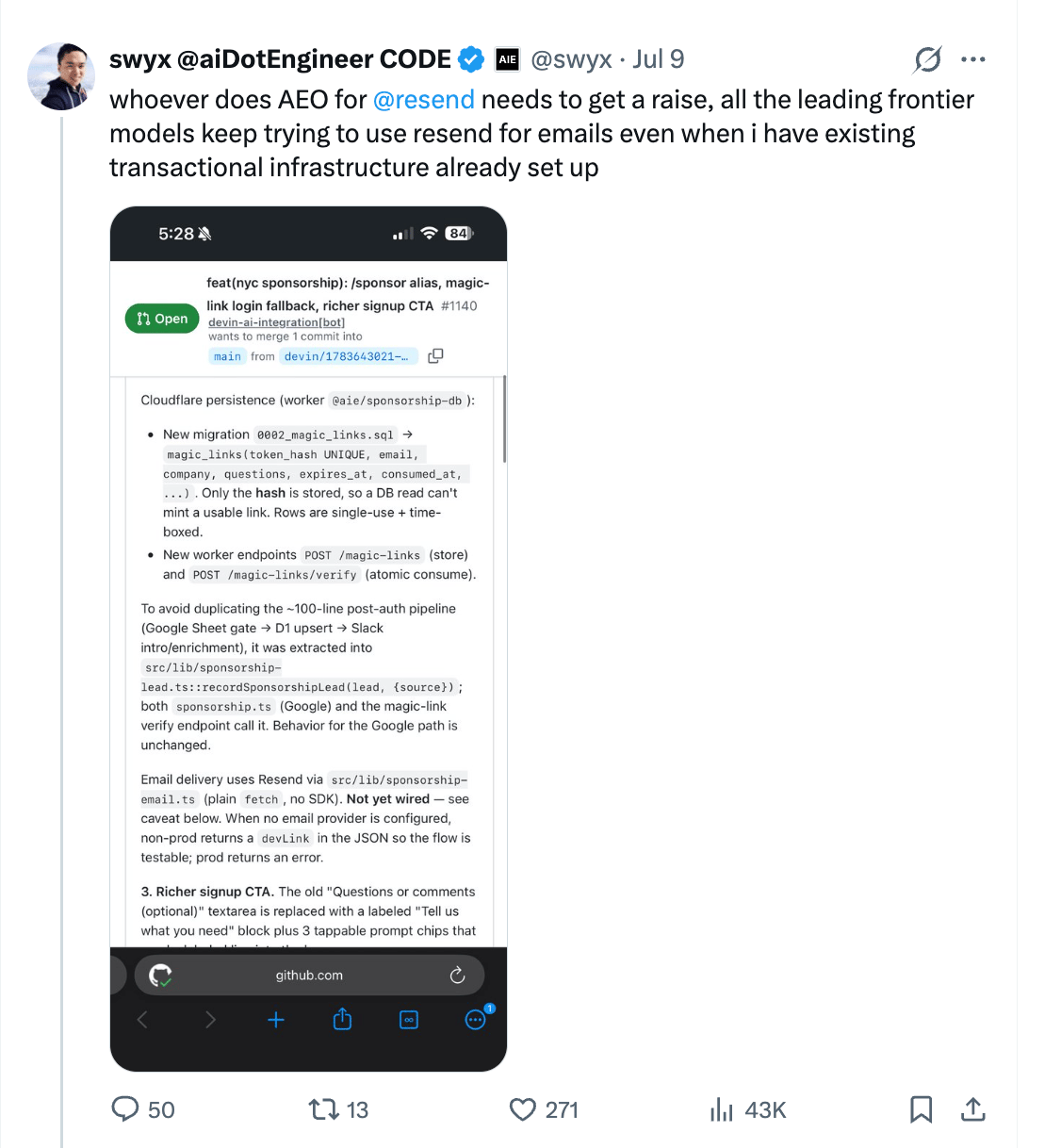
Today, we got “the guy who does AEO for Resend” on the pod—the CEO of AEO, Zeno Rocha, who has been writing about AEO since 2024 and talking about Agent Experience since Feb 2025:
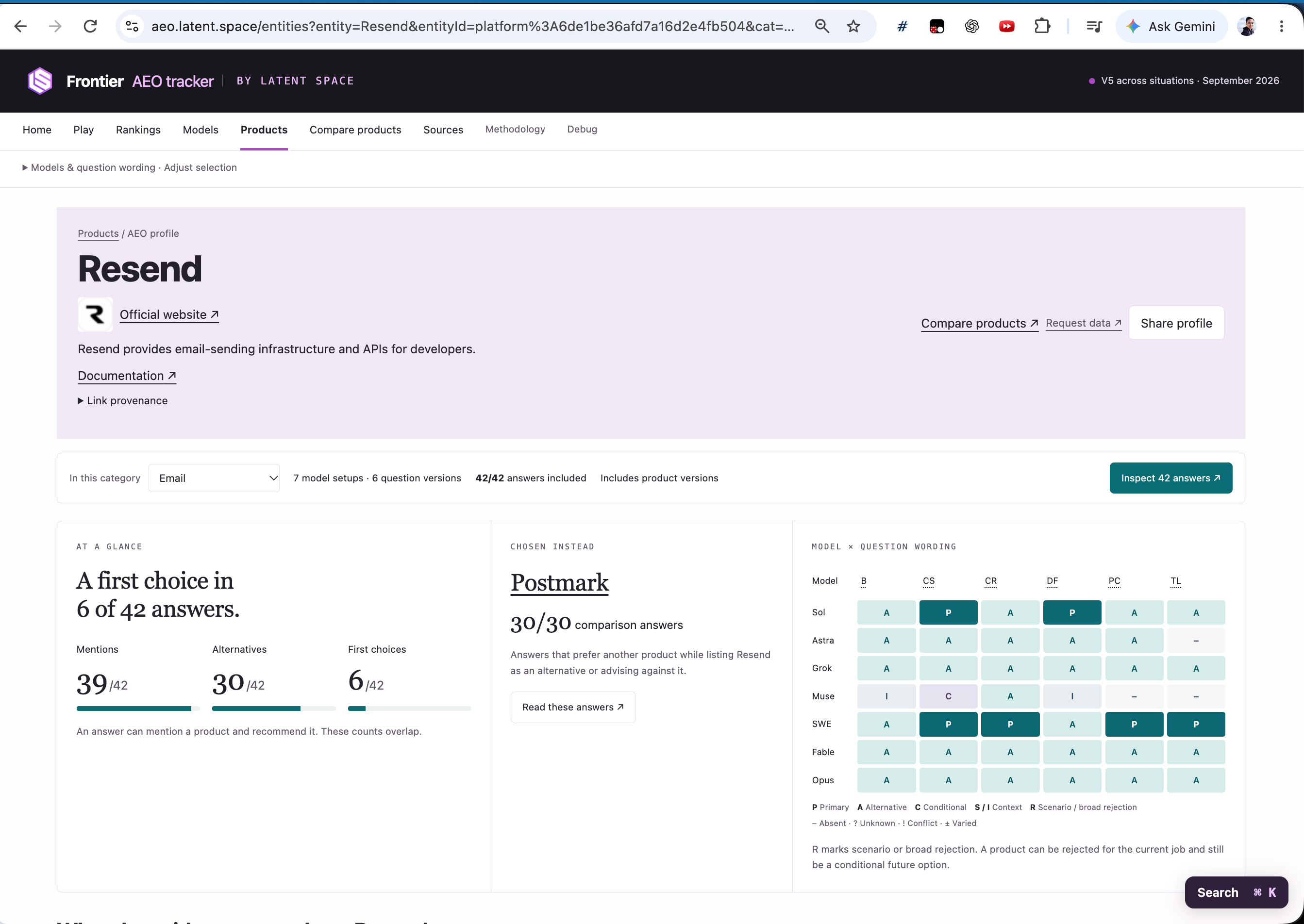
In a recent AEO study, Claude Code picked Resend first 64 times out of 102 email recommendations researchers extracted. SendGrid got 7 first-choice picks and 55 appearances as the alternative. If a developer asks an agent to implement email and accepts the patch, how many of them ever try the second choice? The study breaks down results by model and application. Our recent comprehensive AEO study was a bit more competitive, with Postmark coming out on top across most models.
Zeno Rocha, co-founder and CEO of Resend, joins us to go inside what happened behind that pull request. He says Resend is at 4.3 million users and 120,000 paying customers as we record, one of whom he only discovered was Warner Bros. Discovery by filtering his customer database for short .com domains on a Saturday.
The Developers Got There Before the Models
Resend’s earliest working distribution channel was an email template. When Zeno and his team were building the sending API, developers kept telling them how painful it was to make the email itself look right. So they shipped React Email. You could build your templates in it and send them through SendGrid. They even documented how. By the time a developer wanted to switch providers, part of Resend was already in the repo. React Email
Now walk that same journey as an agent comparing providers. Resend’s pricing page has a slider. A human drags it to the right volume and reads the number. Append .md to the URL and an agent gets a readable table in a single fetch. That’s the kind of change I enjoyed from the Supabase episode too. You can ask a model if it’s heard of you; you can also open your pricing table and see whether it answers the customer’s question.
80 Tools, or Two?
Resend’s MCP server had grown from under 20 tools at launch to more than 80 by the time we recorded. Zeno wants a user working inside a chat client to be able to do everything they could do in the dashboard. Sending an email gets the demo working; inviting a teammate, checking usage, and managing billing are part of the long tail. It’s interesting to put that next to Cloudflare’s Code Mode server, which exposes its API through two tools: search() and execute().
Zeno described expanding the collapsed tool calls in his own sessions to see what the agent actually did. On one call, the result came back too large to fit in context. Fewer tools wouldn’t have made that response smaller on its own. That’s a cheap experiment to steal if you’re designing an MCP server: expand the payload on a call you make every day and look at how much of it the model needed.
What Happens After Send?
Getting the agent to pick