
Ant LingBot Open-Sources LingBot-Touch
What a paradox.
You give a robot a sense of touch, and somehow it gets even clumsier…
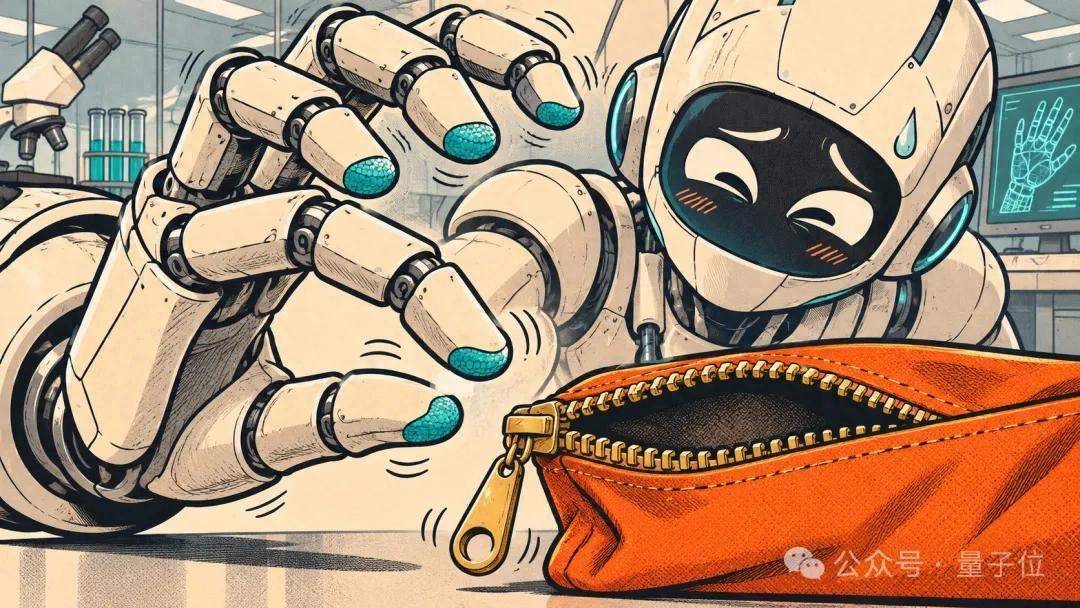 △ Image generated by AI
Here is what happened.
Recently, a research team ran an experiment: they outfitted all five fingers of a Sharpa Wave dexterous hand with tactile sensors and tasked it with zipping up a pouch.
They used π0.5 as the action model. Relying solely on cameras, the robot achieved a 39% success rate.
Next, the team fed the raw readings from the fingertip sensors directly into the model. Logically, with an extra sense at its disposal, the robot should have found zipping the pouch much easier.
But guess what happened?
Yikes… the success rate plummeted straight to 15%!
And this wasn’t an isolated case.
Using the exact same combination of the Sharpa Wave dexterous hand and π0.5, feeding raw tactile data into a box handover task caused the success rate to drop from 57% to 48%.
Even when switching the dexterous hand to the XHand, the average success rate across six tasks fell from 49.71% to 48%.
So why does giving a robot an extra sense make it more clumsy?
The answer lies in the sensor readings.
Tactile data is quite different from other modalities. Because a robot’s fingers aren’t touching objects most of the time, the readings are mostly a vast sea of zeros. Even when contact does occur, the signals are sparse and noisy.
Furthermore, different sensors work in completely different ways: visuotactile sensors capture images of soft gel deformation on the fingertip, magnetic tactile sensors measure magnetic fields, and piezoresistive tactile sensors record electrical resistance… the data formats couldn’t be more different.
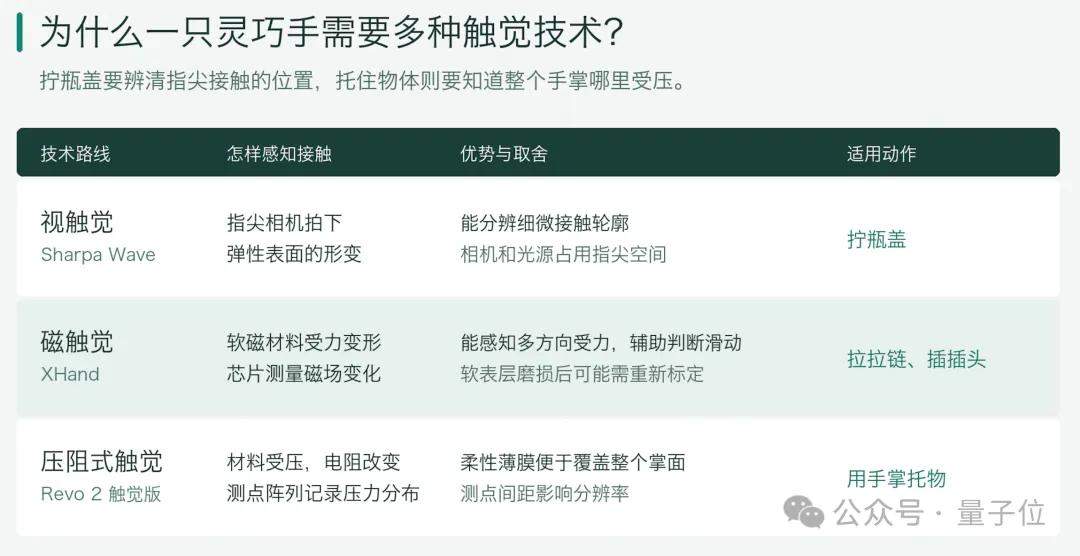 △ How three types of tactile sensors perceive contact and their respective trade-offs
For example, in a task like pinching a bottle cap, the three sensor types output three completely different sets of numbers. Not only does the action model fail to understand them, it is forced to process them anyway—doing more harm than good.
So, how do you break this deadlock?
Ant LingBot came up with a solution: insert a “translator” between the sensors and the action model.
(Note: The experiments mentioned above were conducted by Ant LingBot.)
Simply put, the translator converts raw data from various sensors into information the action model can actually comprehend—such as where the finger is making contact, how much force is being applied, which direction the force is leaning, and whether anything is slipping—before passing it on to the action model.
With the same π0.5 model and the same zipper task, this approach sent the success rate soaring to 59%—a full 20 percentage points higher than using no tactile sensing at all. Similarly, the success rate for the box handover task rebounded from 48% to 63%.
This “translator” is LingBot-Touch, the tactile pre-trained foundation model newly open-sourced today by Ant LingBot.
Powered by LingBot-Touch, twisting off a bottle cap becomes effortlessly smooth:
Video link:
https://mp.weixin.qq.com/s/b7PNN5A3W8e1bZDVNTd5tg
Keep in mind that the most failure-prone part of unscrewing a bottle cap is the tiny contact patch where the finger pad meets the cap. If the grip is even slightly too loose, the finger pad slips against the surface—the wrist turns halfway around, while the cap doesn’t budge an inch. And that micro-slippage is something a camera simply cannot see clearly.
So, how exactly does LingBot-Touch pull off this “translation”?
Dexterous Hands Need a Translator
First, let’s clarify what LingBot-Touch actually does.
In short, it takes in signals from magnetic, visuotactile, and piezoresistive tactile sensors and encodes them uniformly into tactile tokens, extracting contact locations, force magnitudes, and how force directions change over time.
It sits right in the middle: downstream, it connects to different sensors and dexterous hands; upstream, it feeds these unified tokens into various action models.
This way, no matter how varied the signals from different sensor manufacturers may be, the action model receives a unified representation it can understand—all roads lead to Rome.
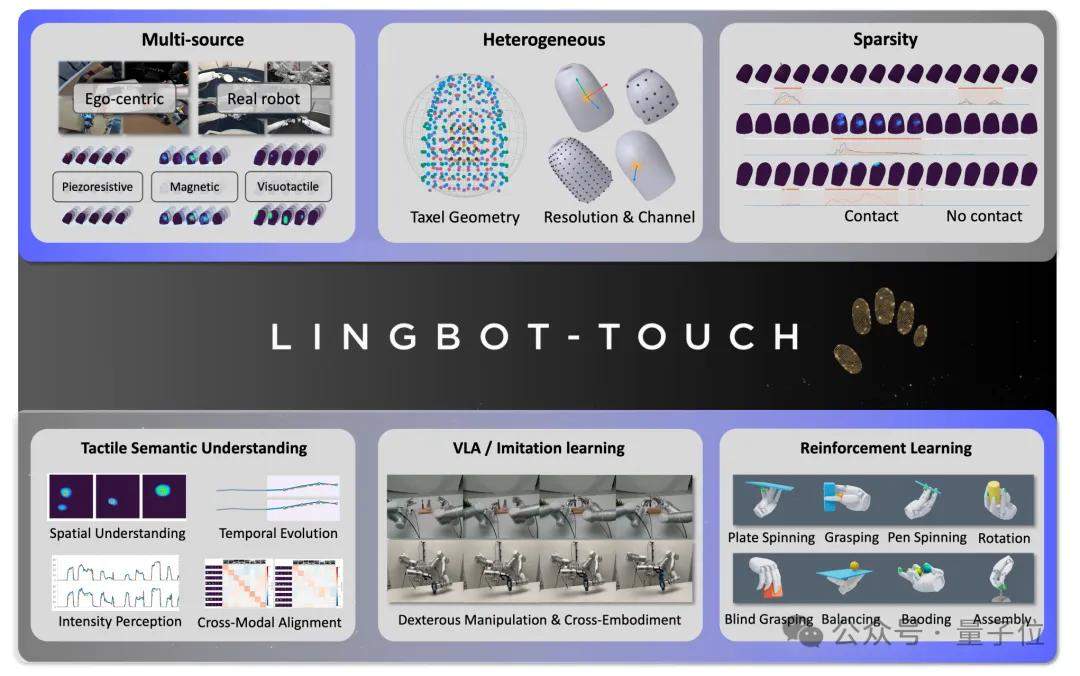 △ LingBot-Touch bridges diverse tactile sensors with real-world dexterous manipulation
Moreover, the lightweight version, LingBot-Touch-Tiny, has only about 5.32 million parameters. Currently, the technical report, code, and model weights have all been open-sourced.
So, how was LingBot-Touch trained?
Overall, the Ant LingBot team broke the process down into three main steps.
Step 1: Unifying Coordinates.
The first hurdle the team faced was the massive variation in the number and layout of taxels (tactile pixels) across different sensors. For instance, some dexterous hands pack 116 taxels onto the thumb alone, whereas some fabric gloves only feature a tiny 3×3 array.
Trying to match them up by index numbers simply wouldn’t work.
To solve this, the team mapped the taxels from all sensors into a single standardized fingertip space, assigning each token an “address” composed of time, finger identity, and 3D coordinates.
This address is fed into the model via Rotary Position Embedding (RoPE). As a result, the model no longer requires a fixed number of taxels and can seamlessly read entirely new layouts.
Building on this, each of the three sensor types has its own lightweight input stem responsible for converting raw readings into tokens. Beyond the input stems, they all share a single tactile Transformer backbone.
In other words, sensor-specific differences are absorbed by their respective input stems, while the underlying physics of contact are learned collectively within the shared backbone.
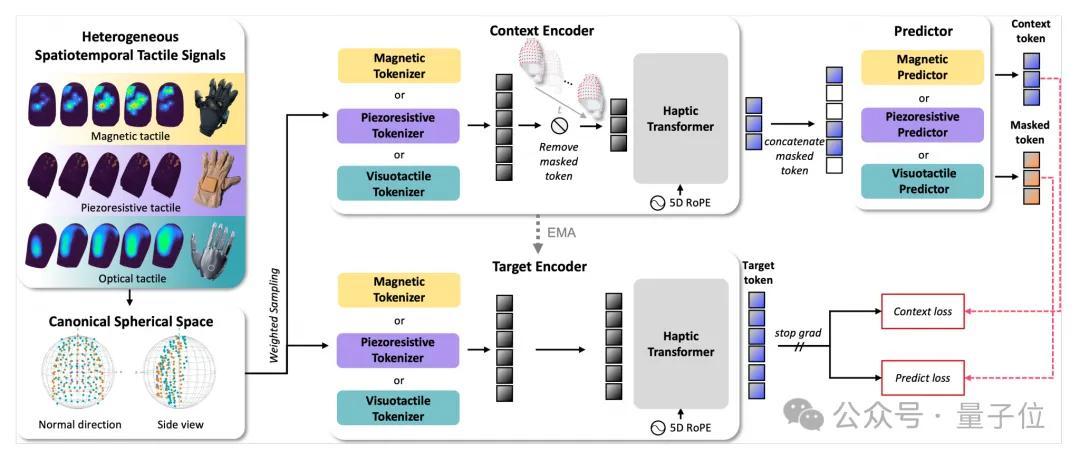 △ LingBot-Touch architecture: dedicated input stems for three sensor types, sharing a single backbone
Step 2: Predicting in Feature Space.
After unifying the coordinates, the team hit a second pitfall: that vast sea of zeros mentioned earlier.
If you train a model to reconstruct raw sensor readings, it quickly finds a shortcut: just learn to predict the “no-contact” background, and the loss drops dramatically. While the metrics look great on paper, the model barely learns any truly useful contact information.
Therefore, LingBot-Touch opted for the JEPA (Joint-Embedding Predictive Architecture) approach.
Specifically, during training, the model randomly masks 90% of the taxels across the entire time window. It then has to predict the feature-space representations of the masked regions based on the changes in the remaining 10%, rather than reconstructing raw readings point by point.
The results were immediate: trained on the same 1,000 hours of data, LingBot-Touch achieved a center-of-contact estimation error of just 0.90 mm, compared to over 3 mm for both VAE and MAE.
As another example, when using a tactile clip to retrieve the corresponding video frame, LingBot-Touch achieved a Recall@5 of 32.07%, whereas the other two methods scored below 6%.
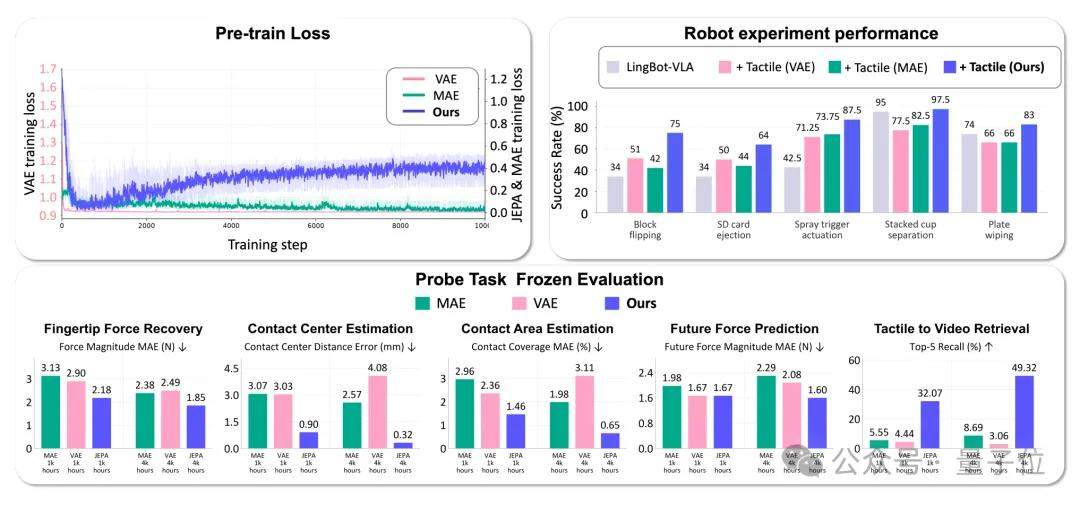 △ Performance comparison between feature-space prediction and raw reading reconstruction on the same data
Step 3: Scaling Up Data and Preventing Rote Memorization.
LingBot-Touch’s pre-training dataset spans 4,983 hours—roughly 1.33 billion frames. Two-thirds of this data comes from humans performing tasks while wearing tactile gloves, and the remaining third comes from teleoperating a dual-arm Sharpa Wave robot.
The team relied heavily on tactile gloves because they don’t require a robot setup; a single person can record several hours of data a day in an everyday environment. Moreover, this dataset is only labeled with high-level task categories like opening, closing, assembling, and pouring—not a single frame is annotated with ground-truth force values.
 △ Composition of the pre-training dataset, covering three sensing principles
However, even with enough data, the team had to prevent the model from “cheating.”
Because the pre-training data only contained three specific sensor layouts, the model could easily memorize those three taxel arrangements and be completely lost when encountering a fourth.
To counter this during training, the team randomly varied the taxel sampling density and slightly jittered the position of each taxel, forcing the model to learn the intrinsic dynamics of physical contact.
With all three steps complete, it was time to put the model to the test on real hardware.
The evaluation covered two dexterous hands across 26 tasks: 20 tasks on the high-DoF Sharpa Wave, and 6 tasks on the low-DoF XHand.
Four action models were tested: Diffusion Policy, π0.5, LingBot-VLA, and T-Rex. Each model was evaluated under three conditions: no tactile input, raw tactile signals, and LingBot-Touch integration.
The results showed that across both hands and all four action models, the group integrated with LingBot-Touch consistently achieved the highest average success rate.
Compared to using no tactile input, the success rates of T-Rex, π0.5, and LingBot-VLA jumped by 23.18, 21.81, and 24.81 percentage points, respectively—at the cost of increasing parameter counts by a mere 0.13% to 0.16%.
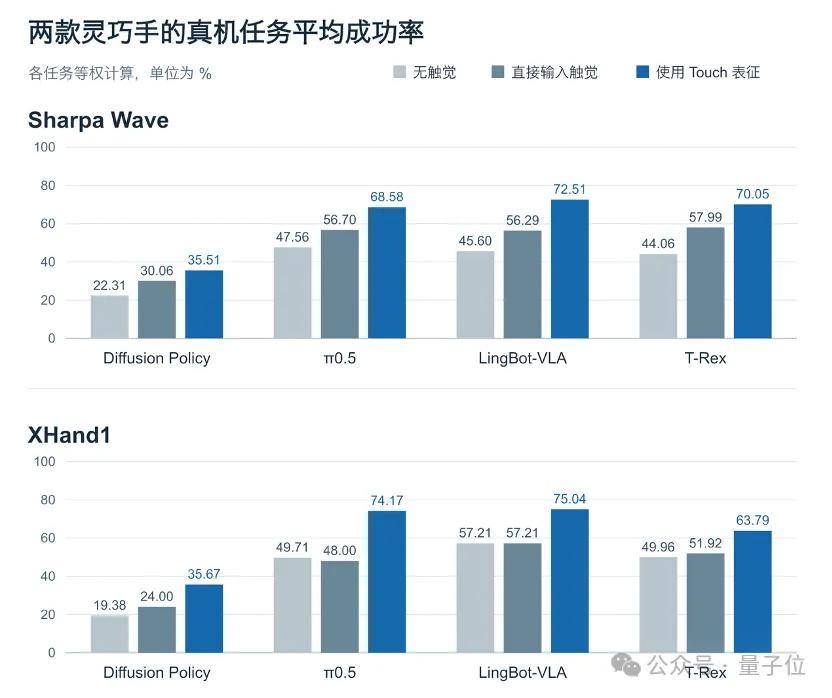 △ Average success rates of four action models under three settings across two dexterous hands
Take the single-handed straw insertion task, for instance. The trickiest part is the exact moment the straw punctures the plastic seal: as the straw presses down against the transparent film, resistance builds up until the film suddenly gives way.
A camera struggles to tell whether the film is merely dented or actually punctured, whereas fingertips can feel the difference instantly. If the robot pulls back its force even a fraction of a second too late, the straw slams straight into the bottom of the cup.
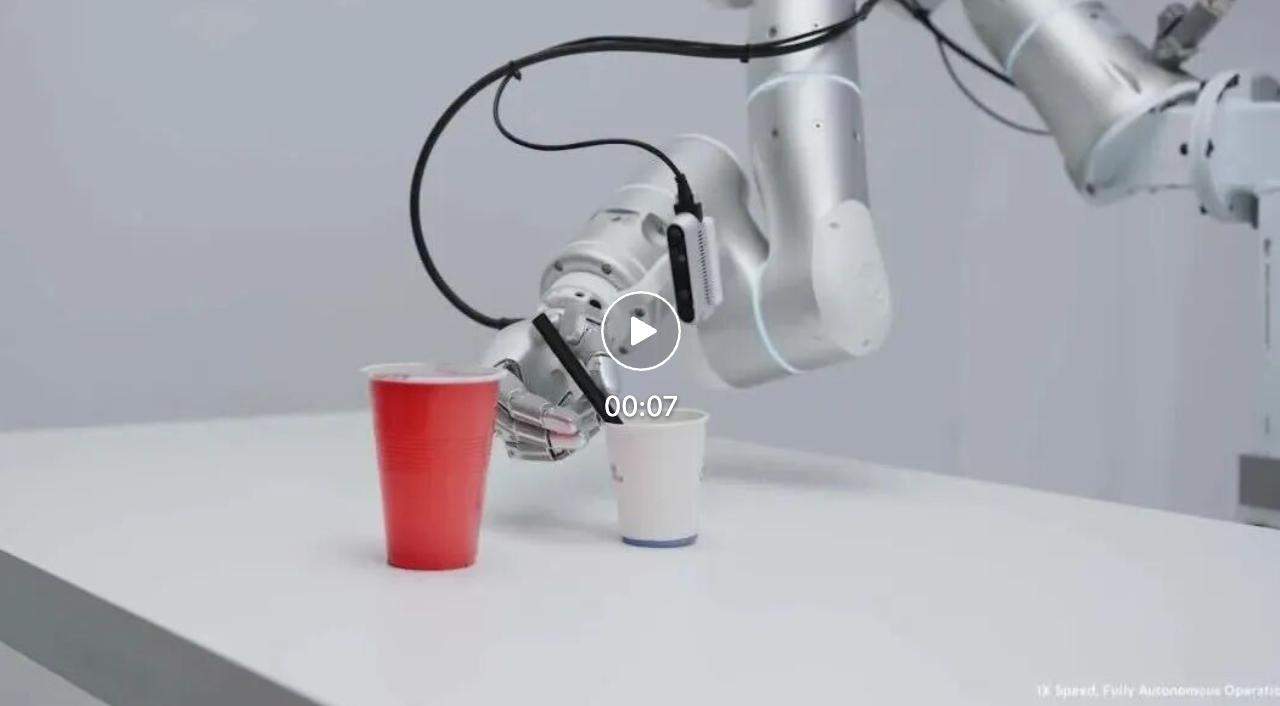
Video link:
https://mp.weixin.qq.com/s/b7PNN5A3W8e1bZDVNTd5tg
Of course, the most telling evidence comes from the XHand experiments.
The specific magnetic tactile sensor model used on the XHand never appeared in the pre-training data; in fact, all magnetic tactile data during pre-training came exclusively from human-worn gloves. Furthermore, when plugged into the XHand, LingBot-Touch didn’t have a single parameter fine-tuned.
Even so, π0.5’s average success rate across the 6 tasks jumped from 48.00% (with raw signals) to 74.17%.
In the cup-unstacking task specifically, the success rate more than doubled, leaping from 32.5% to 72.5%.
This task requires the dexterous hand to pull away only the top cup from a stack: one hand steadies the stack while the other pinches the rim of the top cup and pulls outward. If resistance suddenly drops while the finger pads remain firmly planted on the rim, it means the cup has broken free and the hand should ease off immediately. If the finger pads themselves are slipping against the rim, the hand needs to re-grasp.
To the touch, these two scenarios feel completely different.
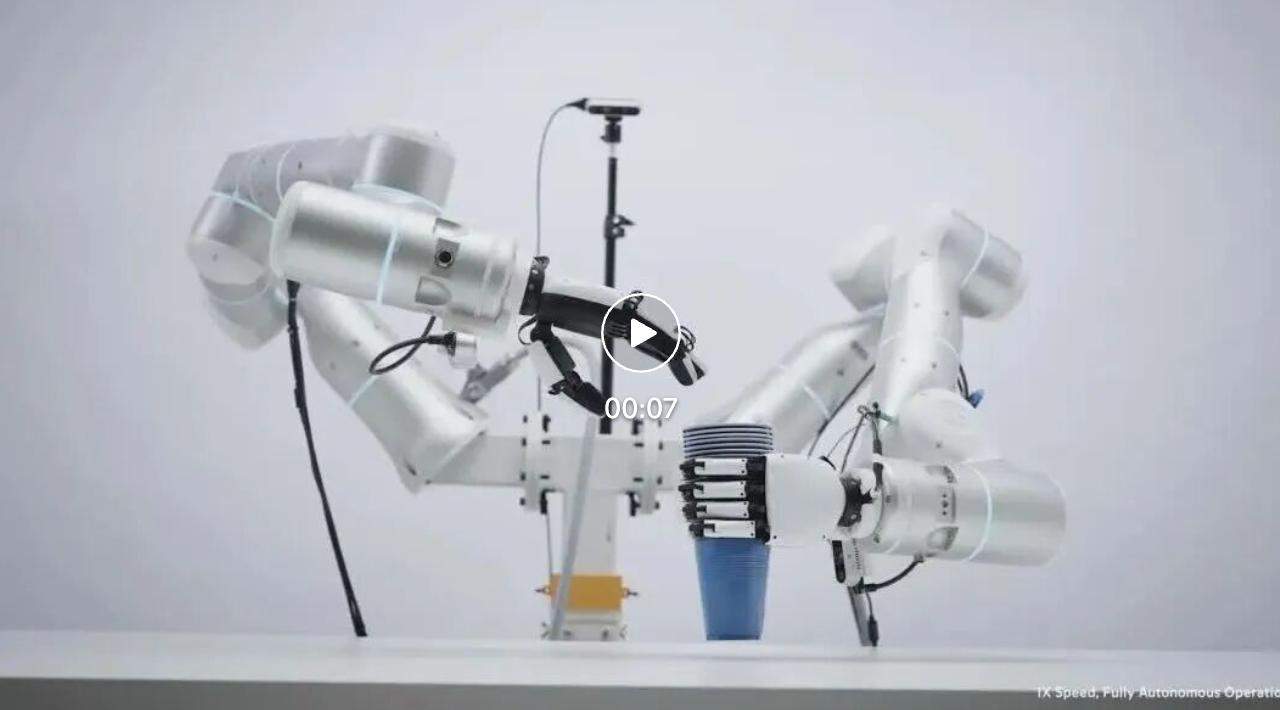
Video link:
https://mp.weixin.qq.com/s/b7PNN5A3W8e1bZDVNTd5tg
In other words, tactile experience accumulated by human hands helped the robot understand a mechanical hand it had never touched before.
Additionally, the team benchmarked LingBot-Touch against FTP-1, a previous tactile foundation model.
When estimating the center of contact on the Sharpa Wave, FTP-1 had an error of 2.19 mm, whereas LingBot-Touch achieved 0.12 mm. On the XHand, the error dropped from 5.89 mm down to 0.16 mm.
Notably, FTP-1 required dedicated adapters trained specifically for each of the two hands, while LingBot-Touch used the exact same frozen encoder for both.
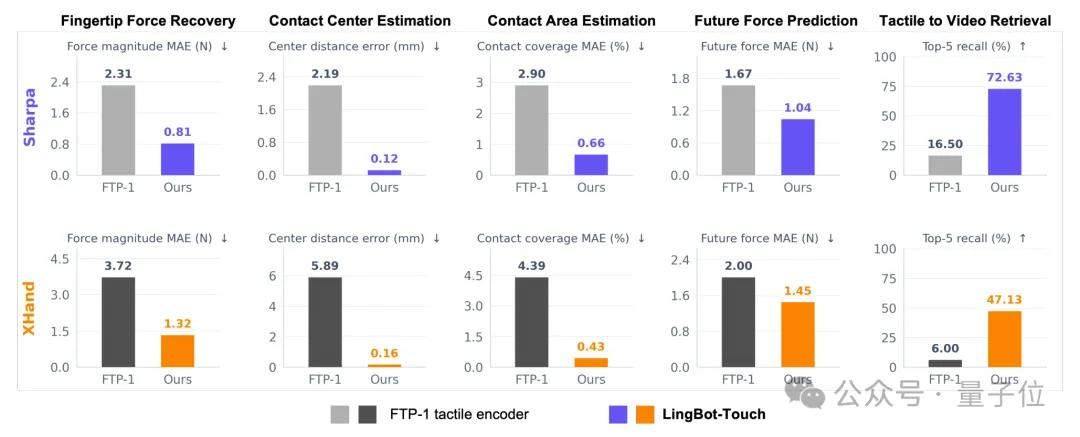 △ Comparison with FTP-1 across two dexterous hands
Furthermore, a Scaling Law for LingBot-Touch is already beginning to emerge.
While the Tiny version starts to saturate around 4,000 hours of data, switching to the higher-capacity Small version allows performance to keep climbing all the way to 5,000 hours. Real-robot task success rates also improve steadily as pre-training data scales up.
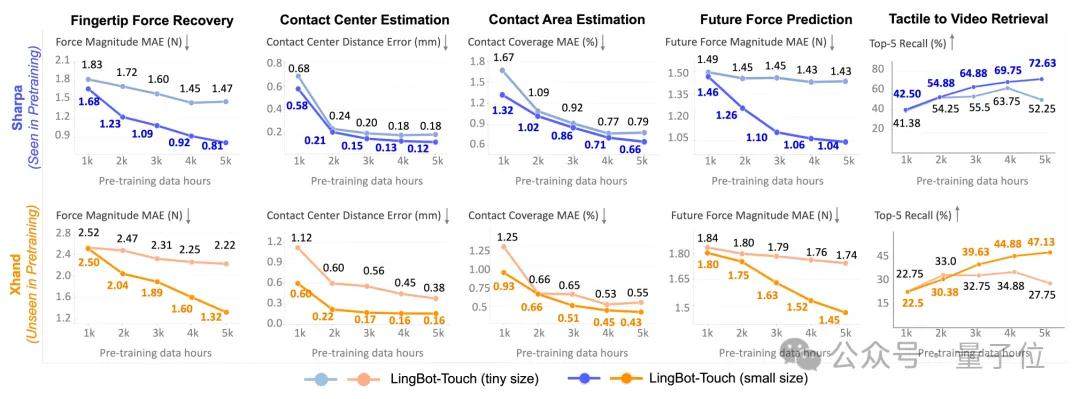 △ Impact of pre-training data volume and model scale on performance
Completing the Tactile Puzzle
Having covered the technical details, placing LingBot-Touch back into Ant LingBot’s broader roadmap makes its role even clearer.
Previously, LingBot’s generalist robot brain had laid out three core pillars: spatial perception with LingBot-Vision and LingBot-Depth 2.0, environmental interaction with LingBot-Video and LingBot-World 2.0, and dexterous manipulation with LingBot-VLA 2.0 and LingBot-VA 2.0.
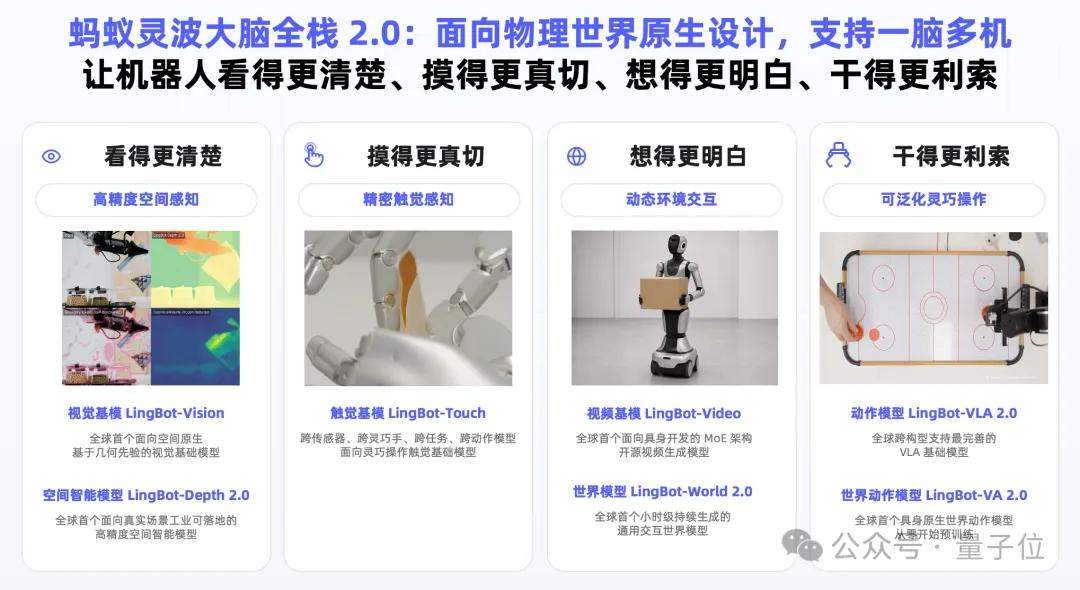
As you can see, those capabilities mostly address problems prior to contact—such as where an object is located, where the hand should reach, and what action to take next.
However, once fingers make physical contact with an object, vision offers much less information: the spot where the finger pad presses against a bottle cap is occluded by the hand itself, and once a key enters a keyhole, cameras are completely blind to what happens inside.
LingBot-Touch fills this exact gap. To sum it up in one sentence: vision handles pre-contact; touch handles post-contact.
Bimanual lock-opening is a classic example.
One hand holds a padlock while the other pinches a key and aligns it with the keyhole—a step that relies primarily on vision. But the moment the hand pushes the key inward, it might nudge the lock crooked; if the key jams halfway in, the hand has to pull back slightly, adjust the angle, and try again.
Once the key is inside the cylinder, cameras are essentially useless. The dexterous hand can only rely on the physical resistance transmitted through the key to its fingertips to make adjustments.
Video link:
https://mp.weixin.qq.com/s/b7PNN5A3W8e1bZDVNTd5tg
At this point, some readers might ask: Why did LingBot build tactile perception into a standalone foundation model?
The reason is that while every robotic hand is controlled differently, they all need to understand physical contact.
By isolating “contact understanding” into a reusable layer, the experience accumulated on one piece of hardware can serve as the starting point for the next robot.
This philosophy is directly in line with LingBot’s earlier work on LingBot-VLA.
VLA explores how a single brain can drive robots of varying morphologies—the concept of “one brain, multiple embodiments.” With Touch, the question moves a step further: can contact experience gathered across different hands and diverse sensors be learned together and transferred to entirely new robots?
The XHand results shown earlier offer a promising initial answer.
Several design choices in LingBot-Touch were reverse-engineered from this very goal. Data was collected using gloves because gloves don’t depend on robot hardware, allowing data collection to scale up rapidly. Input stems were designed around sensing physics rather than specific product models, leaving room to accommodate future sensors seamlessly.
This embodies the embodied-native philosophy LingBot has consistently championed: starting from how a robot perceives and acts in the physical world to dictate how models are architected and what data they are trained on.
Currently, LingBot-Touch has been integrated with LingBot-VLA and LingBot-Depth to enhance the hand-eye coordination and fine manipulation capabilities of the generalist brain.
On the deployment front, LingBot is conducting commercial trials with hardware partners like Leju Robotics and Ti5 Robot, as well as scenario partners like Guoda Drugstore and Longsheng, targeting retail sorting, logistics sorting, and industrial applications.
The Stronger Foundation Models Get, the More Indispensable Embodied-Native Becomes
Having discussed LingBot-Touch itself, let’s zoom out a bit.
After GPT-6 Astra was released this September, the RoboDojo team evaluated it zero-shot across 42 simulated manipulation tasks, where it ranked first overall out of 43 entries.
Truth be told, that briefly sent a wave of anxiety through the embodied AI community.
Yet buried in that same report was another set of numbers: on the precision dimension, GPT-6 Astra achieved a mere 4% success rate, compared to 20.42% for the best public policy. On tasks requiring precise contact—such as tube insertion or tower stacking—it failed almost across the board, and real-robot trials were halted due to safety concerns.
The report attributed this gap to a lack of physical common sense—specifically, an understanding of contact, force, and collisions.
And just today, Anthropic released Claude Fable 5.2, pushing the progress bar for LLM-controlled robotics forward once again.
According to internal benchmarks published on Anthropic’s official blog, Fable 5.2 achieved an average success rate of 64.9% on the RoboDojo simulation suite—more than double that of GPT-6 Astra (29.8%) under the exact same testing framework, and outperforming most AI systems purpose-built for robot control.
In official demos, a robot controlled by Fable 5.2 was shown solving a Rubik’s Cube, unscrewing bottle caps, and painting. Even so, what RoboDojo evaluates is controlling a simulated dual-arm robot purely by looking at camera feeds.