
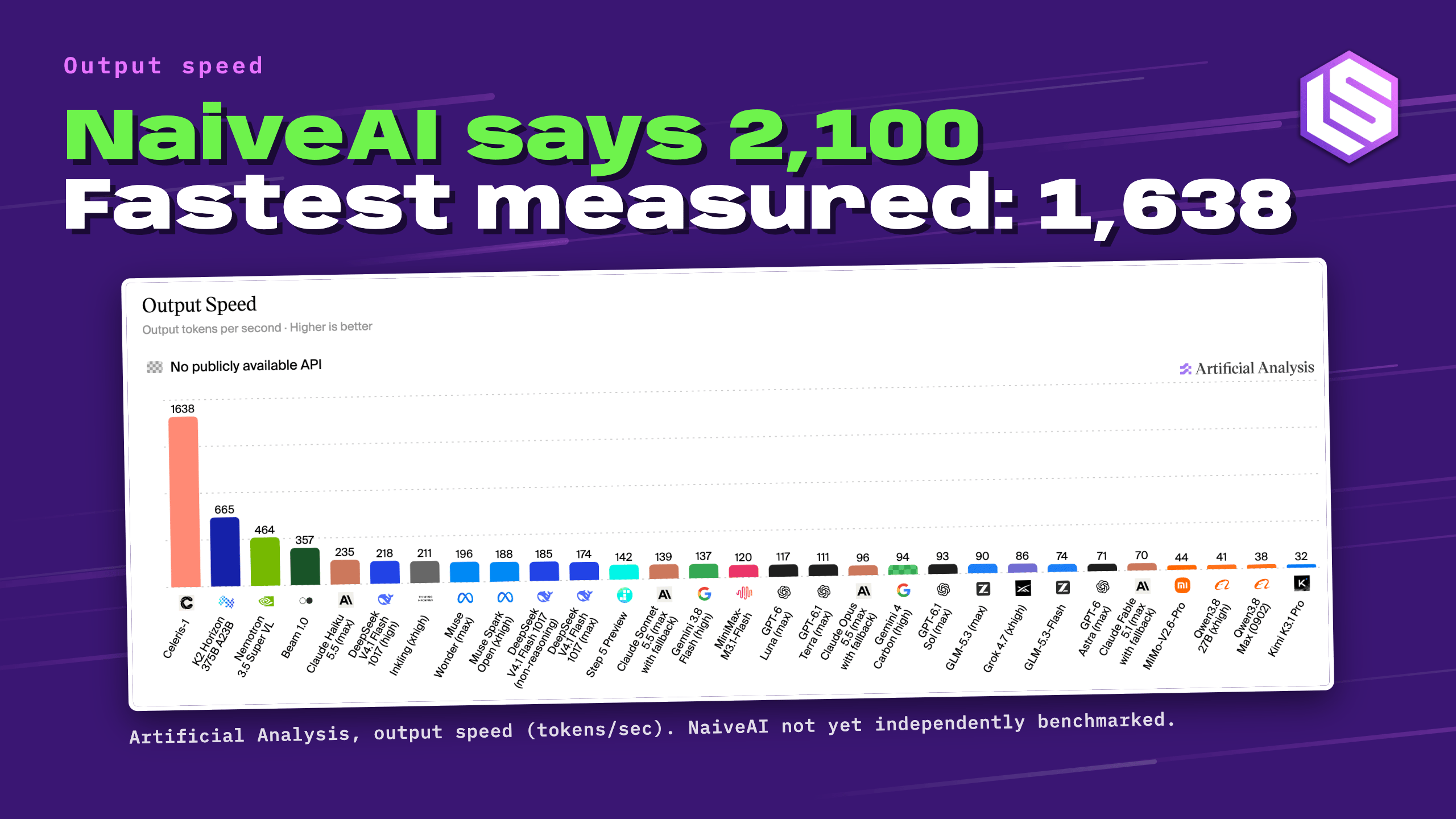
NaiveAI is poised to top the Artificial Analysis speed leaderboard. Our hands-on testing shows its coding quality rivals that of DeepSeek.
Nov 10 · 10 min read
Editor’s Note: With this post, we are officially launching a new series dedicated to trying out new models and products and providing objective reviews. Feel free to send suggestions to tips@latent.space.
Naive-N0.5-Flash is a new open-weights model built specifically for AI coding tasks and tuned to generate as many tokens per second as possible. Developed by a Chinese company called NaiveAI, the model is designed to accelerate engineering and research workflows, enabling teams to experiment, iterate, and solve complex problems faster.
Derived from Xiaomi’s MiMo-V2.5, NaiveAI further trained the model for long-context reasoning and paired it with its proprietary NaiveRT inference engine. Naive-N0.5-Flash comes with a bold pitch: a model largely built by AI and trained to conduct AI research itself, with the long-term goal of achieving recursive self-improvement.
To see what has changed, it helps to understand its starting point. MiMo-V2.5 is a sparse Mixture-of-Experts (MoE) model with 310B total parameters and 15B active parameters, trained on 48T tokens. Its language backbone inherits the hybrid architecture design of MiMo-V2-Flash, combining Sliding Window Attention (SWA) with global self-attention mechanisms.
NaiveAI’s technical approach started directly from these weights. Through continual multi-stage training, the team adapted the model checkpoint to DeepSeek Sparse Attention layers. According to the NaiveAI technical blog, this consumed approximately 3.25T additional tokens on top of MiMo’s original 48T. Of these newly added tokens, around 3T were trained at a fixed 1M context length and a constant learning rate.
Benchmarks: NaiveAI vs. DeepSeek and Z.ai
We benchmarked Naive-N0.5-Flash in ultrafast mode against DeepSeek V4.1 Flash 1017 and GLM 5.3 Flash, and subsequently fed the exact same app-building prompt to all three models.
We found that the trade-off is this: when faced with harder problems, Naive-N0.5-Flash requires longer reasoning traces, but overall, it still delivers the final answer faster. However, this results in a slightly higher cost per query—though for use cases where speed is the top priority, this price may be entirely acceptable.
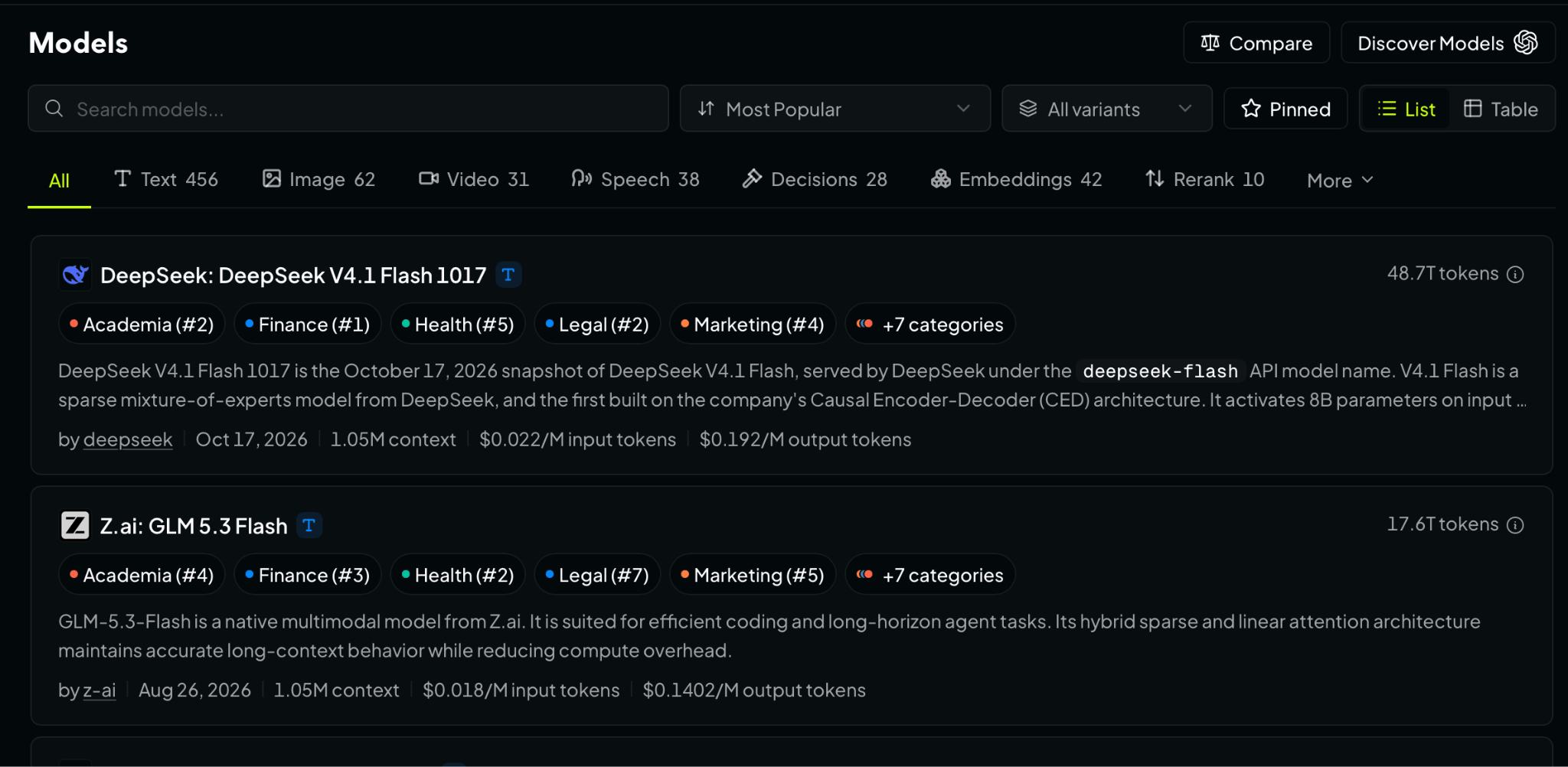
The most popular models on OpenRouter as of late October 2026.
DeepSeek V4.1 Flash 1017 and GLM 5.3 Flash are two of the most popular models on OpenRouter. Both are Flash-tier models and have demonstrated exceptional capabilities in AI-assisted coding.
As of the time of writing, performance statistics for the NaiveAI model are not yet available on Artificial Analysis. Therefore, we have listed the Intelligence Index scores for the models used in our comparison below: