
Cogent and OpenAI partner to build cyber defense factories for enterprises | OpenAI
November 10, 2026
Startups
Cogent combines OpenAI models with enterprise context to help agents automatically remediate vulnerabilities.

-
Company size: Startup
-
Region: North America
-
Industry: Technology
-
Products used: API, Codex, Daybreak
-
75%: 75% reduction in mean time to remediate (MTTR) vulnerabilities
-
5x: 5x increase in vulnerability triage throughput
As Cogent Security saw enterprises facing unprecedented security risks, they realized the hardest part wasn’t finding vulnerabilities—it was fixing them. Vulnerability remediation is complex and often spans multiple teams. It requires contextual understanding of a company’s environment: how an attacker would exploit the vulnerability, which business systems are at risk, and how to make changes safely.
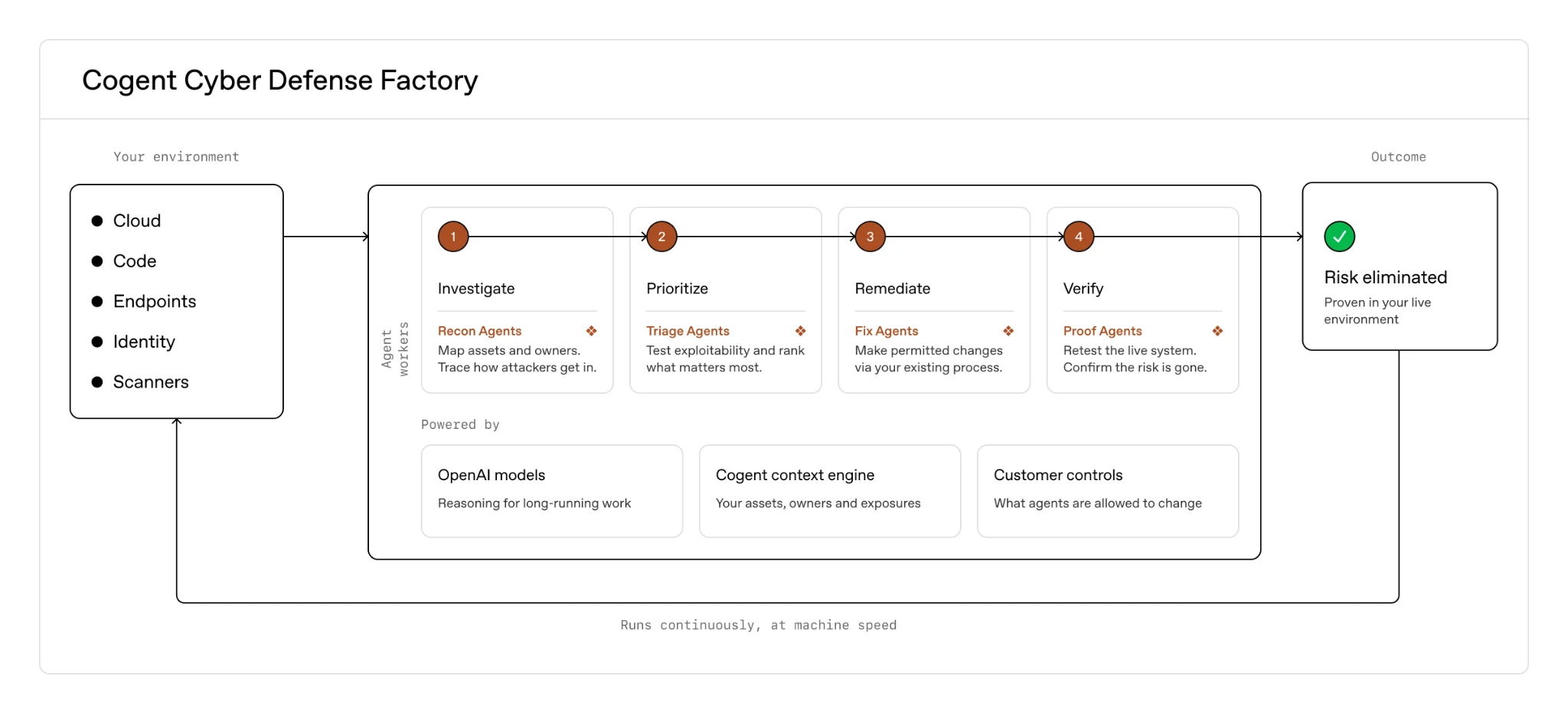
Cogent builds “Cyber Defense Factories” for enterprises to autonomously find and eliminate these risks. These defense factories are designed to help defenders move at machine speed in response to the accelerating pace of vulnerability discovery and exploitation.
The company’s AI agents combine GPT‑6.1 Sol and GPT‑5.6 with its enterprise context and controls to handle the entire workflow from investigation to verified remediation. These agents evaluate exposure, execute approved changes, and confirm the risk has been eliminated. Additionally, Cogent uses Cyber and Daybreak for internal research to explore attack paths and defensive capabilities.
“The ability of OpenAI models to sustain long-horizon tasks unlocks a new level of autonomy for enterprise security defense: AI agents can now close the entire loop from investigation to verified remediation.”
— Geng Sng, Co-founder and CTO, Cogent
Giving agents context and the authority to act
For each customer, Cogent’s Context Engine maintains an enterprise knowledge graph covering assets, vulnerabilities, identities, ownership, and dependencies. Dedicated background agents continuously reconcile and unify information across security tools and systems, giving investigation and remediation agents a consistent view of the enterprise environment.
GPT‑6 Astra handles the upfront planning and complex reasoning for this work. This enables what Cogent Co-founder and CTO Geng Sng calls an “enterprise memory harness.” “We don’t have to relearn what the world looks like every time a new task happens,” he says. Reusing context not only lowers latency and inference costs, but also reduces inconsistency in outcomes.
Cogent’s Agent Policies define the permitted changes and approval requirements for each enterprise, while its policy enforcement engine, TRACE, checks tool calls against policies before execution. These checks are deterministic and require no additional model inference.
An Agent Gateway independently verifies authorization, while high-risk work can run in isolated sandboxes. Customers can delegate investigations, require approvals for changes, or allow autonomous remediation within defined boundaries.
From vulnerability disclosure to verified remediation
When a critical security vulnerability known as PHP2Shell was disclosed in PHP, a programming language used to run websites, customers turned to the Cogent Cyber Defense Factories already deployed in their environments.
GPT‑6.1 Sol and GPT‑6 Astra provided the deep reasoning required for investigation and remediation planning. Using Cogent’s context layer, the agents identified affected systems, assessed exposure, and developed remediation plans that accounted for application dependencies and operational constraints. They then orchestrated the remediation actions using customer-defined approval and execution workflows, and verified that the issue was resolved.
Cogent reports that customers are using its Cyber Defense Factories to resolve vulnerabilities faster and scale their investigation capacity. With Cogent, a Fortune 1000 automotive customer reduced its mean time to remediate critical vulnerabilities by 75%, while a Fortune 500 IT services customer increased its vulnerability triage throughput by 5x.
Trading platform MarketAxess said Cogent helped them decide which exposures to fix first: “Cogent looks at our environment the way an attacker would. It traces the path from the internet to a vulnerable system and checks the security controls along the way. Now, our remediation efforts can focus on the biggest risks and the paths an attacker might actually use to break in,” said Vijay Bala, Global CISO at MarketAxess.
Why Cogent builds on OpenAI models and Codex
Cogent continuously evaluates closed- and open-source alternatives, noting that OpenAI models offer stronger reasoning, higher fidelity on long-horizon security tasks, fewer hallucinations on technical codebases, and more reliable execution. The models can chain tool calls both sequentially and in parallel while maintaining context throughout the entire remediation workflow.
Cogent prioritizes reasoning quality for complex investigations and cost for more straightforward work. It uses GPT‑6.1 Sol for general execution tasks and GPT‑5.6 for routine vulnerability management tasks that don’t require advanced reasoning.
“Compared to other providers, OpenAI models are much more cost-effective. That’s a huge advantage for us, especially when we’re running large-scale agent swarms.”
— Geng Sng, Co-founder and CTO, Cogent
Using OpenAI models has also reduced the amount of supporting software Cogent needs to build for remediation and patching. “A lot of the work we previously had to do at the harness level is no longer necessary,” Geng says. He also shared that the OpenAI API “simplifies request routing and agent orchestration, significantly reducing internal engineering overhead and speeding up our time to market for complex security workflows.”
Most engineers at Cogent also choose Codex for development. According to Geng, they are much more productive when pair programming with it.