
On Friday, we asked Jamin Ball what comes next for Anthropic’s IPO. On Monday, the roadshow kicked off, and Anthropic also released its long-awaited next generation of Claude, Fable and Mythos. Unsurprisingly, it is the new top model in the world, taking back the #1 spot from Opus 5.5 that Gemini 4 Carbon had held for just 10 days.
Fable’s per-token price is down 20%… but it burns more tokens. SemiAnalysis GDPx and Artificial Analysis reached the same conclusion:
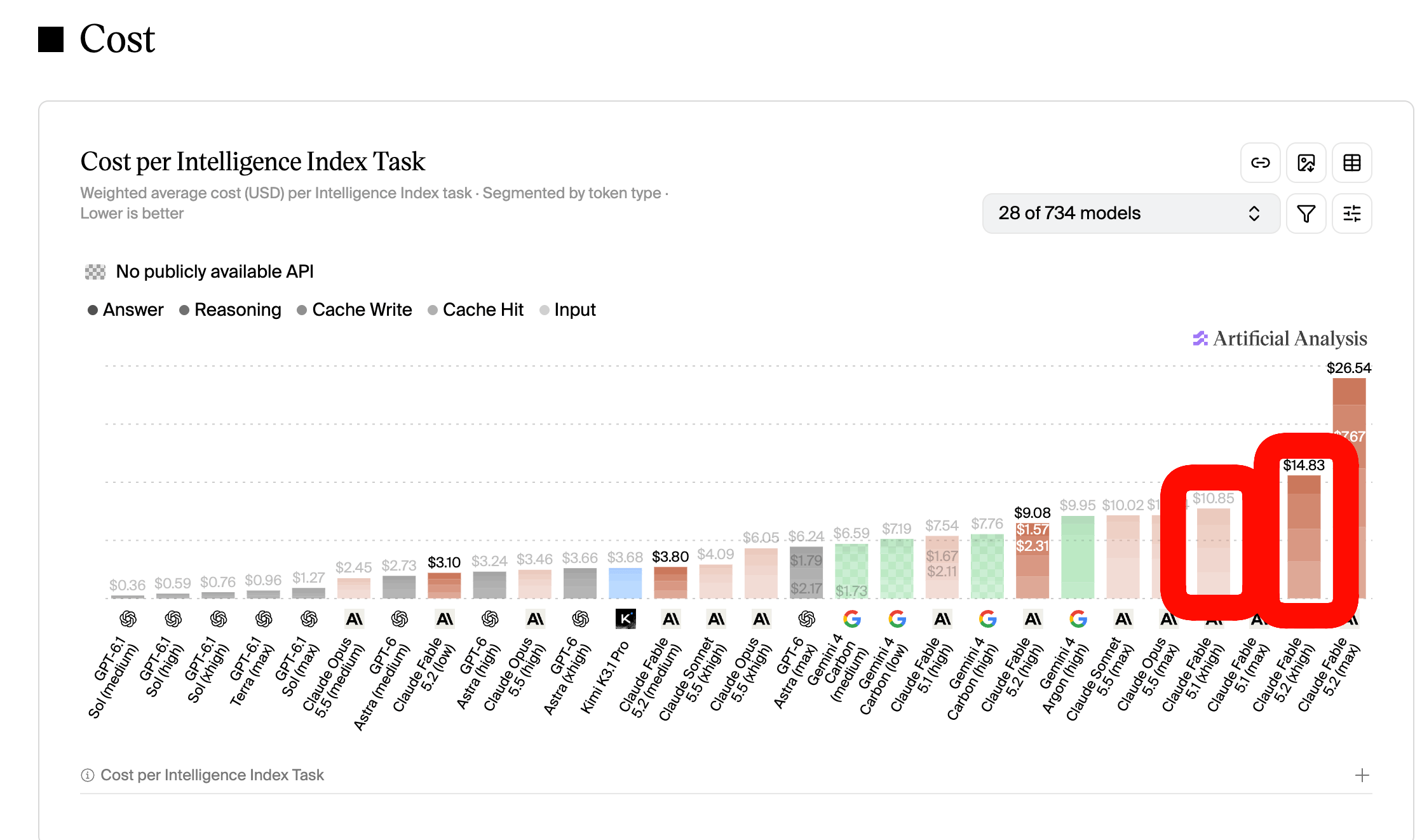
Fable 5.1 costs $10 per million input tokens and $50 per million output tokens, while Fable 5.2 costs $8 and $40. Yet on GDPx, a professional-tasks benchmark, SemiAnalysis actually paid $88.15 per task, up from $67.16 before. The run logs offer a clue: Opus 5.5 and Fable 5.1 typically try around 20 test cases, while 5.2 sometimes writes hundreds or even thousands, and spins up subagents to independently check its own work. Those checks helped Fable take #1 at 16.4%. Either way, you’re the one paying for them.
Which effort tier should you use in production? On FrontierCode 2.0, Anthropic reports that Fable at High matches Opus 5.5 at Max at roughly half the cost per task… though Max-tier Fable is another story.
AI Twitter Recap
Top story: Claude Fable 5.2 / Mythos 5.2 benchmarks, economics, limits, and first impressions
What happened
Anthropic released Claude Fable 5.2 and Claude Mythos 5.2, saying both are “a step beyond Opus 5.5 on nearly every capability we evaluate.” The release tops most independent leaderboards, but it also comes with deliberate RSI (recursive self-improvement) dampening, higher per-task costs, and restricted subscription access.
- Launch announcement. @claudeai announced that the pair of models was built for “the hardest technical challenges,” with improvements in coding, reasoning, and vision. @marktenenholtz noted an unusual phrase in the system card: “the model underlying Claude Fable 5.2 and Claude Mythos 5.2.” This implies the two share the same base model.
- Headline vendor-reported numbers, via @kimmonismus:
- Output speed is up to 30% faster than the 5.1 models.
- On FrontierCode 2.0, Fable 5.2 at High matches Opus 5.5 at Max at about half the cost per task; at Xhigh, it is the strongest model released to date.
- 1,000 Fable 5.2 agents formalized the existing proof of Fermat’s Last Theorem in 30 hours. Under the same setup, Opus 5.5 completed only 26% in 18 hours.
- Mythos 5.2 correctly modeled 28 of 34 gene therapy capsids.
- Alignment performance matches or exceeds recent Claude models, with external pre-release testing.
- Default effort. The default effort in the Claude app and Claude Code is Medium.
- Pricing. $8/$40 per million input/output tokens, 20% lower than Fable 5.1’s $10/$50 (@jaminball, @arena). Other specs, per Artificial Analysis:
- Cache writes cost $10 (5-minute TTL) or $16 (1-hour TTL); cache reads cost $0.20.
- 1M-token context window, with text and image input.
- Five effort tiers: low, medium, high, xhigh, and max.
- Anthropic’s long-horizon demos.
- Over 1,000 subagents built an operating system from an empty folder in 8 days. It boots on a laptop and has its own kernel, disk/keyboard/network drivers, persistent storage, a window system, login, an installer, and a built-in Claude (@kimmonismus).
- From a short prompt, Fable designed three working electronic devices (@kimmonismus).
- It proposed chemical synthesis routes that have not yet been validated.
- It improved on published solutions to 72 open optimization problems.
- @RLanceMartin published a write-up on safety-bounded scaling for the 1,000-agent FLT run.
- Subscription access.
- Ultra and Team Premium users receive Fable “resets” based on usage time: 1 for under 6 months, 2 for 6–12 months, and 3 for over 12 months, usable through March 8