
Introducing our smallest, most efficient model: Muse Ember
Meta AI has just released Muse Ember, a model aimed at the same tier as Claude Haiku and GPT Luna. Here is how they describe it:
[…] our smallest, most efficient model, built for complex reasoning execution and the work agents repeat all day long: tool calling, coding subtasks, routing, information extraction, and long-document parsing.
With shorter prompts, it costs the same as GPT-6 Luna and Claude Haiku 5.5: $0.10 per million input tokens and $0.50 per million output tokens. Claude Fable 5.2, the other major model released today, costs 80 times as much, at $8/$40.
As prompts get longer, though, pricing becomes less straightforward. Luna, Ember, and Haiku all support up to one million input tokens, but each has a threshold above which the price goes up. Once that threshold is factored in, Ember’s pricing lands between the other two:
| Model | Prompt size | Input ($/million tokens) | Cached input | Output |
|---|---|---|---|---|
| GPT-6 Luna | ≤272k | $0.10 | $0.01 | $0.50 |
| GPT-6 Luna | >272k | $0.20 | $0.02 | $0.75 |
| Muse Ember 1.0 | ≤200k | $0.10 | $0.004 | $0.50 |
| Muse Ember 1.0 | >200k | $0.30 | $0.012 | $1.50 |
| Claude Haiku 5.5 | ≤100k | $0.10 | $0.01 | $0.50 |
| Claude Haiku 5.5 | >100k | $0.50 | $0.05 | $2.50 |
But simply comparing per-token prices doesn’t mean much anymore. With reasoning tokens, the number of tokens different models use to solve the same problem can vary enormously.
One useful yardstick here is Artificial Analysis.
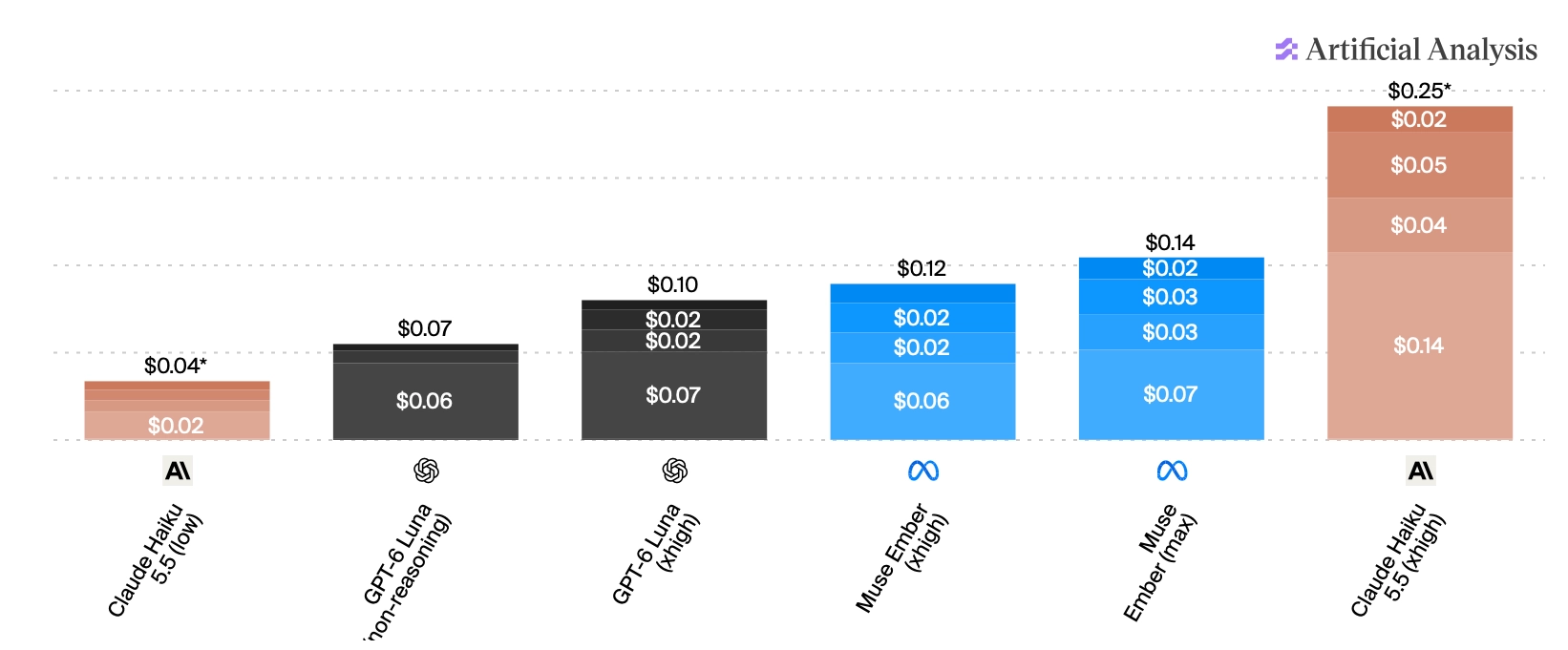
Even more useful is their “Intelligence Index vs. Cost per Task” chart, which shows these three models below:
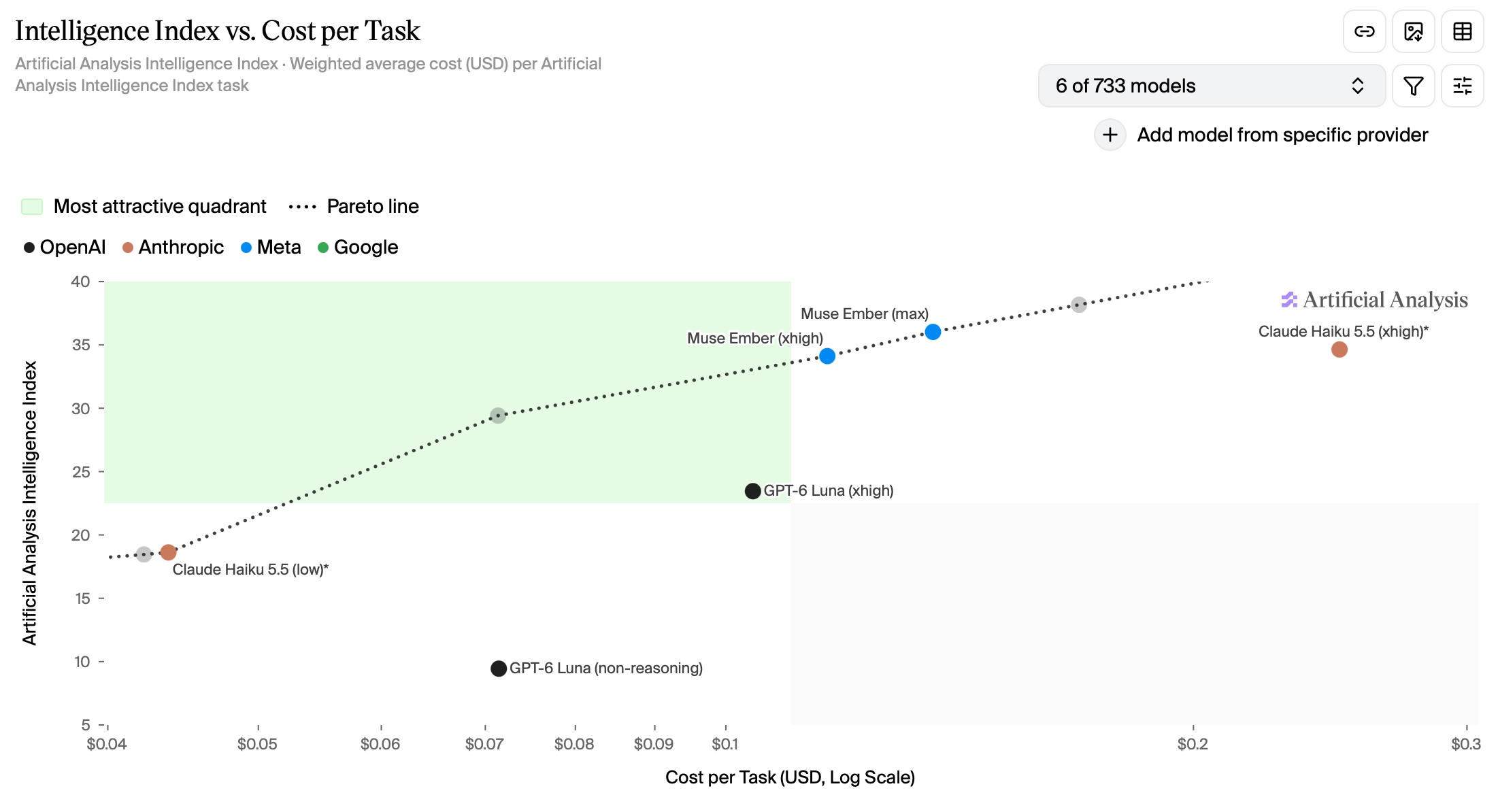
The Muse Ember models sit right on the Pareto line, meaning that along this line, improving one dimension requires sacrificing the other. Meta points this out specifically in its announcement:
It also sits on the efficiency frontier of the full Artificial Analysis leaderboard: no model achieves a higher score at a lower cost per task.
(The gray dot in the middle of the green region, on the Pareto line, is GPT-6.1 Terra (low). Apparently I should be paying more attention to the Terra series!)
Muse Ember has six reasoning levels: minimal, low, medium, high, xhigh, and max, so I rendered six pelicans riding bicycles. The “high” reasoning level failed to return a complete SVG, and among the others, surprisingly, there was no clear correlation between reasoning level and the visual quality of the output.
Here is the result from the “max” level, though the others are worth a look too:

The pelicans Ember generates are comparable in quality to the results I got from Muse Wonder, and Muse Wonder costs 40 times as much as Muse Ember.