
Ant Group’s Robbyant Open-Sources LingBot-Touch, a Tactile Foundation Model
On November 10, Robbyant, Ant Group’s embodied AI company (蚂蚁灵波科技), open-sourced LingBot-Touch, a tactile foundation model that fills a key gap in robot perception: the sense of touch. The model is pretrained on nearly 5,000 hours of real-world tactile data and covers three mainstream sensing principles: magnetic, vision-based, and piezoresistive. It converts these different signals into a single shared tactile representation that can be used across different dexterous hands and action models. Robots that already “see clearly and think clearly” now also gain the tactile perception that fine manipulation requires.
At a time when general-purpose large models are advancing rapidly, releasing a tactile foundation model built for the physical manipulation loop reflects Robbyant’s sustained investment in, and firm confidence in, the embodied-native approach.
Robbyant’s general-purpose robot brain already covers high-precision spatial perception, highly dynamic environment interaction, and generalizable dexterous manipulation, helping robots see more clearly, think more clearly, and work more deftly. Now LingBot-Touch has been integrated into LingBot-VLA, extending perception to the “fingertips.” Robots can “feel more sensitively,” taking the embodied-native general-purpose brain to the next level.
26 Real-Robot Tests: Task Success Rates Up by 14 to 26 Percentage Points
As general-purpose large models keep improving, robots are getting better at understanding complex tasks and reasoning through the steps of an operation. But in the real physical world, every time a robot performs an action, it must sense how the object and the environment have changed, then correct its next move. In many fine manipulation tasks, a robot can see where an object is and reach the right position, yet still fail to complete the task. Once the fingers touch the object, vision alone can hardly tell whether the applied force is appropriate or whether the object is slipping. Touch is needed to fill in the picture.
Take a dexterous hand twisting open a bottle cap. Depth information can help the fingers line up with the cap. Once the rotation begins, the cap may already have loosened, or the finger pads may be slipping along the cap wall. The two situations look similar on camera but call for different adjustments. Here, the fingertip contact location, the magnitude of the force, and how both change over time are all key cues for the action model, and this information is often hidden behind the fingers and the object, out of reach for vision.
To verify how much tactile representations help in real manipulation, Robbyant ran 26 real-robot tests on two dexterous hands, Sharpa Wave and XHand1, covering fine-grained tasks such as turning book pages, twisting bottle caps, and identifying mahjong tiles. With LingBot-Touch integrated, the average task success rate of four action models (LingBot-VLA, π0.5, Diffusion Policy, and T-Rex) improved by roughly 14 to 26 percentage points compared with using no tactile input.
Take T-Rex controlling Sharpa Wave to twist open a bottle cap. Without touch, the success rate was 56.25%. Feeding in raw sensor signals directly gave 62.5%. With the tactile representation from LingBot-Touch, the success rate reached 90%.
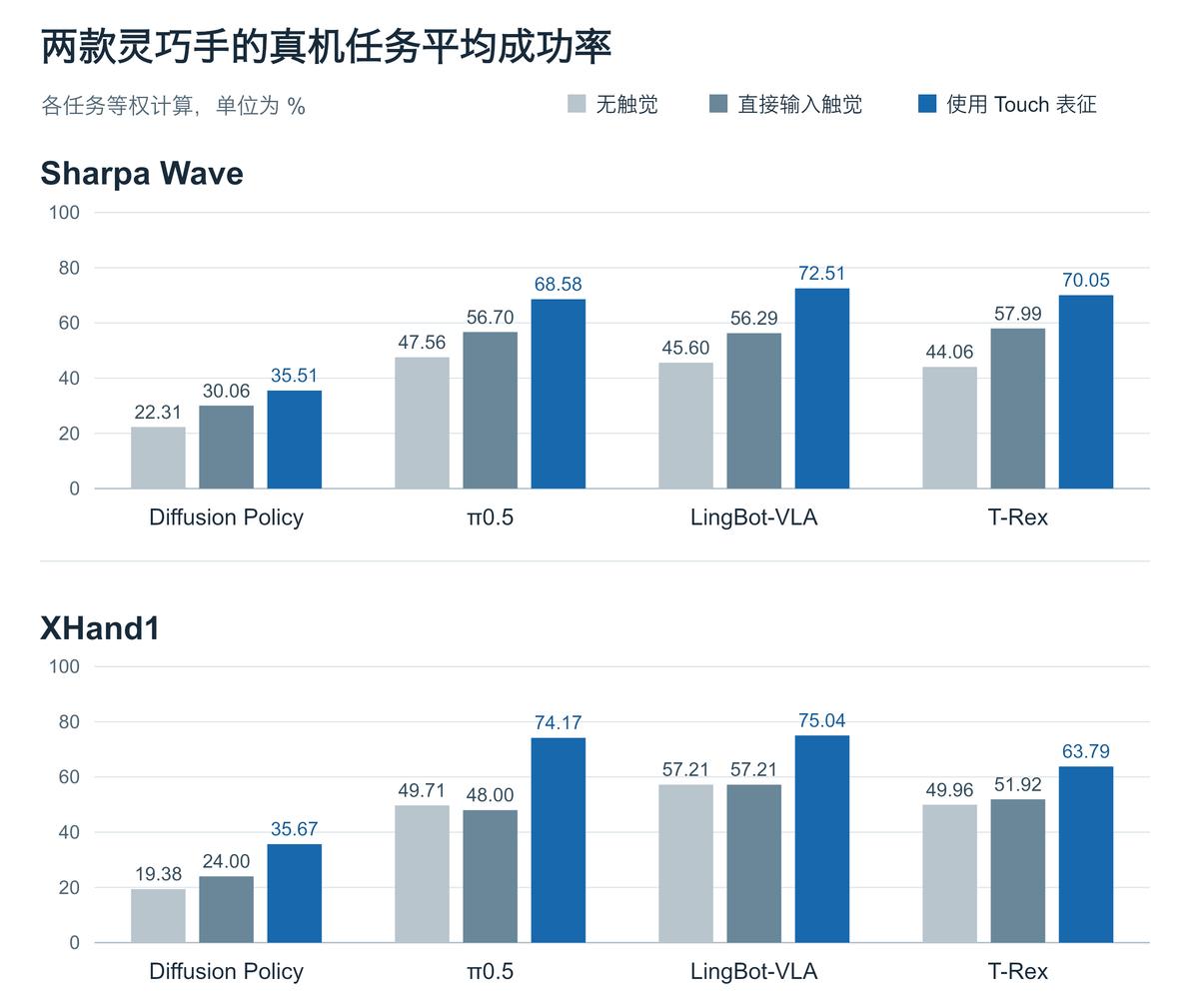
(Caption: With LingBot-Touch integrated, all four action models achieved their highest real-robot task success rates on both dexterous hands.)
A Unified Tactile Representation for Reusing Robot “Touch” Across Hardware
Fitting a robot with tactile sensors does not mean it can make good use of touch. Commercial tactile sensors are still at a relatively early stage of development, and the mainstream approaches (vision-based, magnetic, piezoresistive, and others) each have their own strengths and limitations. Given different cost targets and use cases, multiple technical approaches are likely to coexist for a long time.
More troublesome still, the data these sensors collect is hard to use interchangeably. The same physical contact produces different raw signals under different sensing principles and taxel layouts. If a model learns to interpret only one of them, then after switching sensors or dexterous hands, the existing data and tactile experience may be difficult to reuse, requiring fresh data collection, training, and adaptation. With hardware iterating so quickly, this lock-in leads to duplicated development and raises adaptation costs among hardware vendors, robot integrators, and model developers.
The key to scaling up tactile deployment, therefore, is to free tactile understanding from dependence on the physical signals of any specific sensor. That way, data from different sources can be used together for training, and accumulated tactile capability can be reused across sensors, dexterous hands, models, and tasks.
To this end, LingBot-Touch provides a separate encoding entry point for each sensing principle to handle the different raw signals first. It then maps taxels from different layouts into a unified fingertip coordinate space, where a shared model learns contact location, force, and how they evolve over time, and outputs unified tactile tokens. As a result, data collected from humans wearing tactile gloves and from teleoperated dexterous hands can be used together for training, and different action models can use the trained model to extract contact features. This architecture also leaves room for integrating new types of tactile sensors in the future.
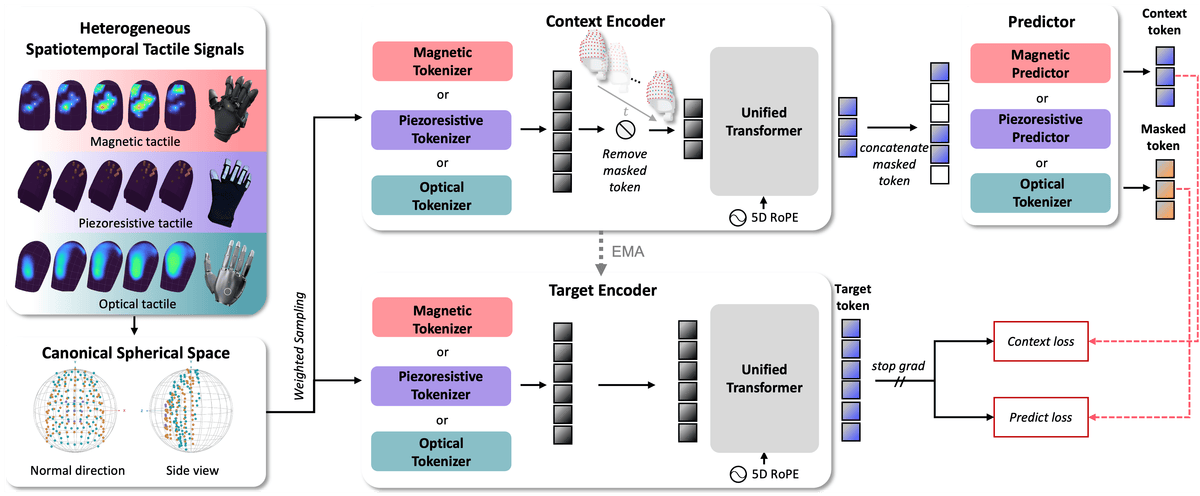
(Caption: LingBot-Touch encodes magnetic, vision-based, and piezoresistive tactile signals into unified tactile tokens for use by different action models.)
On XHand1, the team further verified that tactile capability can be reused across hardware. The magnetic tactile sensor model used by XHand1 was not in the pretraining data, and everything the model learned about magnetic touch came from data collected with humans wearing gloves. After switching to this hand, the team kept the LingBot-Touch parameters fixed and trained the action model using only XHand demonstrations.
In addition, LingBot-Touch was integrated with four different action models in these real-robot tests and is not tied to Robbyant’s in-house models. It provides a general-purpose perception capability that sits between tactile sensors and action models, rather than a module dedicated to a particular piece of hardware or a particular policy. For the industry, this means sensor and dexterous hand vendors can choose hardware based on cost and task requirements, and robot integrators can keep their own action policies, without having to re-invest in tactile development every time the hardware and algorithm combination changes.
To balance perception capability against on-device compute, Robbyant offers models in two sizes. All 26 real-robot tests were completed with LingBot-Touch-Tiny, the lightweight version with about 5.3 million parameters. After integration with LingBot-VLA, π0.5, and T-Rex, the total parameter count rose by only about 0.13% to 0.16%.
The larger LingBot-Touch-Small showed potential for further gains in perception tests: when the pretraining data grew to nearly 5,000 hours, the model still benefited from the additional data, indicating that tactile pretraining has room to keep scaling.
Staying Embodied-Native While Advancing in Tandem with General-Purpose Large Models
Addressing the recent shifts in the technical roadmap for embodied foundation models, Zhu Xing, CEO of Robbyant, said: “Progress in digital-world large language models, represented by GPT-6 Astra and Claude Fable 5.2, has indeed strengthened robots’ complex task reasoning and physical manipulation. We are following this closely and actively absorbing it. But what we see on the front lines of industry tells us that to truly close the manipulation loop, the tough problem of generalization in physical manipulation can’t be bypassed, and to a large extent it still depends on breakthroughs in embodied foundation models themselves.”
In his view, general-purpose large models and embodied foundation models are better seen as a 1+1>2 partnership: the former strengthen understanding and reasoning about tasks and environments, while the latter improve physical perception and closed-loop manipulation. Each advances on its own while boosting the other, together accelerating the maturation of the embodied intelligence industry.
“The quality of the modality inputs largely determines the quality of the action outputs. In other words, without good inputs, there are no good outputs,” Zhu said. Robbyant will stay on the embodied-native path, keep pushing the upper limits of generalization in physical manipulation, and build a general-purpose brain for the robotics industry that works across embodiments. It will work toward aligning more physical modalities, including vision, depth, touch, and even temperature, within a unified model, and will keep open-sourcing to the community while advancing commercialization.
The technical report, model, and code for LingBot-Touch are now open source, and developers can access and download them on Hugging Face, GitHub, and ModelScope.
This article was provided by Robbyant and republished with authorization by QbitAI. The views expressed are those of the original author.