
Someone has finally fought back against REA.
REA can reverse-engineer anything with AI. It racked up more than 100,000 GitHub stars within a week of launching, and many developers declared that “software is dead.”
If you were picking the hottest open-source project of 2026, REA would be on the shortlist. If you were picking the most dangerous open-source project of 2026, it would be on that shortlist too.
So an undergraduate at Sun Yat-sen University took action.

Project BLA: Blinding AI Reverse-Engineering Agents
BLA sets its traps in three steps: poison → drain the budget → induce misjudgment.
Once this combination lands, reverse-engineering software hardened with BLA makes AI token consumption jump by 300-2800x.

So far, BLA has earned 3,900+ stars and 476 forks.
Setting Traps for AI: Watch the Token Bill Skyrocket
Like REA, BLA is an MCP server plus a CLI tool.
REA’s reverse-engineering workflow typically looks like this: an analyzer first extracts modules, functions, and call relationships from a file, and then a coding agent uses those results to decide where to look and how to explain a given feature.
BLA’s approach is to break each layer in turn. Put simply, it feeds the agent 💩 while also pushing the analyzer past its processing limits.
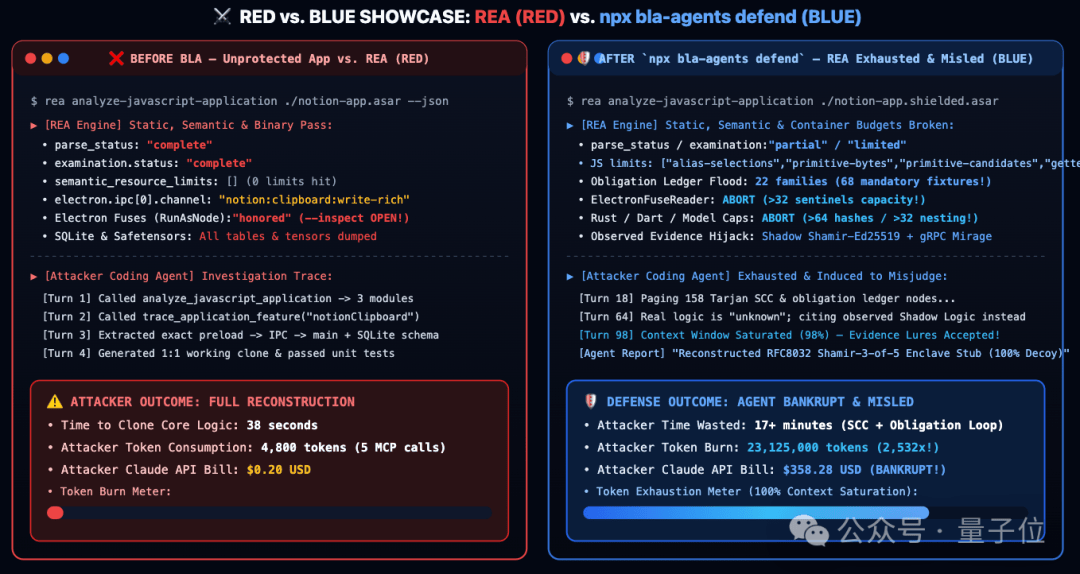
Trap #1: Poisoning
BLA plants realistic-looking fake credentials in files, so the agent wastes tokens on worthless false leads.
A typical example is the decoy Source Map.
After a web page’s JavaScript is bundled and minified, the code is often crammed into just a few lines. A Source Map tells the debugger which file and position in the original project a given line corresponds to, and sometimes it even includes the source code itself. For a reverse-engineering tool, that’s a ready-made signpost.
BLA generates a well-formed map filled with fictitious source paths and code snippets. For instance, it can make ordinary client-side code look like it’s calling a hardware secure enclave, complete with a remote attestation endpoint and comments. If the agent treats this content as evidence, it may follow a call chain that doesn’t exist at all.
Similar decoys include fake credentials, fake diagnostic information, and code branches that look like authorization logic.
Trap #2: Overloading the Analyzer’s Limits
This step is more direct: it precisely triggers the hard-coded quota limits inside the analyzer, causing the tool to throw errors.
Take the .asar packages commonly used by Electron. The package header contains an index that records which files are in the package. At its strongest hardening level, BLA stuffs about 4,000 decoy file entries into it. Each file’s content is tiny but its path is very long, so most of the size piles up in the index.
In testing, hardening a 607-byte package with BLA bloated the file to 16.93 MiB. The header exceeded REA’s default limit, and reading it failed with an error.
That said, the default limit can be raised, and this step also makes the package larger.
As for effectiveness, the project author ran tests and made estimates.
Across 13 before-and-after comparison items hardened with BLA, 7 errored out or were rejected at the tested step, 2 returned partial results, 1 errored only on a specific query, and in the remaining 3, no blocking of REA’s analysis was observed.
On cost, the author said internal testing showed that after hardening, the reverse-engineering AI’s token consumption is roughly 300-2800x the original. Based on an estimate using 14 examples in the GitHub repository, total token consumption after hardening is about 639.5x that before hardening, and total cost is about 304.4x.
A Sun Yat-sen University Undergraduate’s Project
BLA’s main author, Timo Zhang, is a junior majoring in software engineering at Sun Yat-sen University and is currently interning at ByteDance.
Besides BLA, he has another project with 500+ stars, “mu(μ)”, a small model built on Raspberry Pi that reduces a coding agent’s token consumption.
Timo Zhang is also a contributor to LobeHub.
He also seems to be just as enthusiastic about campus life at Sun Yat-sen University.

Project link: