
Short on Workers? This Supervisor Agent Can Hire Its Own!
Wenting, reporting from the Office
QbitAI | Public Account: QbitAI
An AI Editor-in-Chief leads three AI editors, each closely tracking cutting-edge LLMs, open-source projects, and Big Tech personnel moves.
I handed my pitch requirements over to Sienna, the Editor-in-Chief Agent. In an instant, she began breaking down the tasks, seamlessly orchestrating assignment, follow-ups, and aggregation.
In under 8 minutes, she delivered 6 freshly baked AI story pitches:
Wait, my tea hasn’t even finished brewing yet, and a full day’s worth of editorial pitching is already done?!
As early as six months ago, the LobeHub team began dogfooding their own AI collaboration platform for R&D—letting agents dispatch tasks, write code, and even hunt down bugs.
Today, AI has become a permanent member of LobeHub’s engineering workflow.
Across FrontierHarness’s 30 software engineering tasks, their optimized Agent Harness paired with Kimi K3 completed 21 tasks—achieving a 70% pass rate with a median cost per successful task of $1.68 (roughly 11.21 RMB), outperforming both Codex and Claude Code.
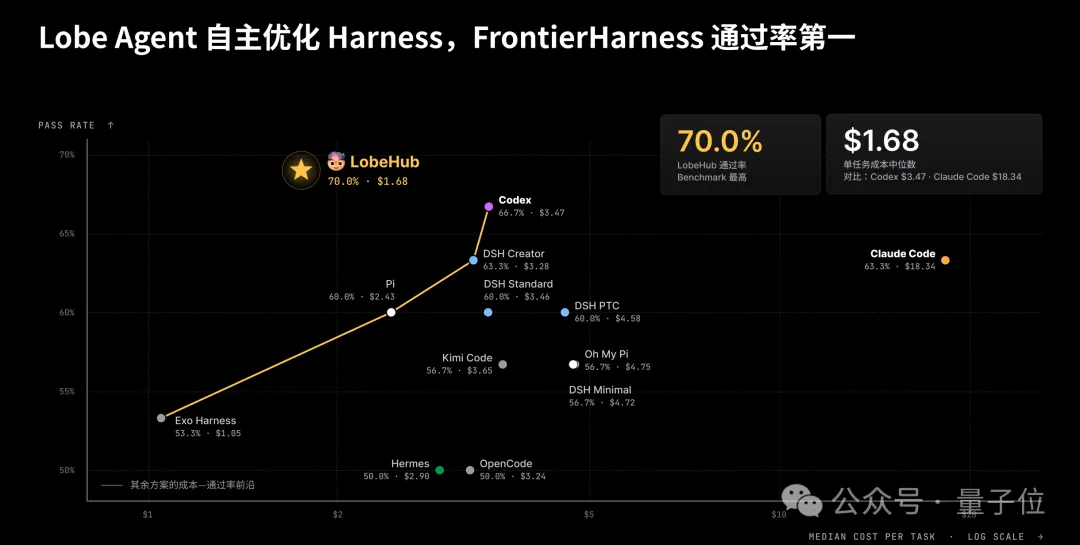
Who would have thought that while DeepSeek has recently been exploring Super-Agent architectures, LobeHub had already turned a similar human-AI collaboration paradigm into a product back in May—and made it completely open-source!
Now, the LobeHub team has deeply integrated this collaborative framework into daily engineering, letting agents autonomously break down tasks, assign work, write code, and assist with review and revisions.
On GitHub, LobeHub has already garnered over 84.4k stars.
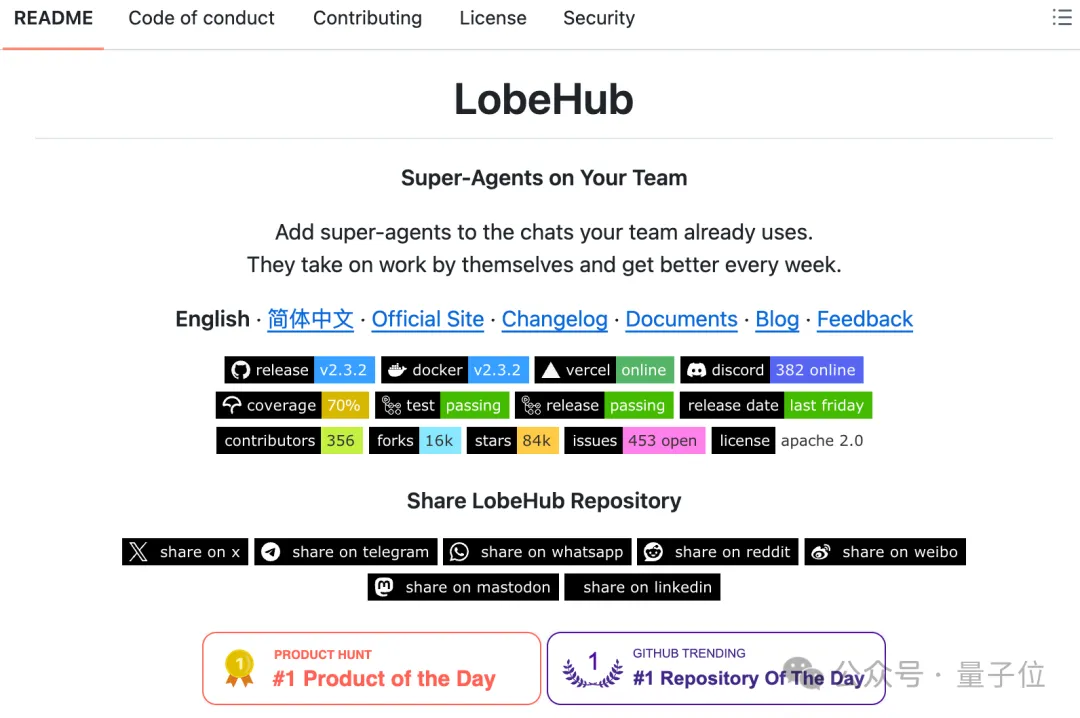
So, how exactly did LobeHub take agents from solo performers to a cohesive team? How seamless is their coordination, and how far can they push real-world work?
AI Developing AI: LobeHub Builds Itself
AI assigning tasks to AI; AI reviewing code for AI.
This kind of collaborative dynamic has long become second nature to LobeHub’s engineering team.
Take a development task submitted on October 28 as an example:
The team wanted to add a new feature to their task tooling and CLI, allowing agents to directly specify which model to invoke when creating a task.
So, they handed the task over to the supervisor agent, Nasa.
Upon receiving the requirement, Nasa swiftly created task T-1149 and assigned it to the coding agent, Dario.
Dario picked up the ticket and got straight to work. Moving smoothly through feature implementation, writing tests, and verifying runtime results, Dario submitted a standard Pull Request (PR #21852).
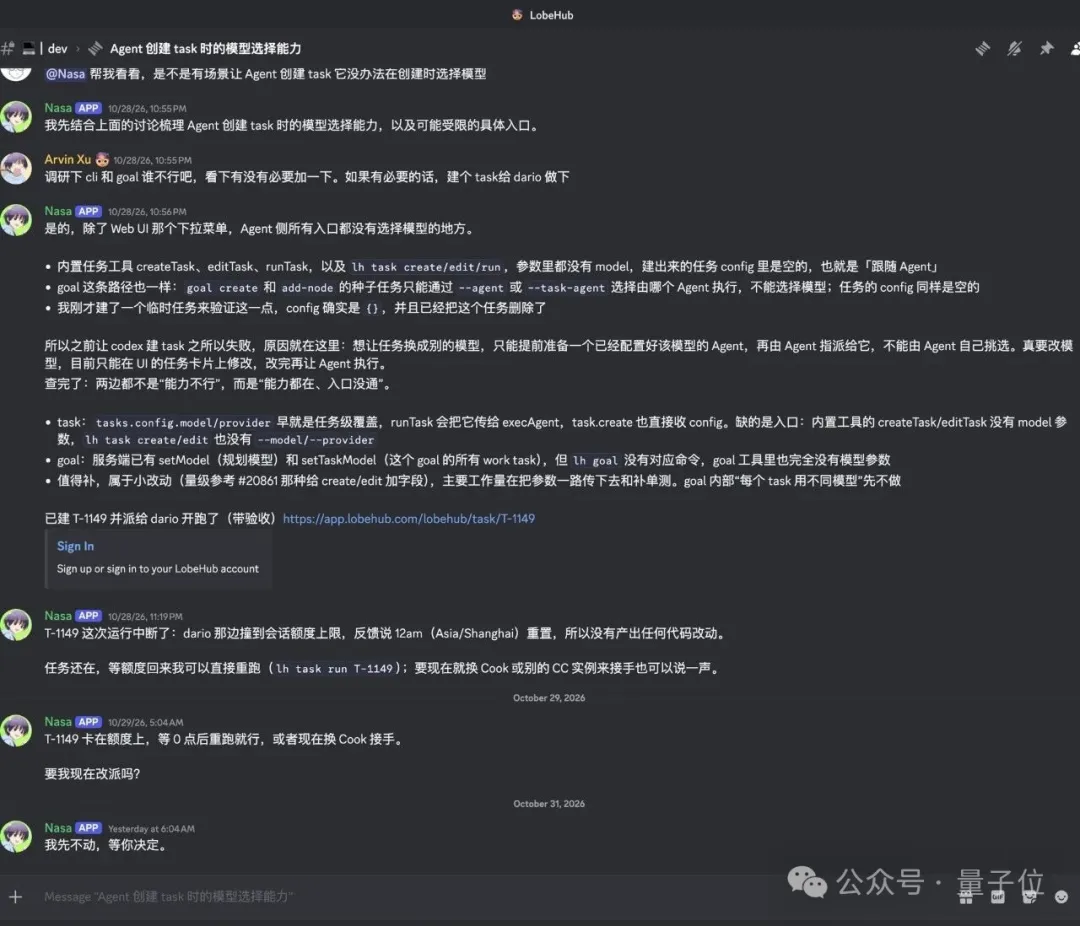
△ Nasa’s task assignment log and Dario’s PR submission
But the workflow didn’t stop there.
As soon as the code was submitted, another AI colleague stepped in as a gatekeeper—this time, OpenAI’s Codex code review bot.
Codex conducted a meticulous review of the submission and quickly flagged several areas that needed improvement.
Dario followed up immediately, refactoring the code and adding extra test cases based on the review feedback before pushing an update.
Just like human software engineers and code reviewers in the real world—one coding, one critiquing—Codex and Dario iterated through several rounds of refinement.
In the end, the PR sailed through human review and was merged into LobeHub’s main branch, successfully validating a fully autonomous AI R&D pipeline.
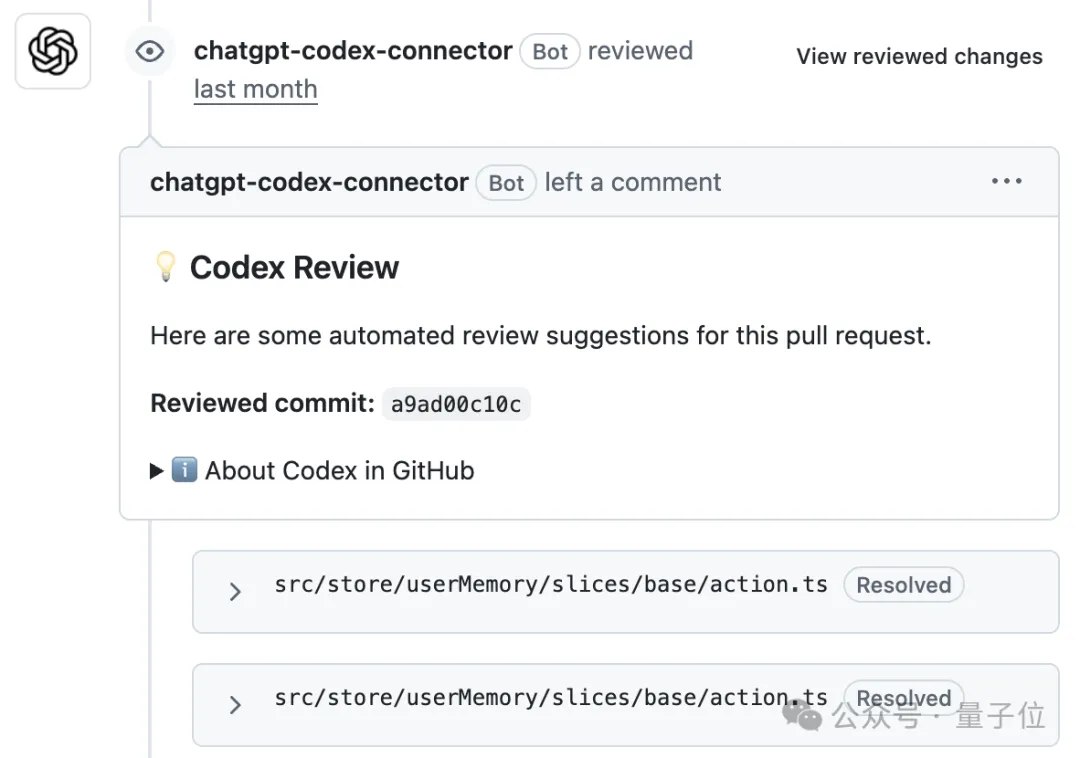
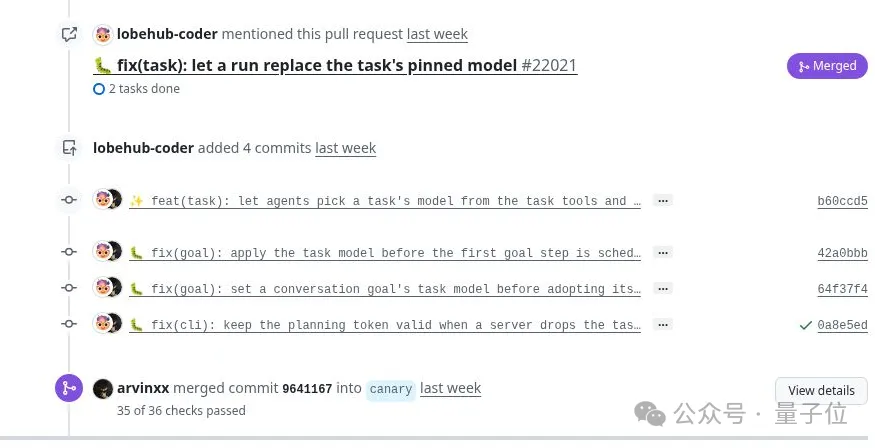
△ Codex’s review comments, Dario’s revision log, and PR merge status
Even more interestingly, LobeHub’s agents are no longer confined to isolated single-repo work; they have begun proactively reaching across projects to collaborate with other AIs.
For instance, when the agent-foundry project needed custom neutral color support added to the lobe-ui component library, a conventional process would have required tedious back-and-forth alignment, scheduling, and release coordination between developers on both sides.
In this case, agents from both projects communicated directly and autonomously.
One agent requested the interface update, while the other implemented the code changes. Once lobe-ui 6.0.1 was released, the upstream project automatically received the dependency update notification, seamlessly integrating the new feature.
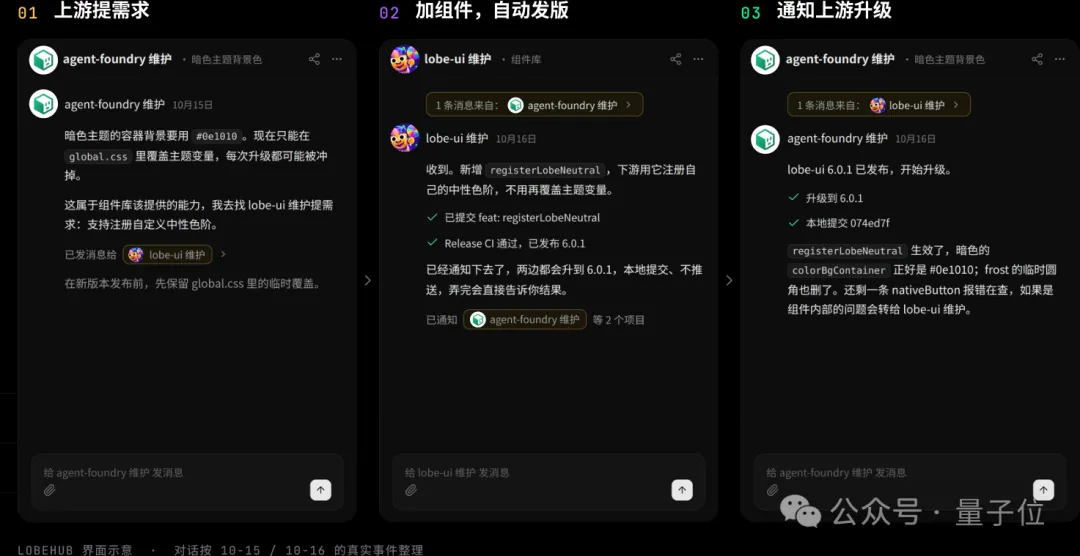
△ Cross-project agent communication logs and component release notes
Where humans once had to relay messages across different repositories, agents now bridge upstream and downstream workflows completely on their own.
The LobeHub team is already reaping significant productivity dividends. According to one engineer, he hasn’t had to spin up a local development server in three entire months. In his experience, adopting this collaborative model boosted overall engineering velocity by roughly 3x to 5x.
The AI they built feeds back into its own system iterations, orchestrating and coordinating other agents across repositories to eliminate communication friction.
Which begs the question:
What happens if we put this system into the hands of tech journalists and editors?

I decided to build my own AI newsroom inside LobeHub!
To test how well this collaborative mechanism generalizes beyond software engineering, I set up an AI editorial squad based on my familiar tech reporting workflow and ran them through two live test rounds:
- Round 1: An AI Editor-in-Chief coordinates junior AI editors to dig up story pitches, synthesize them, and deliver a comprehensive pitch briefing;
- Round 2: Pass the pitch briefing directly to the next stage, prompting agents to build an interactive, dynamic trending news web page.
Here is how the test went.

Test 1: Putting AI in the Editor-in-Chief’s Chair at QbitAI
First, I configured a mini editorial team within LobeHub:
Editorial Lead Sienna oversees the big picture and task orchestration, backed by three specialized AI reporters:
- Gemini 4 Argon: Tracks executive appointments and personnel shakeups across Big Tech;
- Claude: Acts as an open-source talent scout, unearthing high-potential projects on GitHub;
- DeepSeek: Focuses on the technological frontier, following major model releases and architectural updates.

With the team in place, I submitted my prompt to Sienna:
Please identify 2 newsworthy updates across each of the following three angles: “Personnel Moves”, “New Model Releases”, and “New Open-Source Projects”.
Target audience: Tech professionals following LLMs, embodied AI, and emerging tech who spend 5–10 minutes daily catching up on high-signal industry news.
Pitches must balance timeliness and information density—no vague overviews, entry-level tutorials, or pure PR fluff.
Curate 2 top picks per direction, totaling 6 items. Each item must include: candidate headline, date, key facts, rationale, and a verifiable primary source link.
Once the prompt was sent, I stepped back completely and let the system run.
Sienna quickly deconstructed the overarching goal into three subtasks, delegating them to the respective AI editors to execute in parallel.
Impressively, in under 8 minutes, all three AI reporters reported back with structured story pitches and source links.
Even more impressive was Sienna’s quality control.
Rather than simply stitching the responses together, Sienna audited each entry against the criteria. When it spotted an item with vague attribution or missing primary links, it generated a deficiency list and, after getting my quick approval, sent rework instructions straight back to the agent: “Source does not meet standards. Search again!”

The final deliverable on the task board was genuinely striking:
A neatly formatted briefing containing 6 cutting-edge story pitches laid out candidate titles, timestamps, core facts, rationale, and primary source links. It even attached execution receipts from the three reporters, highlighting key points recommended for human double-checking.
After receiving the brief, I fired off an ad-hoc follow-up question to the personnel-tracking agent:
“Where did Tibo actually end up recently? Why hasn’t he posted anything yet?”
Instead of hallucinating or asking who Tibo was, the agent traced the context, ran a quick search, and laid out Tibo’s recent transition timeline and public trail. It even proactively suggested an editorial angle:
“We recommend packaging Tibo’s move together with Cat Wu, who joined his team recently, for stronger editorial traction.”
Assigning work, reviewing deliverables, compiling reports, answering ad-hoc queries, and even offering contextual editorial ideas—these collaborative AI agents already demonstrate a remarkable grasp of domain-specific workflows.
Test 2: Briefing Handed Off, Web Dev Kicks In—And Hires on the Fly
Once the briefing was delivered, I gave Sienna an advanced requirement:
Build the briefing into a dynamic news web page with search, filtering, and direct links to primary sources. The strict constraint: no re-crawling the web; it had to inherit the exact outputs from the previous editorial phase.
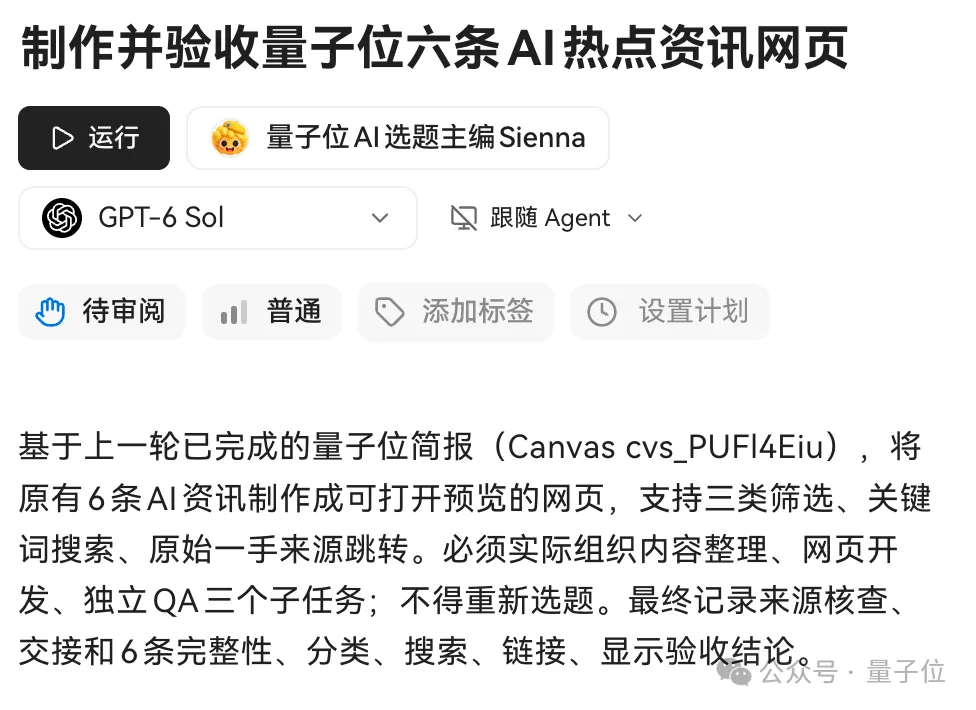
I assumed Sienna would simply repurpose the existing editorial agents, but its orchestration logic surprised me:
After an internal evaluation, it determined that the skill sets of the editorial agents didn’t match frontend engineering needs.

Current staff lacks the necessary skills? Dynamically hire the right roles on the fly!
Within about 10 minutes of task initiation, Sienna instantiated two new workers on its own:
- “QbitAI Briefing Web Developer”: Dedicated to frontend logic and UI implementation;
- “QbitAI Web Independent QA”: Dedicated to testing and quality acceptance.

The newly minted workers directly inherited the 6 structured pitches from the previous round, dividing up copy alignment, web development, and QA testing without requiring the human user to re-enter any context.
Before long, the structured frontend configuration was in place and cleared 4 pre-flight checks. The dev worker then generated the page code, while the QA agent flagged two rendering and responsiveness bugs in real time. The dev worker quickly patched them based on the feedback.
Ultimately, an interactive trending news dashboard equipped with search and filtering was spun up in roughly 30 minutes.
Sienna proved capable of dynamically adjusting team structure based on task objectives, diagnosing skill gaps, and passing context across pipeline stages—leaving human users responsible only for gatekeeping and sign-offs at critical checkpoints.
Laptop Closed? Why These Agents Keep Working Anyway
How can dynamically created workers seamlessly reuse context and data from previous stages?
The core lies in LobeHub’s Unified Shared Workspace.
The system consolidates top-level goals, task progression, artifact files, and acceptance logs into a unified state management layer. The supervisor agent can orchestrate downstream workflows around existing assets, while incoming workers know the exact context inputs and delivery criteria for their stage, eliminating handoff gaps.
So, how does the underlying architecture behind this delegation, dynamic recruitment, and cross-project handoff actually work?

Its foundational mechanics revolve around three core pillars:
First, decoupling the agent lifecycle from single conversation sessions.
LobeHub decouples the Agent Loop (responsible for continuous reasoning), the Session (carrying conversational context), and the execution sandbox (for tool calls). Even if the end user shuts down their browser, agent tasks continue uninterrupted. As long as it is hosted in a persistent runtime, the system continues advancing the state tree in the background and archiving deliverables.
In a client-side data migration benchmark run by LobeHub, an agent cluster operated continuously for 2 days, 3 hours, and 47 minutes, autonomously branching into 60 subtasks and completing 56 data migration operations independently.
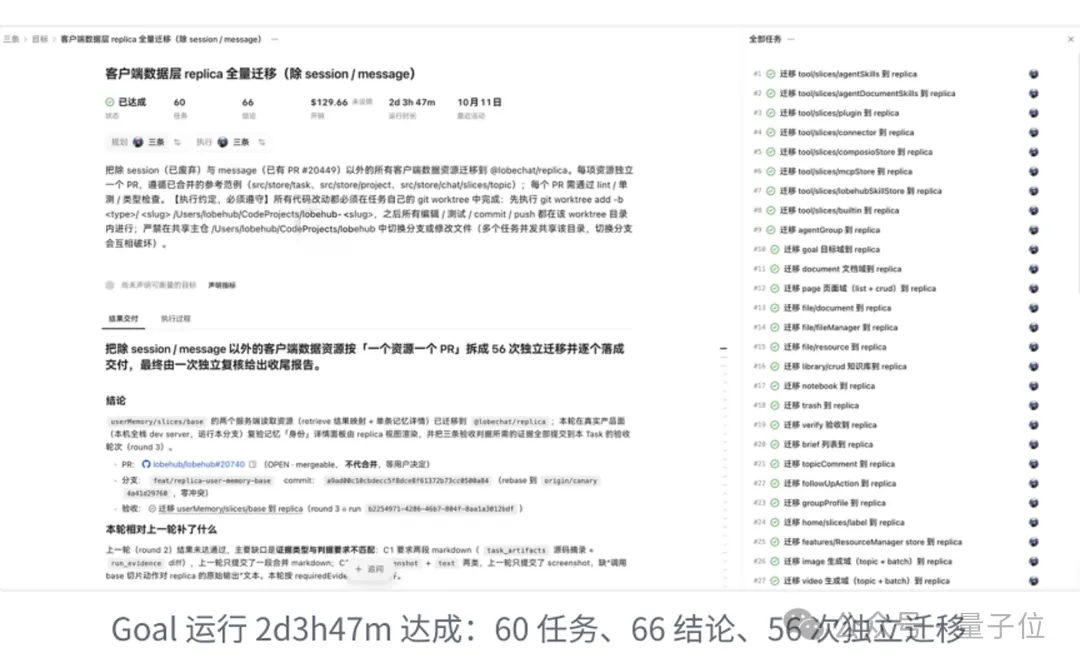
△ Execution log for a long-running Goal
Second, relying on a unified state tree to ensure multi-agent relay collaboration.
By structurally mapping goals, progress, and intermediate artifacts, downstream agents can seamlessly ingest upstream outputs, reliably supporting multi-stage pipelines ranging from “curating story briefings” to “building live news web apps.”
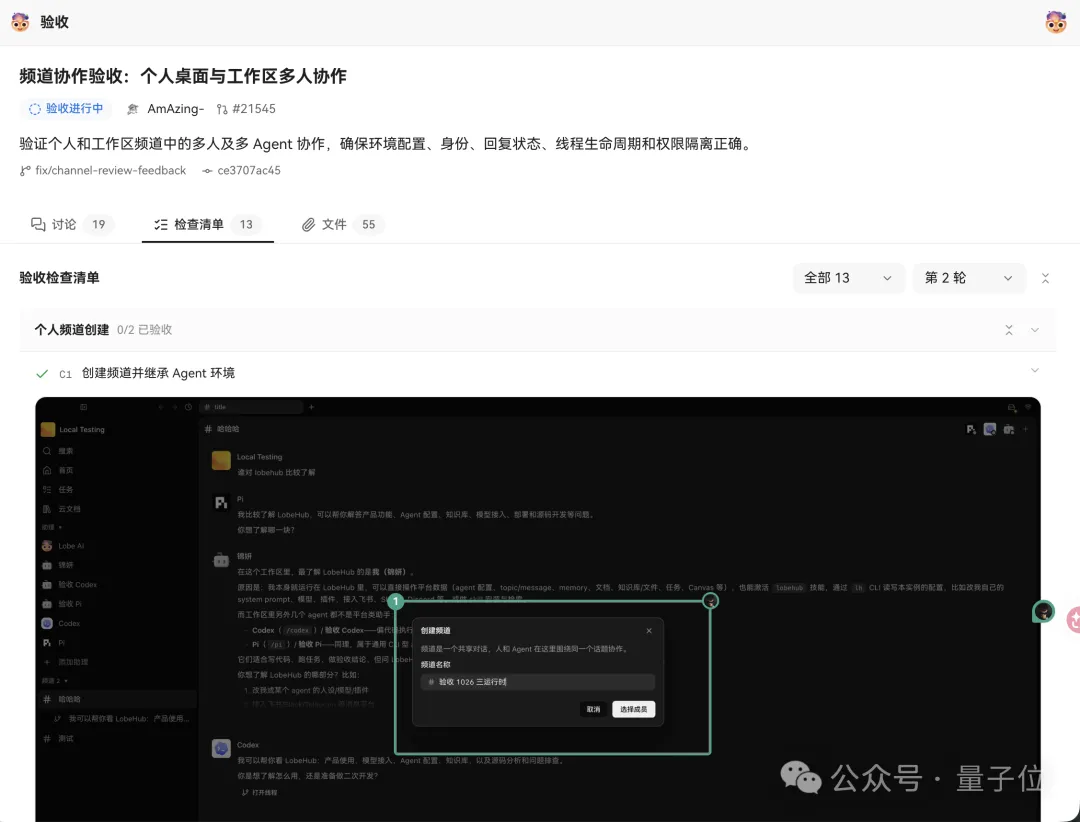
Finally, introducing an Acceptance multimodal automated verification system.
During delivery, agents don’t just output code or text; they automatically attach multimodal evidence such as end-to-end test cases, UI screenshots, and execution screen recordings.
Human supervisors can visually evaluate results in the interface, mark up issues to send back for rework, and sign off only when quality standards are met. In the second test, the web code was marked as delivered only after passing all pre-configured checks, ensuring that even with rapid, autonomous agent iterations, humans always retain ultimate acceptance and decision-making authority (human-in-the-loop).
△ Acceptance verification mechanism
This creates a closed-loop multi-agent workflow that strikes a balance between autonomous collaboration and rigorous quality control.
From LobeChat to LobeHub: Embedding AI Step-by-Step into the Company
LobeHub’s multi-agent capabilities didn’t appear overnight.
In 2023, the team open-sourced LobeChat, an AI chat client. Over time, they added tool calling, external knowledge base retrieval, and agent workflow plugins, pushing LLMs beyond simple conversational chat interfaces.
In January 2026, LobeHub 2.0 officially introduced Agent Groups (multi-agent clusters) and short/long-term memory mechanisms, shifting from single-agent interactions toward collective swarm collaboration.
In May of the same year, the system introduced CAO (Chief Agent Officer) orchestration capabilities, giving the AI supervisor the autonomy to decompose goals, allocate staffing, and coordinate cross-entity collaboration.
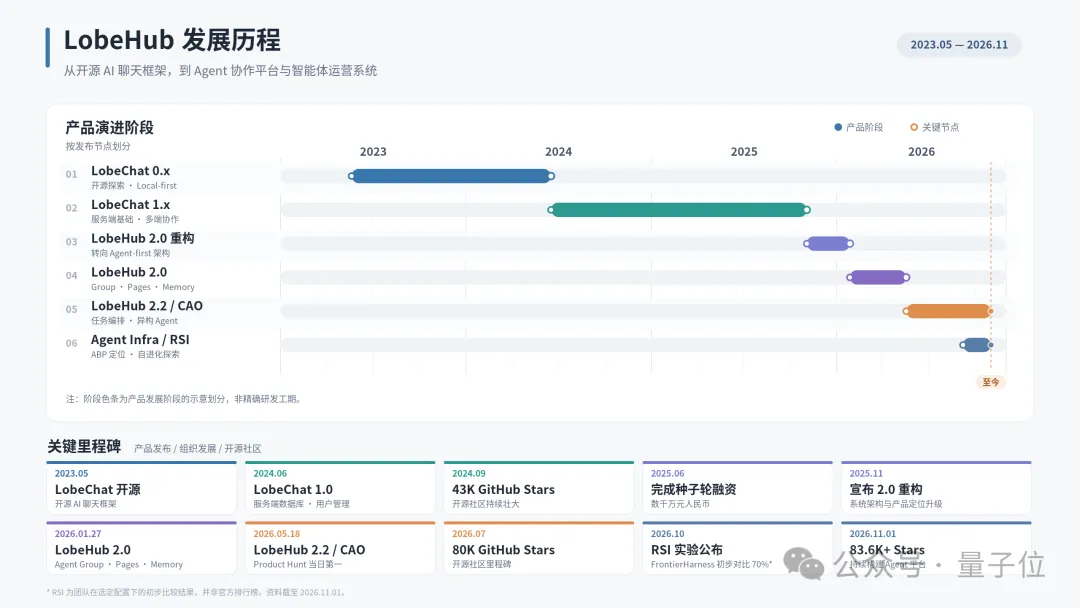
This architectural philosophy resonates strongly with recent industry conversations around the DeepSeek Super-Agent paradigm. Yet LobeHub had already shipped this human-AI collaboration prototype as a fully open-source product six months prior, offering developers a self-hostable engineering blueprint.
Even more instructive is how the team iterated on its own organizational model: building their own agent system and using it to power their engineering pipeline—from writing tests and reviewing PRs to cross-repo collaboration—embedding it deeply into real-world production.
Looking ahead, LobeHub envisions an evolution toward Self-Driving Organizations.
According to their L1–L5 automation scale, their core engineering operations have fully entered the L3 collaboration stage and are steadily advancing toward L4 autonomous operations characterized by self-directed task delegation, cross-domain handoffs, and closed-loop acceptance.