Even Professors Are Phoning It In with Claude…
Jay reporting from the Office
QbitAI | Official Account QbitAI
“AI is destroying my CS degree.”
These words of protest were written by Katie, a college sophomore who had dreamed of studying computer science since childhood.
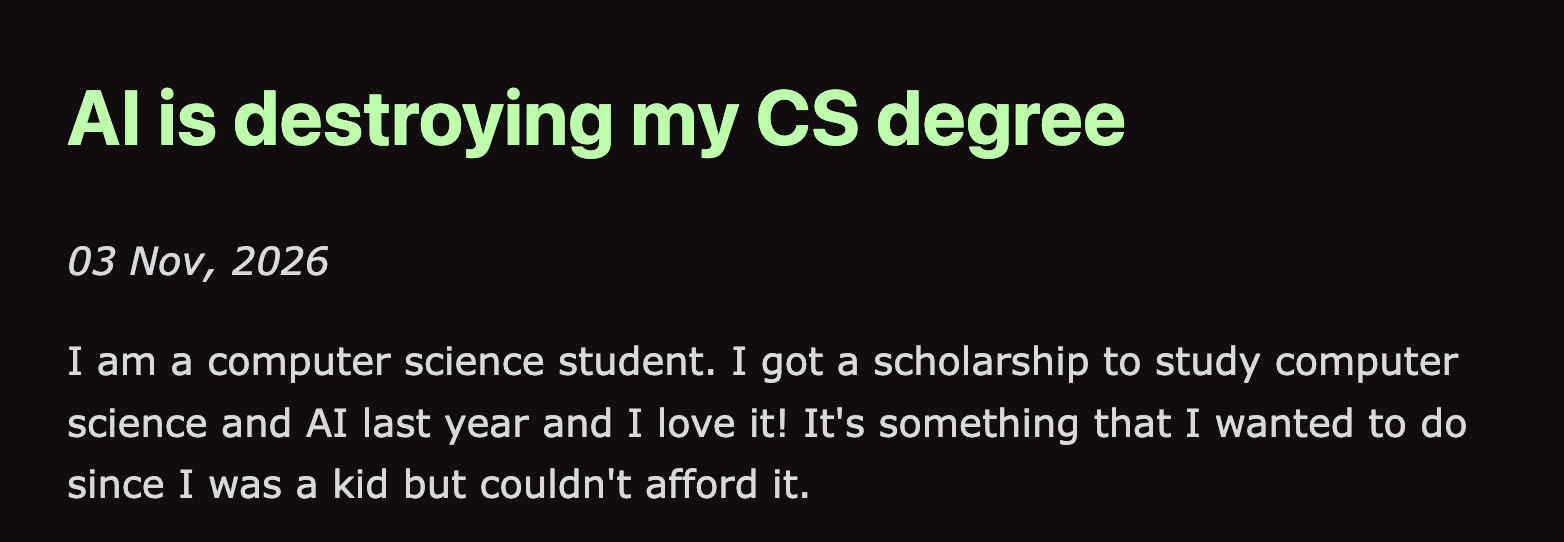
She had no elite-school pedigree, had earned a mere B in high school math, and had never received any formal competitive training; her only brag-worthy “project portfolio” consisted of a few rather crude web-based mini-games.
She originally thought that once she stepped into the ivory tower of university, she would finally be able to learn computer science systematically and in-depth.
Who could have guessed—
Syllabi are generated in bulk by Claude, final assignments are graded automatically by LLMs, and even check-in emails from mentors are most likely automated scripts running in the background…
Faced with this absurd reality, she wrote with resignation:
“Due to AI, it feels like my university is experiencing an existential crisis.”
In less than 24 hours after publication, the blog post rapidly climbed to the #1 spot on Hacker News.
The Utter Breakdown of the CS Department
In her educational journey, ever since the boom of generative AI, the school’s academic policies have been stuck in an endless loop of flip-flopping.
At first, it was an all-in embrace:
Grading student assignments and writing feedback, generating course syllabi, sending automated nudges to students falling behind… everything was hooked up to large language models.
And the result?
Within three months, the administration realized that the generated content was riddled with hallucinations and low-quality fluff, and promptly rolled it all back.
The entire academic management system fell into a state of severe whiplash:
“Under no circumstances are you allowed to use AI!"
"Oh wait, correction: everyone is required to use AI!"
"No, no, wait… looks like you actually can’t use AI after all…”
What followed was a series of painfully ironic scenes.
In the exact same course, the professor strictly required students to use AI for the previous assignment, claiming it was an essential evaluation metric.
Hearing this, you bit the bullet and paid out of pocket for a Claude subscription.
Come the next module, you confidently submitted code carefully tuned with your model, only to be slapped with:
“Suspected academic misconduct: points deducted for using LLMs?!”
Honestly, if it were merely fickle rules, students might somehow manage to adapt.
What the author found hardest to stomach was this: she had paid exorbitant tuition and fought hard to get into university, expecting systematic mentorship under expert professors.
Instead, even university professors were using Claude to phone it in?
Lecturers stood at the podium warning students not to cut corners, only to turn around and dump their own teaching duties onto Claude to generate materials with a single click.
In the past, assignments were carefully designed with pedagogical goals in mind, vetted repeatedly by faculty teams, well-paced, and scaffolded.
Now, professors might not even bother proofreading the generated Markdown files. Flooded with LLM-generated platitudes and filler, a single 3,000-word assignment prompt suddenly demanded 15 separate deliverables.
Running the math, the workload had tripled overnight…

The end result was that ordinary students—those with weaker math backgrounds or who had transitioned from other majors—were forced to swallow concepts whole and skate across the surface just to keep up.
“I came here to actually learn real skills, not to superficially churn through 15 impossible tasks dumped into a 3,000-word assignment prompt!”
Even more exasperating moments were yet to come.
Many students struggled for over ten days, only to find their code would not run no matter what they tried.
It wasn’t until a week before the deadline that the instructor casually sent out an errata email:
“There were two errors in the assignment spec. They have now been corrected. Please resubmit.”
Who pays for the wasted hours and compute costs students burned through?

So, how did higher education end up in this state?
Katie believes that the blame shouldn’t fall entirely on front-line professors—the root cause lies with administration.
“You know what leadership loves to hear? ‘Scale education, automate the entire pipeline!’
That way, they can squeeze maximum profit out of tuition fees without having to hire more staff.”
If LLMs can generate exam questions automatically and grade homework in seconds, why would the school spend money hiring teaching assistants or expanding faculty headcounts?
Technology became the university’s excuse to slash instructional budgets, ruthlessly squeezing academic staff until faculty workloads far exceeded human capacity.
Katie mentioned that she rarely ever saw her advisor in person.
The only interaction she had was when, after failing to log into the online learning portal for several consecutive days, she received a check-in email signed by her advisor—
Only upon opening it with nervous anticipation did she realize it wasn’t written by her advisor at all; it was simply an automated alert triggered by the system.
Heated Debates on Hacker News
After the post went live, it went viral instantly, topping the Hacker News front page.
The comment section was flooded with software professionals.
Surprisingly, even within the tech community, the reception wasn’t one-sided; it fractured into two completely polarized camps.
On one side were industry veterans with established careers.
In their eyes, all this chaos was merely the growing pains of a technological paradigm shift.
“I’ve been in this industry for over twenty years, learning something new every single day. Over the past few years, as AI technology has evolved, my learning efficiency has soared, and my understanding of underlying systems has deepened.”
From this perspective, AI is ultimately just a powerful tool. As long as you know how to engage LLMs in Socratic dialogue, the learning resources available today are vastly superior to what earlier generations had.
“AI won’t replace education or traditional learning. Rather, it enhances your comprehension and retention. For anyone with a technical mindset and the drive to self-teach, AI is a powerful force multiplier.”
Several seasoned veterans even expressed a sense of envy toward the younger generation:
“Being a senior engineer isn’t defined by how many years you’ve spent grinding away in software development. I’ve met exceptionally gifted 21-year-old developers whose coding chops rival or even exceed those of engineers with 20 years on the job.
In my view, the reason they excel so brilliantly comes down to one thing: a rock-solid foundation in computer science.”
But that narrative belongs only to a select few.
On the other side of the scale, the vast majority of fresh grads felt utterly suffocated.
One commenter cited findings from a quantitative study:
“Stanford researchers pointed out that the contraction in entry-level hiring isn’t just ongoing—it’s widening.
Specifically, in industries most exposed to AI, employment rates for young workers aged 22 to 25 are 19% lower than for their peers in less affected fields.”
Seasoned hiring managers readily acknowledged this reality:
“Honestly, instead of spending months training a fresh graduate with zero practical experience, it’s far more efficient to just equip senior engineers with top-tier Coding Agents.
To be frank, I find it hard to offer any practical advice to upcoming CS graduates.”
Spending four precious years studying computer science, only to face an industry with virtually no entry-level openings…
What, then, is the point of a CS degree?
Rediscovering the Heart of Programming
The answer to this question might be found at the very end of Katie’s blog post.
Closing her essay, she wrote:
“I don’t care if CS and math are supposedly dead ends—I still want to learn!
Sure, I care about my future career, but that doesn’t mean I have to discard everything I’ve learned or abandon exploring.
There’s still so much worth exploring in the field, whether it involves AI or not. The constant barrage of media claiming that ‘software engineering is dead’ and ‘you’ll be obsolete if you don’t use AI’ is suffocating.
Can’t a girl just study statistics out of sheer curiosity and fun?”
After enduring this entire fiasco, Katie’s answer was:
“I could keep gaming the system, but I don’t want to anymore. It just leaves me feeling sick to my stomach.
Maybe I’ll go back to OpenProcessing and make some completely useless little games.
At least now, I actually know how to code.”
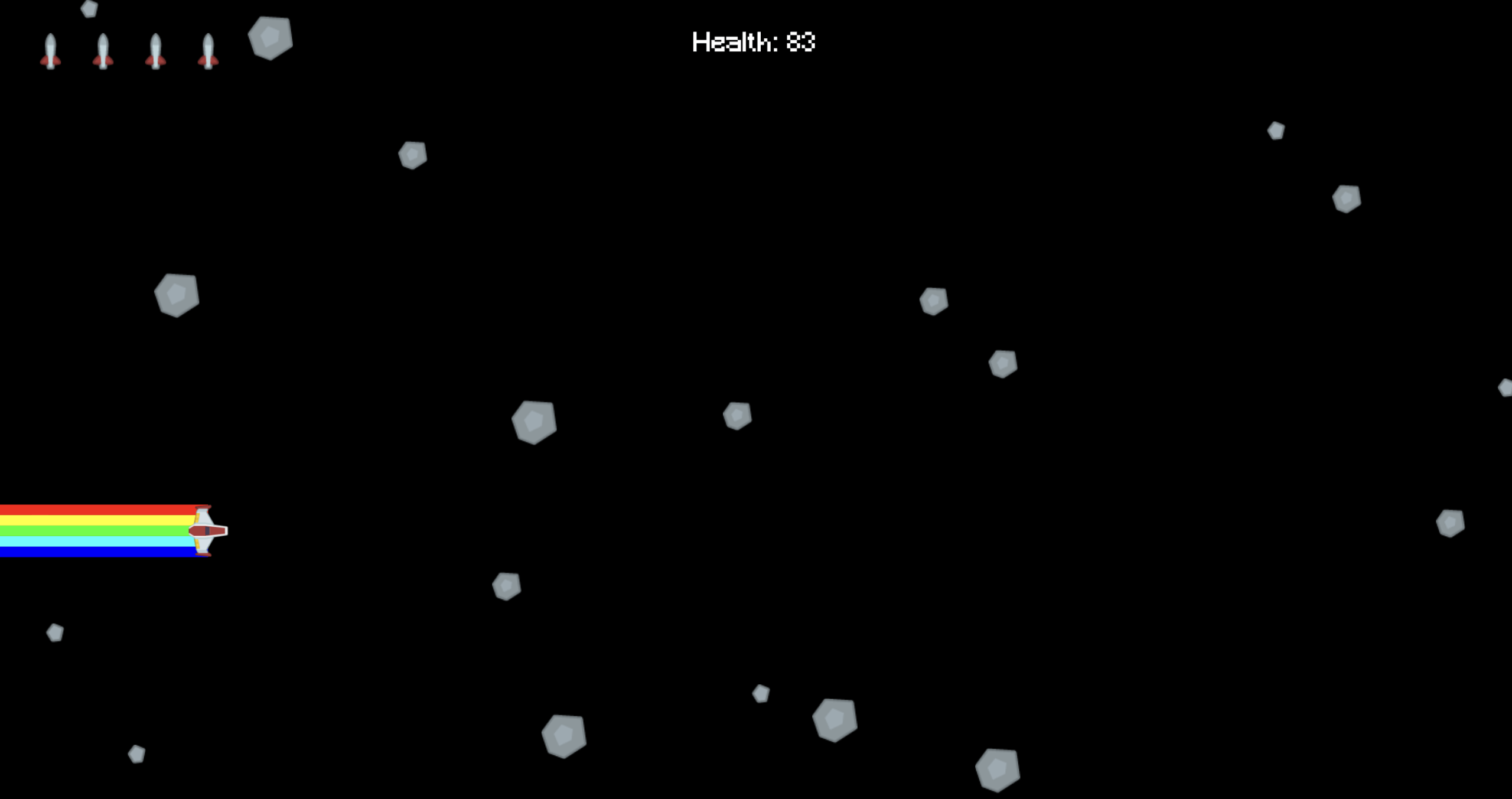
She then showed off a few simple projects she had built on OpenProcessing in her earlier days:
A simple space shooter set to upbeat music;
A Moogle that meows when clicked;

And an interactive demo where microphone input scares away little fish.

To be fair, these creations were rudimentary.
Looked at individually, their polish and visual fidelity cannot compare to what can be generated today with a single prompt in Astra or Fable, nor do they look anywhere near as slick as an open-source model demo.
Yet the moment you open the page, you can still distinctly feel something no model can ever generate—
Vitality.
That is the pure, unfiltered feeling of how many developers first fell in love with coding.
Not to grind through hundreds of LeetCode problems on a job-hunting assembly line; not to report token savings in weekly status updates; and certainly not to fulfill increasingly bloated grading rubrics.
Before this craft was disciplined by utilitarianism, just typing a few lines into a stark black-and-white terminal and watching pixels dance to your own logic was enough to keep you up all night with excitement.
Humanity built near-omniscient intelligent machines with its own hands.
Yet in the process, we seem to have quietly shut the door on what makes us human in the first place: our innate curiosity and the joy of deep, genuine immersion.
Original blog post: https://lordtoots.bearblog.dev/ai-is-destroying-my-cs-degree/