
China’s Answer to Cosmos Delivers Once Again
Just three and a half months later, Chen Tianrun—a post-00s Ph.D. student from Zhejiang University whose startup’s valuation skyrocketed from 4 billion yuan to nearly 10 billion yuan and who boldly set out to build the “Chinese version of Cosmos”—has delivered his latest milestone.
On November 4, at the World Internet Conference in Wuzhen, his startup Moxin Technology officially unveiled its next-generation general-purpose 4D world model: MoWorld 2.0.
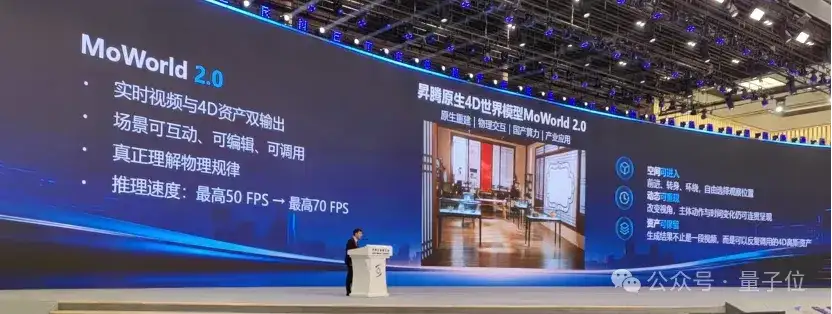
Building on its predecessor’s spatial generation and real-time interaction capabilities, MoWorld 2.0 significantly enhances its capacity to model physical laws.
The model integrates more than a dozen physical elements, including gravity, elasticity, buoyancy, illumination, soft bodies, fluids, rigid bodies, plastic/deformable bodies, and thermodynamics.
According to the R&D team, by deeply learning these physical properties and their interaction dynamics, the world model can accurately simulate object kinematics, collision sequences, and environmental shifts, providing a robust foundation for downstream tasks such as physical simulation.
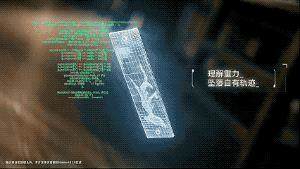
For example, in the demonstration below, MoWorld 2.0 does not merely generate dynamic footage of a falling bookmark; it precisely models the entire contact and force-interaction process with other objects, as well as the resulting descent and bounce trajectories.
When simulating fluids such as water, the model faithfully captures subtle flow patterns and morphological transformations triggered by external perturbations.

While previous world models were largely confined to predicting next frames based on image and text prompts, MoWorld 2.0 takes a major leap forward: the trajectory of this simulated physical world is driven jointly by material properties, external forces, and multi-element physical interactions.
Moreover, to ensure fluid real-time interaction in practical scenarios, the team deeply optimized low-level execution efficiency on Huawei Ascend NPUs, boosting real-time video inference frame rates from a previous high of 50 FPS to 70 FPS.
How did Moxin Technology manage to balance high-fidelity simulation with low computational costs?
Unifying Multiple Physical Elements in a Single Model
Take the everyday act of turning a page as an example:
The direction and strength of a light breeze dictate where the page lifts and the arc with which it falls; the paper’s inherent flexibility and thickness determine how it bends under applied force. It is the intertwining of these multiple physical conditions that produces the full page-turning motion perceived by the human eye.

To realistically reproduce such physical dynamics, a world model must be capable of simultaneously resolving multiple physical variables and computing the dynamic interactions between objects and their environment.
This holistic approach to comprehending and simulating complex physical environments lies at the very core of MoWorld 2.0.
The team explained that during training, the model must master not only individual mechanisms like gravity, elasticity, soft bodies, and fluids, but also learn to extrapolate deformation and kinematic rules governed by combined, multi-factor forces.
In terms of engineering implementation, the team achieved two pivotal breakthroughs:
- Built a physical Gaussian renderer capable of computing multi-element physical interactions alongside high-fidelity rendering;
- Introduced a Mixture of Experts (MoE) prediction architecture to decouple and collaboratively predict physical dynamics, pixel flows, and 3D Gaussian representations.
This architecture empowers the model to meticulously simulate physical variations under distinct environmental constraints, fully enabling downstream physical simulation workflows.
Beyond its physical modeling capabilities, another standout feature of MoWorld 2.0 is its assetization pipeline: generated scenes can be exported as structured 3D/4D Gaussian assets, supporting long-term storage, secondary editing, re-rendering, and cross-platform reusability.
While the concept of “Gaussian assets” may sound abstract, it is essentially a dataset that comprehensively encapsulates 3D spatial properties. Objects and environments in a scene are represented by massive point clouds of 3D Gaussians carrying coordinates, geometric contours, and surface texture attributes.
Graphics engines can leverage this data to reconstruct and render scenes instantly from arbitrary viewpoints; 4D assets extend this further along the temporal dimension, recording how the 3D space evolves dynamically over time.
Consequently, the model’s outputs are no longer non-interactive, throwaway offline videos, but production-grade assets ready for editing, rendering, and reuse—seamlessly integrable into mainstream game engines, film VFX pipelines, and physical simulation platforms for embodied AI robotics.
In an official demo, MoWorld 2.0 reconstructed a fully navigable 3D historical streetscape directly from an ancient painting. The buildings, storefronts, alleys, pedestrians, vehicles, and boats depicted in the artwork were transformed into editable, interactive physical assets. Users can wander freely through the streets, switch perspectives at will, and observe the motion patterns of pedestrians and objects up close.
For film and game production teams, a single scene asset supports flexible camera staging, dynamic weather swaps, and interactive prop placement, drastically slashing pre-visualization and environment-building costs.
For autonomous driving and robotics teams, the system can dynamically inject obstacles, hazardous road conditions, and extreme weather into identical digital twin environments to rapidly test and iterate agents’ perception and decision-making algorithms. Rare real-world edge cases—such as severe blizzards, road cave-ins, and sudden hazards—can be generated on demand and integrated into virtual proving grounds at minimal cost.
However, turning these cutting-edge scenarios into low-latency, real-time interactions and standardizing large-scale continuous training hinges on overcoming the underlying bottlenecks of execution throughput and inference compute costs.
The Chip-Model Co-Design Behind 70 FPS
The aforementioned 70 FPS specifically refers to the frame rate at which the model generates interactive visuals in real time. This metric directly dictates response smoothness when users move cameras or trigger environmental shifts, matching the fluidity of high-frame-rate gaming.
Prior to MoWorld 2.0, Moxin Technology collaborated closely with Huawei for nearly a year on full-stack hardware-software co-optimization for domestic NPUs, reaching roughly 50 FPS real-time video inference in MoWorld 1.0.
With this latest round of architectural refactoring, inference throughput climbed to roughly 70 FPS—representing an approximate 40% performance boost over the previous generation.
In interviews, Moxin Technology revealed that the key driver behind this breakthrough was task-level decoupling and cross-NPU parallel scheduling.
Specifically, leveraging Ascend’s low-level operators and heterogeneous parallel scheduling toolchain, the team precisely partitioned compute-heavy workloads—such as scene decoding and backbone generation—across multiple NPUs for concurrent execution. They also rigorously optimized multi-card communication topologies, minimizing redundant memory transfers and idle waiting.
Building on this, the R&D team overhauled the sparse attention mechanism, combining mixed-precision quantization with generative operator fusion to achieve a dual leap in both end-to-end training and inference efficiency.
Beyond computational speedups, the reduction in deployment costs was equally pronounced.
Official data indicates that MoWorld 2.0’s minimum inference cost on the Ascend architecture is only 30% of an equivalent GPU-based solution. For academic and industrial users requiring continuous, high-throughput generation of virtual simulation environments, this translates to supporting exponentially greater scene complexity and sample volumes within the same hardware budget.
In terms of edge-device deployment, MoWorld 2.0 has also successfully expanded to mobile hardware.
The “Pet Touching” (摸小宠) feature showcased at a recent Huawei launch event is one such edge implementation powered by MoWorld 2.0: users need only upload a few pet photos to generate a 4D digital twin of their pet in real time right on the device, supporting multi-angle viewing and tactile interactions.
This edge-cloud collaborative paradigm features a clean division of labor: high-precision 4D Gaussian assets are reconstructed in the cloud, while a lightweight ~600M-parameter edge model is trained on Ascend infrastructure, distilled, and deployed onto smartphones powered by Kirin chipsets. The rendering pipeline and real-time gesture interactions run entirely on-device in a local closed loop.
Furthermore, the rendering engine for these 3D/4D Gaussian assets peaks at up to 500 FPS, with tested mobile rendering rates holding steady at around 100 FPS.
Across its entire technical footprint—from large-scale cluster training on the Ascend platform and low-power edge inference on Kirin chipsets to millisecond-level rendering and interaction on mobile devices—domestic Chinese hardware and software form the backbone across MoWorld 2.0’s full lifecycle. This deep chip-model co-design has evolved into a mature, production-ready closed loop.
Across the global AI landscape, world models are rapidly maturing from theoretical concepts into a next-generation foundational AI paradigm on par with leading multimodal and large language models.
In line with this paradigm shift, Moxin Technology has solidified its strategic trajectory: grounding its platform in self-reliant domestic compute infrastructure while concurrently advancing high-fidelity physical representation modeling and ultralightweight deployment.
From a 3D Printer to the “Chinese Cosmos”
Tracing the evolution of MoWorld is inseparable from the growth trajectory of its parent company, Moxin Technology.
Founded in 2021 by Chen Tianrun when he was still a junior at Zhejiang University, the company initially focused on consumer-grade 3D printers.
The strategic inflection point from consumer hardware to world models arrived in late 2024.
Industry reports note that during experiments, the R&D team discovered their 3D object reconstruction neural network could do more than parse isolated items—it showed generalized potential to deduce holistic 3D spatial structures. Furthermore, as multimodal input scales grew, its spatial reconstruction accuracy and geometric consistency exhibited a striking self-reinforcing trajectory.
Chen Tianrun promptly decided to elevate this modeling framework into a full-fledged foundation for world models, formally pivoting the company’s strategic focus toward spatial intelligence.
Even after this strategic pivot, the team did not abandon its existing 3D printing business. Instead, they continually tested the generative boundaries of their models through commercial film VFX and cultural tourism digitization projects, establishing healthy cash flow. This dual background in software and hardware development from the consumer electronics space instilled a sharp vigilance regarding engineering execution, bill of materials (BOM) costs, delivery quality, and time-to-market.
Following this roadmap, Moxin Technology launched the KOKONI-World prototype system in December 2025, rolled out MoWorld 1.0 in July 2026, and has now delivered MoWorld 2.0 this November.
The startup’s team has expanded aggressively, scaling rapidly from roughly 50–60 people to over 200 within just six months.
In terms of industrial capital and ecosystem strategy, the team prioritized compute supply, hardware ecosystems, distribution channels, and vertical industry scenarios when onboarding strategic partners. Within a single year, Moxin Technology closed five consecutive funding rounds totaling 2 billion yuan, pushing its valuation near 10 billion yuan and officially securing unicorn status.
Discussing his vision of building a “Chinese Cosmos” rivaling NVIDIA Cosmos, Chen highlighted the industrial synergy offered by domestic Chinese OEMs and summarized Moxin’s core competitiveness into three pillars: deep adaptation to domestic compute architecture, a seamless edge-cloud deployment framework, and rigorous engineering delivery capabilities forged in the crucible of consumer hardware.
His long-term ambition is to position Moxin as a foundational physical-world model system—akin to NVIDIA Cosmos—embedded deep within industrial pipelines across autonomous vehicles, embodied robotics, and physical systems.
Notably, the partners co-releasing MoWorld 2.0 alongside Moxin include three national AI application pilot testing bases focused on embodied intelligence, cultural tourism, and geospatial information. Under the announced plans, the partners will launch extensive collaborations across key areas, including physical simulation interactions, robotics policy training, digital cultural asset commercialization, and high-precision 3D data generation alongside ultra-large-scale neural scene reconstruction.
The iterative breakthroughs of MoWorld 2.0 also pose a thought-provoking question to the industry:
If an AI model, after observing vast amounts of falling object data, can accurately predict the exact motion and pose of a completely unfamiliar bookmark in the next millisecond—
has it merely learned high-dimensional statistical correlations within its vast parameters, or has it genuinely acquired physical laws capable of cross-domain generalization and reasoning about the unknown?
Or, as some theoretical physicists suggest, is the physical universe we inhabit fundamentally just an immense mathematical system of countless coupled variables evolving in real time?