
Tired of the Single-Session Trap: Two Major Agent Players Arrive at the Same Solution
Tian Yanlin 2026-11-07 13:01:17 Source: QbitAI
Mengyao reporting from the office
Great minds think alike.
The moment DeepSeek introduced its concept for the Super-agent architecture, it sparked intense discussion across the industry.
And it was amid these very discussions that the earlier exploratory work of a Silicon Valley-based Chinese founding team finally began to be truly understood.
This technical resonance across the Pacific points to the same fundamental dilemma in human-AI collaboration:
Right now, humans are becoming the bottleneck for AI.
Imagine this: when an AI can push forward 1,000, 10,000, or even 100,000 tasks concurrently—generating far more information than any human could ever review individually—what form should an Agent evolve into?
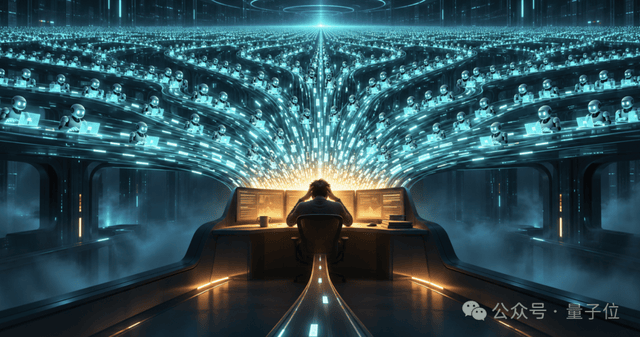 AI-generated
Recently, the DeepSeek Harness team published a landmark post addressing this exact pain point, offering their architectural vision for the next-generation Super-agent:
Build a super-agent with continuous context, capable of autonomously scheduling multiple Agents to work in parallel, and operating 24/7.
The goal is to liberate limited human attention and let Agents take over massive volumes of tasks, handling their own scheduling and self-management.
Reality is often full of dramatic coincidences. What many failed to notice is that as early as the beginning of the year, AFK AI, a Silicon Valley team founded by Chinese engineers, had already implemented the entire underlying “Single Router + Multiple Workers” architecture and its four core characteristics in their product, Comma.
They even took it a step further, directly breaking the context curse imposed by trying to cram everything into a single session. This endowed their Agent with long-term memory, continuous learning, and always-on capabilities. Even better, this system is publicly available right now, and its core codebase is entirely open source.
In an era where everyone is talking about Personal Agents, one team had already brought science fiction’s “Jarvis” into reality ahead of time.
Tired of the Single-Session Trap: Two Major Agent Players Arrive at the Same Solution
For anyone accustomed to multi-agent collaborative workflows, the following scenario is all too familiar and exhausting:
You have an AI debugging a code snippet, and the tests still need ten minutes to run. Suddenly, a client demands a new proposal right away, forcing you to open a new chat window and re-explain all the background context. At that exact moment, your manager messages the work group asking for yesterday’s progress report.
Caught in the middle, you scramble back and forth between switching windows and digging through chat histories. A screen cluttered with Agent chat boxes and chaotic to-do lists ruins the collaborative experience.

This exact frustration mirrors the core bottleneck highlighted by the DeepSeek Harness team in their Super-agent paper:
The cognitive bandwidth of an average human can typically sustain only 3 to 5 active sessions simultaneously. The fundamental issue is not the compute ceiling of the Agent, but that while an Agent’s concurrency can expand indefinitely, human attention has a hard physiological limit.
The Super-agent’s breakthrough strategy is clear: outsource human attention management to the system itself, achieving “Agents managing Agents.”
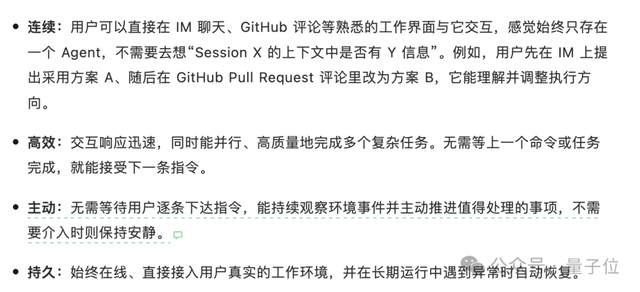
To this end, they proposed four core criteria for next-generation Super-agents: Continuous, Efficient, Proactive, and Persistent.
- Continuous: Seamless continuity across memory and context;
- Efficient: Relying on multiple independent Workers collaborating in parallel;
- Proactive: Capable of autonomously planning and driving tasks forward;
- Persistent: Supporting 24/7 continuous uptime and system self-healing.
Users interact through a single conversational entry point. The primary Agent orchestrates multiple sub-agents to process information in parallel and follow up on tasks across environments, leaving humans responsible only for top-level decisions:
The blueprint for next-generation Agents drawn by DeepSeek Harness is thrilling; yet the Silicon Valley team AFK AI had already forged the same technical path six months earlier with Comma.
The team proposed a highly forward-looking product philosophy: “One team, one conversation.”
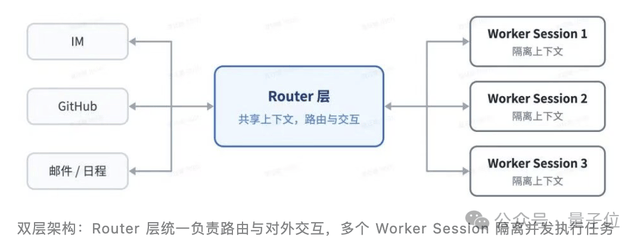
Users interact with a single, persistent primary conversational entry point. A Router handles top-level planning and schedules multiple Workers—each with an isolated context—to execute tasks in parallel.
At the architectural level, both sides arrived at a remarkably unified technical consensus: Single Session + Router (Primary Brain) + Multiple Workers (Executors).
A persistent Router centrally ingests instructions and coordinates global context, while multiple Workers operate in parallel across isolated contexts and report back results. Even with dozens of Agents running simultaneously in the background, users only need a single interface to delegate tasks and review deliverables, completely eliminating the friction of endless tab-switching and tracking down updates across disjointed chats.
However, a new technical challenge inevitably arises: once Agents take over scheduling human attention, who manages the Agents’ own memory?
As the volume of tasks handled within a single session grows, context window capacity limits and retrieval degradation become unavoidable. When a long-lived session digests more and more tasks, the bottleneck shifts from human attention to the Agent’s context limit.
The true challenge lies in building a system capable of continuous learning, long-term persistence, and precise recall of critical memories.
This touches on a deeper technical imperative for Super-agents: building a personal super-agent that, like “Jarvis,” stays online around the clock, operates ubiquitously, and continually refines its experience over long-term operations.
This vision of the future is now a tangible reality within Comma.
From Architectural Consensus to Production: Validating the Super-Agent in Practice
Continuous and Efficient: A Single Conversation Autonomously Orchestrating Multi-Agent Collaboration
When talking about being “continuous” and “efficient,” the Super-agent’s defining feature is a persistent Router managing global scheduling alongside Workers operating in parallel with isolated contexts. Crucially, this collaboration extends beyond multi-task distribution within a single session; it also encompasses cross-environment execution and dynamically understanding and reacting to shifting user intents in real time.
In Comma, this architecture brings about an intuitive shift in interaction: users no longer need to constantly create group chats for Agents, configure predefined personas, or repeatedly explain context. The cumbersome legacy workflows of “one window per task,” “serial waiting queues,” and “endless copy-pasting of background details” are completely streamlined.

In our hands-on testing, we asked Comma to clone the mechanics of the mini-game Overcooked using code, while concurrently assigning it two completely unrelated tasks in the exact same chat window: drafting a weekly review and synthesizing recent AI model releases.
Previously, this would have required opening three separate windows and explaining the background for each one by one. In Comma’s unified dialogue box, however, all three tasks were submitted simultaneously in a single prompt. The system responded immediately and dispatched the three tasks to different Workers. Three Agents worked in parallel without interfering with one another; even when we interrupted with follow-up remarks or appended new requirements mid-flight, the background multithreading proceeded without disruption.
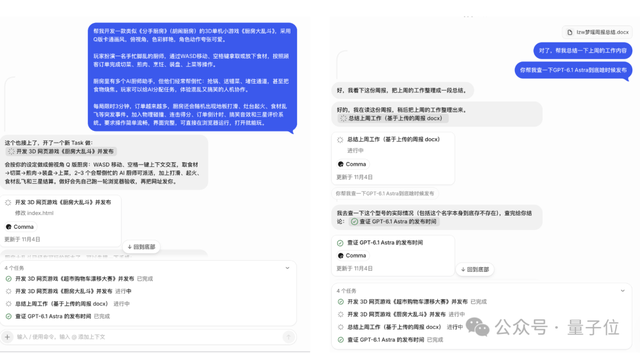
Beyond fluid background orchestration, the task execution quality was just as solid:
In about 10 minutes, Comma built a functional prototype of Overcooked: WASD movement controls, a 3-minute countdown timer, ingredient grabbing, order fulfillment validation, and corridor collision mechanics were all fully implemented.
At the same time, the weekly review on the other side finished concurrently, complete with organized work progress and structured next steps.
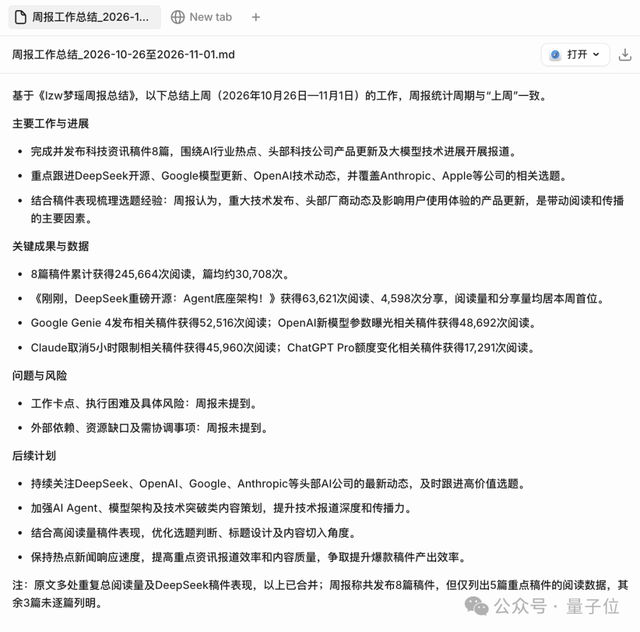
Throughout the entire process, the user only had to define requirements, track milestone progress, and accept deliverables. Task dispatching, parallel execution, and status aggregation were all handled under the hood by the underlying system.
The core logic of managing Agents has thus undergone a fundamental shift from “monitoring the process” to “delivering outcomes.”
Cross-Environment: Seamless Relays Bridging Disparate Workflows
Orchestrating tasks within a single dialog box is merely the baseline. For a Super-agent, the real test is: when a task leaves that window and extends into external platforms, does the workflow continue to advance seamlessly?
This is precisely the deeper requirement that Super-agents demand of “continuity”: cross-environment scheduling.
In DeepSeek’s proposed architecture, this relies on an underlying multi-channel interaction mechanism: the Router centrally parses events and messages across different platforms, while Workers execute tasks independently in the background and return results formatted according to each platform’s interaction protocols. In a development workflow, for instance, an Agent can bridge IM tools and GitHub—not only actively monitoring group chats, but also automatically opening PRs.
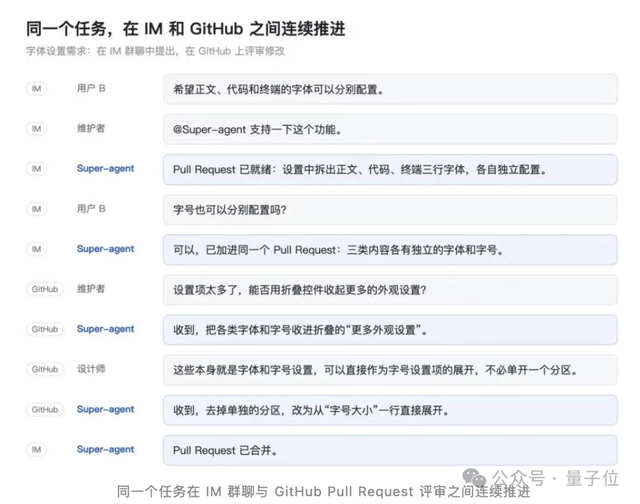
In Comma, this cross-environment mechanism is powered by its proprietary distributed Agent runtime framework, Salix.
The system captures events from various platforms by integrating third-party application connectors, continuously monitors them via programmable loops, and autonomously wakes up Agents to respond when necessary.
Currently, Comma supports integrations with popular collaboration channels such as WeChat, Signal, iMessage, and Linear. It supports secure self-hosting and BYOK (Bring Your Own Key), and is compatible with Codex and Claude Code, enabling cross-platform task supervision and orchestration.
In enterprise collaboration scenarios, users can issue commands via a Comma Bot embedded in an IM client. The system then leverages controlled permissions and information flow constraints to tap into the compute power of an employee’s local environment to complete the task.
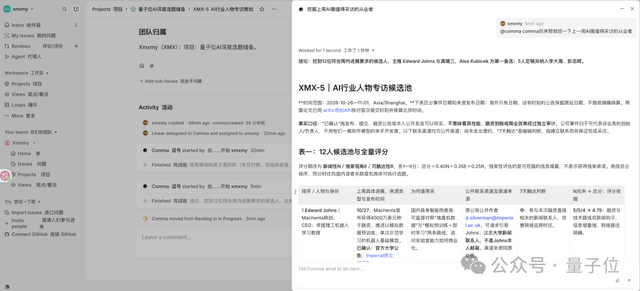
In our practical test, we connected Comma to the project management tool Linear and issued development plans directly inside the Comma dialogue box:
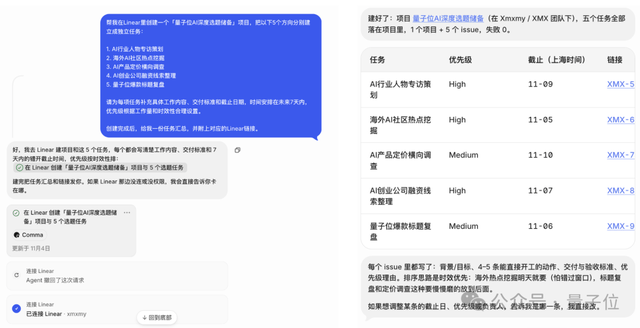
Switching over to Linear, we saw that the relevant Issues had been generated automatically, with task breakdowns and milestone scheduling neatly laid out:
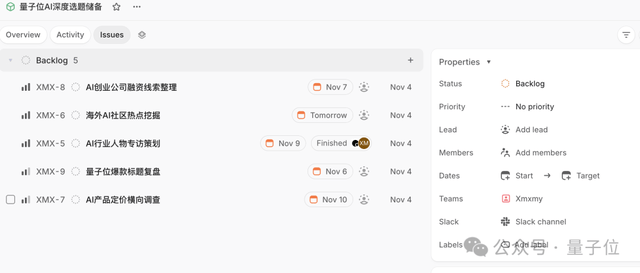
More importantly, Issues in Linear can also be routed back to Comma for execution. Their latest progress and deliverables are automatically synced back to the original Issue. This keeps cross-platform task states bidirectionally aligned at all times, eliminating the friction of manually copying and pasting information across toolsets.
Proactive and Persistent: A Continuously Learning, Always-On Memory Architecture
In DeepSeek’s vision, Super-agents possess two other vital traits: being “proactive” and “persistent”—meaning the agent evolves from passively answering prompts to proactively diagnosing issues and taking on tasks, all while staying online 24/7.
Comma provides a concrete implementation here as well: the system allows Agents to write their own daemon scripts. Even if the LLM is temporarily inactive or the local client is offline, the underlying persistent daemon mechanism keeps listening around the clock and autonomously wakes up the Agent to execute tasks whenever critical trigger conditions are met.
For example, when configured as an “AI Topic Assistant,” the system receives recurring long-term tasks via WeChat, automatically scrapes the latest AI news at designated times each day, synthesizes the key points, and pushes curated topic ideas.
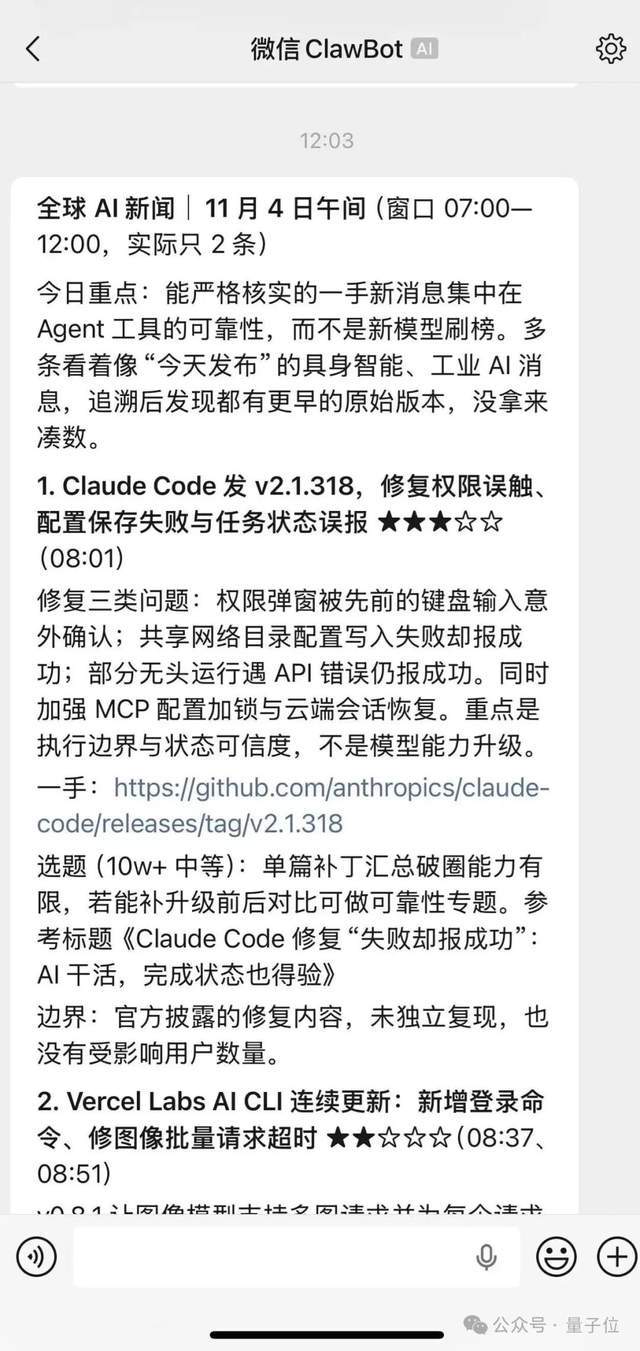
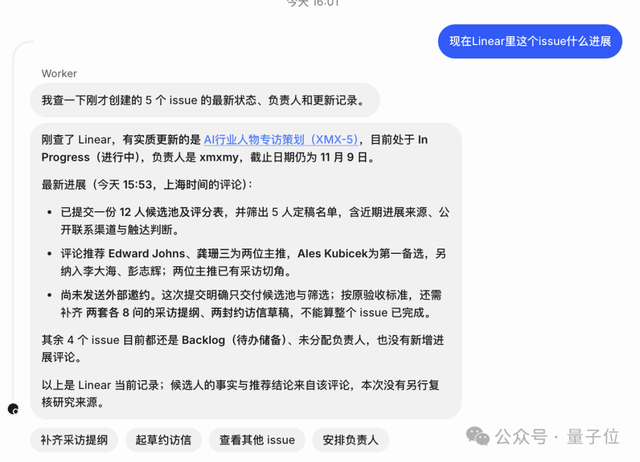
Simultaneously, the system maintains consistent state across multiple endpoints without being tightly coupled to any single app, while still aggregating information across all channels. Even when querying Linear’s progress from within the Comma desktop client, the system locates the information accurately and provides a status report:
Under the hood of its memory management, Comma persists long-term state outside the model’s context window. By leveraging the division of labor between the Router and isolated Workers, it prevents verbose execution details from polluting the primary conversation context.
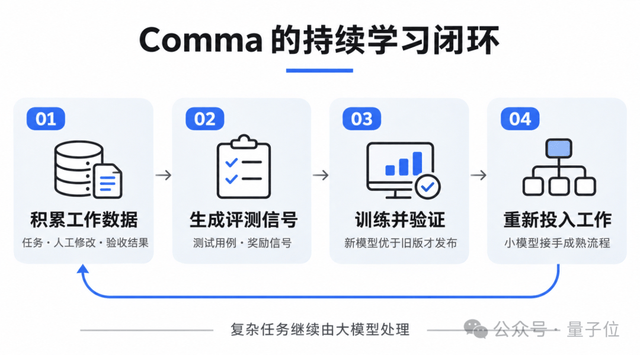
Building on this, the system embeds “continuous learning” directly into the product core: it captures execution outputs, human corrections, and final acceptance feedback, converting them into training data to fine-tune dedicated lightweight models.
Notably, its evaluation mechanism enforces strict performance standards: a fine-tuned model must outperform the previous iteration on benchmark evaluations before it can be deployed to production. For instance, a v3 model that previously tended to misclassify refund requests as bugs was able to accurately recognize them as billing inquiries in v4 after absorbing human-corrected samples.
 AI-generated
This evaluation framework updates its data monthly, progressively offloading structured, standardized workflows to dedicated lightweight models, while complex, open-ended tasks continue to be handled by frontier flagship LLMs. This closed-loop flywheel enables the agent to continuously accumulate real-world operational experience, realizing true, ongoing self-iteration.
From Bridge to Comma: The Technical Evolution of Long-Term Autonomous Agents
Looking back at Comma’s architectural journey, its technical vision took root well before the current industry hype.
As early as April 2026—before “Super-agent” became a mainstream industry buzzword—the Silicon Valley-based AFK AI team had already locked in a clear technical roadmap: a long-lived primary Agent aggregating tasks and scheduling multiple independent Workers for execution.
On April 28 of that year, the team officially unveiled Bridge, the precursor project to Comma. Its early architecture clearly outlined the collaborative mechanics between a Lead Agent and its Subagents.
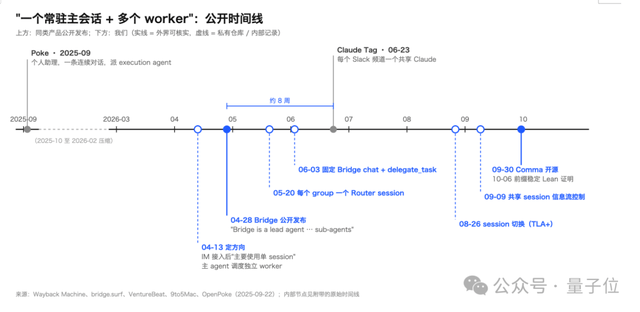
From there, development accelerated rapidly:
- May 20: The team established the design principle of “One Router Session per Group”;
- June 3: The persistent primary chat and task delegation mechanisms officially launched (about 20 days later, Anthropic introduced Claude Tag with a similar concept, enabling shared Claude access within channels);
- August: Implemented dynamic multi-session switching;
- September: Introduced shared session-level information flow controls to safeguard data security during team collaboration;
- September 30: Comma was officially open-sourced, followed shortly by the release of its security verification framework based on Lean formal verification.
From a single primary session coordinating multiple Workers, to cross-session scheduling and enterprise-grade security controls, the team spent months translating architectural blueprints into an engineered, production-ready productivity tool.
If DeepSeek outlined the evolutionary trajectory of Super-agents from a theoretical and architectural vantage point, Comma has delivered the practical answer through product and engineering execution: a Personal Agent that can accompany users over the long haul and autonomously coordinate complex workloads is becoming a reality.
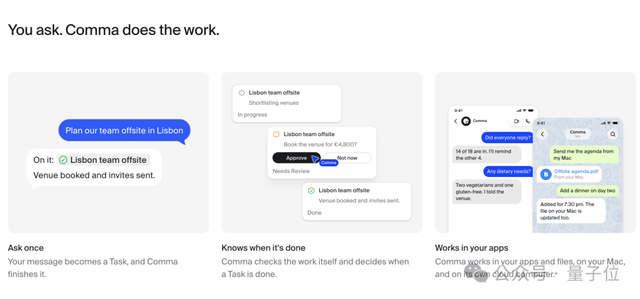
Discerning the macro trend from subtle early signals reveals what lies ahead.
The profound alignment between DeepSeek and AFK AI on their foundational technical roadmaps is, at its core, a shared understanding forged by two teams looking past superficial UI paradigms to tackle the true bottlenecks of multi-agent architectures in real production environments.
As the current AI wave matures, industry focus on Agent Harnesses is undergoing a pivotal shift: moving away from merely racing for concurrent task throughput, and toward testing an engineering architecture’s capacity to handle complex workloads and substantive operational responsibilities.
And as these pioneers have demonstrated, enabling Agents to operate continuously, autonomously, and reliably in production environments is the indispensable path toward next-generation general intelligent collaboration.