
RSI Cannot Be Infinitely Fast
Recursive Self-Improvement (RSI) is an immensely hot topic right now, but can it truly accelerate AI progress to infinite speeds?
Jeff Dean’s take: It’s simply not realistic.
He shared an intuitive example: a researcher kicks off an experiment that finishes at 2 AM, but often no one looks at the results until they return to their desk at 8 AM.
While automated systems can certainly eliminate these idle gaps and decide on the next experiment in real time, the core steps—training, computing, storing data, and evaluating results—still take physical time.
Building and continuously improving foundation models still requires massive amounts of training and experimentation, and these processes can never happen infinitely fast.
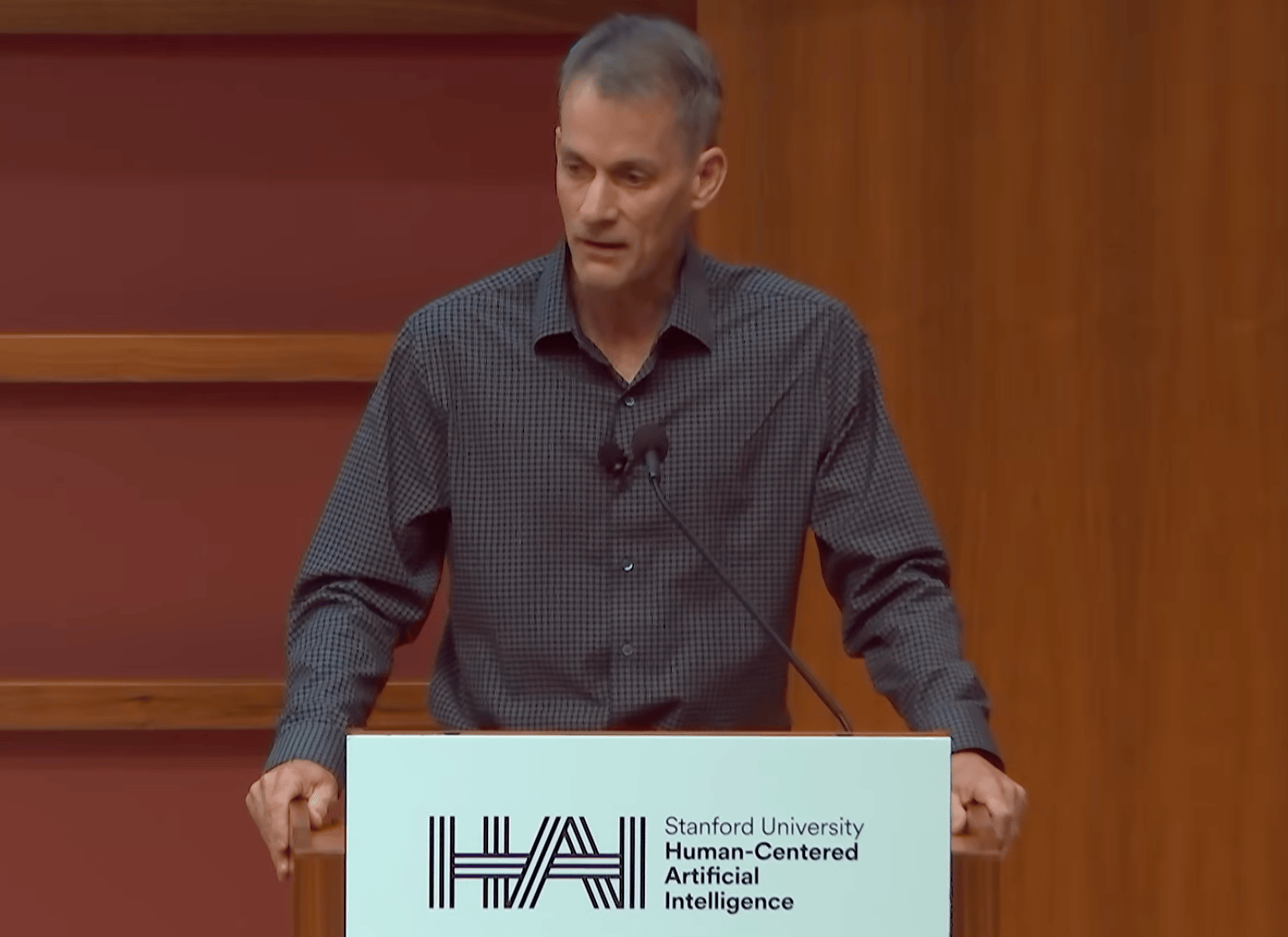
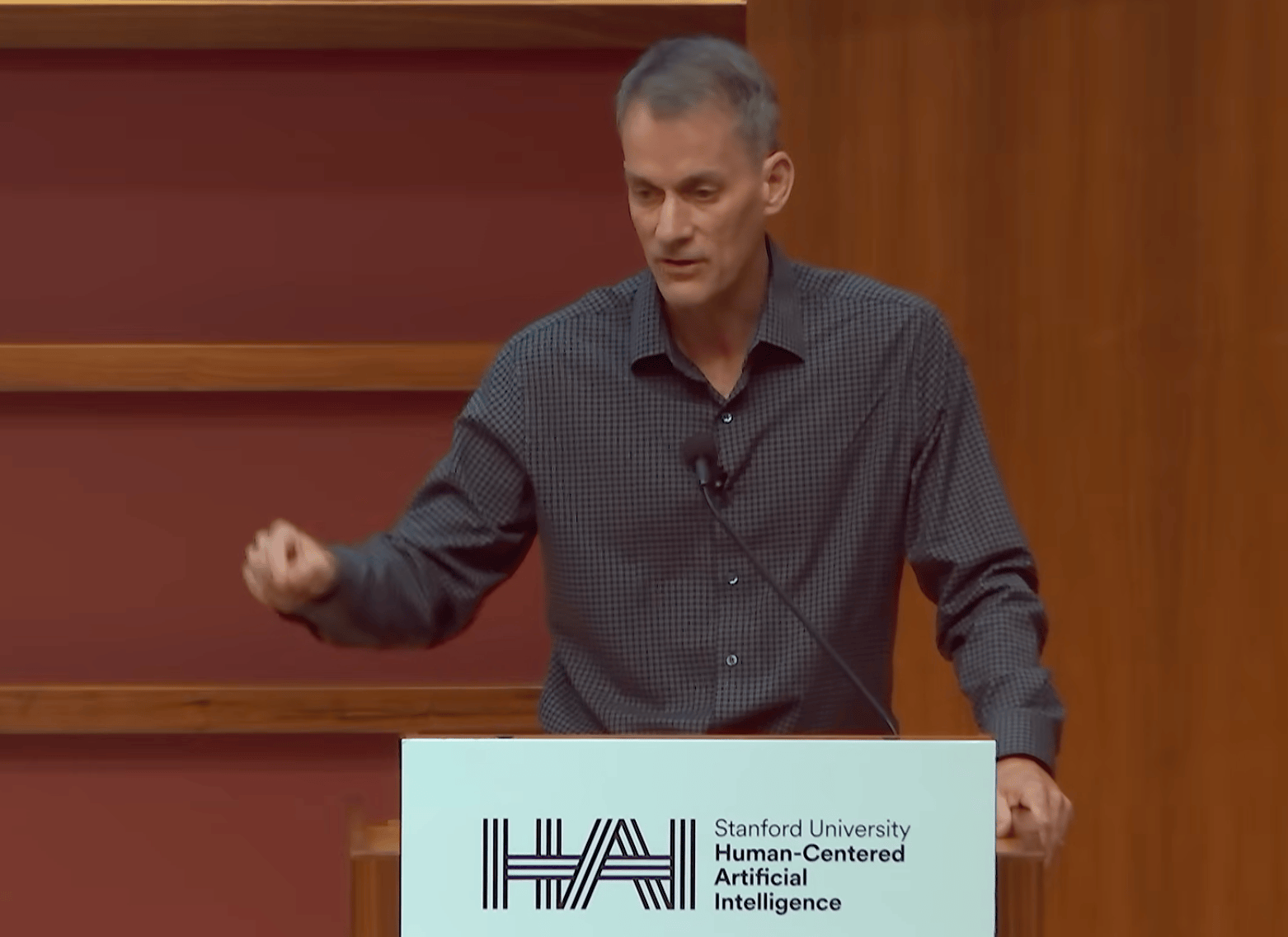
Recently, in a conversation with Fei-Fei Li at Stanford HAI (Human-Centered AI Institute), Jeff Dean delved into the physical limits of RSI and revealed for the first time the core mission of his newly co-founded startup.

The entire presentation stayed true to Jeff Dean’s signature minimalist slide style.
According to Dean, the new venture, Discovery Loop, already has about 20 automated improvement loops running continuously and has built a framework designed for seamless human-agent collaboration.
Their goal is to empower a tiny cadre of domain experts, working alongside swarms of agents, to conduct scientific research—boosting expert productivity by 20x to 50x.
To build this core team quickly, they conducted 400 interviews in coffee shops and similar spots within the first three weeks of founding.
Discussing the technical trajectories driving these advances, Dean candidly admitted to having made a few misjudgments in the past.
One of them was code generation and programming capabilities.
In the Gemini project, coding was originally just one of several priority focus areas; he hadn’t fully anticipated how deeply code generation would empower and reshape a model’s broader ability to solve general, complex problems.
He also once expected neural networks to evolve far more exotic, irregular topological structures—a path that didn’t pan out quite as he had envisioned.
When discussing AI in mathematics, he expressed deep appreciation for machine-generated formal proofs, but emphasized that the true value lies in whether humans can understand and extract reusable, generalizable scientific methods from these machine derivations.
Keynote by Jeff Dean: Letting AI Run Autonomous Experiments to Boost Expert Productivity 20x to 50x
Fully Automating the Experimental Loop
It’s great to be here with everyone today. Today, I’d like to introduce Discovery Loop.
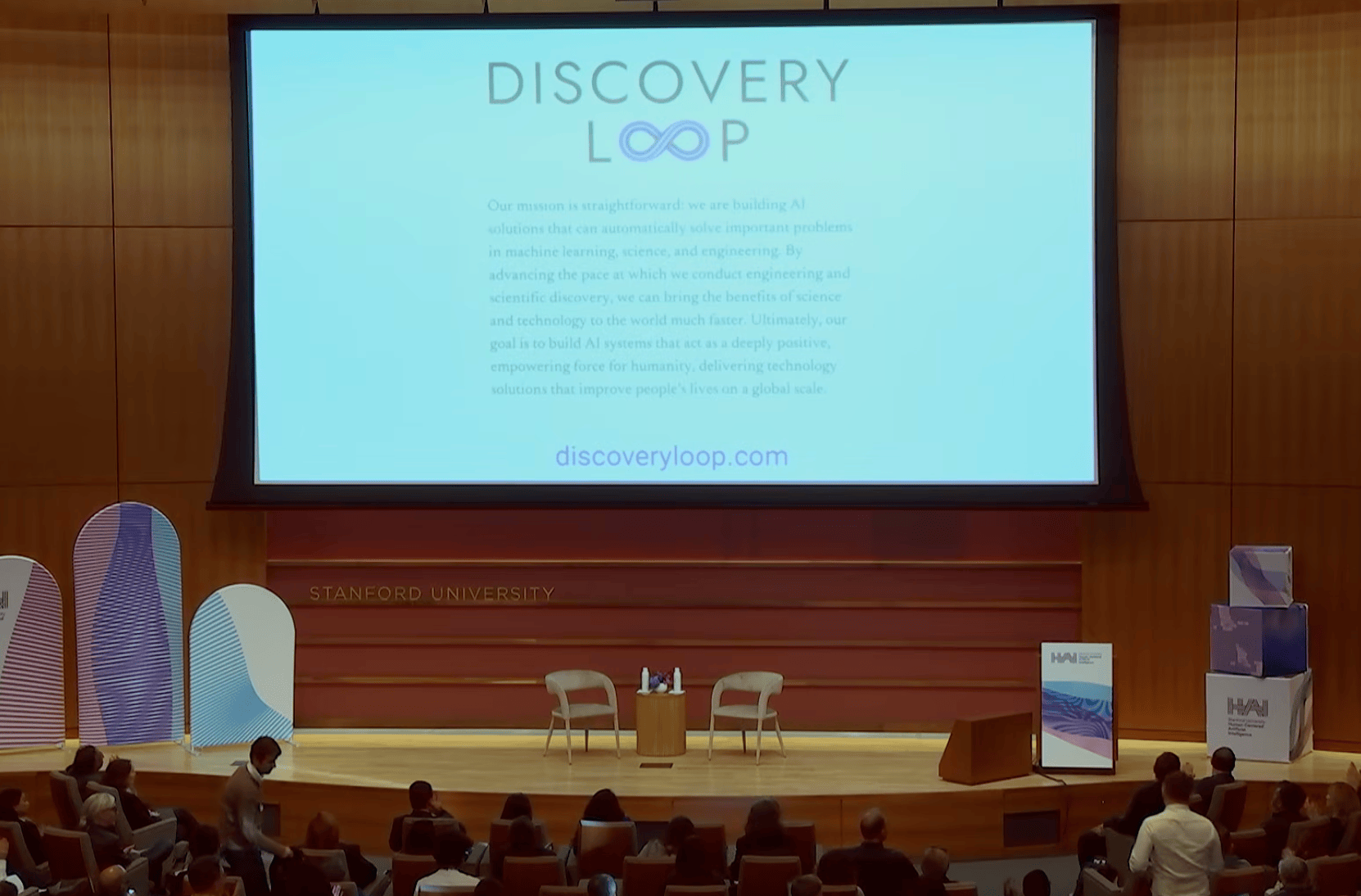
Our mission is to build AI systems that can autonomously solve major, critical problems across machine learning, science, and engineering.
We firmly believe this will catalyze more frontier scientific discoveries, and that’s the vision we find most exciting.
Across many scientific disciplines, there is a remarkably consistent core research paradigm—the universal cycle of science and engineering: formulate hypotheses and design experiments, deploy and run them, observe outcomes, evaluate metrics, and decide on the next step—which is usually launching another iteration.
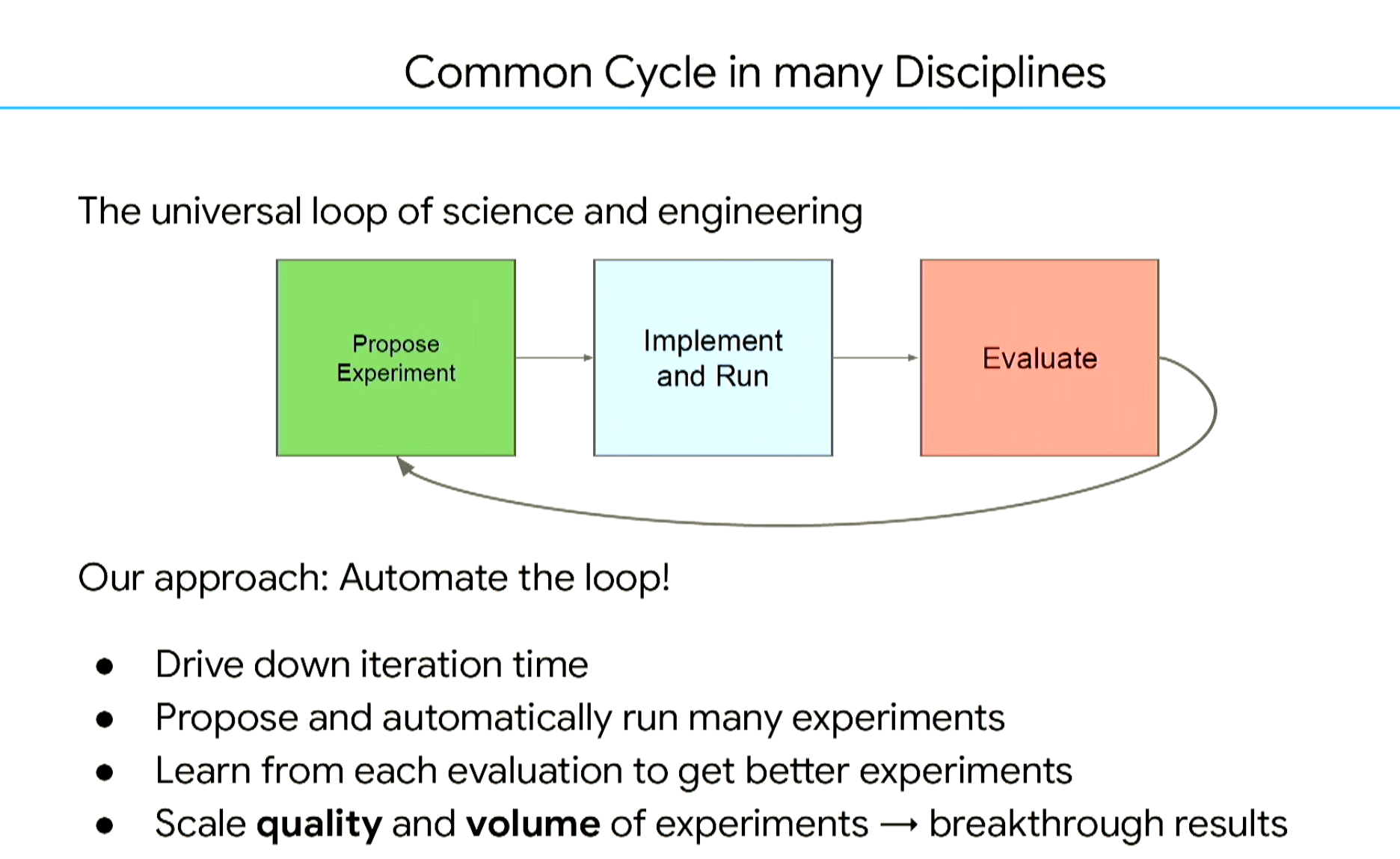
Our core thesis is to fully automate this entire experimental closed loop. We believe that if we can drastically compress iteration cycles, autonomously run thousands of experiments around the clock, and continuously reinforce learning from each evaluation feedback so that subsequent experiments build on accumulated prior knowledge, the breadth and quality of experiments will see a massive leap, ultimately delivering breakthrough discoveries.
This is precisely what we are pushing forward.
Consider the Grand Challenges for Engineering outlined by the National Academy of Engineering—these are the pivotal problems that demand solutions in the 21st century, a century that is already nearly a quarter behind us.
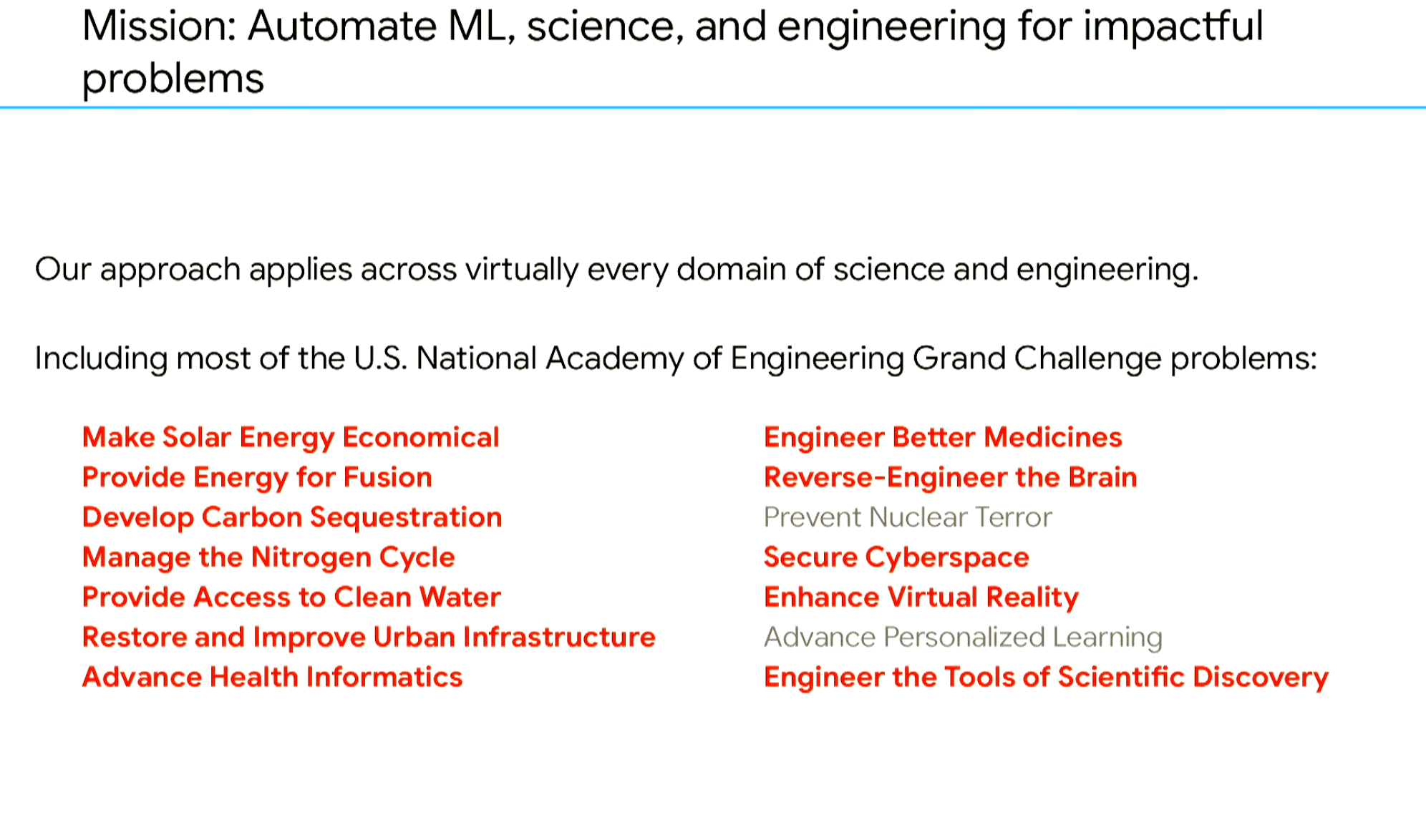
If you examine the key technical subfields required to tackle these grand challenges—especially the areas highlighted in red—we are convinced that automated loops for scientific discovery will be a transformative catalyst.
Why Form a Public Benefit Corporation?
Technology, when used properly, can have an extraordinarily positive impact on the world. But ensuring that this positive value is realized requires the right organizational structure and aligned efforts. That was one of the central motivations behind launching an independent company.
As such, we organized the company as a Public Benefit Corporation (PBC).
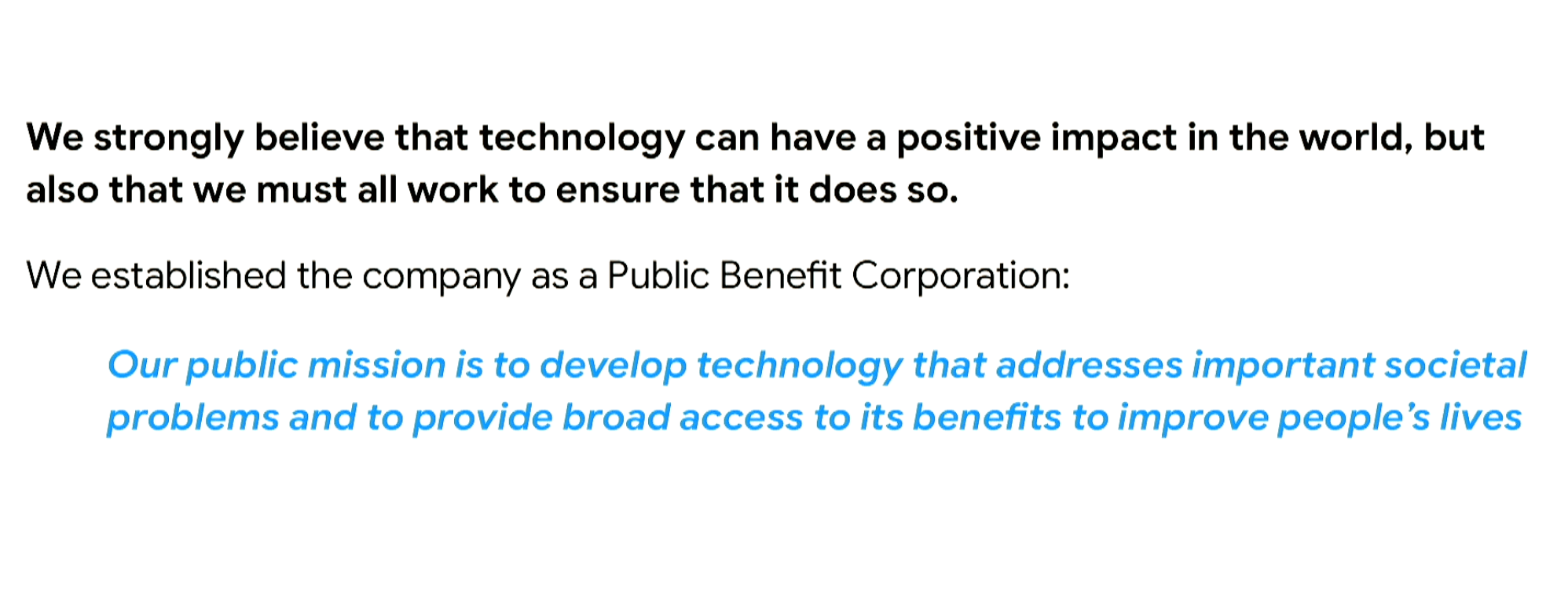
Our public charter is clear: develop core technologies to address major societal challenges, ensure the broad and equitable distribution of technological benefits, and meaningfully improve the well-being of people worldwide.
Technical Heritage of the Four Founders
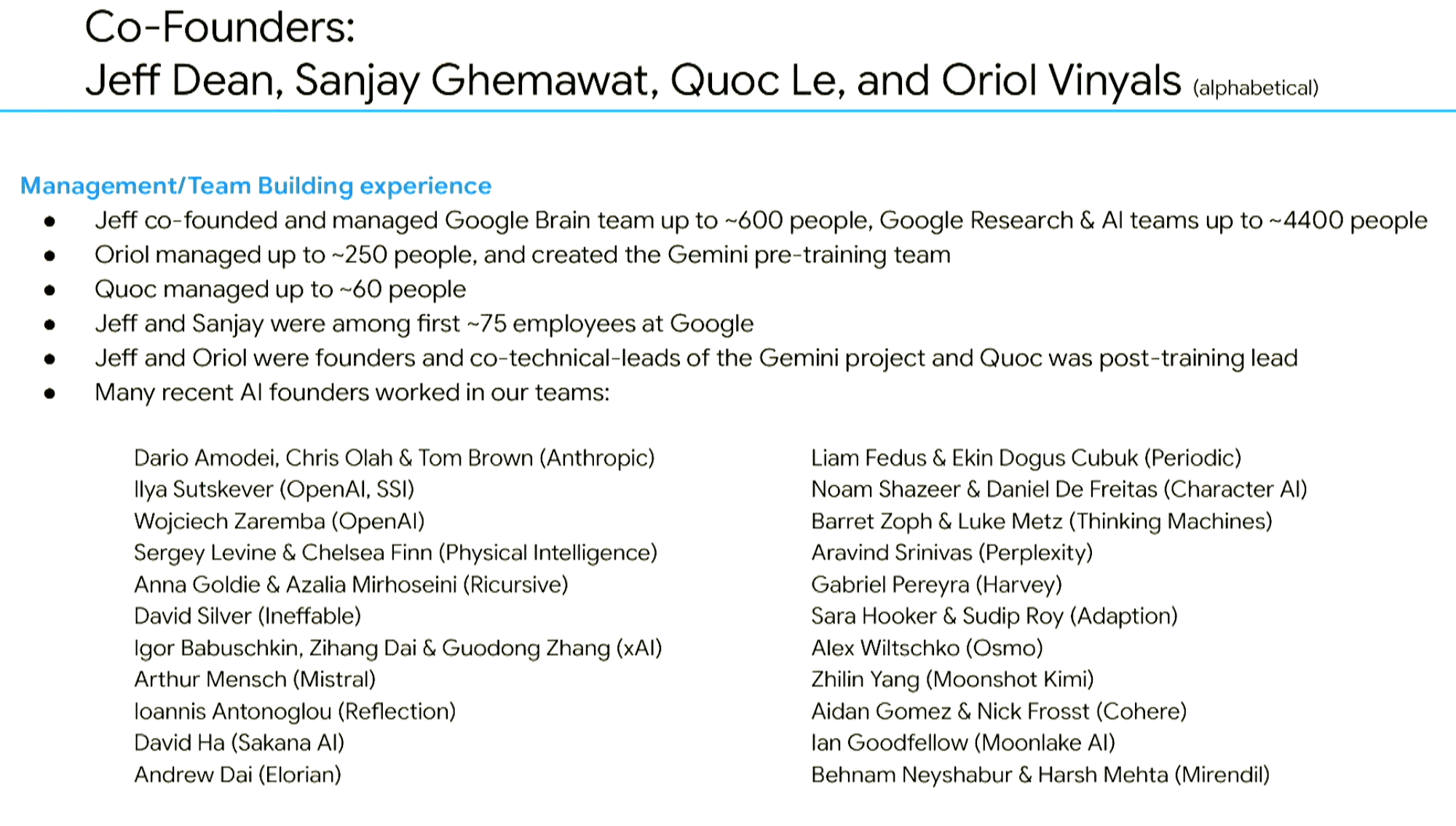
A brief introduction to our founding team: my three co-founders are Sanjay Ghemawat, Quoc Le, and Oriol Vinyals.
Counting pairwise collaboration histories, we have worked alongside one another for anywhere from 14 to 30 years. We have always loved tackling the hardest engineering and research problems, and our respective skill sets are deeply complementary.
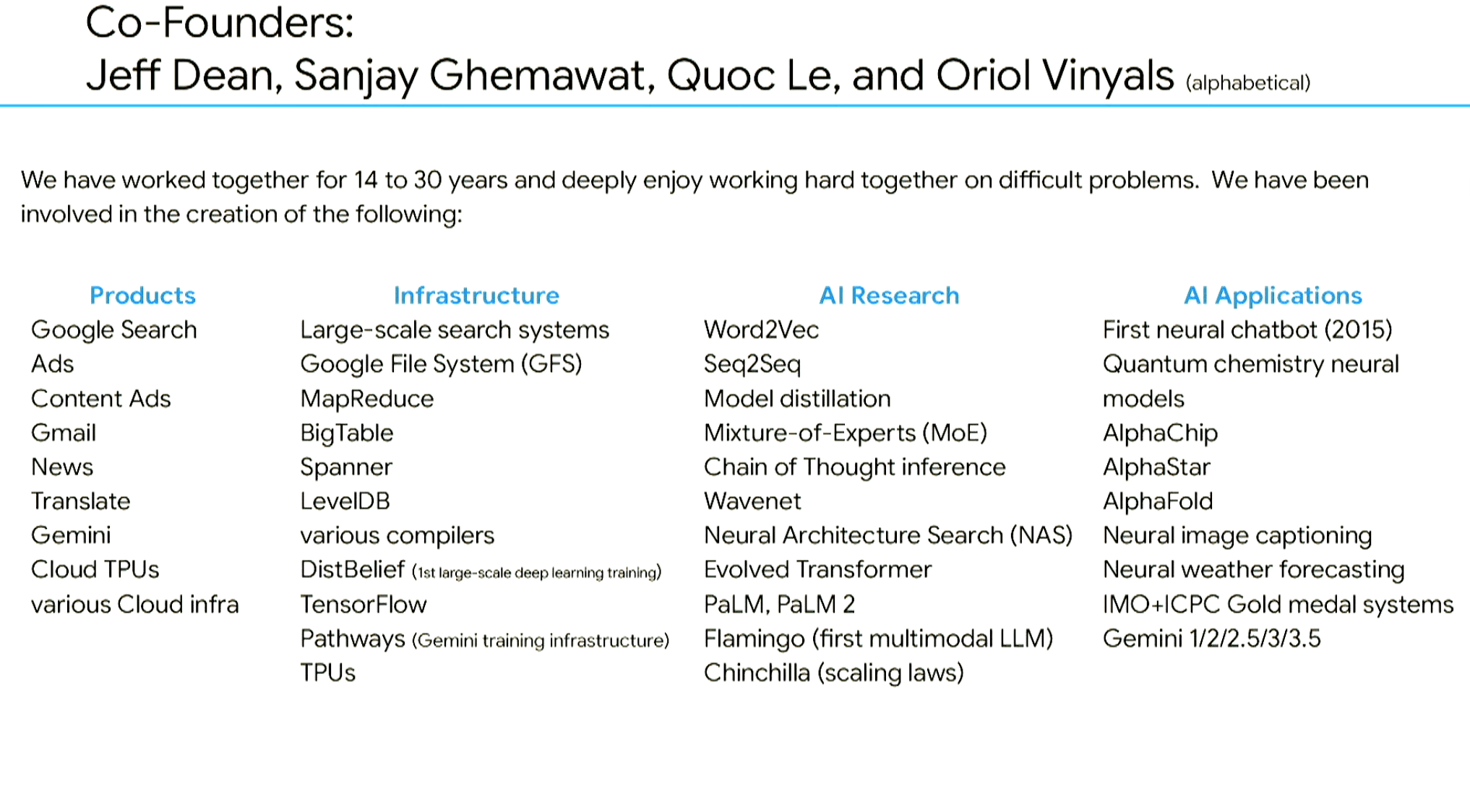
All of us come from Google, and the achievements shown here were born during that tenure: we led or contributed to multiple generations of Google Search architecture, early commercial ad systems, content-matching engines, and core products like Gmail, Google News, and Google Translate.
The second column covers systems infrastructure: the top half shows the foundational systems that power massive-scale data organization, storage, and distributed computing; the bottom four items represent generations of hyper-scale ML infrastructure built specifically to train ever-evolving frontier models. On top of that, we were deeply involved in developing TPU hardware tailored for AI compute.
On the algorithmic research side, we contributed directly to many of the key technologies powering today’s frontier models, including Knowledge Distillation, Mixture of Experts (MoE), and Neural Architecture Search (NAS).
Neural Architecture Search can actually be seen as an early precursor to automated experimental loops: using algorithms to automatically discover the best neural network topology tailored to a specific task.
We have also long driven cross-disciplinary applications of AI, particularly in fundamental science. For instance, Quoc and I contributed to AlphaChip, which applies reinforcement learning to microchip floorplanning; Oriol was involved in AlphaFold as well as neural network-based weather forecasting systems.
I also accumulated extensive experience managing large-scale organizations. I headed the Google Brain team (up to about 600 people) and later oversaw both Google Research and AI, an organization of roughly 4,400 people.
One day, I realized I was spending far too much time on administrative overhead like Q2 operating budget meetings. So, with an organizational restructuring email, I streamlined my direct reports from managing a 4,400-person organization down to just four people.
A week later, Geoff Hinton announced his retirement, dropping my direct reports to three.
Later, Oriol and I served as co-technical leads on the Gemini project, while Quoc led post-training.
What makes us even prouder is that many of the colleagues who fought alongside us in the trenches have gone on to achieve remarkable things across the industry, including founding leading companies like Anthropic, OpenAI, and Physical Intelligence.
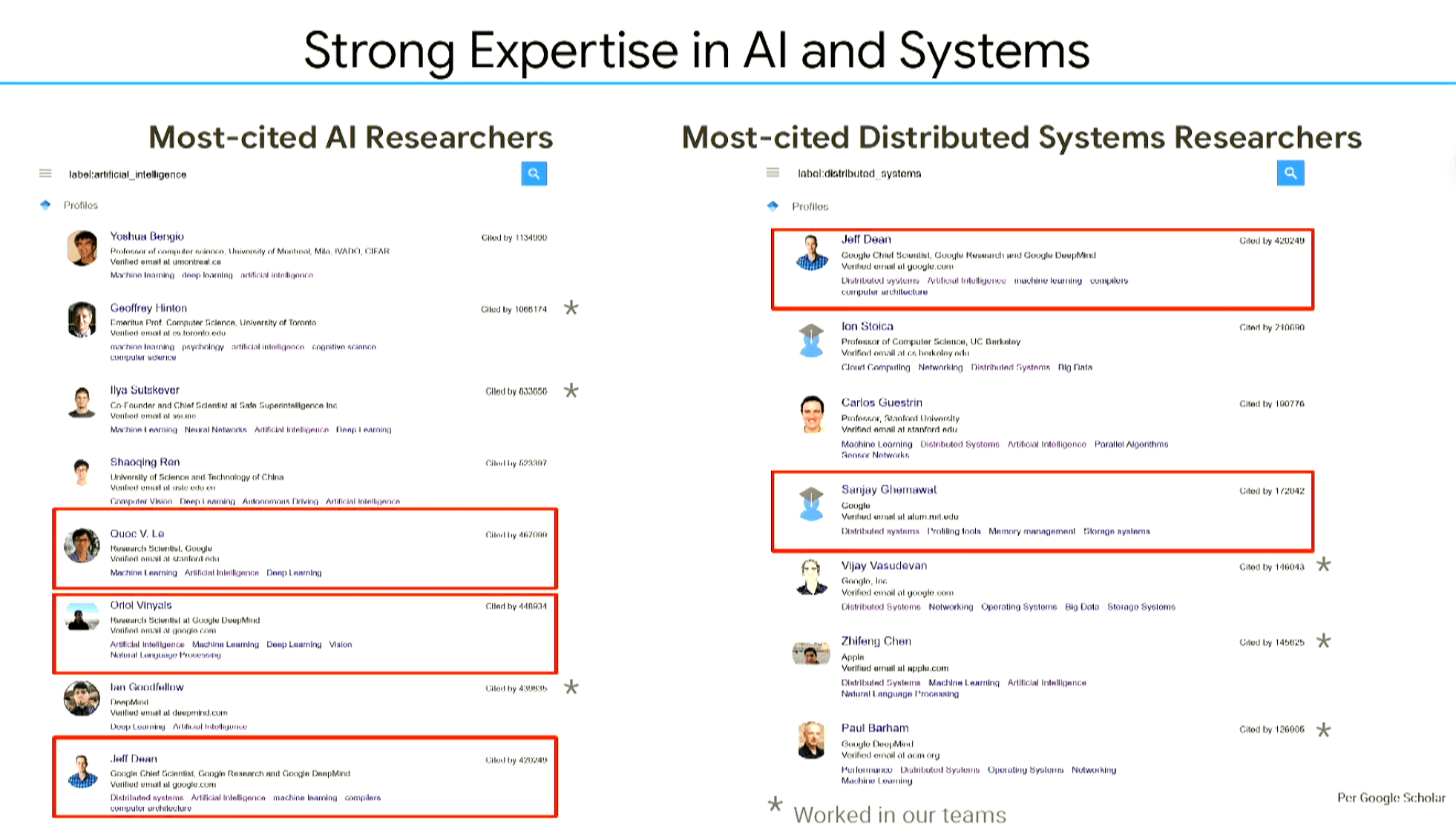
Our technical foundation deeply integrates frontier AI research with large-scale distributed systems engineering.
This Google Scholar citation graph highlights top researchers across AI and distributed computing. The red box outlines the four of us, and the authors marked with asterisks are all people who worked with us on the same teams.
Team Building and Early Hiring
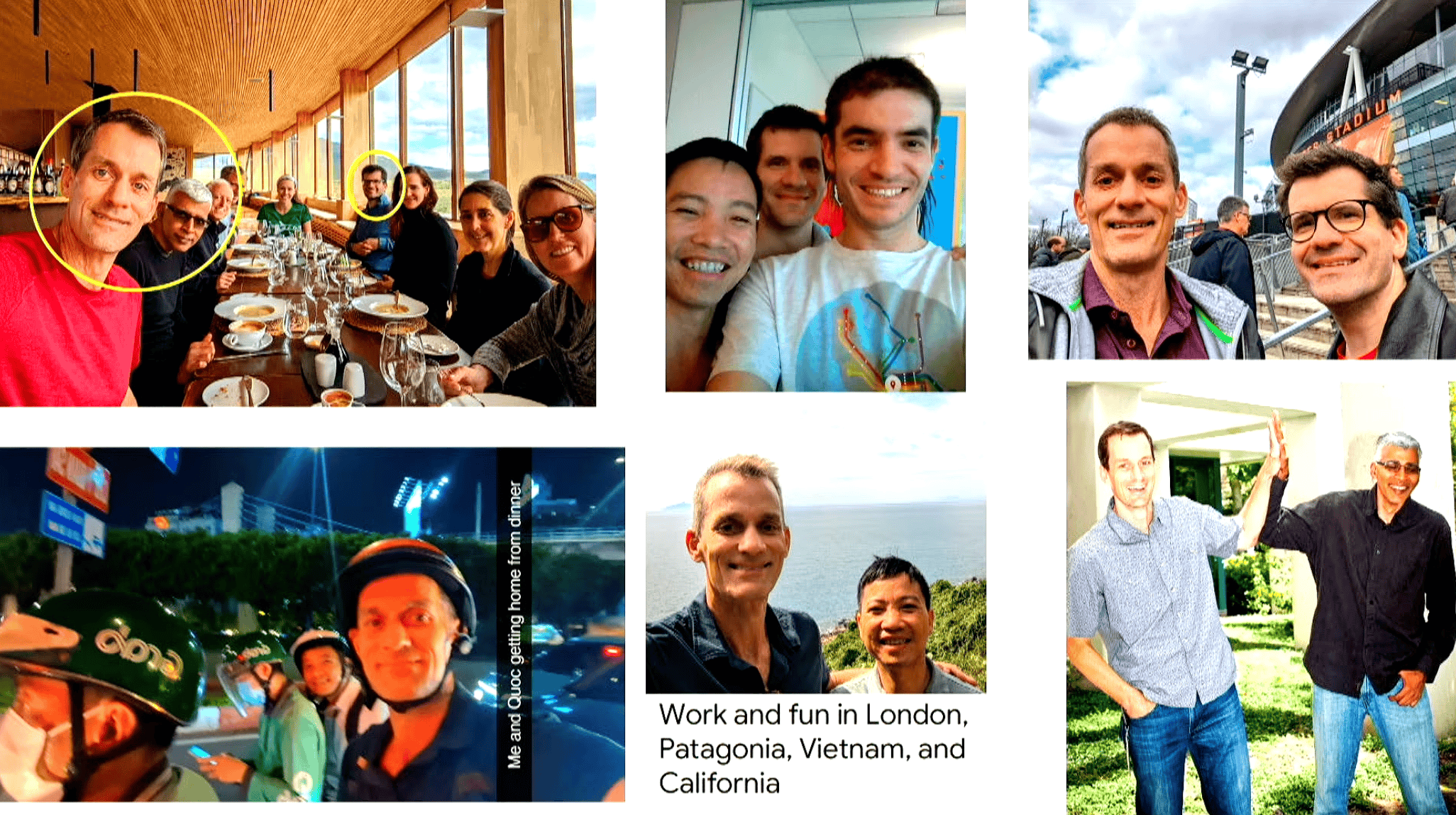
Outside of work, we’ve always been great friends, traveling together across London, Patagonia, Vietnam, California, and beyond.
I remember one evening in Vietnam after dinner, Quoc and I shared a ride on a local Uber-like scooter back to where we were staying.
In the earliest phase of the company, we poured all our energy into recruiting the core team. Their backgrounds are remarkably diverse; many have founded successful startups or spearheaded benchmark open-source and commercial projects.
The team includes not only top-tier engineering experts at the level of Go language core maintainers, but also core contributors to benchmark models like Gemini, DeepSeek, and Kimi K3. For example, a co-author of the Kimi K3 paper and author of the Attention Residuals research recently joined the team.
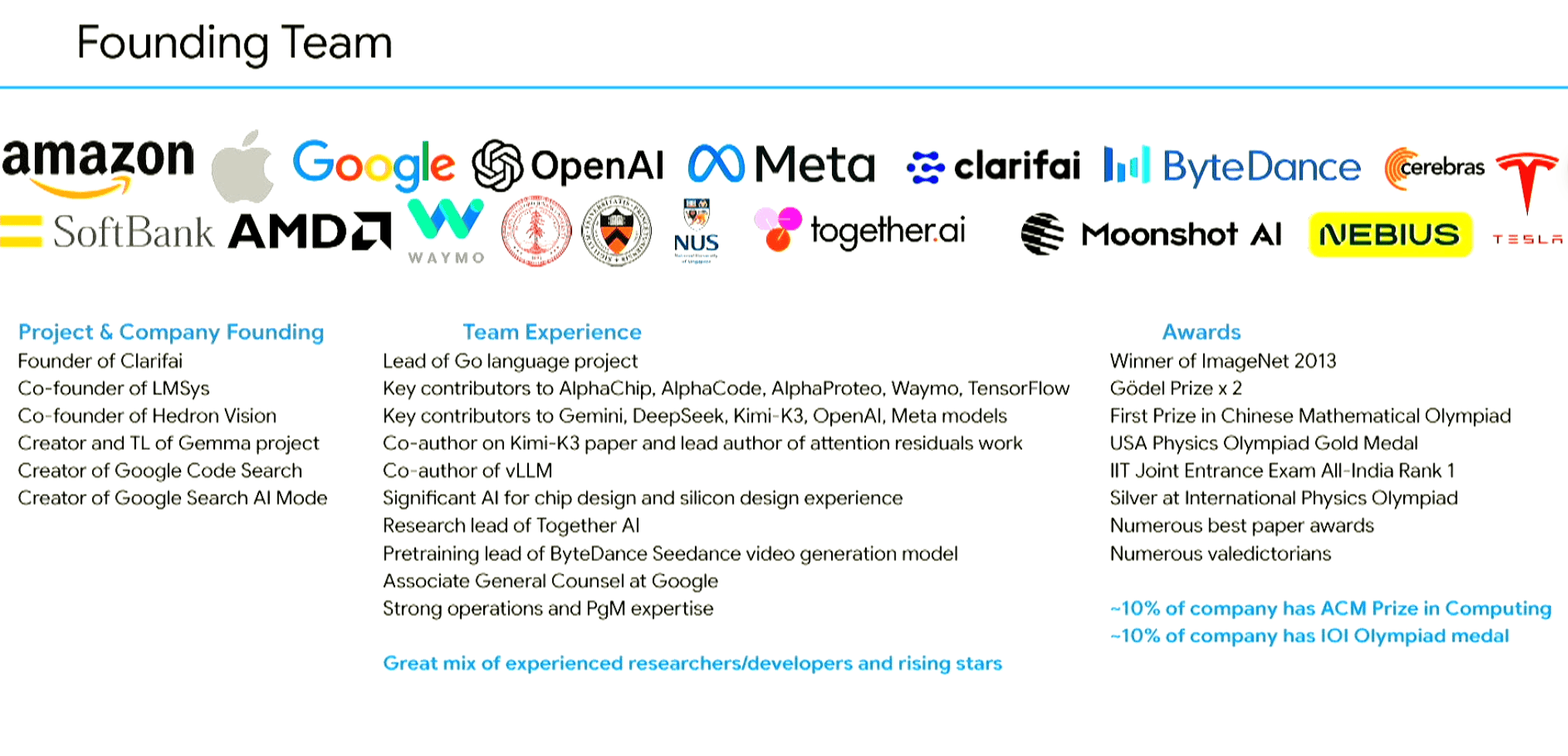
Our R&D bench brings together seasoned top experts and rising technical leaders. Currently, about 10% of our team members are ACM computing award recipients, and roughly 10% are IOI (International Olympiad in Informatics) medalists.
Beyond the sheer talent density, the seamless collaboration and chemistry among the team are what we value most.
Why Pursue This Now?
The answer: the capabilities of frontier foundation models have crossed a critical tipping point. This is built upon 10 to 15 years of relentless progress across the entire AI stack.
First came hardware breakthroughs—TPUs, GPUs, and custom accelerators. Then came major upgrades in software abstractions, enabling researchers to implement frontier ideas with unprecedented ease and map computation graphs cleanly onto underlying hardware.
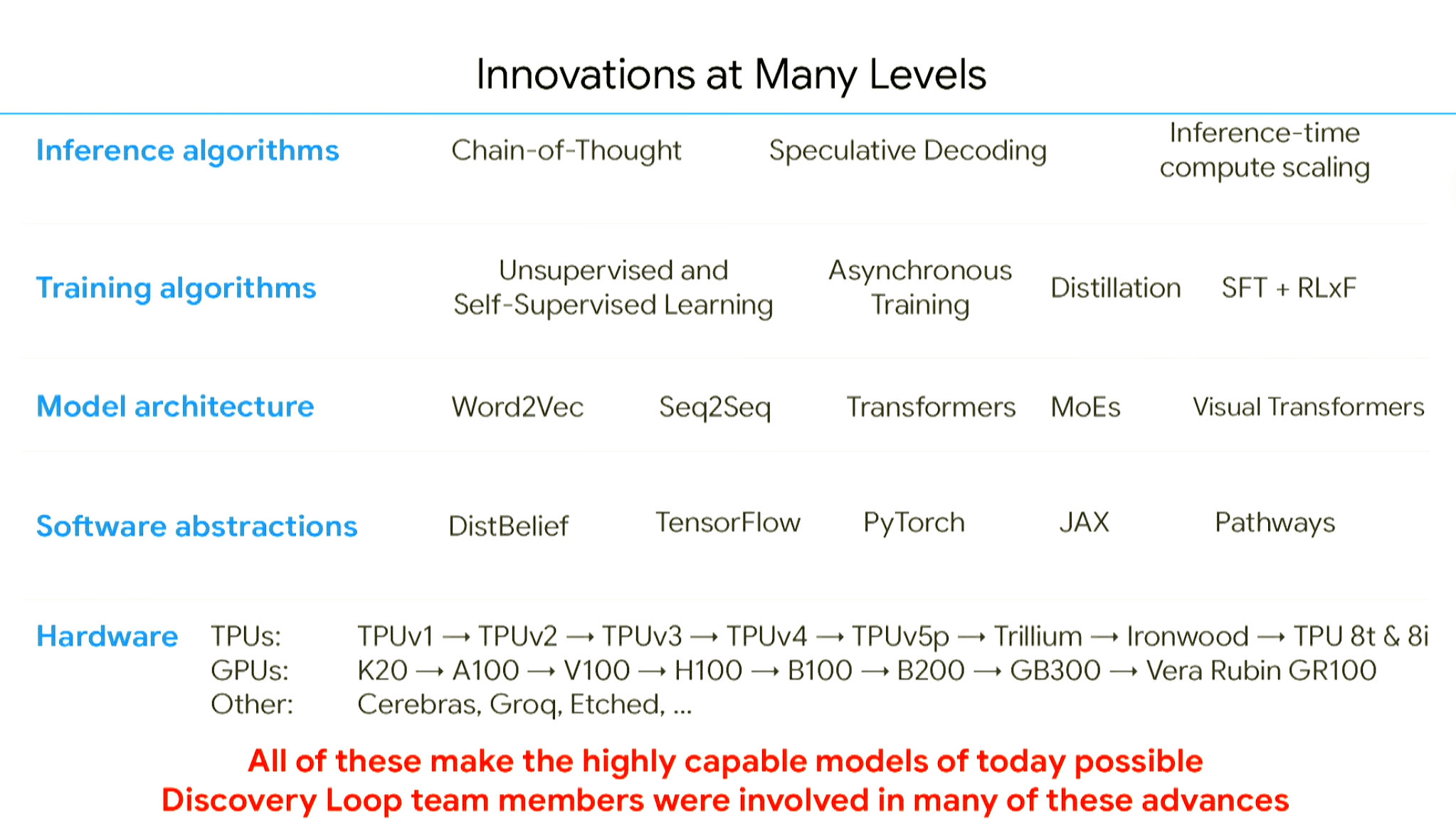
In model architecture, we evolved from early word2vec and Seq2Seq to the ongoing refinement of Transformer and MoE architectures. Huge advances in training and distillation have allowed compact models to deliver stunning generalization as well.
The reasoning paradigm has undergone an especially decisive leap. By scaling inference-time compute with techniques like chain-of-thought (CoT) reasoning, multi-path exploration, and verification, model reasoning quality has improved by orders of magnitude.
Models Need Tool Use, Creativity, and Accumulated Experience
Yet foundation models alone are far from enough to solve truly hard scientific problems. We must build upon cutting-edge base models by deeply integrating agent architectures, teaching systems to wield toolchains skillfully so they can execute complex, multi-step engineering tasks.
More importantly, agent systems must exhibit genuine scientific “creativity.” Transformational breakthroughs in science and engineering fundamentally require models to synthesize cross-domain insights, propose novel and feasible hypotheses, and autonomously drive experimental validation.
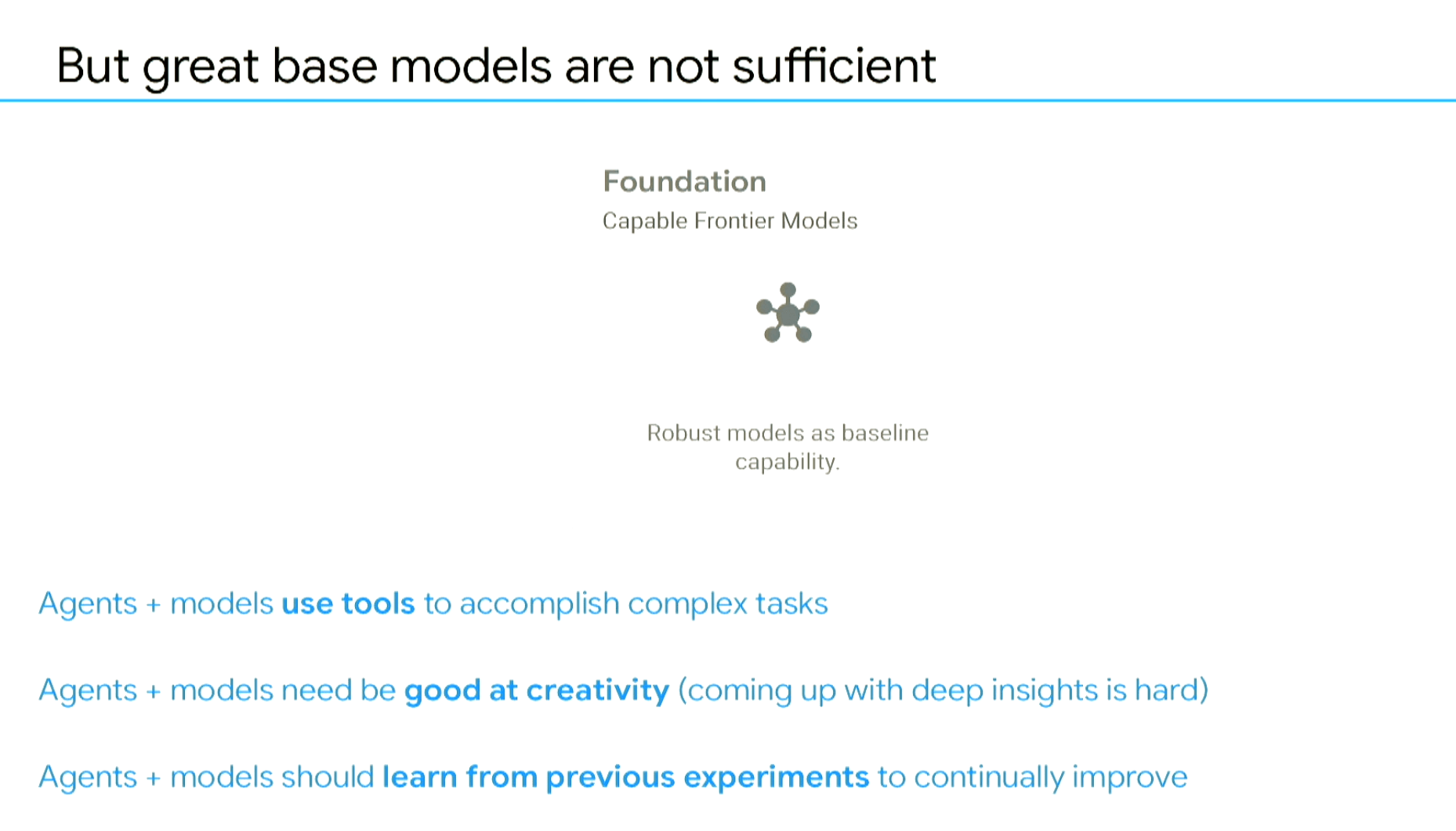
At the same time, the system must be capable of building long-term memory and accumulating experience across iterative experimental runs.
For example, once an agent system has tackled and solved 5,000 complex engineering problems, when confronted with the 5,001st task, it should be able to instantly recall and transfer the most relevant past problem-solving insights and hard-won lessons.
The Bottleneck in Massive Engineering: Division of Labor and Coordination Overhead
Traditional scientific R&D loops are heavily human-dependent.
When a problem is massive in scale, engineering complexity grows exponentially. You must first break it down into sub-problems or modular components—and decomposing a problem effectively is itself a notoriously difficult meta-problem.
In each specialized area, large teams of researchers typically work in parallel to validate local approaches.
This inevitably introduces massive organizational friction, resource contention, and cross-system integration overhead. Elegantly decomposing a problem is hard enough; seamlessly stitching fragmented solutions back together is equally daunting.
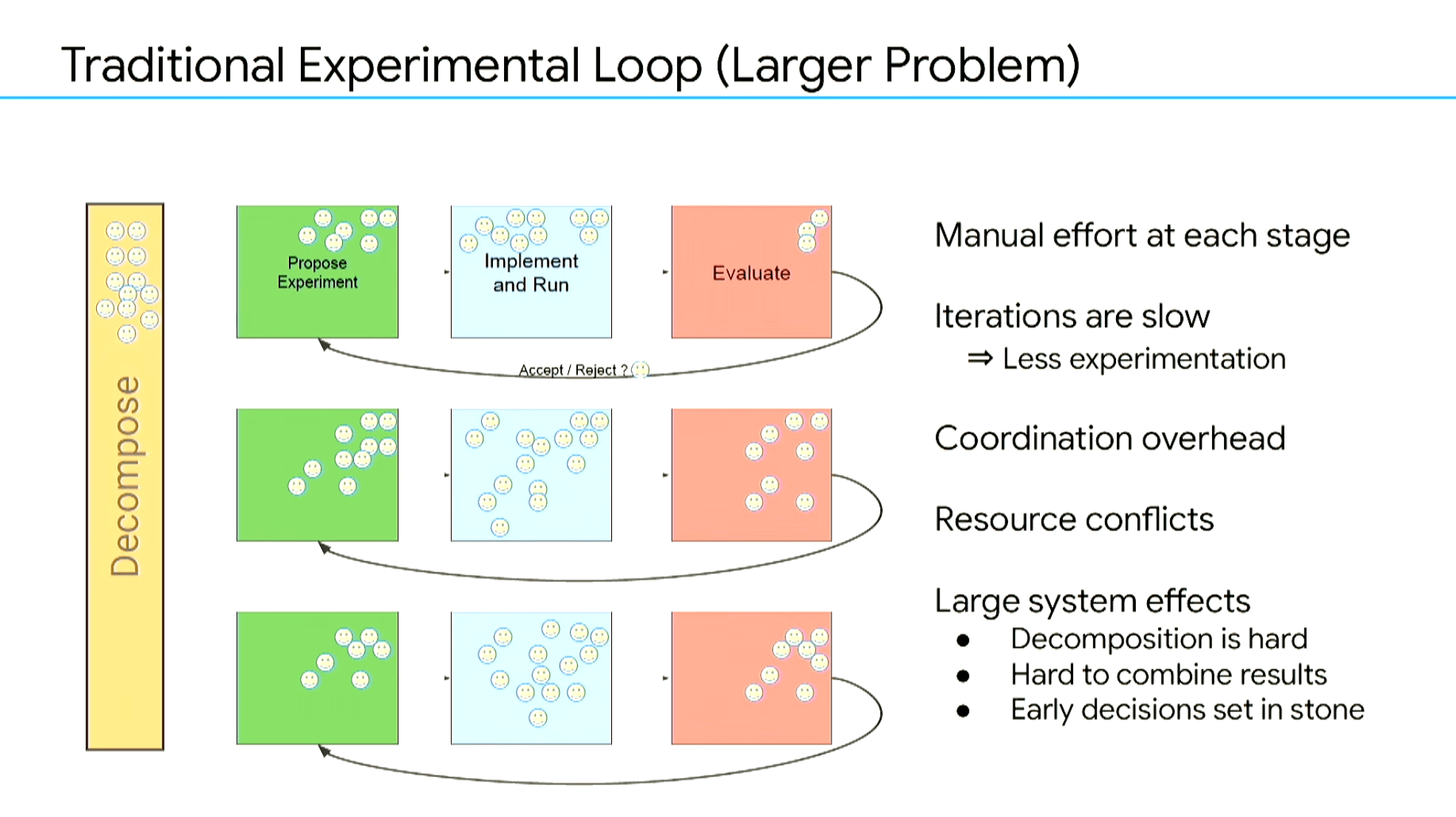
Even worse, once large-scale R&D efforts get underway, the initial architectural decomposition tends to become deeply entrenched. Whether building complex hardware systems or developing frontier foundation models, course-correcting foundational structural decisions mid-flight is extraordinarily difficult.
Our approach: leverage automated systems to empower a very small team of elite domain experts to steer the broader R&D agenda. Ideally, the intelligent system should autonomously identify the most scientifically valuable sub-problems and orchestrate compute end-to-end to solve them in a closed loop.
During this evolutionary phase, seasoned experts are still needed to provide high-level direction and govern priority roadmaps.
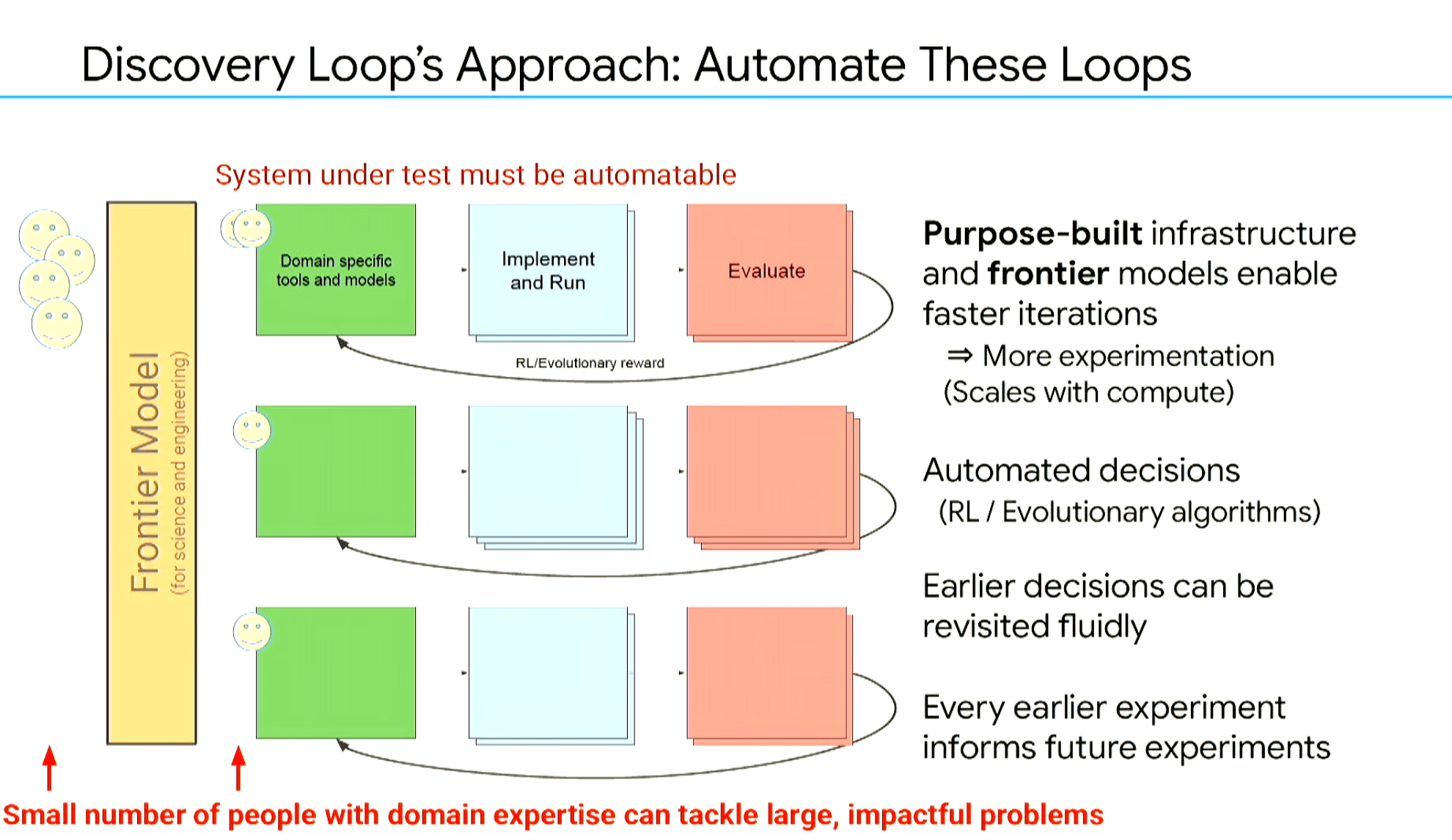
In this way, a lean group of core experts can drive high-impact, strategic initiatives. We firmly believe that purpose-built infrastructure is the cornerstone of this collaborative paradigm.
The underlying platform must not only support tens of thousands of concurrent automated experiment workflows, but also rigorously evaluate the marginal utility of each experiment node to dynamically converge on the next optimal action.
Reinforcement learning and evolutionary strategies play a pivotal role here, giving early decision paths the flexibility to be re-evaluated and adaptively backtracked. Every early exploration should serve as an informative prior for subsequent experiments.
Around 20 Self-Improving Loops Running Around the Clock
What progress has Discovery Loop made so far?
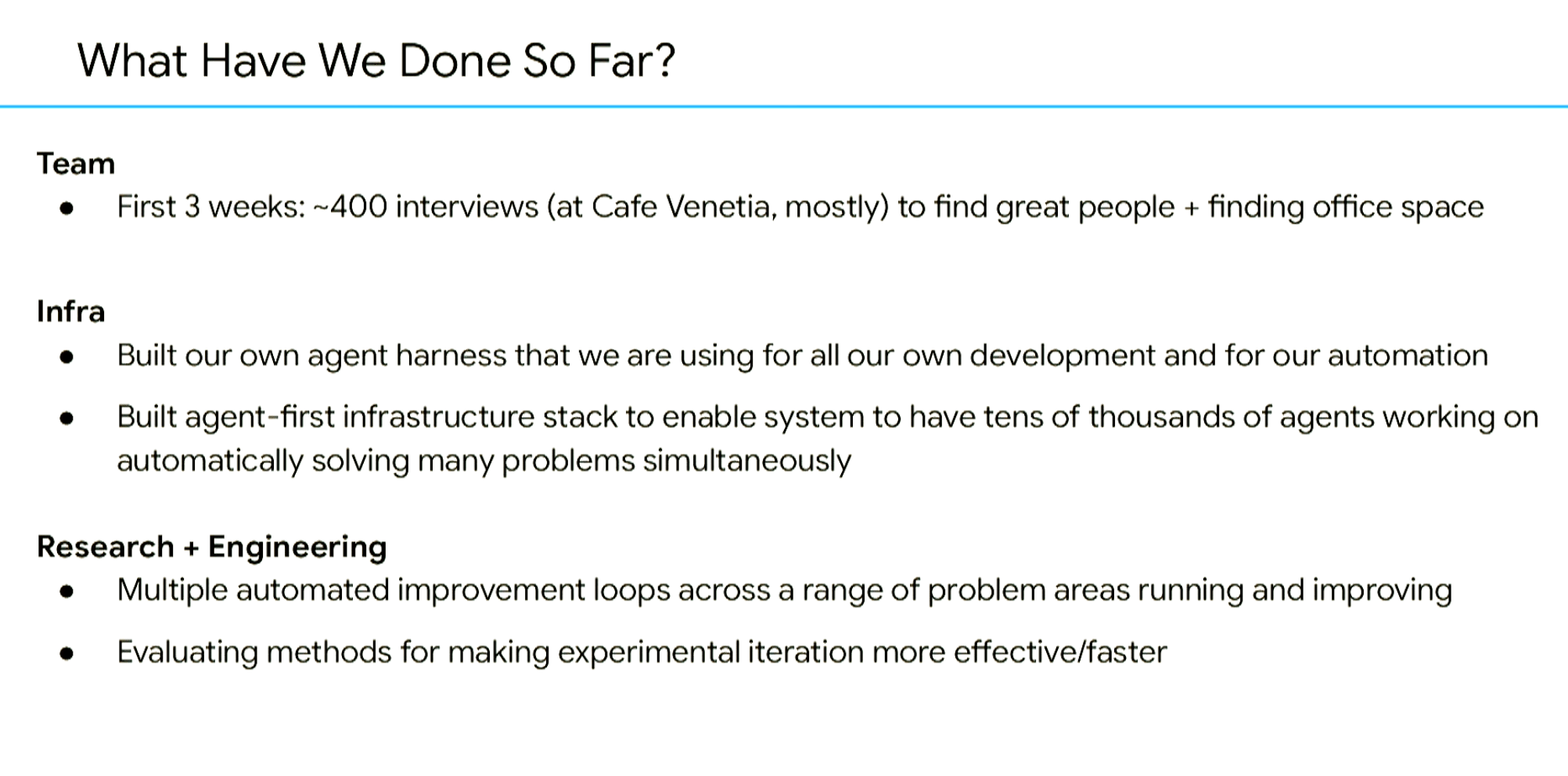
In our first three weeks, our team conducted 400 intensive interviews at Cafe Venetia on University Avenue, hand-picking top talent aligned with our mission.
The company has since moved into the former Zibibbo restaurant space, turning it into a distinctive, hacker-spirited R&D headquarters.
On the engineering side, we built a proprietary Agent Harness to power internal self-bootstrapping development and autonomous operations.
The framework offers robust distributed collaboration: an engineer can troubleshoot with an agent individually, or pull in teammates at any point, enabling a multi-agent, multi-human collaboration mode where teams orchestrate multiple agents collectively.
Team members can review proposals online and annotate modifications before execution, ensuring quality control on experimental plans upfront.
Unlike standard tooling, our infrastructure was architected from day one for large-scale concurrent agent orchestration, natively supporting the dispatch of thousands of agents in parallel clusters rather than just human-scale collaboration.
To date, about 20 self-optimizing improvement loops are running stably 24/7 inside the system.
We are continually evaluating how to further slash per-iteration latency and maximize reuse of historical metrics and telemetry, accelerating the system’s self-bootstrapping evolution.
Core Mission: 20x to 50x Expert Productivity
This is our primary arena: using software loops to empower and automate the end-to-end machine learning lifecycle, leveraging that foundation to unlock deeper autonomous scientific discovery.
As a starting point, we are focusing on automated closed loops to tackle hard bottlenecks within machine learning algorithm development and large-scale ML engineering itself.
Our medium-term core target is to boost domain experts’ effective research productivity by 20x to 50x.
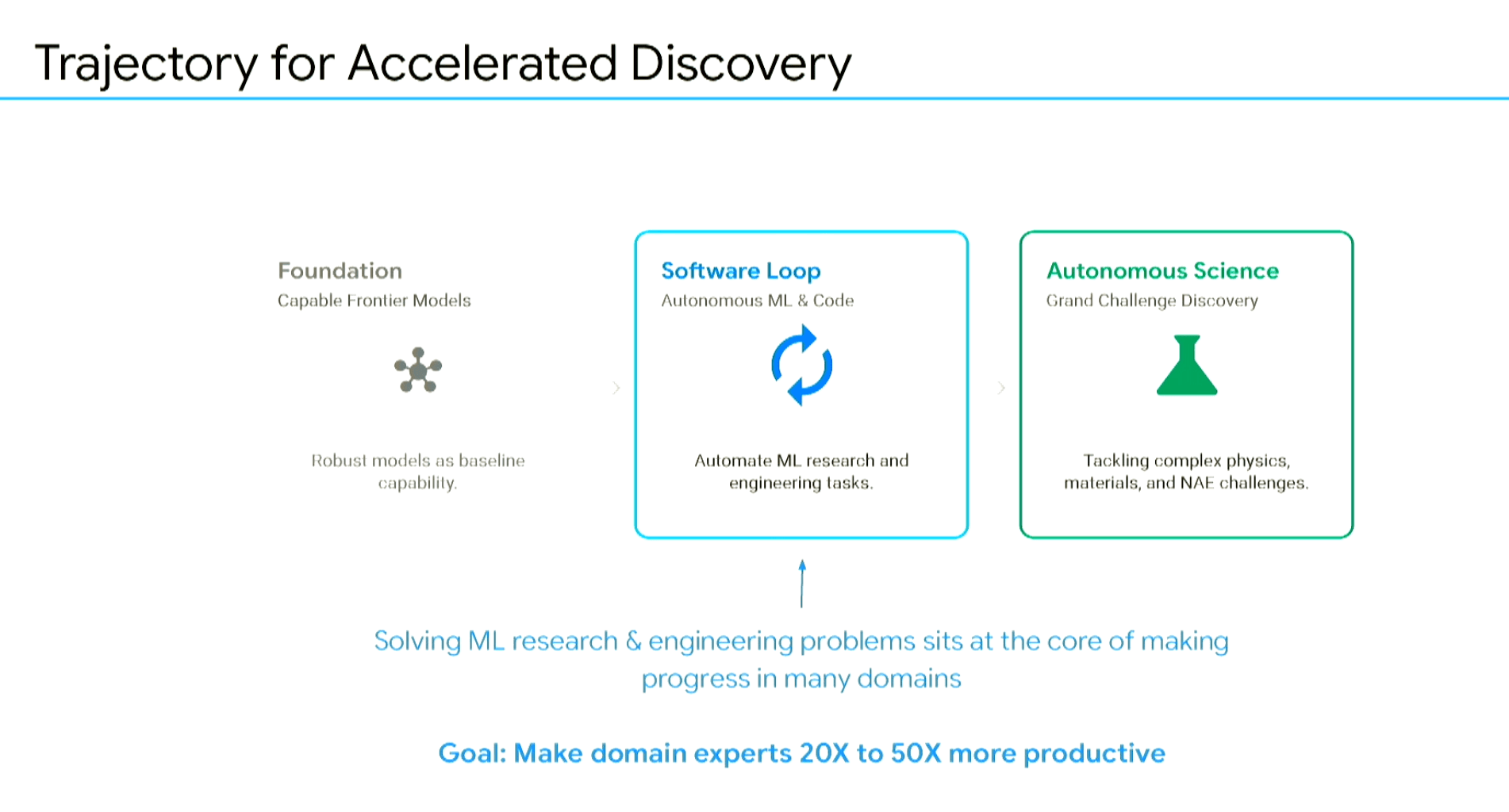
We want to empower scientists and engineers working on ambitious problems to attack core challenges with far less mundane cognitive overhead. In this paradigm, humans remain firmly at the helm of strategic direction.
The explosion of machine learning over the past 15 years has laid a rock-solid model foundation, creating the fertile ground needed to usher in a new era of automation across ML, natural sciences, and engineering.
Jeff Dean in Conversation with Fei-Fei Li: RSI is Bound by Physical Reality, and Distillation Was Initially Cold-Shouldered
Why Leave Google to Go All-In on a Startup?
Fei-Fei Li: Thank you, Jeff. Fantastic talk. I believe this is today’s closing session, which puts us right between the audience and the afternoon refreshments.
Jeff Dean: Haha, that’s always a tough spot on the schedule.
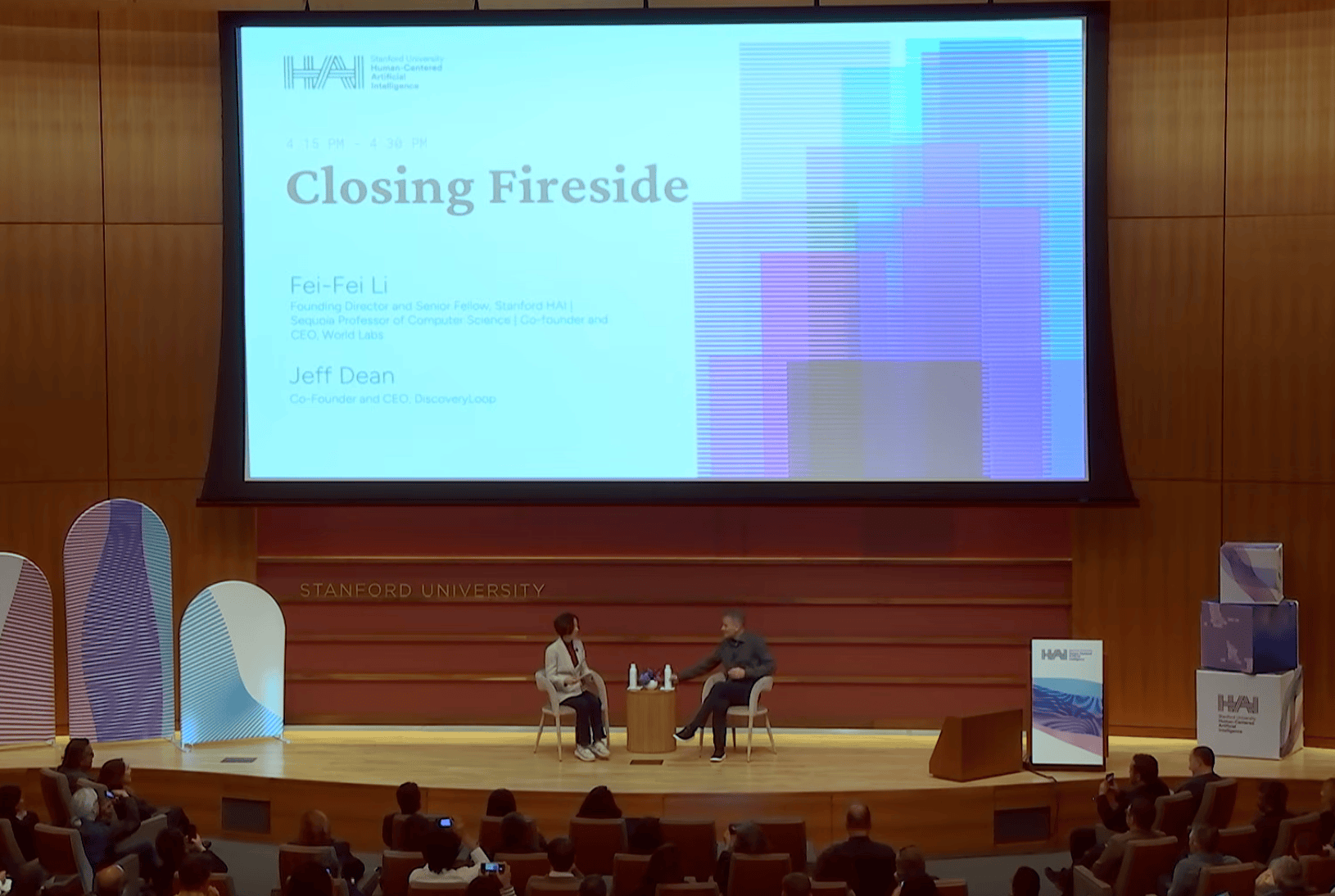
Fei-Fei Li: I originally prepared some deeply geeky technical questions. But since this is a fireside chat, I’ll balance the roles of interviewer and co-explorer.
First, congratulations! My first question cuts straight to the core: Why found Discovery Loop right now?
All four of you spent years at Google—especially you, having joined back in 1999. The industry’s technological leaps in recent years are well-known, but I’m curious: what was the defining “aha” moment over the past year or two that convinced you, Quoc, Sanjay, and Oriol that you needed to build something completely different, and that you had to step outside the existing system to do it?
Jeff Dean: The crux of it is that we clearly saw the astonishing potential of automated systems across the entire software engineering lifecycle.
A decade ago, Quoc pioneered much of the groundbreaking work on Neural Architecture Search (NAS). In essence, that was an early form of recursive self-improvement: letting algorithms autonomously search for optimal model topologies for vision or NLP tasks.
Even back then, we validated the feasibility of that direction. The only limitation was that the entire system relied on mountains of verbose, cumbersome, and highly bespoke Python boilerplate to hardcode the search space.
Today, you can simply use natural language to express high-level goals directly to capable foundation models and agent clusters—like, “Explore a dedicated neural network architecture best suited for analyzing specific MRI features”—and the system can execute the exploration and validation end-to-end.
This qualitative leap in interaction has fundamentally reshaped our understanding of computational boundaries and AI’s potential. If we can harden the reliability of such systems to an industrial grade, the value unlocked will be immense. We are convinced that the natural sciences and deep engineering are the ideal arenas to unleash that maximum positive impact.

Fei-Fei Li: So the true catalyst for stepping outside and founding a company was this new paradigm—one that pairs closed-loop execution with the potential for self-evolution.