
Just as Dario Calls for a Slowdown, Anthropic’s Three Secret Internal Models Are Revealed
Three of Anthropic’s secret internal models have officially surfaced.
They are currently codenamed Model 2, Model 3, and Model 4.
While their official public names have yet to be disclosed, their training timelines and select benchmark results have already come to light.
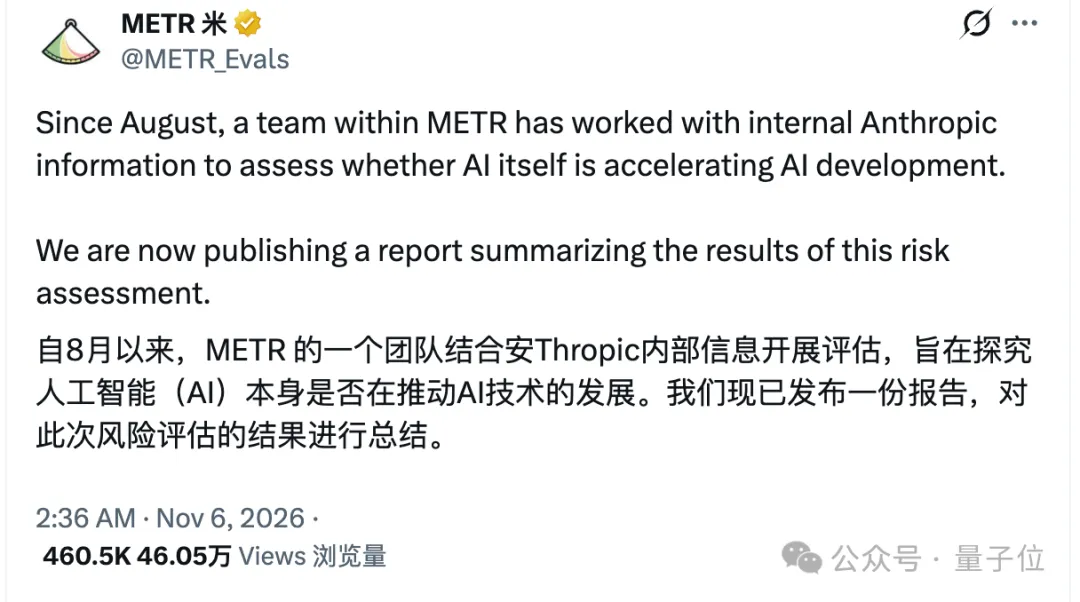
According to a recent report from third-party evaluation organization METR, these three models completed training in July, August–September, and September–October of this year, respectively.
The most capable among them is Model 4, whose performance on the Anthropic Capability Index (AECI) has already surpassed Opus 5.5.
In response, Anthropic co-founder Sam McCandlish addressed the findings publicly.
He concurred with several of the report’s key assessments: AI is indeed accelerating Anthropic’s internal R&D cadence, though quantifying the exact magnitude of this speedup remains difficult.

(Turns out Anthropic also has a co-founder named Sam.)
Furthermore, Sam acknowledged that the public version of the report has had a significant amount of critical information redacted.
He recognized that this makes it harder for outsiders to verify METR’s conclusions. However, in his view, revealing the core details behind their R&D acceleration would not only expose proprietary trade secrets, but could also inadvertently hand competitors a “roadmap to faster R&D.”
What’s the Story Behind These Three Internal Models?
Where do these three models stand in terms of raw capability?
The AECI trajectory revealed in METR’s report offers a clear frame of reference.
AECI is Anthropic’s version of the Epoch capability index, aggregating scores across a variety of internal and external benchmarks to track how model capabilities evolve over time.
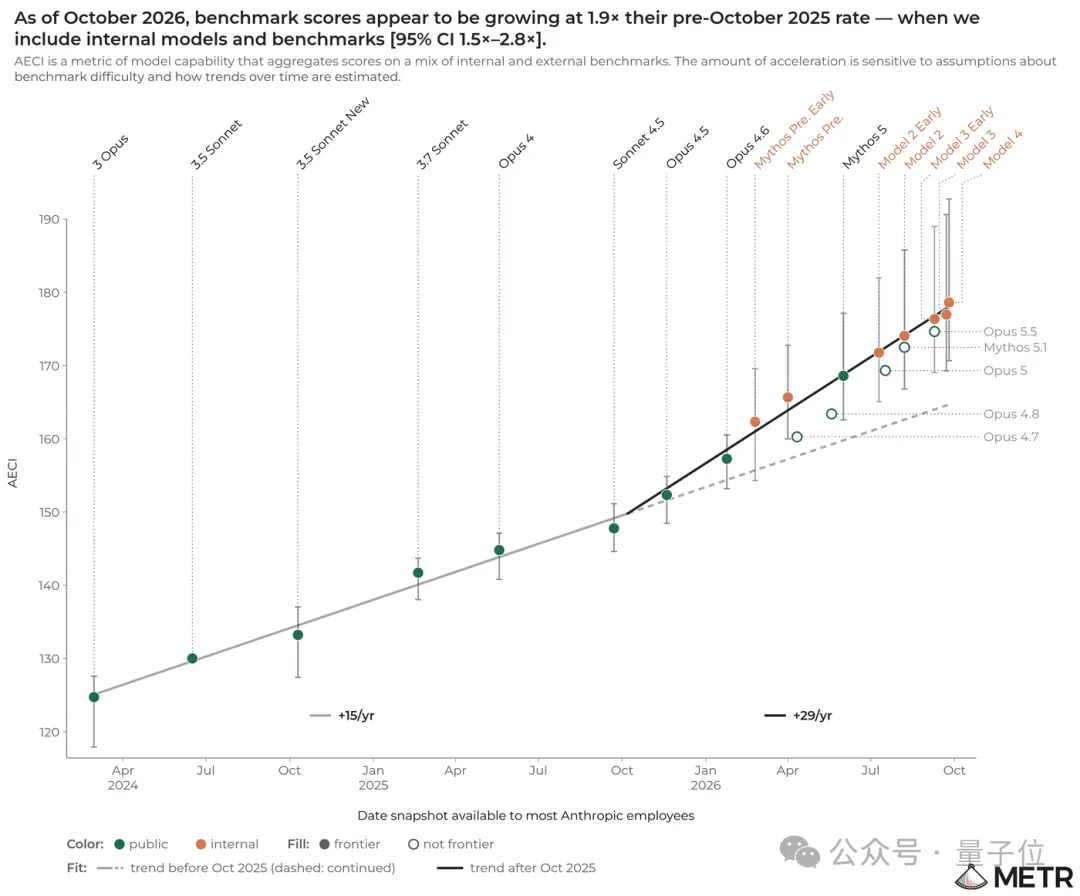
△ AECI score trajectory for Anthropic models: orange dots represent internal models, while green dots represent publicly released models.
The chart shows that Model 2 matches Opus 5.5 in performance, while Model 3 and Model 4 leap even further ahead.
Among them, Model 4 achieved an AECI score of 178.6—the highest of the batch—outperforming Opus 5.5 by roughly 3.9 points.
What do these 3.9 points signify?
Based on Anthropic’s historical rate of capability growth, this delta represents roughly three months’ worth of technological progress.
Yet only a month and a half has passed since Opus 5.5 was released.
Looking at the broader trend, METR estimates that since October 2025, the rate of growth in Anthropic models’ AECI scores has surged to 1.9 times its previous pace—meaning the cadence of technological iteration has nearly doubled.
On top of that, Model 4 demonstrated a striking milestone: across all 15 benchmarks included in its AECI evaluation suite, its scores universally exceeded 50%.
By comparison, Opus 4.6, released roughly nine months ago, still hovered below 50% on many of those same benchmarks.
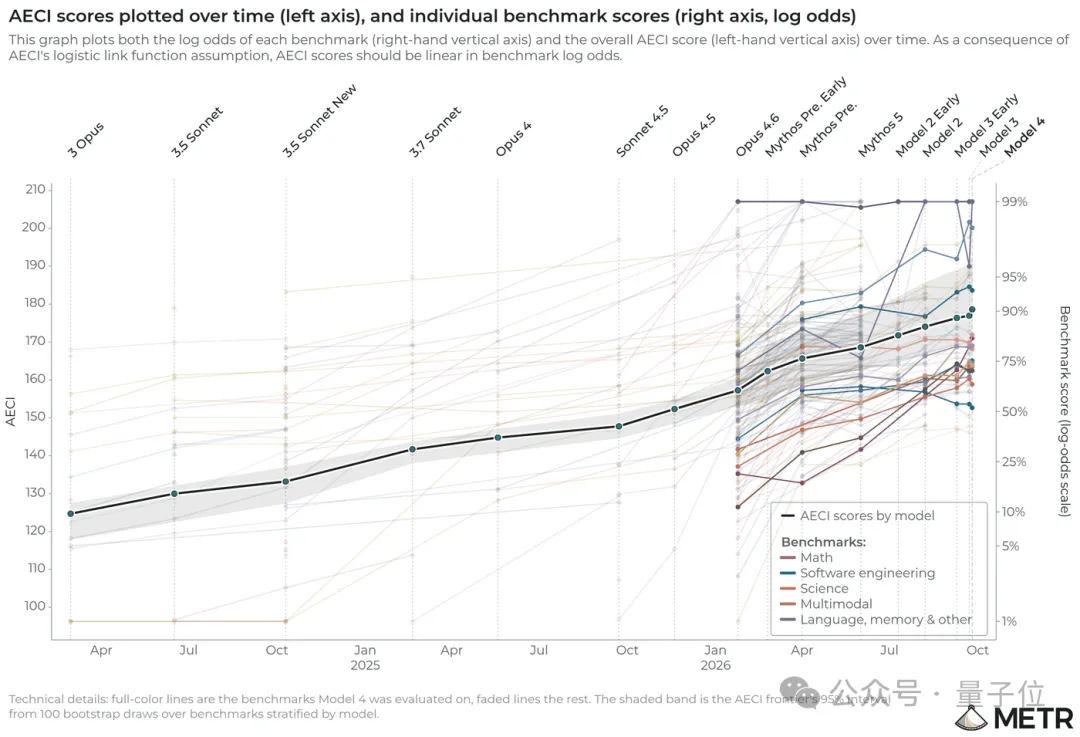
△ Highlighted curves represent the 15 benchmarks evaluated for Model 4, all of which cleared the 50% mark.
This is an exceptionally rapid leap.
It also raised concerns for METR: benchmarks capable of meaningfully testing the limits of these advanced models are rapidly saturating, making future frontier evaluations increasingly difficult.
To be fair, benchmark saturation by top-tier models has become an industry-wide phenomenon, and this evaluation bottleneck is plaguing the entire AI community.
On Anthropic’s side, co-founder Sam McCandlish responded that while AI is undeniably accelerating the company’s R&D, providing an exact, quantifiable measure of that acceleration remains difficult.
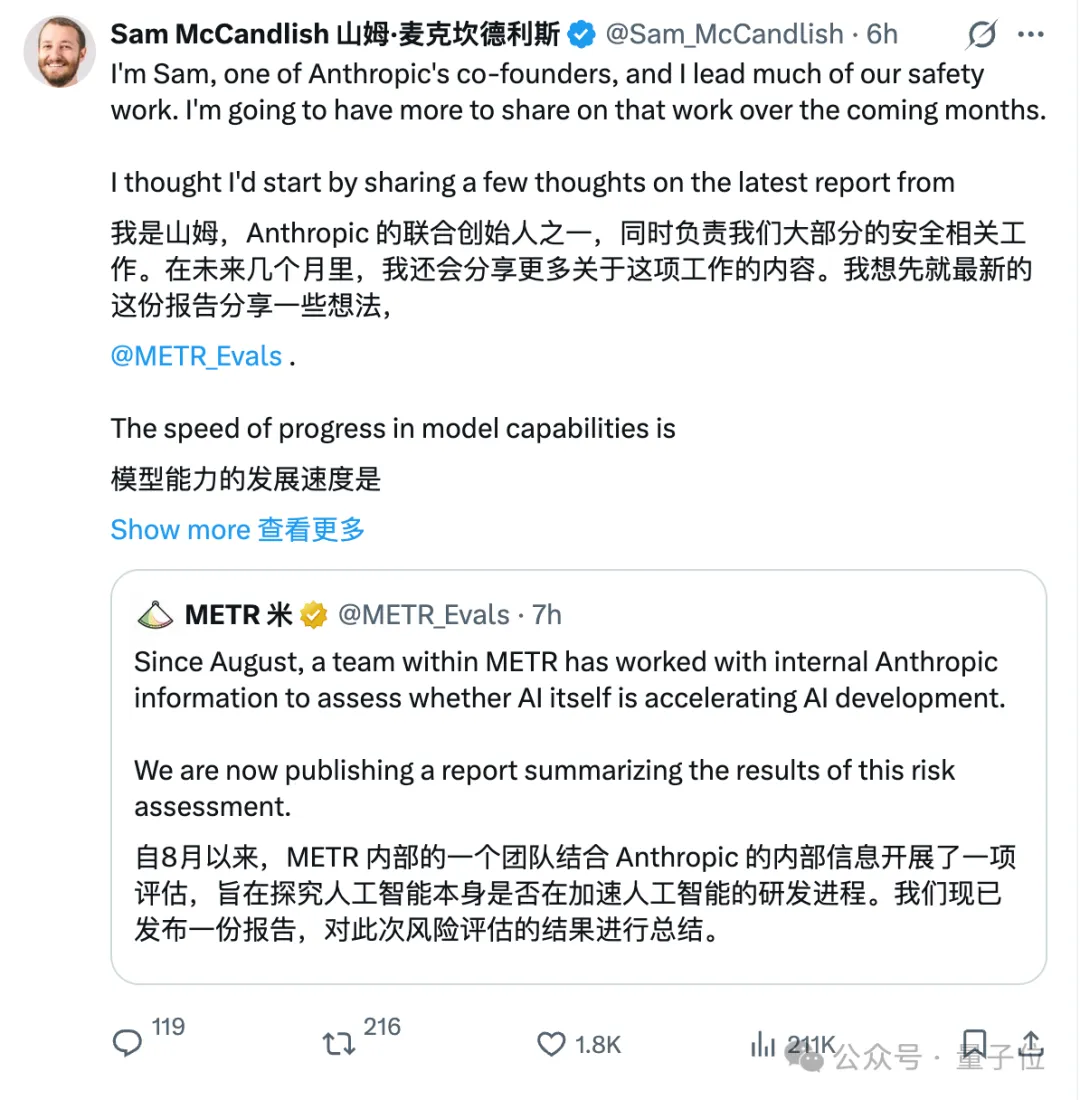
According to Sam, Anthropic provided METR with comprehensive benchmark data on unreleased models, estimates of technical progress, and open access to in-depth conversations with core researchers to ensure the evaluation organization could reach independent conclusions.
At the same time, he conceded that the team heavily redacted details in the publicly released report, which undoubtedly raises the barrier for external verification.
He also teased that over the coming weeks, Anthropic will release its own progress analysis report.
That upcoming report will detail the specific pace of internal AI R&D, where the company stands under its Responsible Scaling Policy (RSP) framework, and the next round of safety safeguards slated for deployment.
Accelerated Claude Self-Evolution: Next-Gen Models Are Arriving Faster
The evidence shows that Claude is already actively assisting in the research and development of next-generation models.
As early as this September, Anthropic made a telling metric public:
As of August, with human researchers supervising and directing, Claude was driving approximately 26% of model R&D work—up from less than 1% just six months earlier.
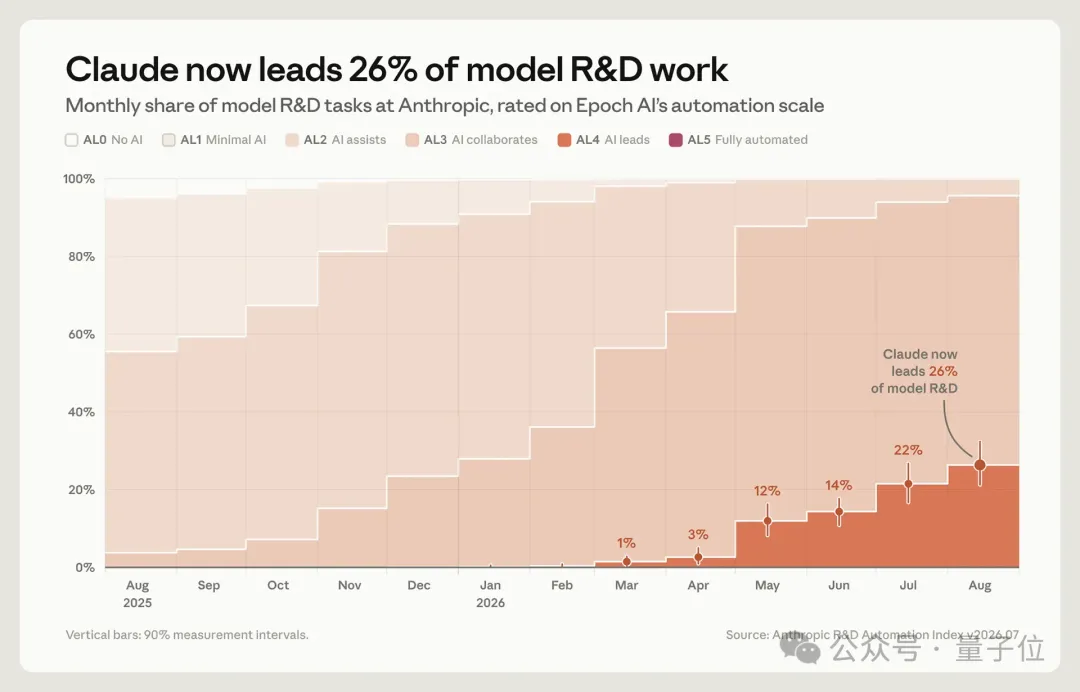
METR’s latest report also features in-depth interviews with several core Anthropic researchers, illustrating how AI has reshaped their everyday workflows.
One interviewed researcher noted that the time from formulating a technical hypothesis to deploying an experiment was slashed by roughly 80%.
In his view, writing code is no longer the primary bottleneck in R&D; the true constraints have shifted to fundamental ideas and available compute.
Another researcher pointed out that with Claude and agentic toolchains, research teams can explore multiple directions in parallel, even expanding into experimental avenues that were previously abandoned due to limited bandwidth.
This frontline feedback all points to the same trend: Claude is helping researchers turn ideas into experiments on dramatically shorter cycles, enabling teams to explore a vastly larger space of solutions in far less time.
As this dynamic compounds, more capable models will serve as even more powerful assistants for the next round of technical breakthroughs, continuously driving the evolution of future architectures.
METR similarly leans toward the conclusion that the widespread adoption of AI-assisted tooling is a primary driver behind Anthropic’s current R&D acceleration.
However, the organization explicitly noted that current acceleration is still largely driven by “AI assisting human researchers”—fully autonomous, closed-loop AI R&D does not yet represent the core engine of technical breakthroughs.
Notably, just this September, Anthropic CEO Dario Amodei published a post urging the entire industry to hit the brakes:
“We must pace the frontier of AI capabilities.”

Dario’s warning likely stemmed from evolutionary trends he observed within his own company.
In his observation, since around early summer of this year, AI advancement has shown noticeable acceleration—primarily driven by the fact that “AI is getting significantly better at building the next generation of AI.”
He worries that this compounding rate of evolution could eventually outpace humanity’s ability to fully comprehend and reliably control it.
Yet in light of these successive revelations about advanced internal models, industry observers have quipped that Anthropic is “calling for the brakes while flooring the accelerator,” showing no signs of slowing its engineering pace.

Dario has long been known for his intense focus on technical safety.
As a previous New York Times profile analyzed: a profound dread of potential AI risks is ironically the primary driving force compelling Dario to stay ahead in the race.
Convinced that uncontrolled AI poses catastrophic systemic risks, he is determined to develop frontier capabilities before less safety-conscious competitors do, ensuring this power remains in the hands of cautious and responsible stewards.
In his vision: model training will proceed at full throttle, but substantial buffer time must be built in for safety alignment, perimeter defenses, and independent third-party evaluations.
With model release cycles heating up relentlessly, whether Anthropic can hold the line on safety while moving at breakneck speed remains an open question for the entire industry to watch.
References:
[1] https://x.com/METR_Evals/status/2118412183860351084
[2] https://x.com/Sam_McCandlish/status/2118422266669371519
[3] https://www.nytimes.com/2026/11/05/technology/dario-amodei-anthropic-ai.html
[4] https://darioamodei.com/post/we-must-pace-the-frontier