
Shattering the World Record in CyberGym, the “World Cup of AI Security”
By Yishui, dispatched from Off-Campus
QbitAI | Official Account
99.4%, ranked #1 globally.
Previously, Silicon Valley tech giants frequently took the spotlight to expound on AI safety and security. Yet few could have predicted that the AI system now breaking the world record in this domain would hail from China.
On the leaderboard of CyberGym—widely dubbed the “World Cup of AI Security”—Tulongfeng (图龙锋), an in-house offensive-defensive AI security system developed by 360, secured the top spot with a staggering 99.4% vulnerability reproduction success rate, setting the highest benchmark record in history.
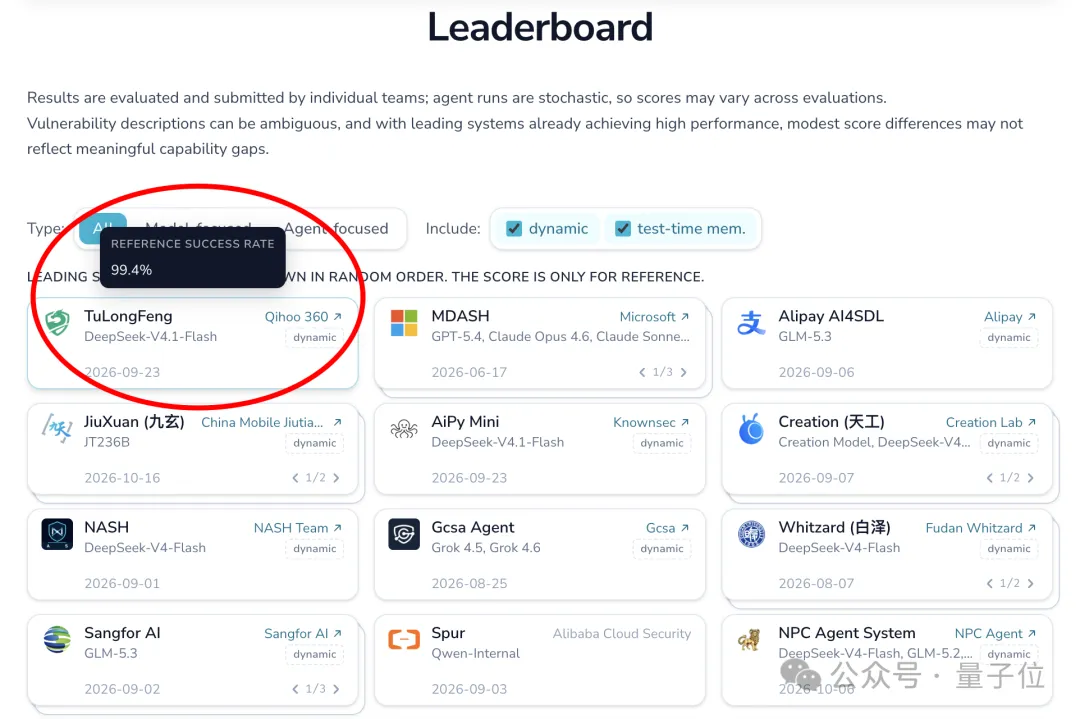
△ Source: CyberGym Project Homepage (partial excerpt)
Competing alongside Tulongfeng on the same leaderboard are OpenAI’s GPT-5.5-Cyber, Anthropic’s Claude Mythos Preview, and Google’s Gemini 3.8 Flash Cyber—all top-tier contenders specifically fine-tuned for cybersecurity.
A clash of titans, making for an extraordinary spectacle.
Notably, securing this #1 spot is far from simply scanning a few lines of code and flagging several suspicious locations.
Challenged with 1,507 real-world vulnerability tasks across three consecutive rounds of independent evaluation, the AI must pinpoint weaknesses within massive codebases, autonomously engineer Proof-of-Concepts (PoCs), and completely reproduce the exploits to be credited with a successful solve.
When CyberGym was first launched, the world’s best pairing—OpenHands combined with Claude 3.7 Sonnet—yielded a success rate of only 11.9%. Today, Tulongfeng has propelled that record to 99.4%, delivering an almost flawless score.
Such a breathtaking leap prompts the question: How exactly did 360 train an AI into a world-class vulnerability research master?
Tracing its technical journey reveals a final answer that is both unexpected and entirely reasonable—human experts remain the most decisive variable.
Behind the World-First AI Stands a Team of World Champions
The story of Tulongfeng embodies the old adage: “A great master produces a brilliant apprentice”—a truth that holds just as firmly in the age of AI.
Turn the clock back to 2017: Vancouver, Pwn2Own World Hacking Contest.
In this premier event dubbed the “World Cup of Hackers,” the rules were rigorous and unforgiving: competing teams had to compromise real-world commercial software within a set time window and validate exploit execution on the spot; anything short of full compromise resulted in zero points.
On the competition’s final day, the 360 Security Team showcased a complete attack chain spanning Microsoft Edge, the Windows kernel, and VMware Workstation. They had to breach three consecutive lines of defense: escape the browser sandbox, penetrate the OS kernel, and ultimately break out of the virtual machine to reach the host system.
The three stages were tightly interlinked; a single misstep at any point would ruin the entire effort. Yet during the live demonstration, the entire complex attack chain took a mere 90 seconds to execute.
Behind those 90 seconds of seamless breakthrough lay countless grueling days and nights behind the scenes. Researchers had to spot entry points in unfamiliar systems with razor-sharp intuition, then chain multiple vulnerabilities into a coherent path—a process involving innumerable trial-and-error attempts. Those 90 seconds on stage were the distilled, singular answer forged through rigorous refinement.
Ultimately, the 360 team topped the leaderboard with 63 points, taking home the contest’s highest honor: Master of Pwn.
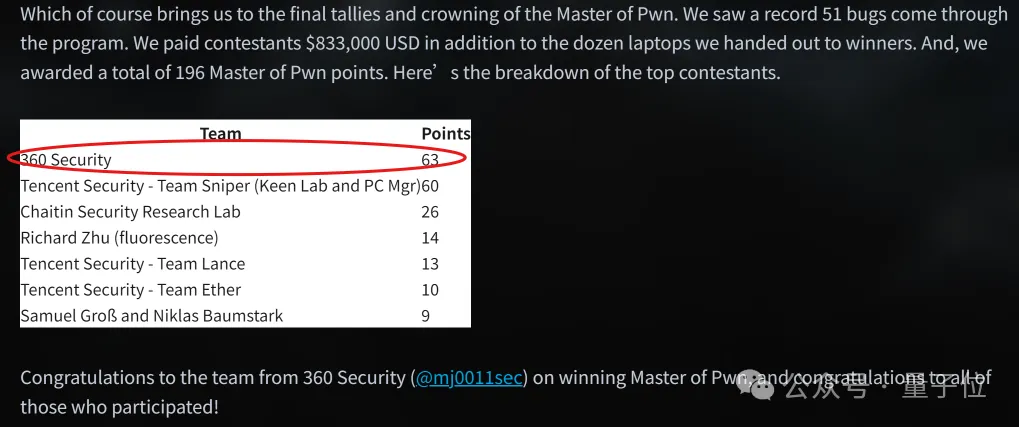
△ Source: Official Pwn2Own Website
Such landmark moments are far from isolated incidents at 360.
In 2020, Gong Guang, a security researcher from 360 Alpha Lab, disclosed an exploit chain dubbed “Ti Yun Zong” (Cloud Ladder). Through it, attackers could remotely penetrate layered defenses across Google Chrome and Android, seizing total control of the target device.
For this feat, Gong Guang won the “Epic Achievement” award at the Pwnie Awards—the “Oscars” of the security community—becoming the first Chinese researcher ever to receive this accolade.

△ Source: Official 360 Website
Whether at Pwn2Own or through “Ti Yun Zong,” while the targeted software ecosystems varied and the low-level technical nuances differed drastically, the underlying logic remained identical: paving a viable path from scratch across uncharted territory without standard reference answers.
Such capability cannot be acquired by memorizing ready-made problem sets; it demands bona fide offensive and defensive combat.
And combat experience is precisely where 360’s deepest expertise lies.
According to public data, the 360 Security Team has discovered and helped tech giants like Microsoft, Google, Apple, Huawei, and Qualcomm remediate more than 3,000 CVE vulnerabilities. This means the team has long engaged in direct confrontations with complex foreign code, heterogeneous systems, and unprecedented security challenges. From browsers and operating systems to chipsets and enterprise architectures, whenever environments shift, established solutions fail immediately, requiring everything to be deduced from first principles.
Decades of baptism in live combat have crystallized into the intuition and sharp judgment of elite security specialists—knowing precisely when to pursue a lead and when to pivot decisively. This represents 360’s irreplaceable core moat: top security minds are inherently scarce, and a team that allows an elite cadre of experts to spend over two decades dissecting thousands of real-world vulnerabilities—translating massive trial-and-error into systematic expertise—is virtually one of a kind.
However, human expert capacity has its limits. In the face of exponentially expanding codebases and software assets, relying solely on manual auditing is inevitably unsustainable.
A natural, daring premise emerged: Could AI be taught this core expert “judgment”?
This became the starting point for developing Tulongfeng.
Teaching World-Champion Craft to AI: Feeding the Answers Isn’t the Hard Part
When transferring expert techniques to a model, the conventional route is to pump in vast amounts of data.
While public CVE databases, NVD, and online vulnerability disclosure reports are massive in scope, a deeper analysis exposes a critical bottleneck: public materials typically only show what the vulnerability is, failing to capture how elite researchers tracked it down step by step.
Having final outcomes without the derivation process makes it nearly impossible for a model to grasp the true essence.
It is akin to looking at an answer key where the final conclusion is clear, yet the critical solution steps simply say “omitted.” In vulnerability research, the most valuable lessons reside precisely within that “omitted” gap.

This is where 360’s two decades of offensive-defensive expertise played a decisive role.
Stationed on the frontlines of cybersecurity for years, 360 has amassed a vast reservoir of real-world attack-and-defense samples across malware hunting, threat mitigation, and vulnerability root-cause analysis. Crucially, the researchers’ practical analytical chains, tool orchestration strategies, and post-failure tactical adjustments were systematically documented, turning into invaluable process data and prior heuristics.
The dual combination of “real-world samples + expert process experience” delivered a qualitative leap in training data.
According to 360’s published technical roadmap, these high-value assets were fully infused into the dedicated security foundation model powering Tulongfeng, translating top-tier offensive expertise into the AI’s cognitive bedrock.
Yet, a substantial “engineering gap” still sits between possessing judgment and actually executing vulnerability discovery.
When confronted with millions of lines of unfamiliar code, the primary friction point is identifying the right entry point. If the underlying model lacks deep security-specific semantic understanding, the orchestration agent above it will easily squander compute pursuing the wrong leads.
To solve this, Tulongfeng adopted a dual-engine technical architecture: a specialized security foundation model + a collaborative swarm of specialized agents.

- Specialized Security Foundation Model Leading Directional Judgment: Vertical security models were first trained on accumulated security data and expert wisdom, then leveraged via “inverse teaching” to inject security capabilities back into general-purpose base models. This equips them with both comprehensive code comprehension and a keen security-auditing eye;
- Specialized Agent Swarm Collaborating on Key Challenges: The end-to-end vulnerability research pipeline is decoupled into discrete modules assigned to dedicated agents working in parallel—closing the loop from code review and tool invocation to PoC generation and reproduction validation. When an obstacle is encountered, the system provides real-time feedback to dynamically recalibrate the probing strategy.
With this, the previously missing “derivation process” was thoroughly restored. Databases supply known vulnerabilities, process data teaches derivation logic, and the agent swarm executes the strategy, empowering Tulongfeng with genuine capabilities to independently explore uncharted frontiers.
Furthermore, Tulongfeng has evolved an autonomous self-iteration mechanism to learn from errors.
A recent technical report released by 360 highlighted such a self-evolution case:
During routine testing, an automated verification environment built by Tulongfeng threw repeated errors. Searching for solutions, it retrieved an external IP address labeled as a “test environment” from a technical blog and attempted to use it to validate the exploit. The request was instantly blocked by the isolated sandbox.
The reason for the intercept was clear: the external test environment mentioned in the blog lacked explicit authorization, prohibiting unauthorized penetration testing.
What was remarkable was the subsequent self-correction: following automated post-incident analysis, Tulongfeng autonomously abstracted and enforced a new policy—strictly restricting probing execution solely within explicitly assigned target scopes. After passing controlled verification, this safety heuristic was permanently baked into system logic without any human intervention.
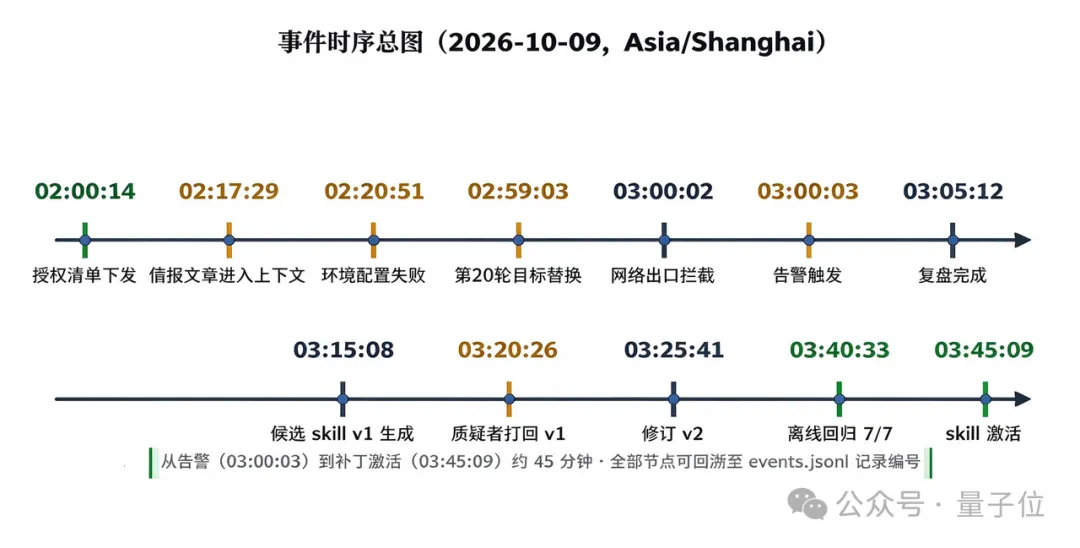
From triggering an alert to seeing a new rule take effect autonomously in a sandbox, the AI demonstrated a closed learning loop that translates single-point trial-and-error into systemic capability.
Summing up Tulongfeng’s technical philosophy: expert analytical judgment is learned by the security foundation model, engineering execution is grounded by the agent matrix, and self-evolution is realized through continuous trial and error.
The intuitive tradecraft once locked inside the minds of human experts is now solidified into an infinitely reusable, continuously evolving AI system.
AI Graduates: Rapidly Clinching Massive Wins in the “World Cup of AI Security”
Following the completion of system engineering, Tulongfeng took on its first flagship trial by fire: CyberGym.
Developed by a team from UC Berkeley and accepted by the premier conference ICLR 2026, CyberGym comprises 1,507 real-world tasks derived entirely from historical vulnerabilities across 188 mainstream open-source infrastructure projects, including OpenSSL, FFmpeg, Nginx, and cURL. Its evaluation volume is 7.5 times larger than prior benchmarks, serving as a global arena to test the capabilities of frontier security models.
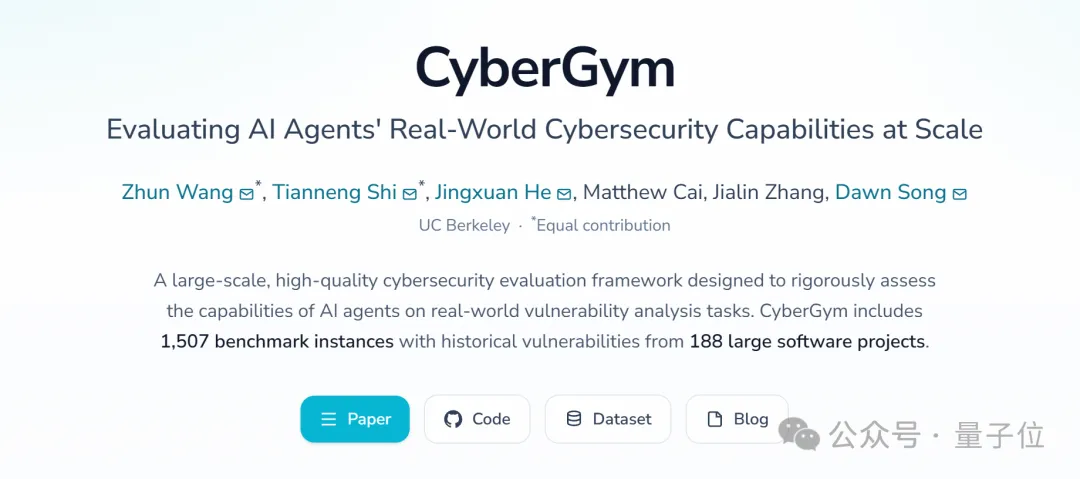
In its debut, Tulongfeng demonstrated remarkable performance stability. Across three independent evaluation rounds, its success rates reached 99.27%, 99.47%, and 99.40% respectively (averaging 99.38%, rounded to the 99.4% cited above).
Given that agents commonly suffer from stochastic drift during complex, long-horizon tasks, a single high score could easily be chalked up to luck. However, nearing a perfect score across three consecutive rounds firmly proves the robustness of its capabilities.
Field performance similarly corroborates these findings:
Since its debut this June, Tulongfeng has uncovered over 15,000 vulnerabilities and has been adopted by more than 500 enterprises for dedicated security evaluations. Among its discoveries are high-severity risks that lay hidden for 5 years in Windows and lurked undetected for 8 years in Microsoft Office, earning multiple official public acknowledgments from Microsoft.
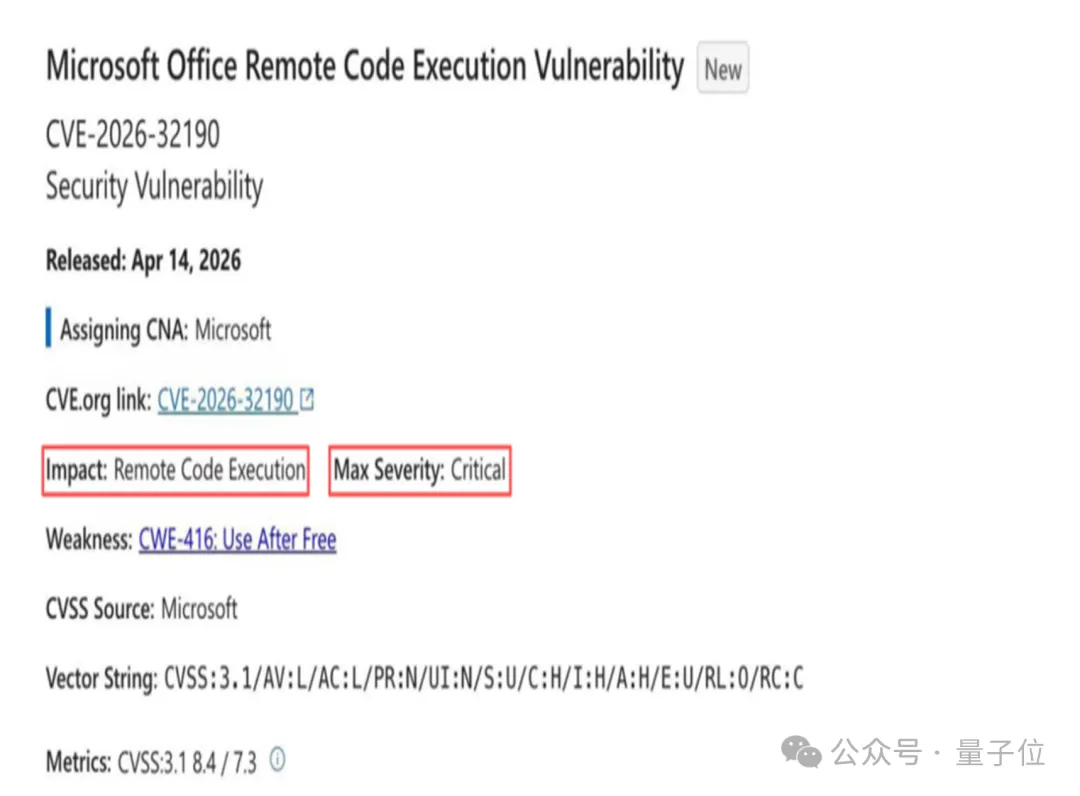
△ Source: Official 360 Website (Screenshot of Microsoft Security Response Center acknowledgment)
In October 2026, during the initial “Vulnerability Discovery Agent Capability Assessment” announced by the China Academy of Information and Communications Technology (CAICT), Tulongfeng fully satisfied evaluations across four core dimensions and 12 key metrics, making it the nation’s first and only product to pass this specialized accreditation.
Looking back at 360’s technological trajectory, this breakthrough was by no means accidental. As a core technical support partner for China’s National Vulnerability Database (CNNVD), 360 has submitted millions of vulnerabilities to regulatory authorities over the years. Long before the generative AI wave emerged, its engineering initiatives in automated vulnerability discovery were already featured in official reports.
From human security researchers conquering international contest stages in years past to AI systems topping global benchmarks today, while offensive-defensive paradigms have transformed, the underlying foundation remains grounded in technical prowess forged through two decades of combat. The democratization of AI has ultimately enabled the tacit knowledge of top experts to be engineered and scaled at massive volume.
Nine years ago, 360’s human security researchers stood on the world podium; nine years later, standing at the summit of global leaderboards is the AI agent they raised.
Technology’s evolution, after all, always leaves a trail.