
Conquering High-Stakes Commercial Video Scenarios
The business model behind AI micro-dramas is now going full “Taobao.”
During this year’s Double 11 shopping festival, Taobao Micro-Dramas, in collaboration with Tmall Hey Box, Tmall Global, and various partners, released a wave of derivative AI “branded micro-dramas.” What’s even more groundbreaking is that viewers can binge-watch a series and immediately follow product links, creator reviews, and brand livestreams—completing a seamless, full-funnel conversion from initial content discovery to final checkout.

Among this lineup, renowned actress Irene Wan starred as the female lead in Taobao’s AI micro-drama Advent of the Nine Tails, simultaneously acting out a cyber-cultivation storyline and pitching products for brands like Midea and Dyson.
Even more striking: no matter how quickly the camera cut or how dynamic the action was, the character’s facial consistency remained rock-solid. Skin textures and micro-expressions were captured with pinpoint accuracy:

Meanwhile, well-known brand Quanyou Home Furnishings also leveraged Double 11 to launch an innovative campaign alongside Taobao AI micro-dramas. They created a custom series, Beyond the Final Chapter, specifically tailored around their wardrobe products, positioning the furniture as a pivotal narrative device connecting two parallel worlds.
From material textures and spatial proportions to multi-camera angles in complex environments, the product details stayed remarkably stable, passing the rigorous test of accurate perspective and spatial consistency:

Another standout was The Clumsy Paws Bistro, an AI micro-drama launched under Tmall Global’s “Pet First Aid Kit” campaign. In the series, every strand of animal fur was crisp and well-defined, facial expressions felt lively and natural, and multiple cute pets interacted on-screen without visual clutter or artifacting. Even across frequent camera cuts, individual coat colors, markings, and costume details remained perfectly consistent:

Making this pipeline run smoothly boils down to robust underlying AI technology. The model must not only faithfully render characters and merchandise down to the finest detail, but also weave brands organically into the narrative fabric, producing output that meets true commercial standards.
The engine behind this demanding feat is Alibaba’s next-generation video generation model released in August: Wan 3.0.
Evidently, the battlefield for video generation models has moved past early tech demos, plunging directly into the deep waters of enterprise commercial deployment.
The High Stakes of AI Video: Shifting Focus to Commercial Productivity
Ask anyone in the AI video space today, and they will tell you the same thing: the barrier to generating a single, visually stunning, visually punchy shot has dropped dramatically.
Among this year’s hottest trends, AI micro-dramas, AI feature films, and AI short-form clips have undeniably claimed the spotlight. Yet, despite the apparent boom across the board, one specific segment—the closest to core monetization and the ultimate test of commercial delivery—has remained notoriously hard to crack: e-commerce advertising.

Why is that? Compared to other video scenarios, advertising has unforgiving requirements: visual appeal alone is not enough; the model must also stably and precisely reproduce commercial assets.
Standard video generation permits the algorithm creative freedom, hallucinations, slight morphing, or subtle tweaks. But ad content demands absolute precision: packaging cannot be warped, brand logos cannot be distorted, and core selling points cannot be arbitrarily altered by the model. A single visual glitch can render the footage unusable as promotional material—or worse, trigger a PR risk for the brand.
This means AI must not only comprehend products, brands, and narratives, but also grasp the logic of commercial conversion to satisfy advertisers’ stringent delivery standards.
Consequently, commercial-grade video models are no longer judged solely on visual aesthetics. They must offer exceptional consistency, controllability, and editability, tailored deeply to business needs, before they can truly integrate into standard production pipelines for commercial content.

To solve this bottleneck, select technical teams have carved out viable real-world paths.
Alibaba’s next-generation video generation model, Wan 3.0, launched this past August, directly targets key friction points in commercial production with several core technical capabilities:
- Consistency: Accurately replicates reference details, maintaining strict consistency across characters, props, voice, spatial relationships, and visual styles.
- Realistic Texture: Delivers intricate facial features and micro-skin textures, natural and restrained emotional expressions, and organic coordination between micro-expressions and body movements.
- Style Mastery: Faithfully recreates cinematic, production-grade aesthetics while preventing style bleed when alternating between diverse visual styles.
- Video Editing: Enables fine-grained adjustments to visual elements, plot progression, and dialogue lines, dramatically streamlining post-production workflows.
These capabilities form the bedrock enabling AI to understand commercial intent, reliably reproduce brand assets, and scale up e-commerce content production.

Even more notably, Wan 3.0 takes these technical capabilities into an even more demanding format: AI micro-dramas. Here, the model must endure long-form narrative arcs, a high volume of storyboard shots, and the recurring presence of key characters and featured merchandise across varied scenarios.
Wan 3.0’s real-world delivery capabilities have already been battle-tested across the short drama industry: the model previously partnered with leading content studios like Buming Culture, Qinjiu Tech, and Bikan Tech, with multiple series released or slated to launch on major platforms like Hongguo Short Dramas and Douyin.
Among them, the series Stepmother Uses Bullet Comments to Turn a Brat into a Straight-A Student, produced by Lingjing Space-Time, surpassed 29.75 million popularity points on Hongguo, with 4,564 collections/saves.
From single-shot visual generation to the end-to-end delivery of full-length micro-dramas, Wan 3.0 is steadily pushing the technical frontiers of video generation into mature commercial productivity. And the trio of AI-powered branded micro-dramas launched during this year’s Tmall Double 11 served as an intensive litmus test for Wan 3.0 in live e-commerce environments.
Three AI Micro-Dramas: Wan 3.0 Takes on High-Difficulty Commercial Scenarios
Advent of the Nine Tails: Flawless Celebrity Likeness, Lifelike Detail, Blended Aesthetics, and Dynamic Camera Work
The celebrity-customized AI micro-drama Advent of the Nine Tails, co-produced by Wan 3.0 and Tmall Hey Box, represents an ambitious experiment. With authorized portrait rights from Irene Wan, the production constructs a near-future world in 2100 where humans and deities coexist, casting Irene Wan as “Su Zhaoying,” a cyberpunk protagonist blending Eastern grace with futuristic aesthetics.
For branded micro-dramas, hooking an audience in seconds hinges on industrial-grade visual quality. Advent of the Nine Tails boldly adopts a hybrid aesthetic fusing “cyberpunk + Eastern mythology.”
One moment, you are in a neon-drenched cyberpunk metropolis filled with futuristic tech; the next, the camera seamlessly transitions into a bustling, warm-lit mythical market:
Original Link:
https://mp.weixin.qq.com/s/WoivbF8jGnpWYhjSSWgWWA
The transition between these two contrasting aesthetics is remarkably fluid. Suspended transit vehicles gliding through the sky maintain structural integrity without visual breakdown, achieving cinematic-grade visual transitions.
Rendering an impressive celebrity still in a single frame is relatively straightforward; the real challenge lies in sustaining tight character consistency across extended storyboard sequences.
Take Irene Wan’s action sequence fending off enemies with a folding fan: her white sleeves billow naturally with her torso’s movements in a continuous, fluid motion. Even during rapid motion, skeletal and body structures stay intact without the warping or dropped frames common to generative models. Her facial contours also remain perfectly consistent under dramatic camera shifts:
Original Link:
https://mp.weixin.qq.com/s/WoivbF8jGnpWYhjSSWgWWA
Zooming in for a close-up reveals precise lip-sync alignment, realistic skin luster and micro-textures, clear hair contours, and nuanced emotional expressions. This demonstrates Wan 3.0’s mature control over micro-texture rendering, facial anatomical consistency, and authentic physiological realism:
Original Link:
https://mp.weixin.qq.com/s/WoivbF8jGnpWYhjSSWgWWA
Moreover, dramatic tension relies on subtle, layered emotional buildup, which rigorously tests the model’s command of performance pacing across sequential shots.
In another scene, the character shifts from restrained forbearance to an incisive, commanding gaze as the camera pushes in, projecting an overwhelming aura that mirrors the gradual emotional escalation achieved by professional actors in traditional filmmaking:
Original Link:
https://mp.weixin.qq.com/s/WoivbF8jGnpWYhjSSWgWWA
On the commercial front, the success of an AI e-commerce drama hinges on the organic nature of brand integration. Smart appliances from brands like Midea featured in the series display crisp logos and digital control panel UIs free of distortion:
Original Link:
https://mp.weixin.qq.com/s/WoivbF8jGnpWYhjSSWgWWA
Crucially, the products appear naturally along the character’s cooking and home-organizing paths, striking a balance between narrative flow and commercial visibility.
The Clumsy Paws Bistro: Balancing Microscopic Fur Physics with Multi-Character Interactions
Produced under Tmall Global’s “Pet First Aid Kit” banner, The Clumsy Paws Bistro tackled a completely different technical challenge. Centered around an ensemble cast of anthropomorphic pets—including a Siberian husky, an orange tabby, a border collie, and a raccoon—the series chronicles their shared adventures running a pet bistro.
In computer graphics and video generation, animal subjects are notoriously difficult: fur physics are computationally expensive, and dynamic animal movement often leads to collapsed anatomy and distorted faces.
Here, Wan 3.0 highlighted its edge in microscopic detail, excelling in both physical fur rendering and morphological consistency under continuous motion. In close-up shots, the fine fur grain across the husky’s snout, individually discernible whiskers, and the reflective, wet sheen of its nose remain clearly visible:
Original Link:
https://mp.weixin.qq.com/s/WoivbF8jGnpWYhjSSWgWWA
A far more stringent test was the shot-to-shot consistency of group scenes. In a sequence featuring six pets lined up in distinct uniforms, the camera dollies in from a wide shot to an intimate close-up. Each animal’s coat pattern, marking distribution, and costume details match with precision.
In multi-entity generative scenes, feature bleed and cross-contamination are frequent issues. Wan 3.0, however, preserved clear character identity and spatial entity positioning across varying focal lengths and camera angles—a vital requirement for storyboard-heavy micro-drama production:
Original Link:
https://mp.weixin.qq.com/s/WoivbF8jGnpWYhjSSWgWWA
During high-intensity kitchen action scenes where multiple animal chefs tossed woks and deep-fried ingredients simultaneously, the physical interaction between cookware, leaping flames, and muscular exertion showed strong visual cohesion. Even amid dense, fast-moving elements, the model maintained sharp temporal continuity and spatial stability:
Original Link:
https://mp.weixin.qq.com/s/WoivbF8jGnpWYhjSSWgWWA
Beyond the Final Chapter: Structural Fidelity in Multi-Dimensional Spaces and Precise Product Replication
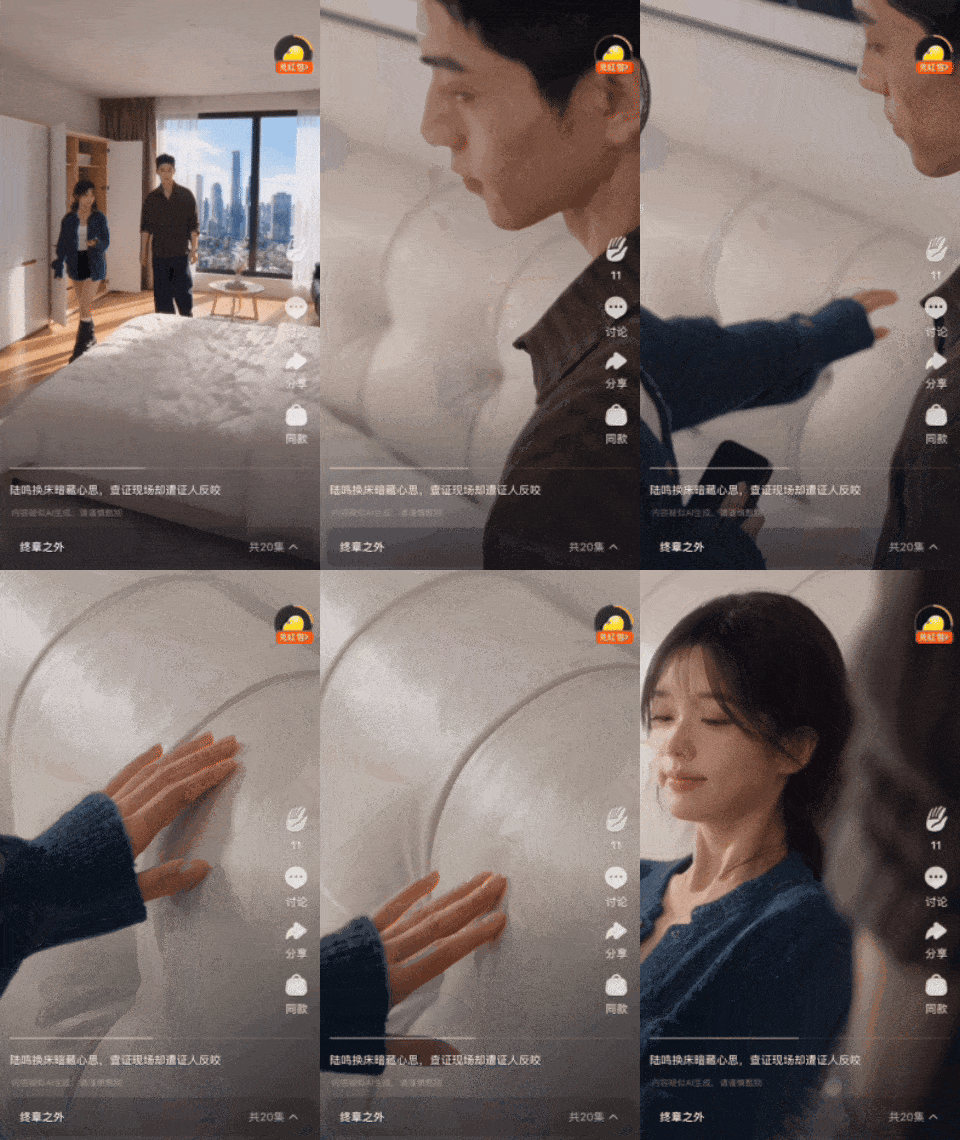
In the custom micro-drama Beyond the Final Chapter for furniture brand Quanyou Home Furnishings, a wardrobe is designated as the dimensional conduit linking dual realities, elevating the piece of furniture from background set dressing into a core narrative catalyst.
This premise posed a dual technical challenge: complex physical space modeling and structural consistency for industrial products. For home furnishings, the scale, material texture, and structural lines displayed on screen directly influence consumer purchasing decisions:

In the opening scene, as the female lead sits on a sofa to use her laptop, the intricate weave of the white fabric is faithfully rendered. The compression and rebound of the sofa cushion beneath her body strictly adhere to realistic gravitational physics. Meanwhile, the spatial perspective between the sofa, floor lamp, and expansive window view remains scrupulously accurate:
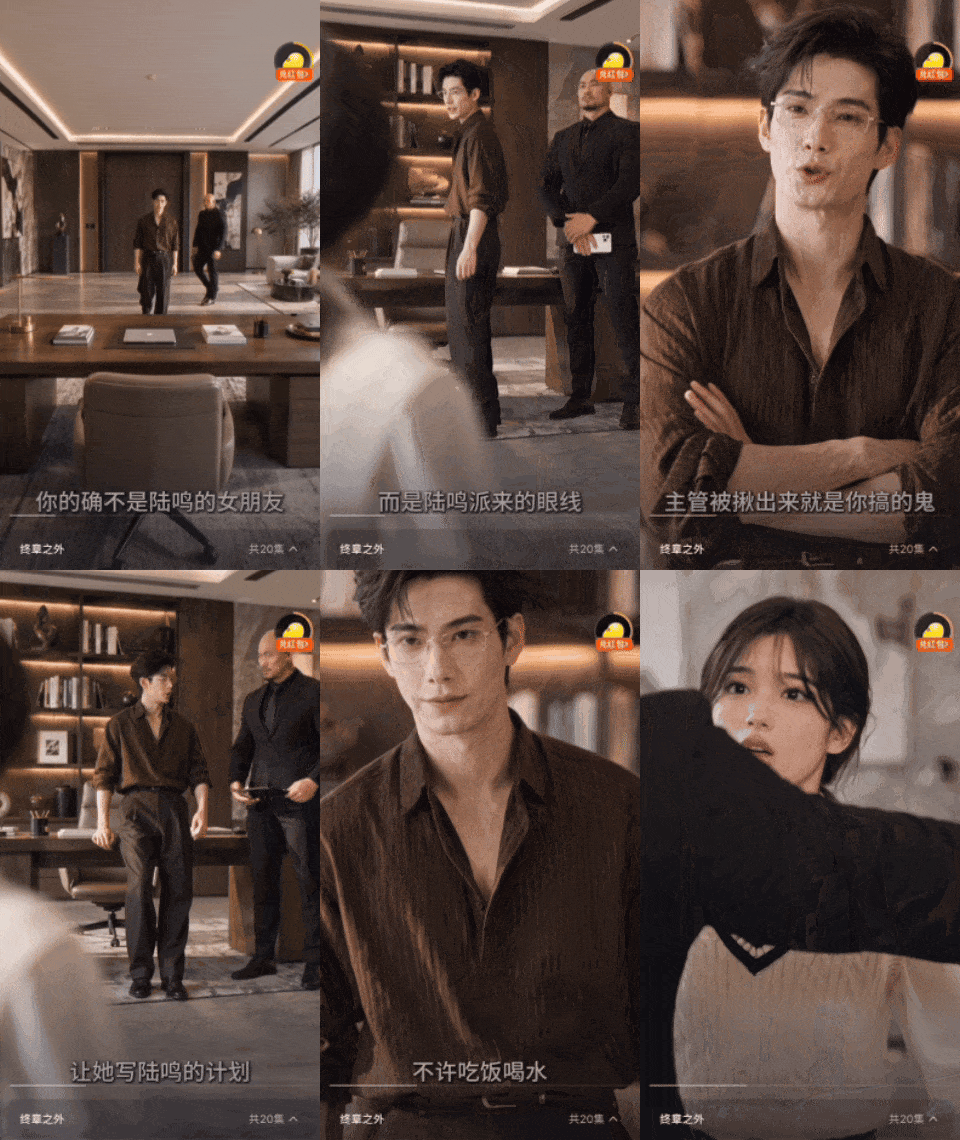
In a dialogue scene set inside an expansive, open-plan penthouse office filled with elaborate decor, the camera executes multiple rapid cuts across varied angles within seconds. Yet throughout these viewpoint shifts, the spatial coordinates of the office furniture and the architectural perspective lines stay entirely consistent, without spatial drift or warping objects:
Taken together, the performance across these three micro-dramas reflects common demands in commercial video generation: controllable character attributes, precise brand assets, multi-shot spatial stability, and seamless narrative-brand synergy. Wan 3.0’s capabilities signal that video models are evolving from novelty generation tools into engineered, reusable commercial production pipelines.
Moving Past View Counts: AI Micro-Dramas Take on Direct GMV Targets
Producing an AI micro-drama marks only the first half of the commercial journey.
For brands, investing in custom micro-dramas is never just about logo exposure; it is about leveraging cohesive emotional storytelling to highlight key usage scenarios and directly guide consumers toward conversion. The burning, pragmatic question for brands is straightforward: Can AI micro-dramas generate incremental sales?
Unlike conventional micro-dramas that treat view count as the ultimate North Star, Alibaba’s micro-drama strategy points directly at GMV (Gross Merchandise Volume).
Powered by Wan 3.0 and backed by Taobao and Tmall’s mature transaction ecosystem, Alibaba has built a closed-loop funnel running straight from content generation to merchandise conversion: brands define campaign objectives, Wan 3.0 steps in with cost-effective, high-quality content generation, Taobao Micro-Dramas drives distribution across its ecosystem, and touchpoints like product anchors, influencer reviews, and brand livestreams funnel viewers into storefronts to finalize purchases. This closed loop binds model capabilities, content assets, brand merchants, and transaction surfaces into an integrated unit.

This operational loop has already produced concrete commercial results.
Take the Pechoin-customized AI drama Chronicles of the Spirit Jade: Otherworld: within 30 days of release, it surpassed 35 million views across all platforms. Data revealed that viewers who watched the show in depth showed an 80% surge in both paid brand orders and conversion rates compared to pre-viewing levels, alongside a 130% jump in organic brand search volume. The new product featured in the drama, “Spirit Jade Cream,” cleared 10 million RMB in GMV within its debut month.
Another title, My Plane Connects to Another Dimension, along with its promotional derivative clips, gathered over 70 million total views and prompted more than 300,000 product card clicks.
Public figures show that since the 618 shopping festival kickoff this year, the Taobao Micro-Drama section has launched over 30 AI branded series, collaborating with more than 50 leading cross-industry brands—including Dyson, Shiseido, AMD, Nestlé, Pechoin, CHANDO, Blue Moon, and Quanyou Home Furnishings—spanning beauty and personal care, consumer electronics, home furnishings, maternal-and-infant products, and apparel.

Within this framework, Wan 3.0 delivers high-stability, highly controllable visual productivity; Taobao Micro-Dramas serves as the distribution hub; and the Taobao and Tmall platforms capture downstream search intent and handle checkout conversion. Keeping the entire funnel closed within a single commercial ecosystem subjects the generative model’s real-world utility directly to the scrutiny of revenue data.
This clearly mirrors a fundamental shift in how the video generation landscape is evaluated: as AI video permeates deep into real-world business workflows, the yardstick for assessing models is moving away from sheer visual novelty toward the tangible commercial value delivered to clients.