
As efforts in Systems Biology to map biology across higher resolution, broader dimensions, and more modalities continue to heat up, Fabian Theis is pushing the research frontier beyond atlas-building toward predicting and, ultimately, controlling biology.
Nov 6 · 51 min
Listen to this episode (51 min)
Fabian Theis has been one of the central figures driving the Virtual Cell concept and its various initiatives. It is no exaggeration to say that his lab has consistently remained at the algorithmic forefront of making sense of multiscale, multimodal (“multiomics”), and time-varying biological data.
In fact, his leadership across Helmholtz Munich, multiple startups, and likely Biohub itself has profoundly shaped the broader research vision and the landscape of data collection at scale.
Watch the full episode on YouTube…
Much of the recent attention in the “AI x Bio” space has centered on protein and molecular design—spanning AlphaFold, ESM, BioHub, Chai, Leash, Isomorphic, Boltz, Genesis, Octant, the Baker Lab, and many others. Yet once the initial excitement subsided, virtual cell efforts saw comparatively less spotlight—largely due to emerging skepticism around whether foundation models can effectively tackle even the most fundamental virtual cell problems.
A $1.8 Billion Bet
Biohub’s announcement a few weeks ago garnered massive media attention due to its sheer scale: a $1.8 billion commitment from Biohub, the NIH, the DOE, Google, and Meta[1]. The announcement highlighted new imaging and measurement capabilities, the generation of massive datasets, and making that data openly available for AI training.
Why double down right now? These projects have been brewing for years, so what makes this the critical inflection point to push forward?
New measurement capabilities and scalable infrastructure are now falling into place, giving Biohub’s push the potential to profoundly impact science. The DOE and NIH are developing “lab-in-the-loop” automated capabilities at scale; Google is expanding and broadening its connectomics efforts (episode coming soon!); and Biohub itself has partnered with several labs to develop and refine imaging platforms—such as laser phase plate microscopy, light sheet microscopy, and advanced post-processing for conventional microscopy to unlock deep phenotypic data. These technologies are maturing rapidly and are poised to play a pivotal role in Biohub’s initiatives.
The Virtual Cell Dilemma
This kind of multiscale, multimodal data mirrors the exact data types Fabian has spent his career modeling. On the other hand, virtual cell modeling has run into substantial hurdles, dampening enthusiasm across systems biology.
The 2025 Arc Virtual Cell Challenge highlighted this challenge: a flurry of papers revealed that, on Perturbation Prediction tasks, a constant baseline (not even a linear one!) often beat sophisticated models. If you alter a cell’s inputs or programming (via gene editing, small molecules, or environmental shifts), how will its “state” change? The sobering reality was that many models failed to outperform even the simplest baselines🤦♂️.
It’s not all doom and gloom, however:
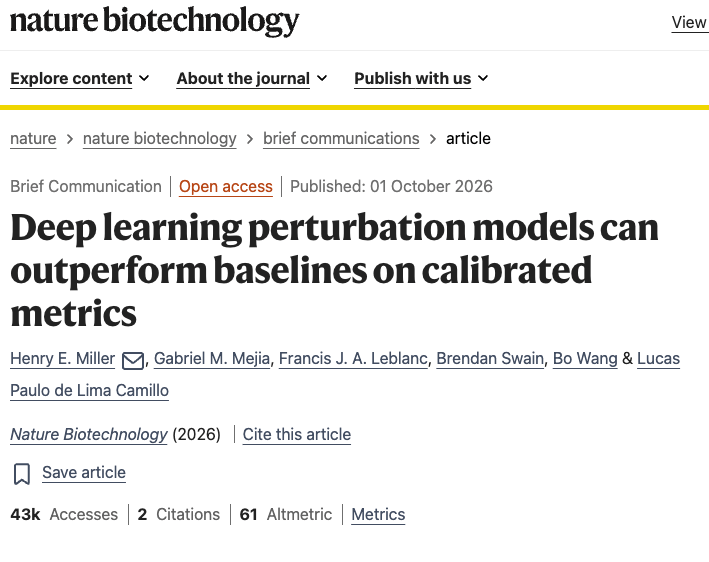
This excellent paper demonstrates that many existing…