
Anyone else gotten completely hooked on The Accident lately?
When Lorna and Keaton started dating, the audience was practically more anxious than they were…
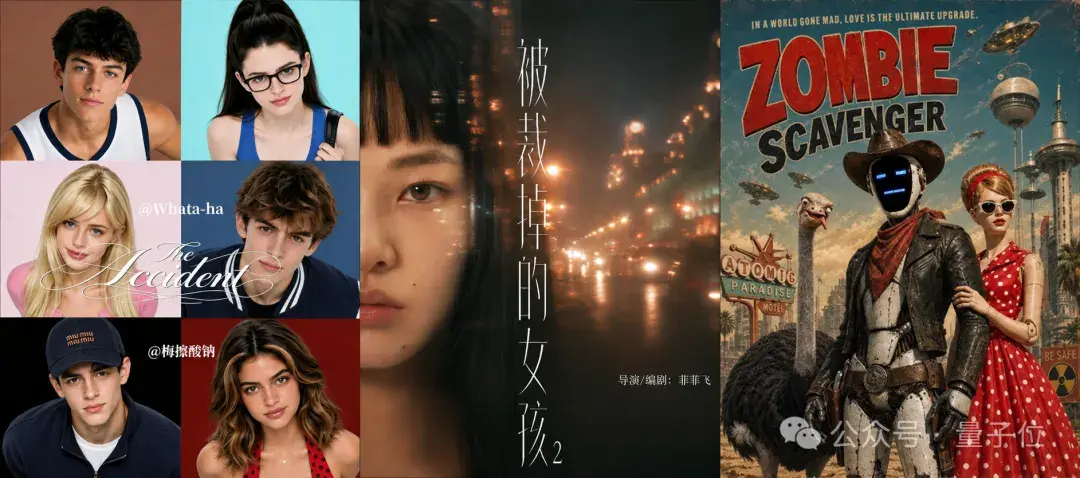
High-quality micro-dramas breaking into the mainstream have been popping up one after another recently:
One moment you’re watching Fang Taozi conquer the modeling world in The Laid-Off Girl, and the next you’re watching the sci-fi short Zombie Scavenger, fighting off undead hordes alongside a robotic cowboy.
As AI video generation models continue to evolve, an increasing number of creators are attempting long-form storytelling. However, producing episodic series has always been plagued by pain points like poor character and scene consistency, as well as cumbersome asset management—leaving creators’ creative energy easily drained by tedious procedural workflows.
With these challenges in mind, I decided to try my hand at creating an American high school-style micro-drama.
This teen drama sketch was built entirely using Jimeng Drama Studio (即梦短剧工作室).
The core highlight of Jimeng Drama Studio is that it offers an entirely new path beyond infinite canvases for creators aspiring to produce serialized shows. The platform unifies scriptwriting, asset library management, and storyboard design into a single workflow. It lets you start from a one-sentence logline or import existing novels or scripts to flesh out.
Industry rumors previously swirled about a merger between Jimeng and Xiaoyunque. According to Jimeng, the reality is that Jimeng integrated Xiaoyunque’s micro-drama Agent capabilities, with both operating under ByteDance’s CapCut (Jianying) umbrella. This integration aims to expand Jimeng’s tool matrix across diverse creative scenarios, with the primary objective of aligning precisely with creators’ real-world production demands.
So, when it comes to producing a story with consistent characters, rich emotions, and sharp comedic timing, just how much of the heavy lifting can Jimeng take off a creator’s plate?
Let’s dive straight into the hands-on test.
Turning a High School Brainstorm into an Executable Script
At the start of the project, my initial prompt for Jimeng was quite casual:
“I want to make a popular American high school micro-drama, something like The Accident.”
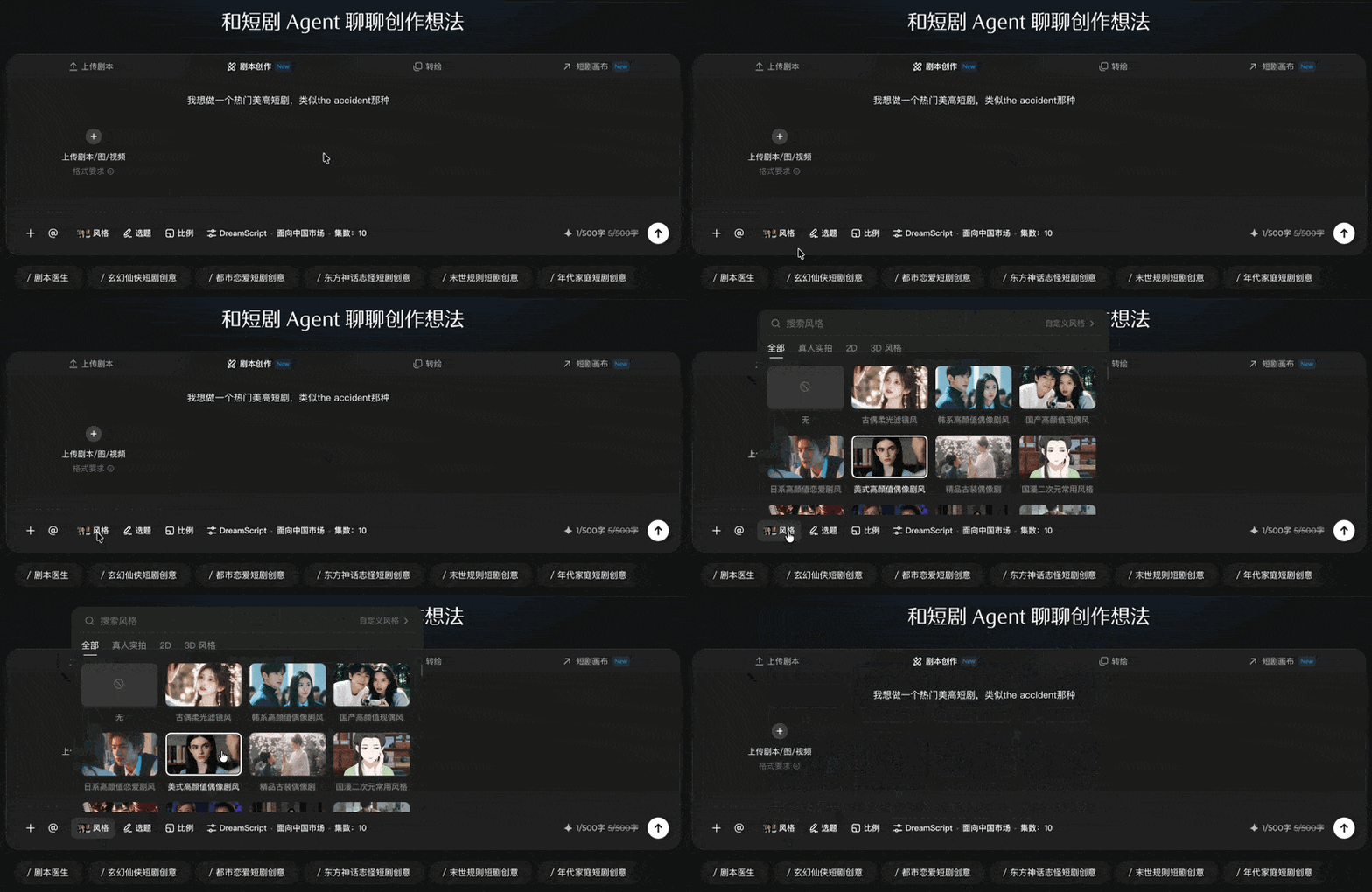
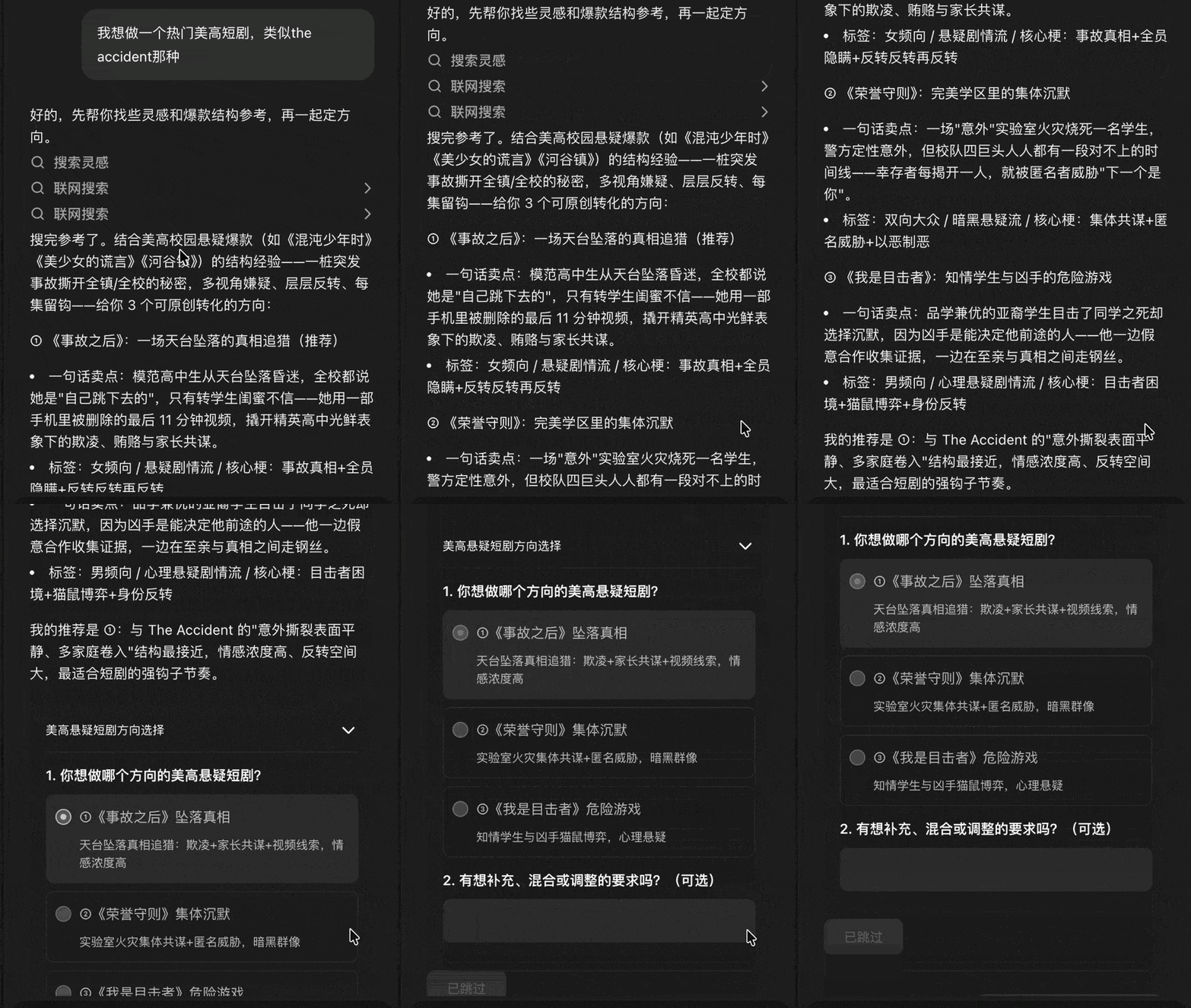
The Drama Assistant first combed the web for inspiration before serving up three options. Looking through them, the dramatic tension was turned up to eleven: students plunging from rooftops, a sudden lab fire, and a witness matching wits with a killer. Suffice it to say, attending this fictional high school was anything but peaceful.
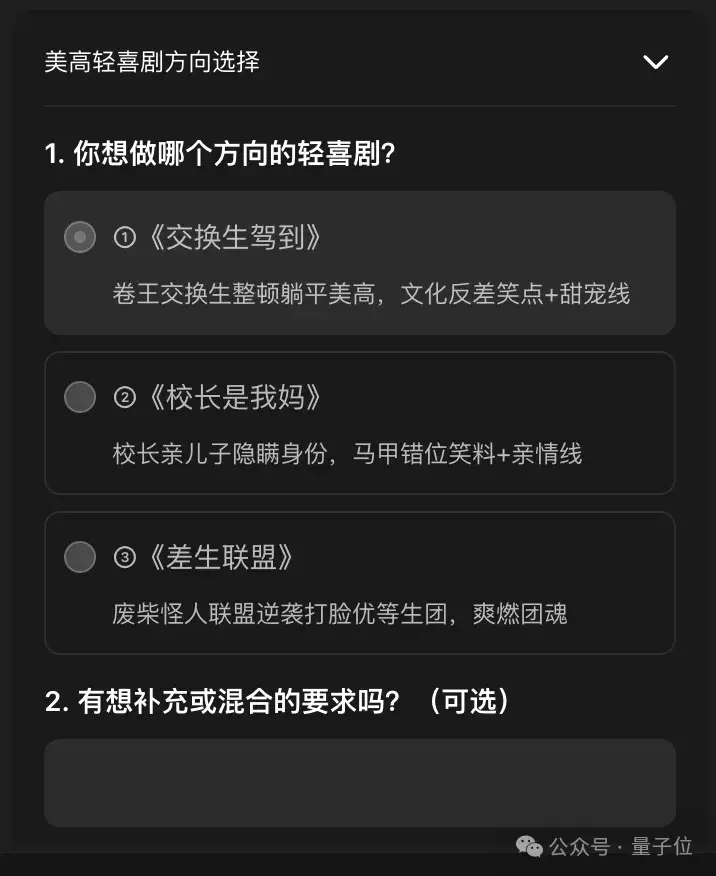
I quickly added a follow-up constraint: “It doesn’t have to be a thriller—let’s make it a light comedy.”
This adjustment hit the sweet spot.
Among the three brand-new concepts generated, I chose The Exchange Student Arrives: Lin Xiao, a Chinese exchange student at a California high school, steps up for his self-introduction and whips out not a personal bio, but a semester goal tracker—complete with plans to assign “weekly progress KPIs” to the entire class.
This workflow is powered by the scriptwriting model DreamScript. Once the direction was locked in, Jimeng swiftly mapped out the world-building and character profiles: pairing Lin Xiao with Jack, an underachieving deskmate who perpetually flunks math, and Chloe, an assertive cheerleader captain who butts heads with him at every turn.
The system then automatically generated a 10-episode outline and full scripts for the first three episodes, complete with detailed plot arcs and cliffhangers for each installment.
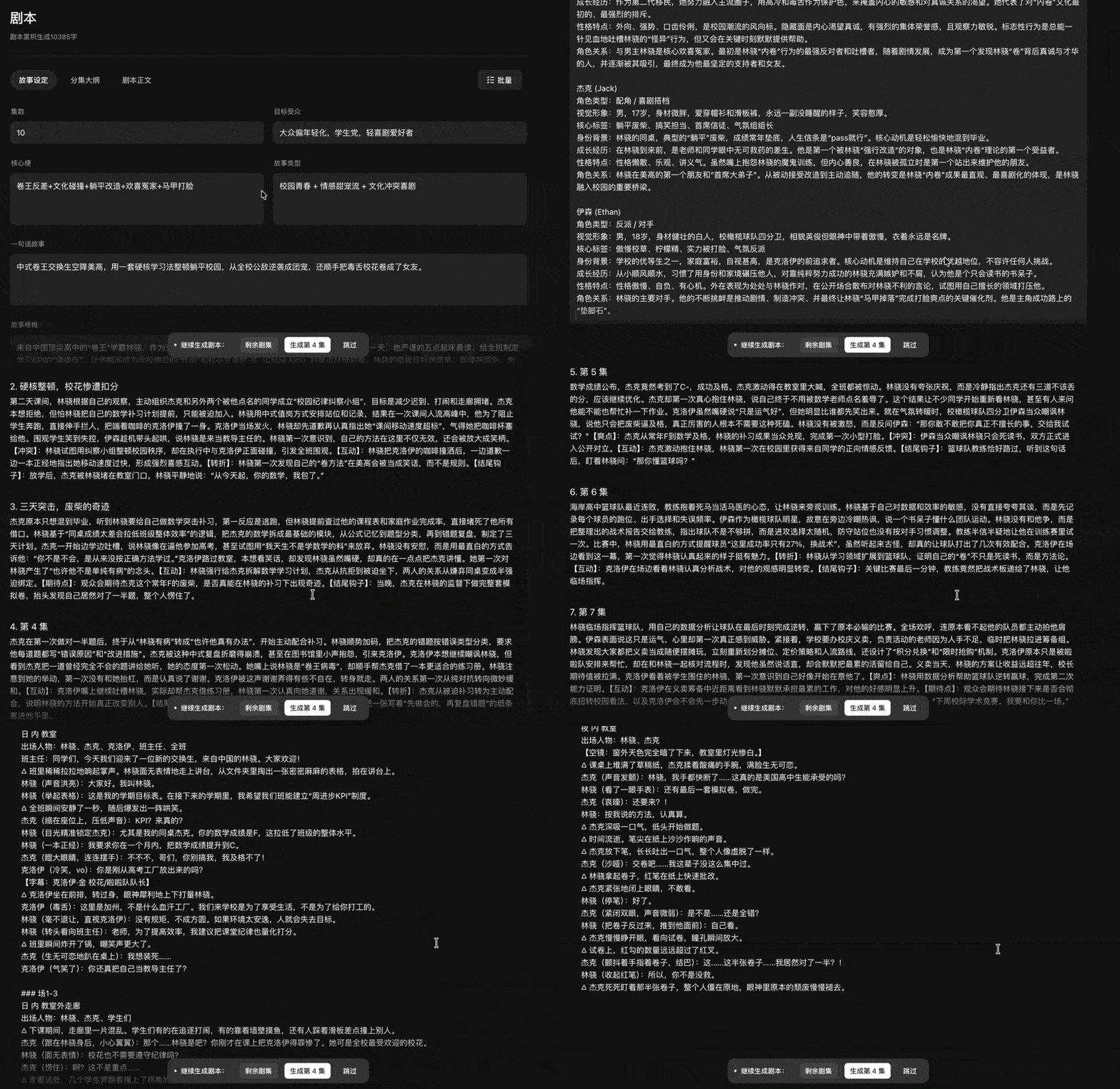
The level of detail in the script was remarkably solid; beyond standard dialogue, character body language and subtle facial expressions were meticulously annotated.
However, while reviewing Episode 2, I spotted a narrative plothole: the episode title explicitly read “Campus Belle Gets Points Deducted,” yet the body text omitted the actual deduction event. I flagged this to the Drama Assistant, which quickly proposed a fix. Once confirmed, the change was automatically synced back into the script.
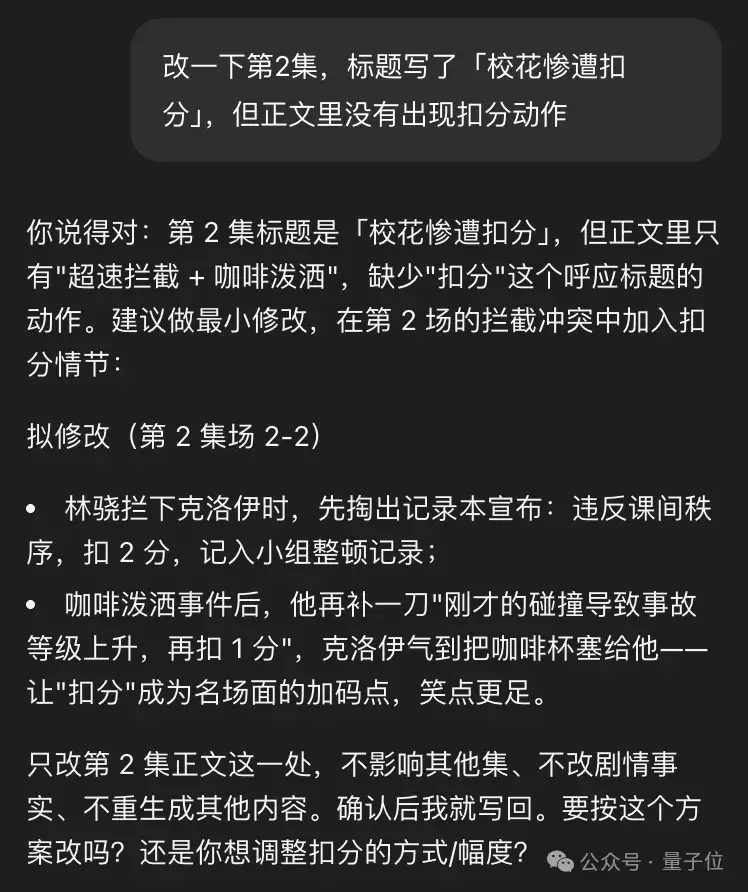
With the script finalized, we transitioned into actual production for the first three episodes.
Opening the Production Asset Library, the 7 characters and 3 core environments needed for the first three episodes were already automatically extracted from the script. Alongside the three leads—Lin Xiao, Jack, and Chloe—even minor background characters like “Student A” and “Student B” had their own character profile cards. Clicking on any character or scene card revealed a pre-configured, high-quality prompt, ready for single-click image generation.
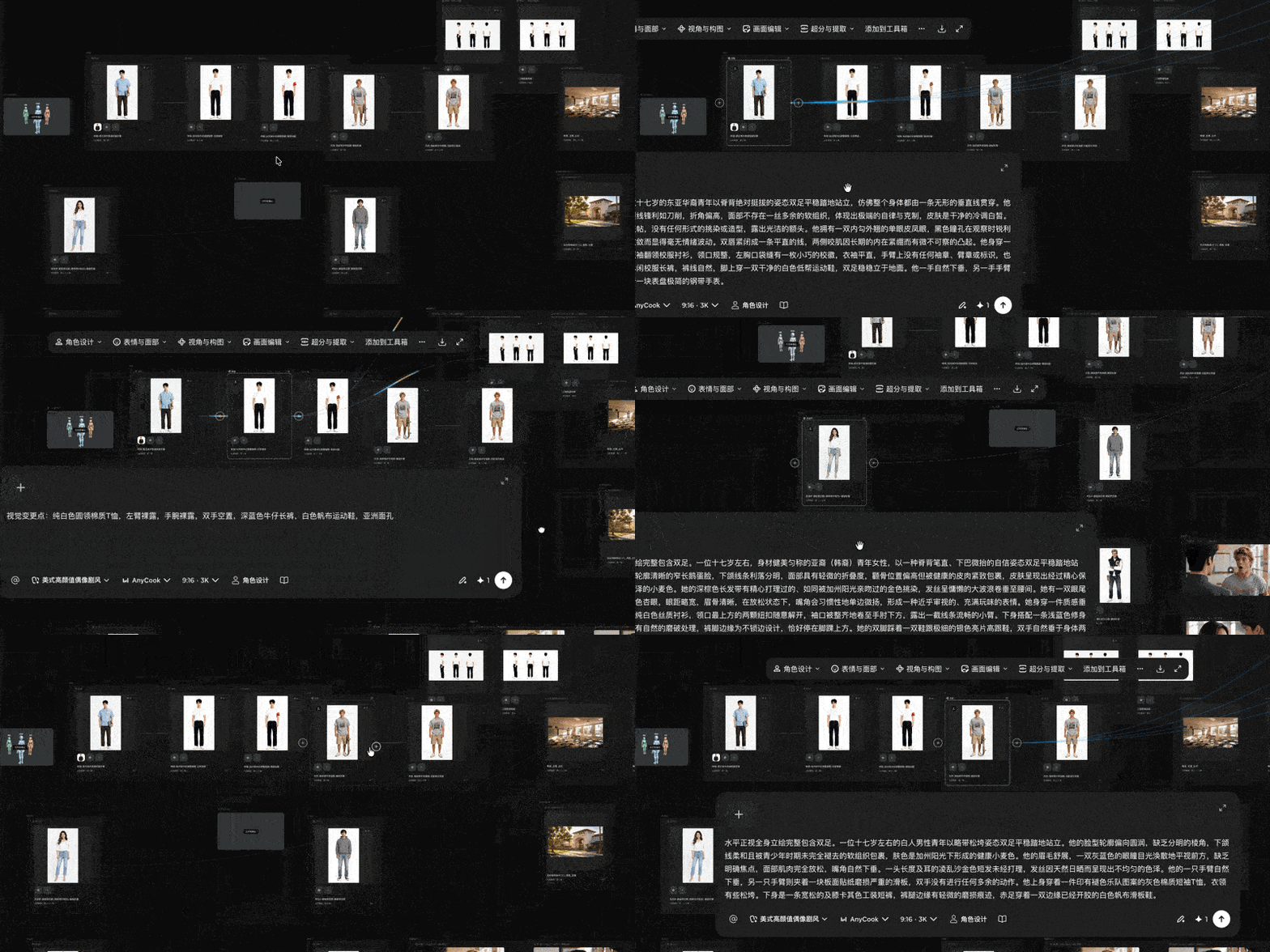
Even more efficient: the asset library supports batch generation for entire sets. In roughly 10 minutes, all character look-books and campus concept renders were fully generated.
Clicking “Next” takes you to the “Storyboard Generation” interface.
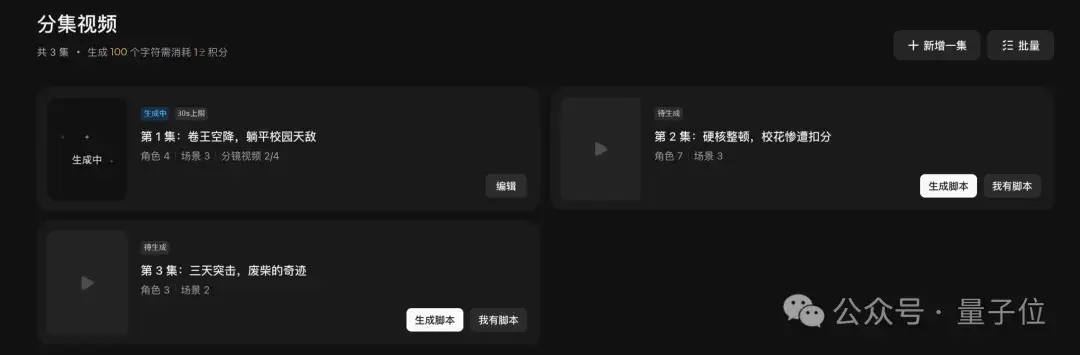
Content for the first three episodes is laid out cleanly. The system lets you choose “AI Auto-Generate Storyboard” or start with a blank board to craft shots manually.

I opted for auto-generation to test Episode 1. The first clip rendered straight out in about 4 minutes, exhibiting an impressive degree of production-ready polish.
However, for the closing shot at the school gate, I wanted to adjust the audiovisual treatment: the original shot used a wide establishing frame when Jack delivered the line, “Dude, you’re weird,” which felt a bit emotionally flat. I wanted a cut to a close-up of Jack, followed by his bewildered reaction as the school bell rings, overlaid with bilingual subtitles.
After piping these instructions directly to the Storyboard Assistant on the right, the system first updated the shot description—explicitly noting that the line required a frontal close-up—and then re-rendered the video clip.
The reshot clip followed the revisions faithfully: it delivered the frontal close-up of Jack and captured his bewildered expression toward the eccentric new transfer student with precision, significantly elevating the dramatic tension.
Pre-visualization First, Full Render Later: Fine-Tuning Shots and Cost Control
Throughout the process, I also uncovered a practical trick to conserve generation credits: pairing “Smart Pre-visualization” (智能预演) with 480p low-res preview tests.
Creators can leverage the Director Console and Camera Motion Library to validate scene blocking and camera choreography before committing to full-spec final renders once satisfied.
For example, in Scene 03 of Episode 1, the initial cut had minor flaws: Chloe inexplicably glanced down at Lin Xiao’s cuffs mid-conversation (a wasted motion), and while the main characters were speaking, the background classroom appeared completely empty—only for the scene to abruptly cut to the entire class bursting into laughter.
I fed these revision notes into the Storyboard Assistant and triggered “Smart Pre-visualization”:

The assistant promptly generated a new reference frame alongside an 8-second, low-bitrate previz video, enabling quick verification of actor blocking and overall pacing.
It is also worth noting that the platform supports converting storyboards into an interactive 3D space via its 3D Director Console. The spatial depth of the classroom, the positioning of the three characters, and camera angles can all be intuitively inspected and adjusted in full 3D:
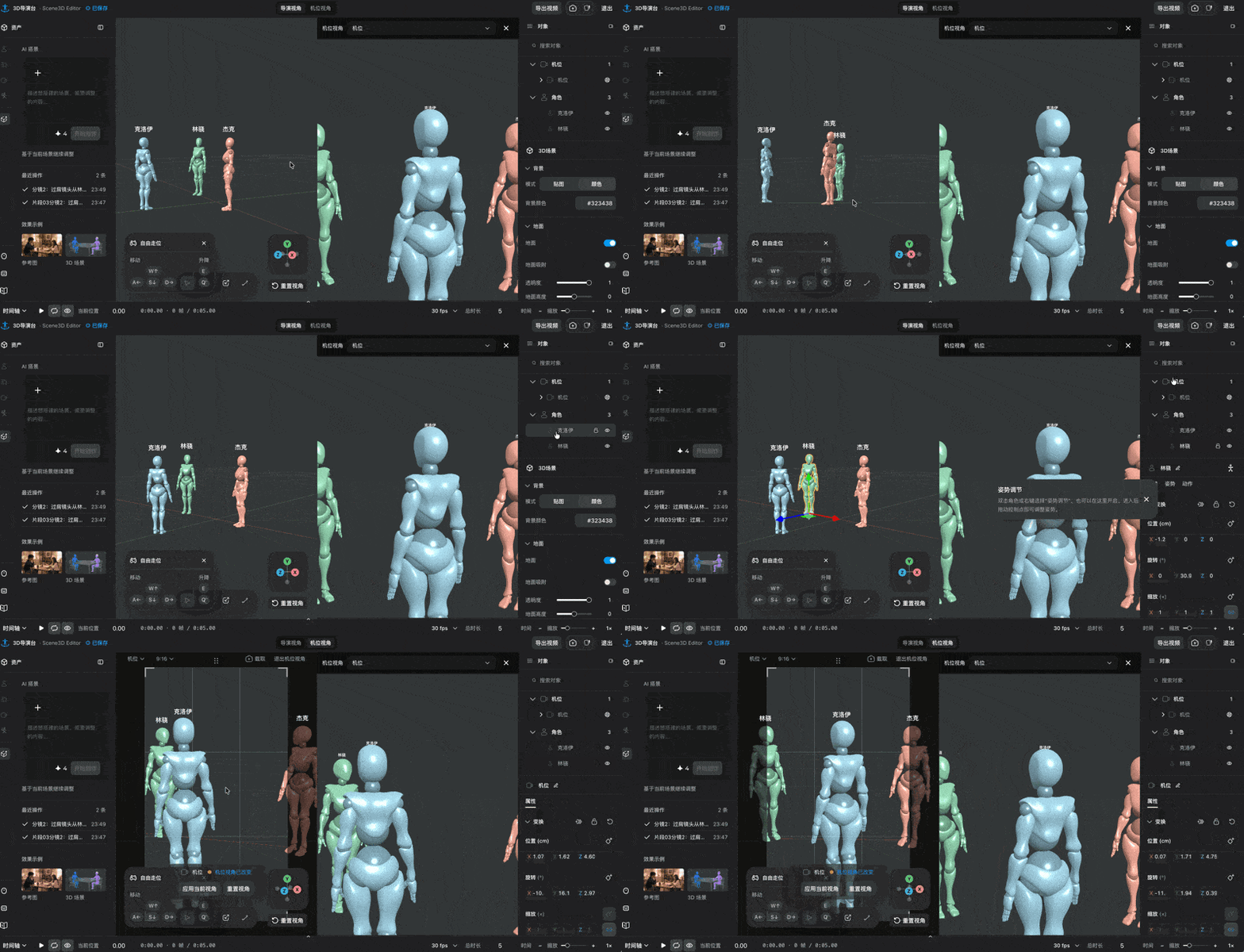
The core value of this feature lies in validating spatial eyelines and the 180-degree rule (axis of action). For instance, when placing Lead A in the foreground and B and C diagonally behind, you can intuitively verify spatial plausibility, check if character eyelines match, and ensure camera angles avoid continuity breaks. Once verified, generating a 480p preview first significantly cuts down on unnecessary credit consumption.
After a few iterations, the newly generated preview stabilized: environmental continuity made sense, and character staging matched the pre-visualization setup perfectly.
If minor flaws persist, you can invoke the “Partial Reshoot” (局部重拍) feature to isolate only the frames that need touch-ups and describe your adjustments. For example, prompting the system to eliminate Chloe’s rapid, repeated blinking:
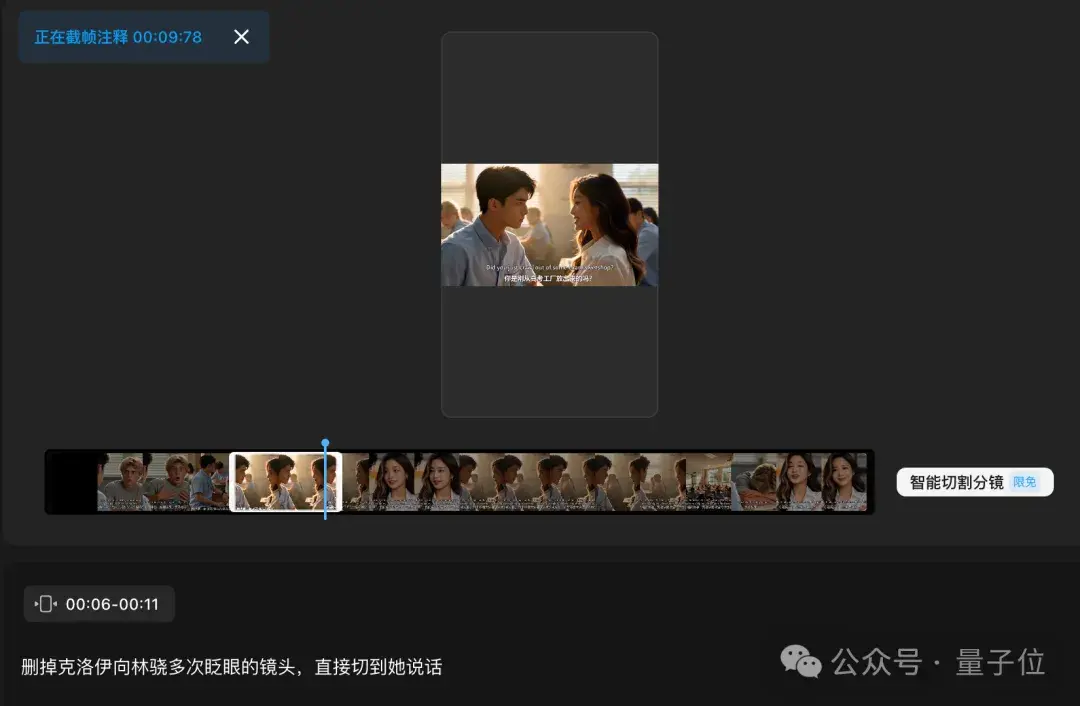
Jimeng Drama Studio immediately delivered the fine-tuned cut. By preserving preceding and succeeding character positioning and visual consistency while applying surgical fixes, this approach offers far greater predictability and control than re-rendering an entire sequence from scratch.
Lowering Production Barriers and Empowering Sustainable Content Creation
After running through the end-to-end production of a full episode, the most striking takeaway is that micro-drama production is a rigorous, systematic engineering process.
Contrary to some outside perceptions, AI micro-dramas are not merely the mechanized churning of low-quality trope-heavy pulp. They are well-suited for fast-paced, accessible, serialized narrative storytelling. Through Jimeng Drama Studio, we completed a closed-loop workflow spanning from “a spark of inspiration” to “final film export.”
Furthermore, the genres Jimeng supports aren’t restricted to formulaic tropes; slice-of-life comedy, romantic narratives, and urban workplace drama are all well-supported. The system provides generous creative freedom, capably fielding in-depth demands for serialized content while organizing assets into reusable, project-level repositories.
For team collaboration, the platform offers a Team Tier that enables shared asset libraries and flexible allocation of credit quotas. For studios with custom proprietary pipelines, underlying generation capabilities can also be integrated directly into existing production workflows via APIs.
Downstream in the delivery phase, the platform has rolled out corresponding ecosystem support initiatives. Solo creators can apply for resources through the Jimeng Creator Growth Program, while high-throughput production studios receive targeted support addressing two critical bottlenecks: IP sourcing and distribution/marketing.
In late October, Jimeng officially launched the “Jimeng Drama Agency Partner Program,” open to professional studios, MCNs, and international micro-drama teams. Selected teams receive a one-month trial of the Premium Team Membership along with direct access to mature external IP adaptation pipelines.

Among them, teams selected as “Pilot Partners” gain access to premium IP libraries from leading web novel platforms like Fanqie Novel and Meitian Dudian Gushi. Once a project is chosen, dedicated platform managers assist with pacing and topic selection, alongside specialized channels for copyright clearance.
Once released, top-performing projects will receive tailored promotional and marketing support, including clip marketing strategies and multi-channel matrix distribution guidance. Should a project achieve top-tier view counts across major domestic or international drama platforms, it can earn up to 100,000 RMB in cash incentives plus an equivalent 100,000 RMB in Jimeng credits. For teams churning out continuous releases, these credits seamlessly feed into character modeling, camera tuning, and preview testing for their next project.
Marking the “Double 11” shopping festival, Jimeng has rolled out substantial discounts for Seedance 2.5: annual personal memberships are discounted up to 55% off (4.5折), and team plans up to 58% off (4.2折). When using Seedance 2.5 with video-to-video references for 720p output, individual per-second costs drop to 0.16 RMB, and team per-second costs drop to 0.15 RMB, lowering the barrier of entry for creators experimenting with high-end generative models.