
PPIO Sandbox: Turning “Cloud Computers” into Out-of-the-Box APIs
Recently, “Personal Agents” have become one of the hottest topics across the AI landscape.
However, much of the industry’s discussion remains focused on product concepts and user interactions, while the foundational pillar powering Personal Agents is hidden deep within the “execution layer.”
Behind every agent capable of truly “taking action” lies a dedicated, isolated execution environment: Meta equips each user with a Muse Secure VM, Manus assigns an independent cloud virtual machine to each task, and OpenAI provides every “dot” with a cloud-based computer and a virtual browser.
The reliable operation of a Personal Agent is inseparable from this dedicated “cloud computer.” What PPIO Sandbox delivers is precisely the packaging of this “cloud computer” into an out-of-the-box API, providing dedicated solutions for Personal Agent deployment scenarios such as personal office assistants, research assistants, and coding assistants.
01 From Conversation to Action: What Changed with Personal Agents?
While general-purpose agents have been continuously evolving, how do Personal Agents fundamentally differ from previous agent products?
First, Personal Agents are user-centric rather than task-centric.
Take Manus as an example: the previous generation of Manus was a quintessential task-oriented agent. A user issues a prompt, the system spins up a virtual machine, executes the task, delivers the output, and immediately tears down and destroys the VM—everything resets to zero once the task concludes. As Manus officially acknowledged: “Every standard chat starts from scratch; it cannot access what you did yesterday.” In contrast, a Personal Agent serves the same user over the long haul. Personal preferences, authorized accounts, and ongoing workflows are permanently bound to the user’s identity, allowing continuous accumulation and context retention across multiple tasks.
Second, under this user-centric premise, Personal Agents must support long-running, continuous execution.
Conventional task-oriented agents are typically “on-call, gone when done,” whereas Personal Agents are persistent (always-on). OpenAI officially describes “dots” as always-on, “continuing to drive work forward between conversations”; Meta similarly positions Muse as a “24/7 personal clerk running errands on your behalf.” Even if the user closes their client, the agent continues running in the background, proactively notifying the user only when significant progress is made or when critical decisions require confirmation.
Beyond this lies an easily overlooked yet critical dimension: it is proactive rather than reactive. It remembers user preferences and ongoing tasks, exploring ahead and reporting back periodically without waiting for explicit prompts. Persistence solves the problem of “always being there,” while proactivity solves the problem of “advancing work autonomously.”
All these differences ultimately converge on a single product prerequisite: the ability to take action. And to truly take action, the agent must have access to a computer that its “hands” can reach and operate.
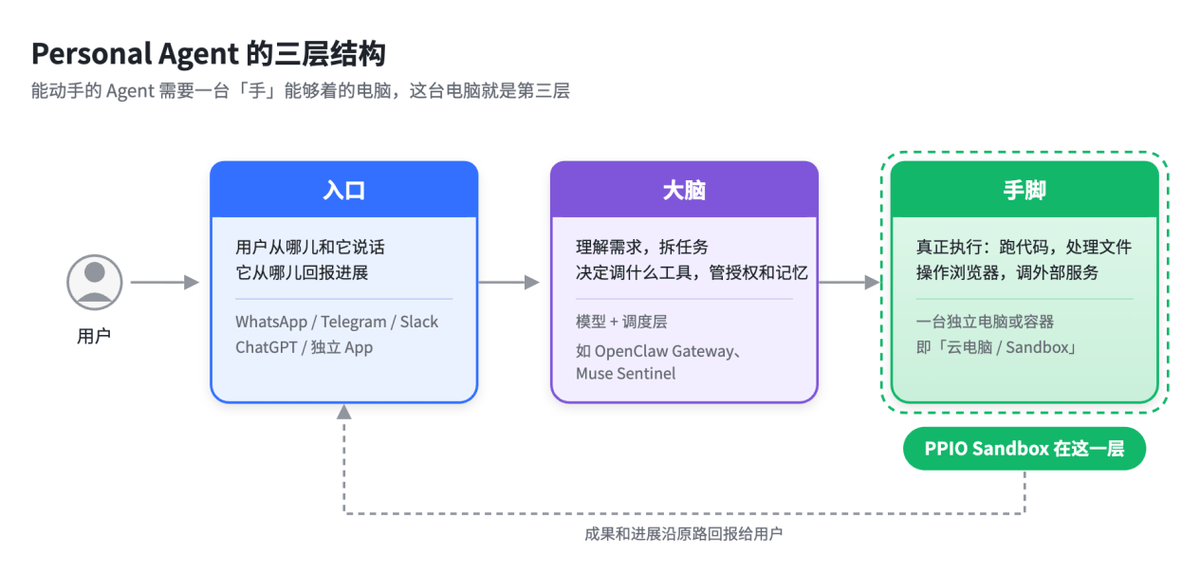
Deconstructing a typical Personal Agent architecture reveals three layers:
- Interface Layer: Handles user interaction channels, commonly in the form of WhatsApp, Telegram, Slack, or standalone clients;
- Brain Layer: Responsible for intent understanding, task decomposition, tool-calling decisions, and managing authorizations and memory. It typically consists of LLMs paired with an orchestration layer, such as OpenClaw’s Gateway and Muse’s Sentinel;
- Execution (Hands & Feet) Layer: Handles the concrete execution of specific tasks, typically running on a dedicated bare-metal machine, cloud computer, or container.
Where this computer is hosted, who manages and maintains it, and what its blast radius is when failures occur—these are the fundamental architectural choices that all Personal Agent products in 2026 must confront.
02 Behind Every Personal Agent Lies a “Cloud Computer”
Looking across the current Personal Agent landscape, every system genuinely capable of execution and persistent operation equips each user with an isolated execution environment. Based on who provides this “computer” and where it is hosted, the industry is split into two primary paths: local execution and cloud execution.
The first approach is local execution: No dedicated cloud computer is provided; instead, the agent runs directly on the user’s local terminal device or a self-rented server. Finding hardware, configuring environments, and maintaining security are left entirely to the user. Open-source projects like OpenClaw and Hermes, as well as Anthropic’s desktop agent Claude Cowork, fall into this category.
However, running agents locally introduces non-negligible security risks, depending heavily on the implementation of isolation mechanisms. For example, the OpenClaw community previously suffered severe security incidents where 42,000 Gateway instances were exposed directly to the public internet, and over 300 malicious skills infiltrated its skill marketplace. Furthermore, users must shoulder the ongoing costs of 24/7 hardware uptime, system maintenance, and cybersecurity themselves.
More crucially, local devices can rarely guarantee 24/7 uninterrupted uptime. Once a device is powered off or enters sleep mode, the agent is abruptly halted. As a result, this approach fundamentally struggles to meet the requirements of long-term, continuous execution essential to Personal Agents.
The second approach is cloud execution. Cloud execution also branches into two implementation routes:
The first is self-built execution environments, built and maintained in-house by platform providers, with underlying specifications largely kept proprietary as internal architecture. Typical examples include Meta Muse, OpenAI dots, and Manus.
For instance, Meta Muse provisions a dedicated Muse Secure VM for each user—a cloud-based Linux VM equipped with Chromium, Debian runtime containers, and local storage, supporting code compilation, parallel sub-agent orchestration, and scheduled cron jobs. Its core agent runs within an unprivileged container, external communications are taint-tracked via host-side Sentinel processes integrated with eBPF, and credentials are dynamically injected at the network perimeter via authd, preventing the model itself from ever touching plaintext passwords.
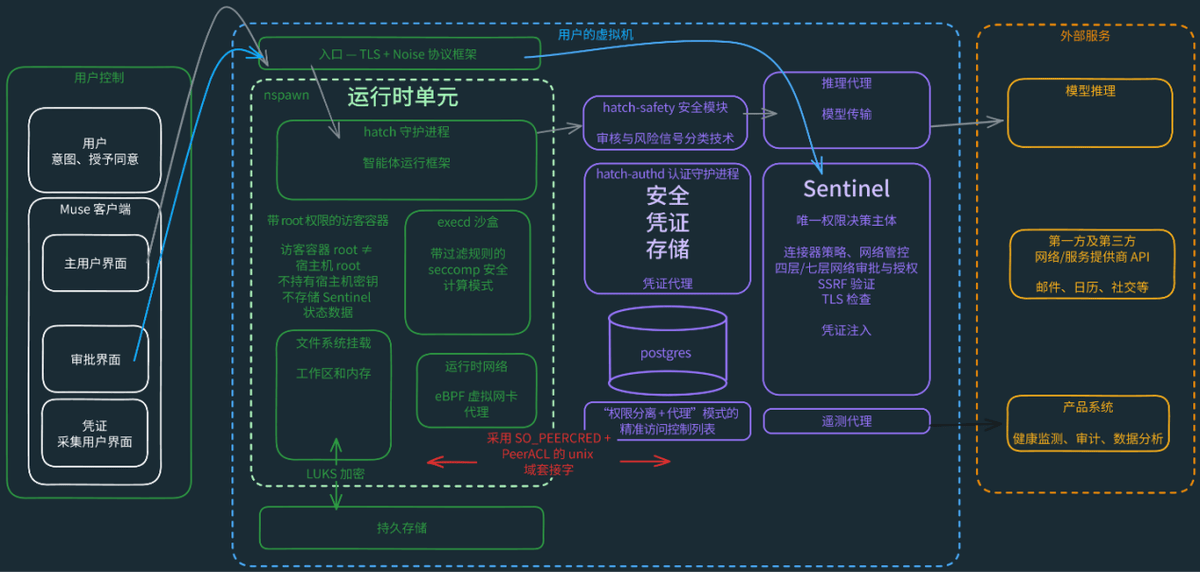
Each OpenAI dot is also backed by a dedicated cloud computer and a virtual browser that keep operating even when the user is offline. Its memory builds upon ChatGPT memory, and in unassisted mode, it operates strictly with read-only research permissions, preventing unauthorized external messaging. Manus takes an even finer-grained approach, allocating a fully isolated cloud VM to each individual task, provisioned with complete networking, a file system, a browser, and root access. The system automatically hibernates after detecting inactivity and recycles the instance if hibernation exceeds a certain threshold, while separately offering a persistent Cloud Computer option.
The other route is integrating with third-party Agent Infra providers, such as PPIO. Developers can deploy open-source or proprietary agent frameworks directly onto third-party cloud-hosted platforms, achieving zero-configuration, out-of-the-box operation.
Earlier this year, during the OpenClaw craze, numerous vendors rolled out cloud-hosting solutions. For instance, Moonshot AI launched Kimi Claw, deeply integrating OpenClaw into the Kimi ecosystem so users can run it directly inside a browser tab. Each user gets a dedicated 24/7 online cloud instance preloaded with over 5,000 extension skills from ClawHub, with support for scheduled tasks and persistent memory. Simultaneously, PPIO introduced cloud sandbox hosting solutions—PPClaw and PPHermes—supporting one-click deployment, rapid launch in under ten minutes, on-demand spin-up and billing, and zero billing while paused.
As we enter the Personal Agent era, this cloud-hosted architecture remains just as vital.
Tech giants typically treat the “execution environment” as a proprietary moat, rarely exposing the underlying infrastructure specs. Small and mid-sized development teams looking to replicate similar experiences are forced to build execution layers from scratch. However, they lack the massive infrastructure capabilities of tier-one giants, yet cannot offload tedious environment setup onto end users. Partnering with a mature, professional execution environment provider thus becomes the optimal path.
PPIO’s core mission is to abstract and encapsulate the indispensable “cloud computer” into turnkey APIs, empowering developers end-to-end.
03 PPIO Sandbox: Turning Essential “Cloud Computers” for Agents into APIs
PPIO focuses on perfecting the foundational execution layer—the “hands and feet”—leaving the “interface” and “brain” for developers to build autonomously. With a single standard API call, developers can spin up an isolated sandbox pre-configured with a complete environment on demand. Sandboxes can be allocated flexibly per user or per task, automatically released upon task completion, and natively support pause, resume, and snapshot cloning.
As a cloud execution environment custom-built for agent scenarios, PPIO Sandbox equips Personal Agent developers with five core capabilities:
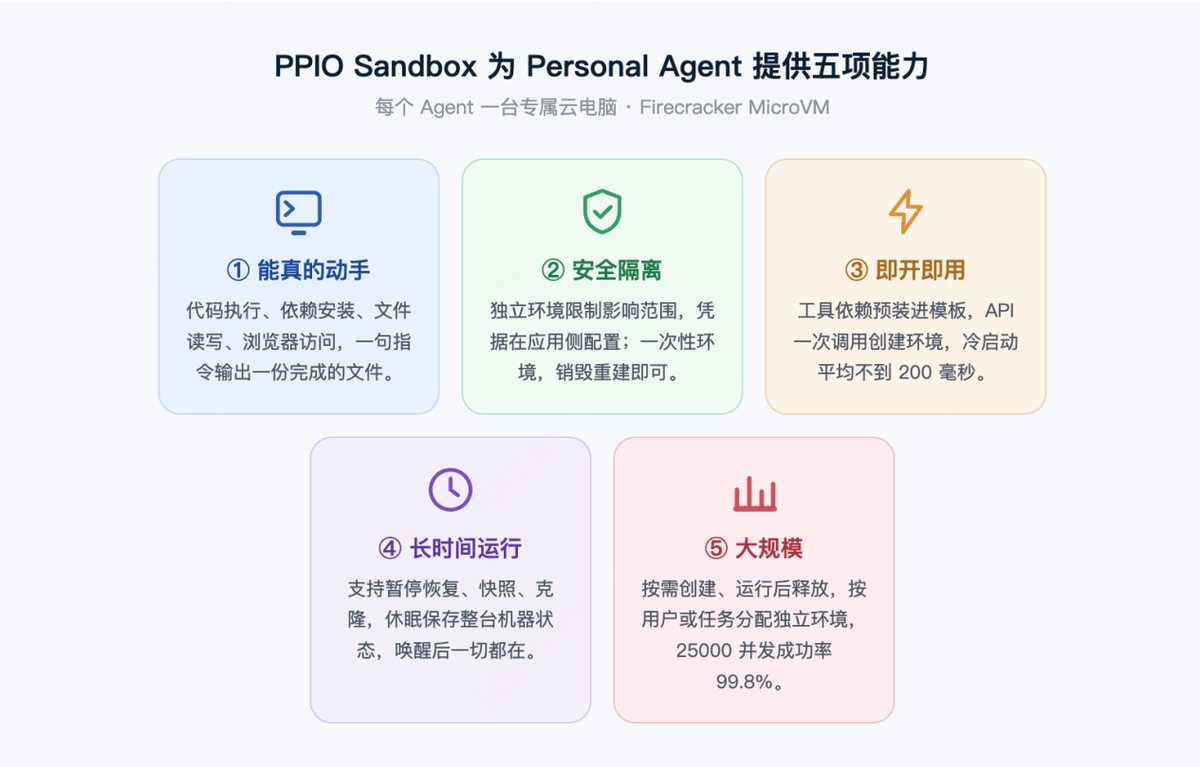
First, real-world execution capabilities—supporting Excel, PDF, and multimedia processing, running code scripts, and driving virtual browsers. This is the fundamental prerequisite separating Personal Agents from conventional text-based chatbots.
PPIO Sandbox provides a lightweight yet complete microVM runtime environment where code compilation and execution, system dependency installation, low-level file I/O, and headless browser navigation are executed seamlessly end-to-end within the sandbox. Common utilities and runtime environments can be pre-baked directly into base image templates. Upon receiving natural language instructions, the agent can output fully formatted deliverable files—bridging the gap from “verbal conversation” to “real-world task execution,” with the reliable execution environment being the critical differentiator.
Second, rigorous sandbox isolation, providing agents with an independent workspace. Once an agent gains real operational capabilities, permission controls and blast radius management become critical; restricting code execution to an isolated sandbox environment has become the industry standard.
PPIO Sandbox utilizes completely isolated runtimes that strictly confine an agent’s blast radius. Sensitive credentials and execution permissions are granularly configured on the application side, ensuring the sandbox environment never accesses host-level privileges without authorization. Furthermore, sandbox instances are stateless and disposable: even if an agent deletes critical files, installs conflicting dependencies, or corrupts the OS environment, the system can immediately destroy the faulty instance and provision a clean sandbox in seconds, guaranteeing that user machines and multi-tenant data remain secure and completely isolated.
Third, instant readiness and fast replication—zero configuration is a key monetization driver. Self-hosting an OpenClaw setup locally typically demands Node.js 22+ and a dedicated cloud server, requiring 30 to 60 minutes of tedious configuration. In contrast, Kimi Claw streamlined this into a “sub-second launch in a browser tab,” successfully achieving commercialization—proving that both developers and users are more than willing to pay to eliminate configuration overhead.
PPIO Sandbox pre-installs popular developer tools and complex dependencies directly into container templates. Spinning up a sandbox environment via API call achieves an average cold start time of under 200 ms, eliminating long waits for compute initialization and delivering true out-of-the-box productivity.
Fourth, native support for long-running tasks, ensuring sustained progress and complete retention of intermediate artifacts. This is a substantial advantage of cloud execution environments over local setups: once a local PC shuts down or sleeps, the agent halts immediately. Meanwhile, task-based temporary VMs like Manus enforce fixed hibernation and reclamation windows (7 days for Free / 21 days for Pro), after which temporary files are purged.
PPIO Sandbox natively supports pause/suspend, resume, system snapshots, and instance cloning, working alongside external storage and application-layer states for persistent lifecycle management. When a sandbox hibernates, it captures the entire machine’s memory and system state; upon wake-up, foreground processes, environment dependencies, and disk files are preserved seamlessly, allowing users to reconnect right back into their original workspace.
Fifth, high-concurrency elastic scaling to reliably support massive concurrent usage. From the “one instance per user” model of Muse, dots, and Kimi Claw to Manus’s granular “one instance per task” pattern, building Personal Agent products inevitably leads to an explosion in execution instance scale proportional to user growth. Relying solely on manual operations and basic VPS deployments is completely untenable.
PPIO Sandbox supports sub-second on-demand provisioning and automated reclamation upon completion, allocating isolated execution environments either per user or per task. Under stress testing with 25,000 concurrent requests, the sandbox creation success rate exceeded 99.8%, reliably guaranteeing high availability for “one instance per user” architectures under massive concurrent loads.
For developers building Personal Agents across domains like personal office assistants, research assistants, and coding assistants, PPIO Sandbox’s most direct value proposition is eliminating the need to “reinvent the wheel.”
As China’s first sandbox service compatible with the E2B interface standard, PPIO Sandbox allows developers to migrate and go live by modifying just a few configuration lines, with virtually zero changes required in their core business code. Within a year of launch, PPIO Sandbox creations grew more than 120-fold, with daily active sandbox instances reaching the millions.
To help more developers accelerate real-world task execution, PPIO recently launched the “Personal Agent Developer Booster Pack,” offering a 100 RMB Sandbox voucher (equivalent to roughly 27,800 minutes of 1 vCPU / 2 GiB compute time) to help developers quickly launch their first autonomous agent task.
For more technical details and developer support, visit the official PPIO website.