
As November arrives, families of high school freshmen preparing for subject selection face a familiar round of dilemmas.
Should subject choices be guided by raw scores or class ranks? How does scaled scoring work? Should Physics and Chemistry be bundled together?
To make matters worse, a student’s day-to-day academic performance often leaves parents even more conflicted: struggling to follow biology class yet scoring well on exams; understanding geography effortlessly yet consistently receiving mediocre grades.

Factor in university major prerequisites and the actual subject combinations available at school, and 10th-grade subject selection becomes a critical milestone that many families must face head-on.
This decision must be carefully evaluated before subject combinations are finalized. Different subject combinations not only dictate the range of eligible college majors later on, but also directly shape a student’s long-term career trajectory.
If families wait until submitting their Gaokao college preferences to discover that their chosen subjects do not meet the prerequisites of their target majors, their options will be severely limited.
Now, parents have a new advisor to turn to: an AI Career Planner.
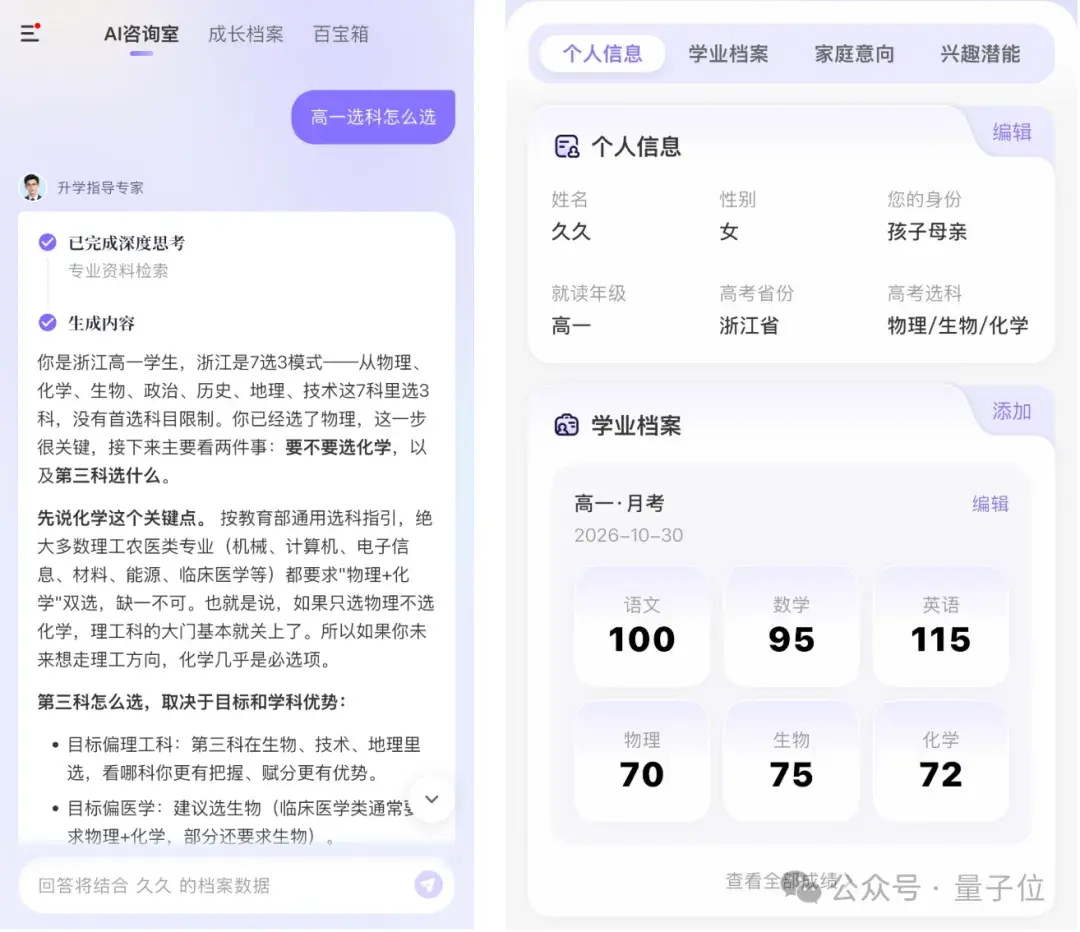
It begins by understanding the student’s academic performance and personal interests, clarifies the family’s educational goals, and then integrates specialized pedagogical insights with local admissions policies to outline the specific requirements and preparation steps for each pathway.
It also features a Growth Profile, enabling career planning services to accompany the student throughout their ongoing development.
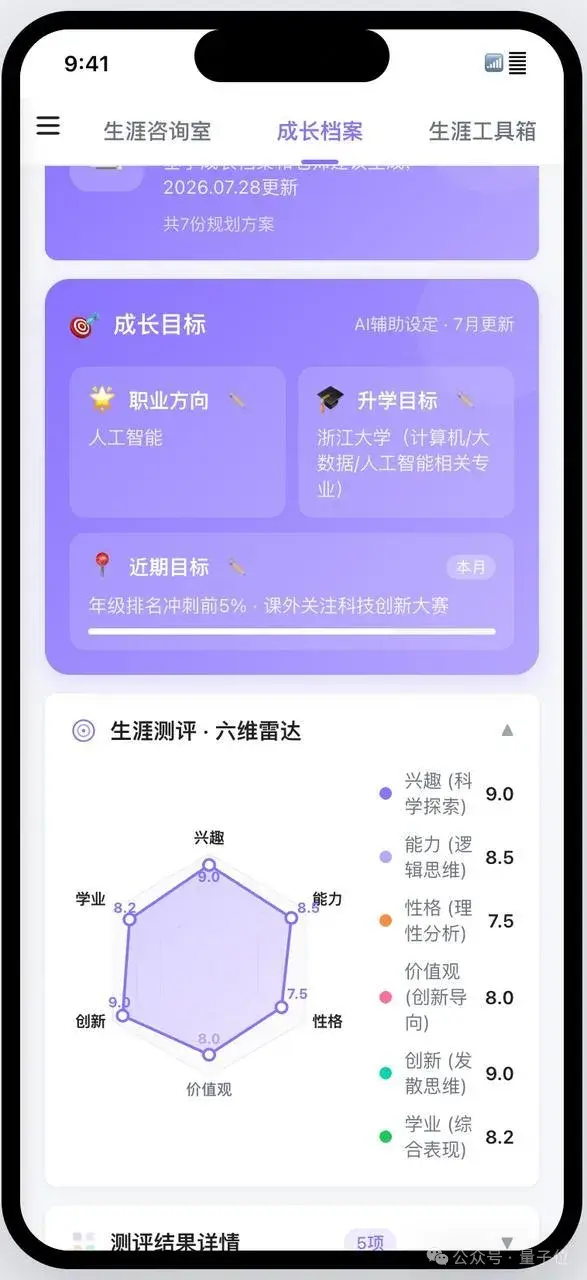
Whenever a student’s academic results or interests shift, the system re-evaluates historical records to dynamically adjust its recommendations.
Covering subject selection, interest development, and college admissions planning, the platform offers its foundational planning services completely free of charge.
This product is the e-Career service platform, developed by Hailiang Tech Service and powered by its proprietary OpenSpan Career Large Model.
Today, Hailiang Tech Service aims to harness AI to bring high-quality, professional guidance to everyday families.
What Makes an AI Career Planner Truly Professional?
You might wonder: can’t standard, general-purpose AI handle a student’s subject selection just as well?
While general-purpose AI can offer basic baseline information, the e-Career platform evaluates a student’s specific circumstances to deliver far more nuanced, targeted planning solutions.
Let’s look at a few real-world test cases:
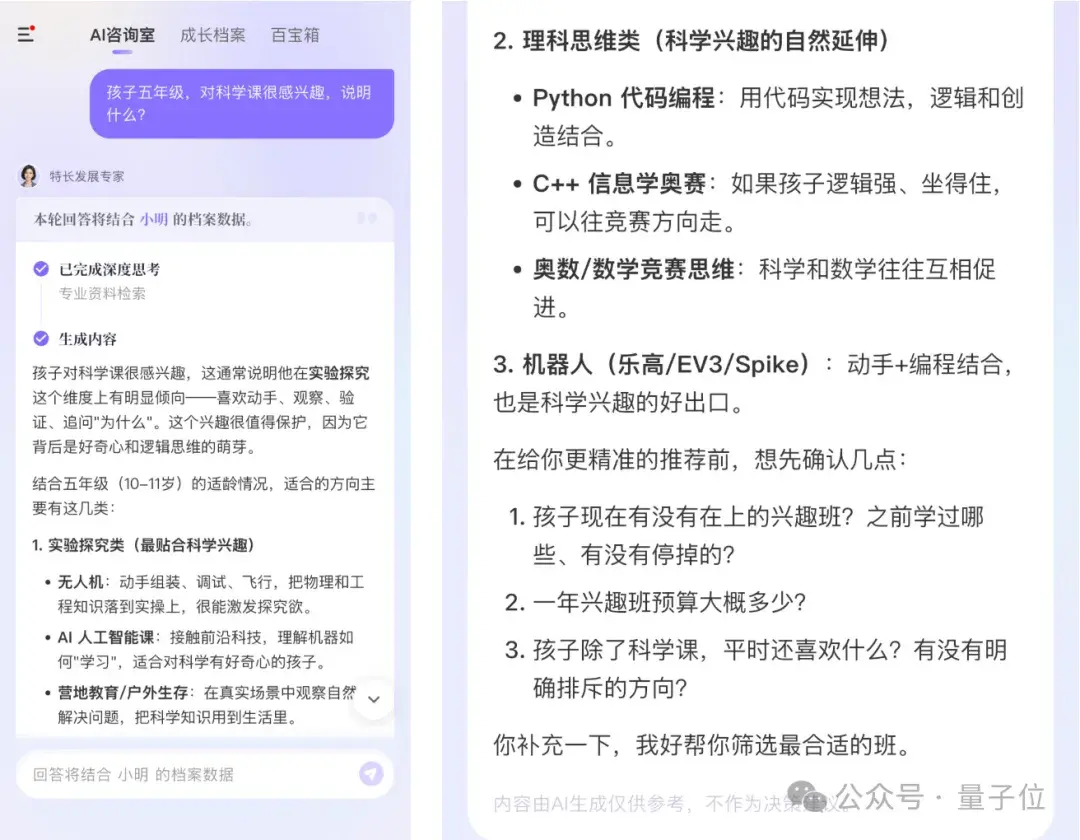
First Question: “My child is in fifth grade and really enjoys science class. What does that mean?”

In this exchange, the general-purpose AI breaks down the inquiry across dimensions such as curiosity and cognitive style, then asks which specific branch of science the child prefers.
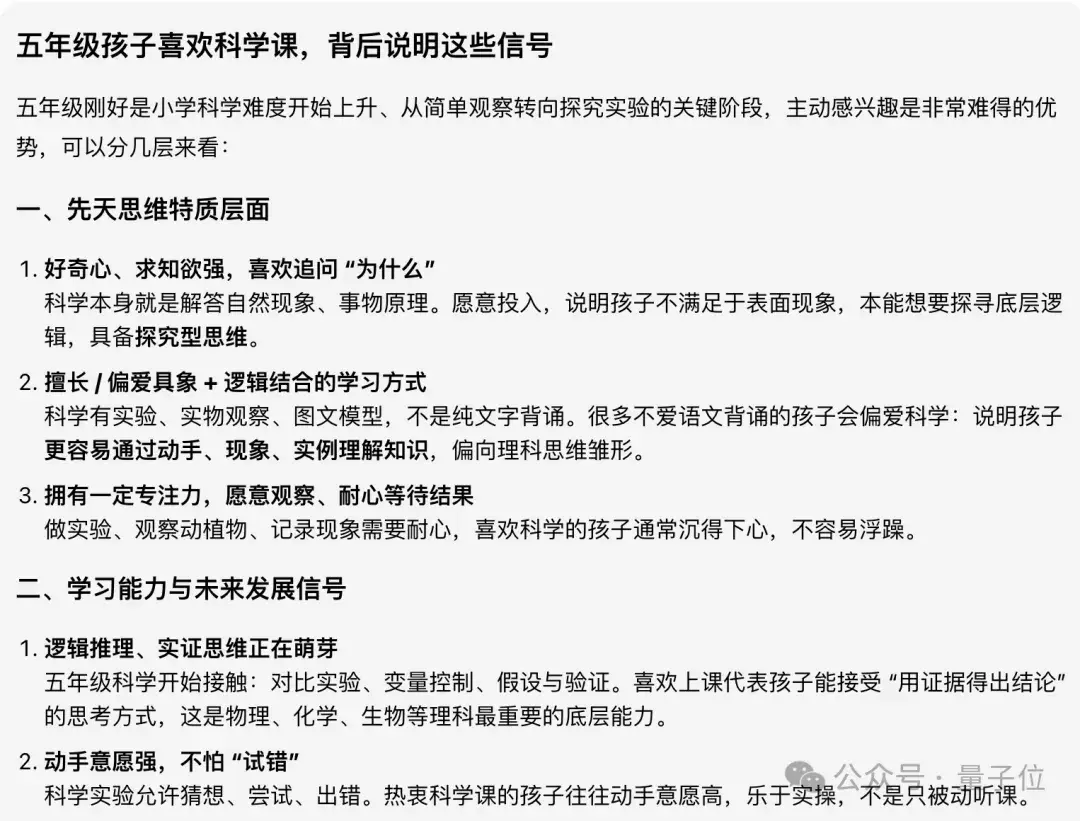
When the user replies that “they find every topic interesting,” the general-purpose AI provides a few general suggestions, but the response remains high-level and generic.
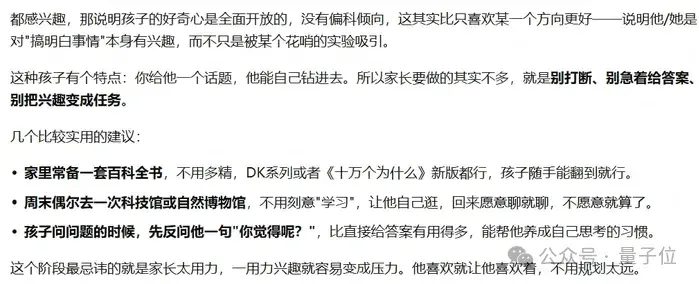
Now look at how e-Career approaches the same prompt. The interaction is routed to the platform’s specialized “Talent Development Expert” agent.
It approaches the question through the lens of experimental inquiry, noting that the child likely leans toward hands-on manipulation, observation, and verification, demonstrating an inclination to actively investigate underlying causes.
Factoring in the cognitive development stage of a fifth grader, it outlines concrete avenues for exploration: hands-on drone assembly to translate scientific principles into practice; youth coding to bring ideas to life programmatically; or robotics projects that blend physical hardware construction with software logic.
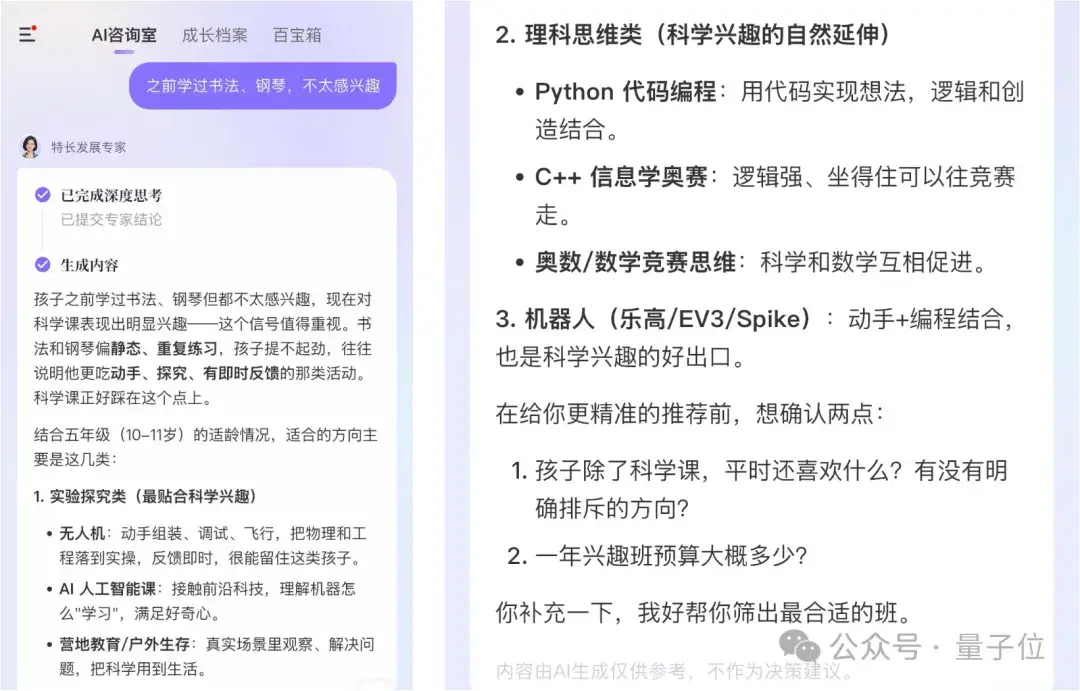
Next, we added context: “The child previously tried calligraphy and piano, but wasn’t very interested in either.”
e-Career incorporated this background into its assessment, analyzing the interactive dynamics of those past activities, and followed up by asking about other preferences as well as the family’s educational budget.
We then set explicit constraints: an annual budget of around 10,000 RMB, and that the child also enjoys sports.
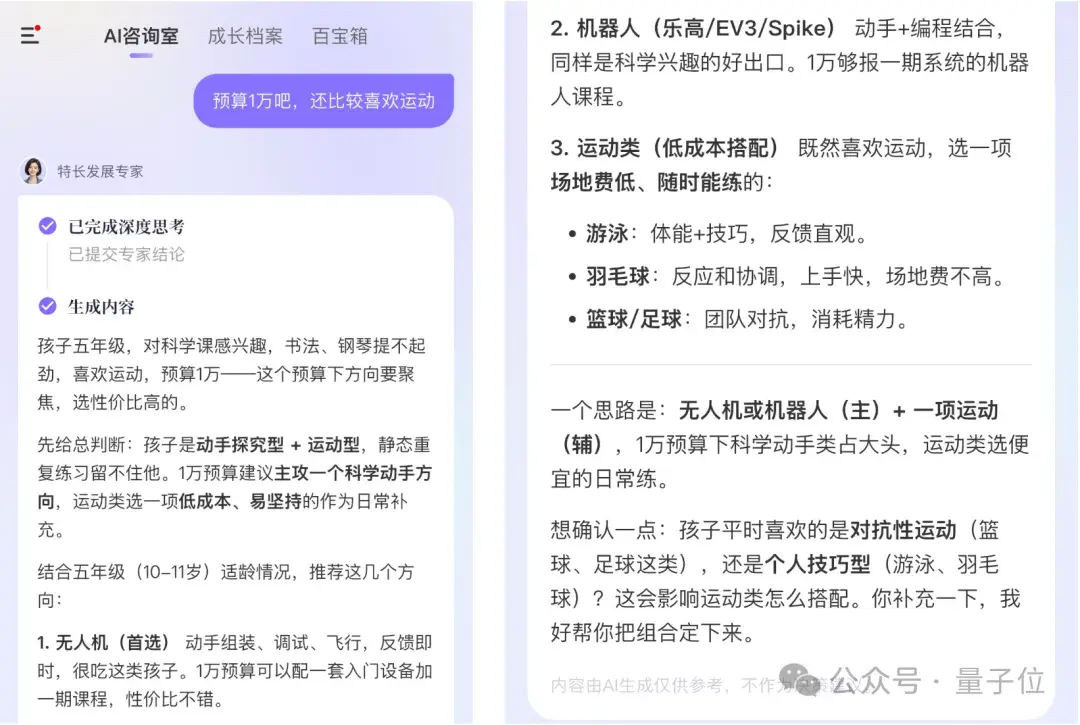
Working within these boundaries, e-Career delivered a detailed developmental blueprint and budget allocation plan:
It recommended allocating the majority of the 10,000 RMB budget to a single hands-on science pursuit (such as drones or robotics), paired with a lower-cost, easily sustainable sport for regular physical activity.
For the drone track, it itemized the cost ratio between entry-level hardware and introductory courses; for sports, it reminded parents to factor in court/field rental fees and daily convenience.
The reasoning became straightforward: focus the core budget on hands-on science exploration while using sports for routine balance, addressing both scientific curiosity and physical development.
Through several rounds of multi-turn dialogue, a simple observation—“my child likes science class”—was systematically translated into an actionable developmental plan. Parents gained clear direction on what to explore first, how to allocate their budget prudently, and how to gauge their child’s sustained commitment over time.
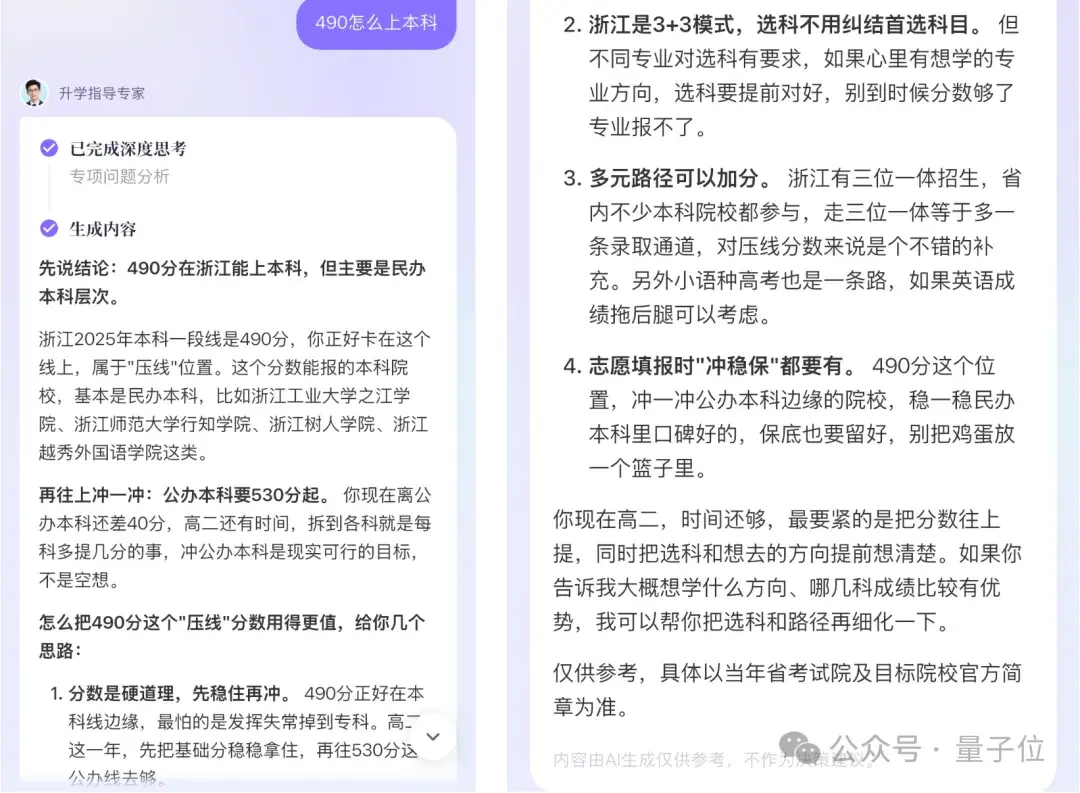
Next, we tested a second scenario: “How can a student with a score of 490 get into an undergraduate program?”
The profile: a high school sophomore (11th grade) taking History, Politics, and Biology as elective subjects.
The general-purpose AI quickly pivoted from the core question of “how to secure an undergraduate admission” to “how to raise test scores.”
Although it listed several institutions and admissions tracks, it failed to proactively query critical variables such as family budget or geographical preferences, nor did it verify hard prerequisite cutoffs for different admissions pathways before prescribing generic subject-by-subject study plans.
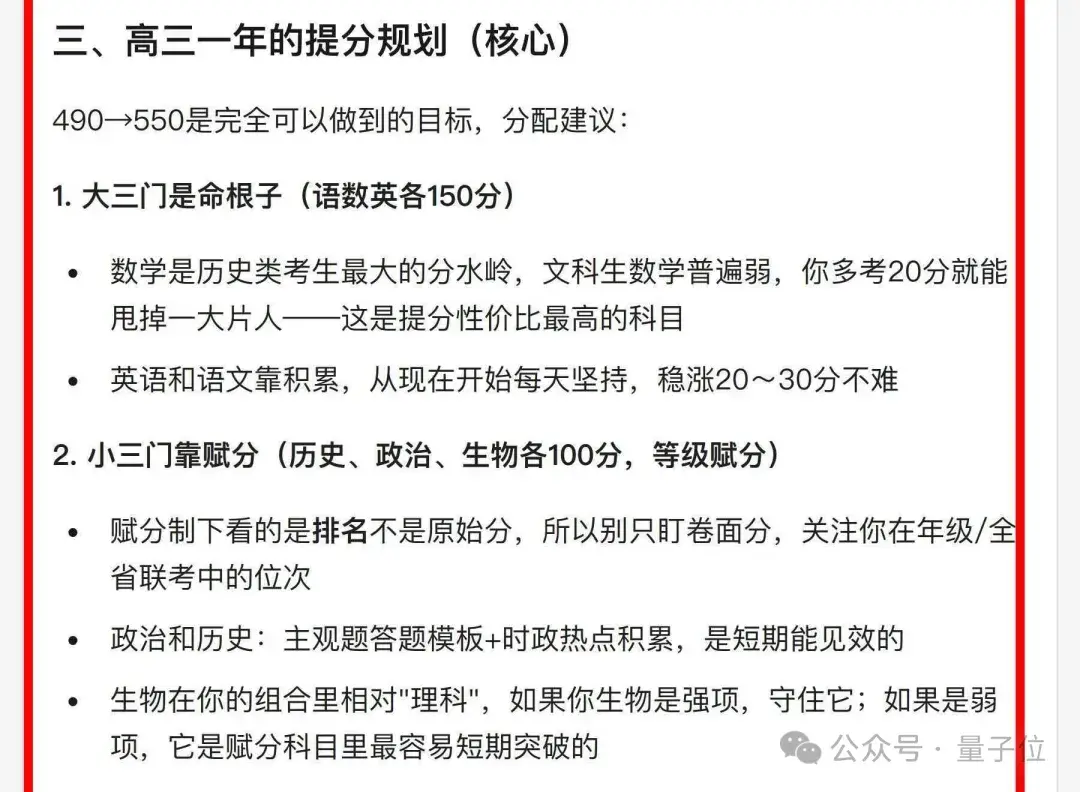
The user received a list of study tips, but the essential question remained unanswered: if the student’s Gaokao score ultimately stays in the mid-to-lower range, which undergraduate options are worth investigating ahead of time? What preparatory steps need to begin in 11th grade? These decisions require prudent analysis tailored to the student’s specific profile.
e-Career, by contrast, grounded its response in China’s diversified admissions framework. While addressing academic score improvements and regular preference matching, it highlighted specific avenues worth exploring, such as Zhejiang’s “Trinity” Comprehensive Evaluation Admissions.
(Note: “Trinity” is a specialized university admissions model in Zhejiang Province that combines a student’s unified Gaokao score, academic proficiency test results, and comprehensive quality evaluation according to predetermined ratios to determine admission.)
What if we broaden the scope further?
We followed up with: “What if we consider studying abroad?”
At this point, the interface smoothly transitioned the consultation from the “Admissions Guidance Expert” to a “Study Abroad Consultant,” shifting the advisory focus entirely toward international pathways.
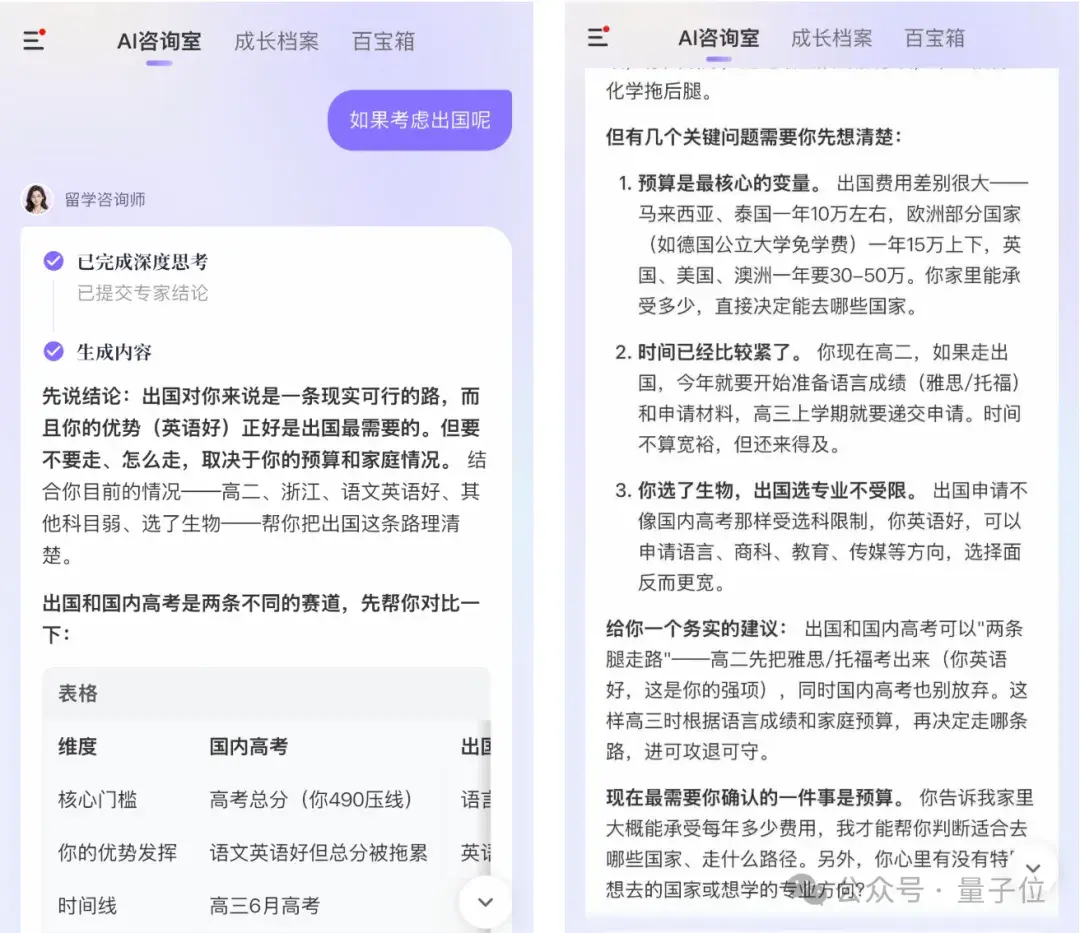
It first provided an objective comparison between domestic Gaokao routes and overseas applications in terms of admissions mechanisms, preparation timelines, and cost structures, before systematically narrowing down the family’s core constraints.
Financial budget was placed front and center: What is the family’s annual budget range for tuition and living expenses? Are there specific target countries or intended fields of study?
These variables directly govern which destination countries and application channels are viable, defining what application materials must be assembled.
In subsequent responses, e-Career organized content modularly by pathway, explicitly detailing qualification criteria and preparation milestones, while advising the user to verify specifics against official brochures from local examination authorities and target universities. Parents could also drill down further into any specific pathway.
Compared to general-purpose AI, the fundamental difference is clear: e-Career does not treat score inquiries as surface-level lookups; it treats them as systematic planning challenges that require validating real-world family constraints step by step.
Of course, establishing whether an advisory service is genuinely professional requires an objective, quantitative evaluation framework.
According to Hailiang Tech Service, the e-Career team established an evaluation benchmark tailored specifically to authentic career planning scenarios.
This evaluation framework rigorously assesses the completeness of student profile gathering, the depth of intent comprehension, the accuracy of domain-specific knowledge, the validity of planning logic and conclusions, and the overall communication quality of the interaction. Each dimension is scored on a 0-to-3 scale and weighted accordingly.
In internal blind testing on its r43 release, covering 89 long, multi-turn real-world dialogue sessions, the platform achieved an overall production-grade usability rate of 92.1% (using an overall score of 2.0 or higher as the benchmark).
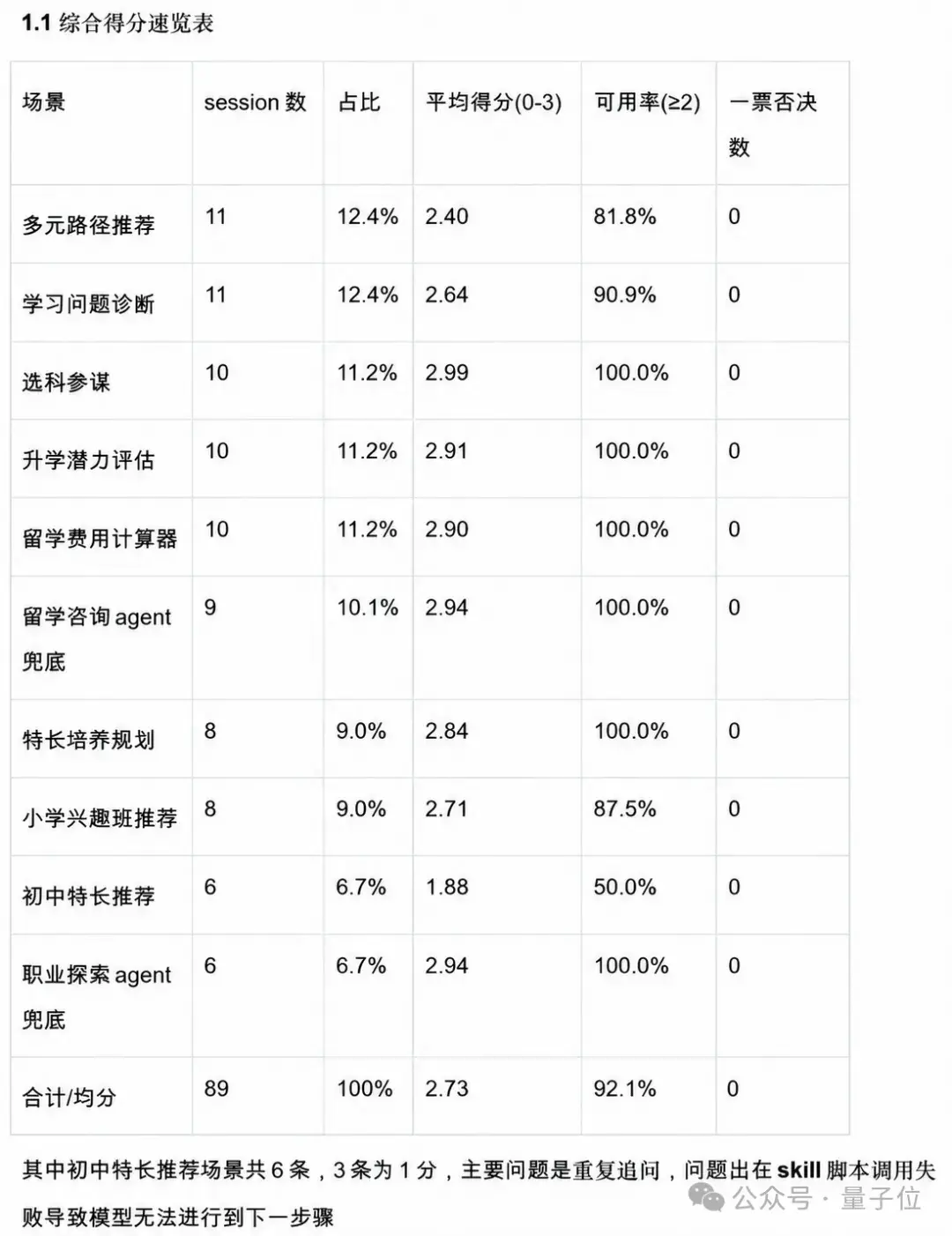
This metric demonstrates the model’s reliability across complex reasoning chains. In real-world career advisory, assessments must closely monitor several critical pain points: whether key constraints are overlooked, whether recommended strategies have sound causal backing, and whether the proposed plans fit the student’s actual academic standing.
Seamlessly applying this rigorous advisory framework to subject selection requires deep underlying capabilities that link student profiles, university major admissions catalogs, and regional Gaokao policies.
This relies entirely on the architecture and engineering foundation supporting e-Career.
How AI Tackles Planning: The Mechanics Behind Subject Selection
Returning to high school subject selection: determining whether a subject combination is viable requires evaluating a student’s current academic strengths and potential, matching them against university major directories, and ensuring the student actually has the desire to pursue that field.
OpenSpan synthesizes these interconnected dependencies into an intuitive Autonomous Decision-Making Landscape.
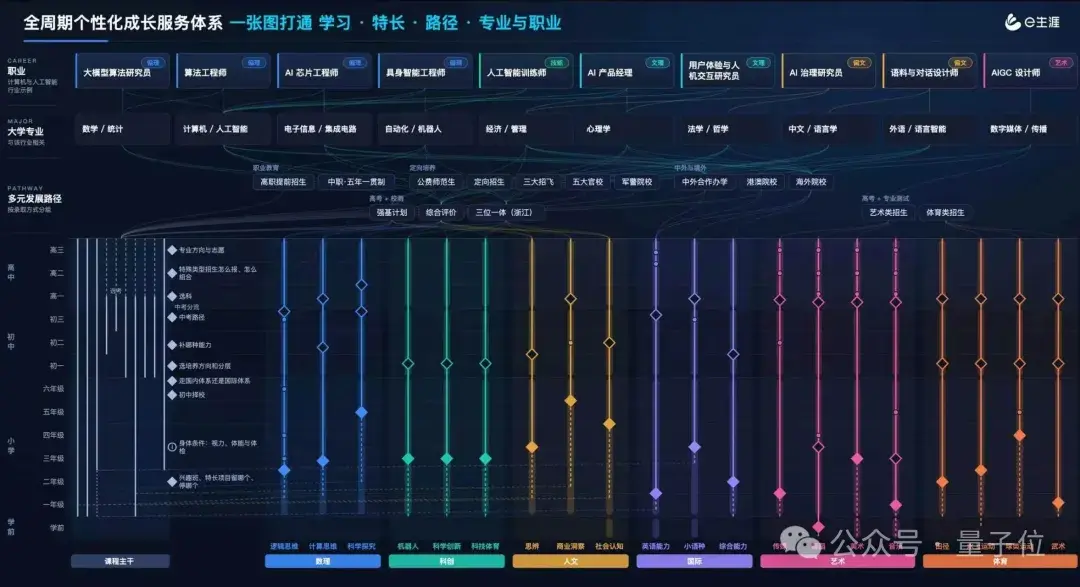
Starting from academic competencies and talent cultivation, this landscape spans developmental milestones across educational stages, connects horizontally to diverse admissions tracks, and extends forward into academic disciplines and long-term career paths.
Students with clear goals can work backward from their target major to identify mandatory subject requirements and necessary academic milestones. Students without a defined direction can work forward from their strongest subjects and personal interests to uncover viable paths.
With this landscape as a reference benchmark, subject selection is no longer a shot in the dark. Parents and students can clearly analyze how a given combination aligns with specific personal traits—and what constraints it might impose on future major selections.
This visual landscape directly mirrors the domain knowledge graph powering OpenSpan.
According to the e-Career R&D team, the topological relationships and autonomous decision logic inside the graph distill years of accumulated domain expertise from veteran career counselors. The team structured these expert methodologies into machine-searchable, machine-reasoning graph data structures, paired with a comprehensive domain knowledge base.
Applying this massive knowledge framework to unique individuals requires a sophisticated advisory state machine and agent-driven workflow orchestration.
Throughout an interaction, the system dynamically extracts factual triplets from the dialogue stream, progressively assembling a high-fidelity student profile. For instance, the province of registration determines the applicable Gaokao policy framework, while subject score percentiles establish a quantitative baseline of current competitiveness. As the conversation advances, the student profile updates in real time.
The system then accurately identifies user intent, dispatches the task to the appropriate domain expert agent, and activates specialized skill modules to carry out the planning workflow.
Years of human counseling experience have been engineered into advisory state rules strictly executable by algorithms.
Each skill module has well-defined activation criteria, fact-collection checklists, knowledge retrieval rules, logical reasoning constraints, and structured output formats. Whether deriving elective combinations, assessing extracurricular strengths, or matching college tracks, every step adheres to strict professional service standards.
This explains why, in the earlier test case, the AI methodically gathered family budget details and verified educational targets—the underlying reasoning engine actively drives the system to fill in missing constraints, ensuring the final recommendations are grounded in reality.
Admissions policies are also highly time-sensitive. The e-Career team notes that the system maintains live links to provincial examination authorities, university undergraduate admissions portals, and other authoritative public sources, supported by automated update pipelines and secondary expert verification. During retrieval, structured graph data and unstructured university policy documents cross-validate one another to ensure every recommendation is verifiable.
When policy changes occur, related knowledge bases and inference rules update immediately, mitigating the risk of relying on obsolete information.
In subject selection, another critical factor is often overlooked: student growth is dynamic.
A few exams during the first semester of 10th grade rarely reflect a student’s performance across all three years of high school. As coursework becomes more demanding and perspectives broaden, students frequently develop new academic interests or reconsider their previous ambitions.
This dynamic evolution is precisely why the Growth Profile is integrated into e-Career’s core architecture.
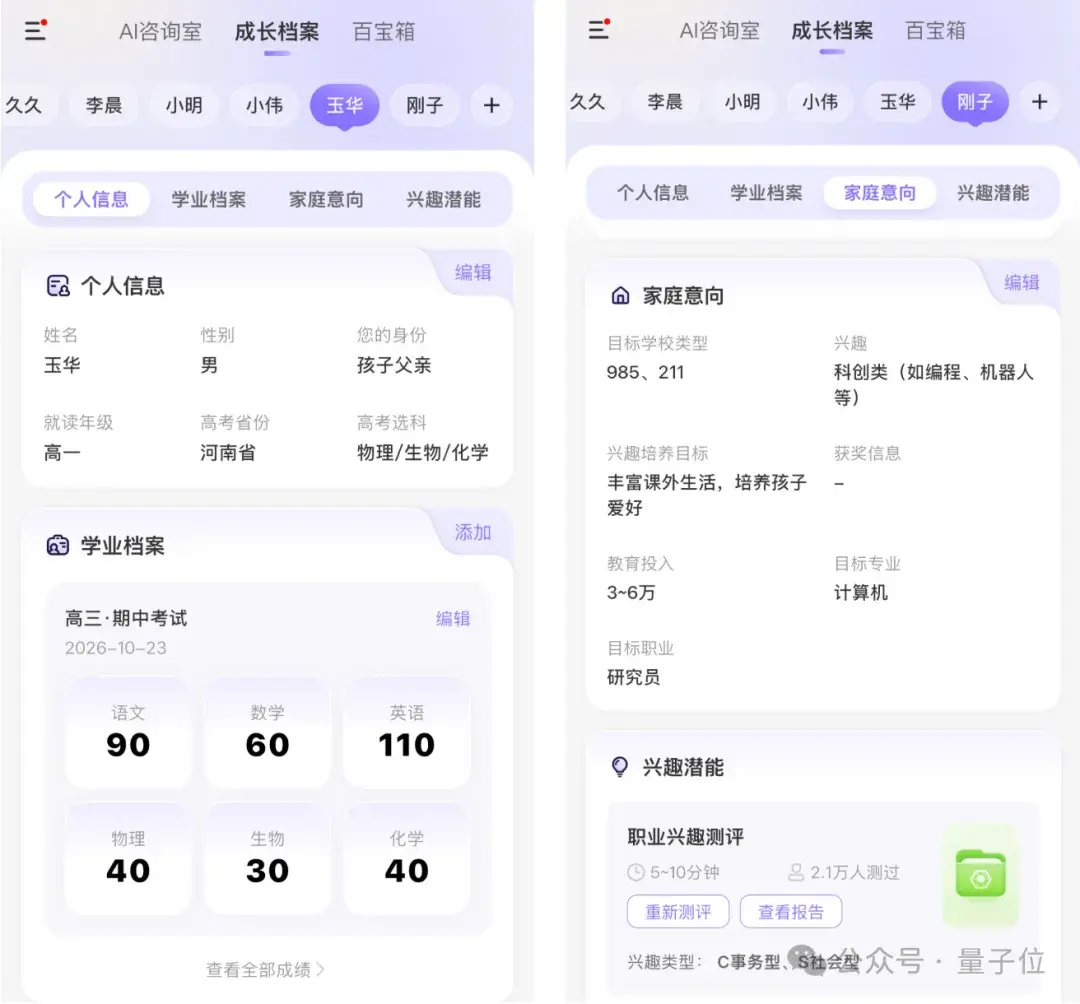
The Growth Profile tracks academic performance trends over time, synthesizes interest inventory assessments with family goals, and provides dynamic contextual memory that allows the AI to generate deeply personalized, long-term guidance. Across multiple sessions, newly surfaced information is written back into the student profile.
For example, a student might initially show interest in general science, subsequently explore programming, and later decide to pursue a specific branch of engineering. These developmental milestones are recorded in the profile, providing rich context for future consultations and enabling earlier recommendations to adapt accordingly.
Even after subject combinations are finalized, the planning system remains responsive to fluctuating grades or shifting goals.
This persistent memory mechanism enables parents to return to previous records at any stage of high school to resolve emerging questions, keeping the guidance synchronized with the student’s ongoing growth.
What Kind of AI Do Major Life Decisions Demand?
Information is easier to find than ever, yet answering “which path is truly right for me” remains difficult. This uncertainty extends far beyond high school subject selection—it applies equally to family healthcare management, elder care planning, and other high-stakes life decisions.
These choices often influence a family’s trajectory for years or even decades, carrying heavy costs if mistakes are made. Navigating overwhelming amounts of information requires more than simply knowing “what to do”—it requires understanding the reasoning behind each option and knowing whether one’s personal circumstances satisfy the underlying assumptions.
While experienced human specialists can untangle these complexities, high service costs and limited availability make top-tier human consulting inaccessible to most families. Furthermore, when a family’s circumstances change even slightly, the entire chain of reasoning often has to be reworked from scratch.
As large language models enter critical public-interest domains, their ability to grasp a family’s real-world constraints has become the true benchmark of their social value.
Users need intelligent systems that can cross-verify objective facts, weigh trade-offs across options, and provide continuous support as circumstances shift.
In intelligent healthcare, clinical recommendations must account for a patient’s medical history and physiological profile, highlighting which lab markers require follow-up. In elder care, care plans must realistically balance the family’s caregiving capacity against their financial resources.
High-stakes educational counseling requires the same rigor. Test scores fluctuate, perspectives mature, and goals shift; the system must be capable of tracking changes and refining recommendations over extended periods.
This demands that vertical AI tightly couple authoritative domain knowledge with dynamic personal constraints, updating its evaluations adaptively through ongoing interaction.
In practice, high-impact vertical AI products must do more than curate accurate industry knowledge—they must structure complex real-world variables into repeatable reasoning frameworks that uncover underlying needs through dialogue.
Hailiang Tech Service’s work in this domain serves as a practical blueprint for this engineering approach.
Years of hands-on career advisory work helped the team develop proven decision models, while digital tools standardized that expertise into reusable software capabilities.
By embedding this knowledge and reasoning structure into OpenSpan and e-Career, everyday families can now use natural language interaction to work through major life decisions step by step.
Domain expertise built over years in the education sector translates directly into engineering strengths: knowing which constraints to evaluate first, and identifying common misconceptions held by parents and students, informs how agents route tasks and refine their reasoning.
Broadening access to high-quality counseling also requires minimizing adoption barriers.
Hailiang Tech Service has stated that e-Career’s core planning services are entirely free. For families in county-level and underserved areas who rarely have access to premium offline career counseling, this provides a transparent digital gateway to explore college pathways and evaluate eligibility independently.
Returning to the challenge of 10th-grade subject selection, the true value of sound guidance lies in helping students and parents understand the reasoning behind each choice, identify key milestones at every stage, and maintain the flexibility to adapt in an uncertain future.
Bringing this caliber of accessible, professional support to more families is where the application of large language models to major life decisions delivers its greatest practical impact.