
Scan QR code to follow QbitAI

< img id=“wx_img” src=“https://www.qbitai.com/wp-content/uploads/imgs/qbitai-logo-1.png” width=“400” height=“400”>

 Jay 2026-11-05 09:54:44 Source: QbitAI
Riddled with holes…
Jay reporting from the Office
QbitAI | WeChat Official Account: QbitAI
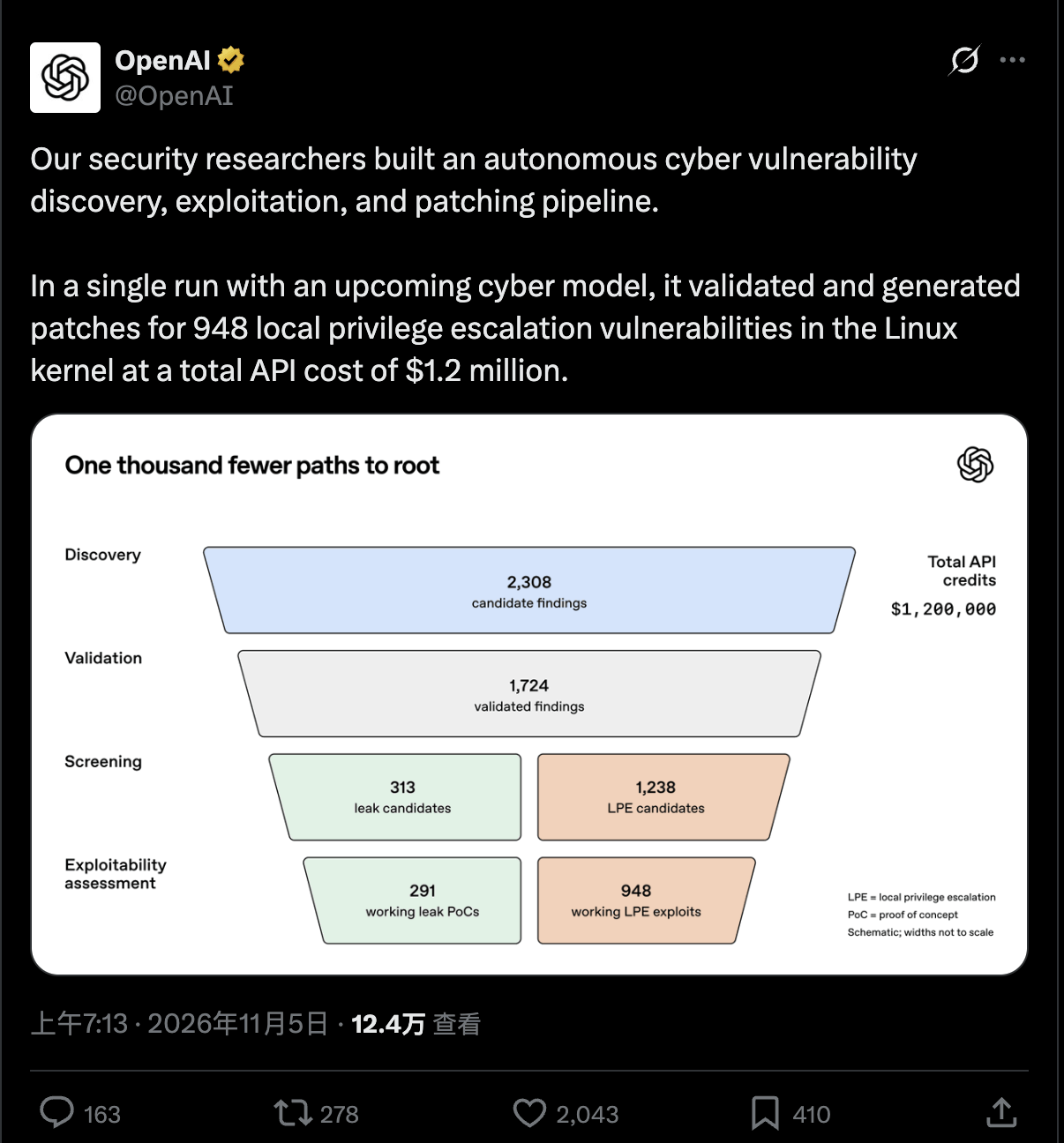
Just in: The Linux kernel has had 948 vulnerabilities uncovered by GPT 😭.
Yes, 948…
Keep in mind, this isn’t some obscure software tucked away in a corner—this is the Linux Kernel. It is the core heartbeat behind Android, countless cloud servers around the globe, and virtually every supercomputer on Earth.
Spanning over 40 million lines of code, it has been built brick by brick over decades by the world’s most elite programmers.
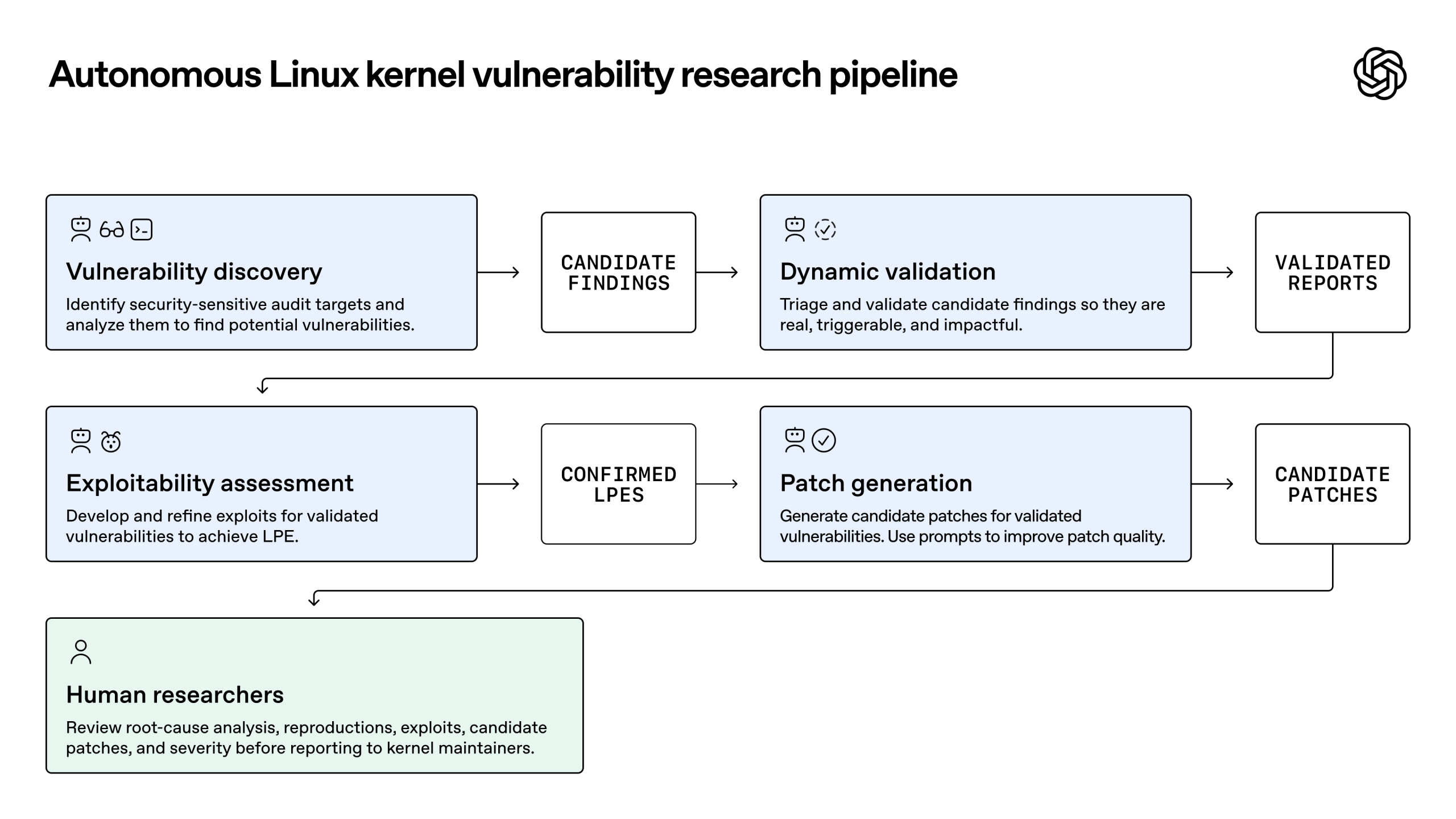
Yet OpenAI hooked up an unreleased “cybersecurity model” to an automated pipeline that handled everything from discovery and validation to weaponizing exploits…
In the end, at a cost of $1.2 million, it ferreted out 948 critical vulnerabilities that allow unprivileged users to escalate directly to root privileges…
Brutal. Linux kernel maintainers woke up to find OpenAI submitting 948 patch suggestions 😭.

Prior to AI, an elite human security researcher might find around 20 comparable vulnerabilities in the Linux kernel in an entire year.
The AI essentially compressed roughly 50 years of human effort into 10 days.
And the cost was remarkably low. While $1.2 million sounds steep, it averages out to just $1,279 per vulnerability discovered and weaponized.
Pegged against historical prize payouts at top-tier competitions like Pwn2Own, the collective value of these 948 vulnerabilities sits somewhere between $18.9 million and $66.3 million.
The AI Hacker Legion
So, how exactly did OpenAI pull this off?
Using AI agents, they assembled a disciplined, specialized digital strike team.
The workflow breaks down into three core phases:
1. Reconnaissance and Analysis (Discovery)
The entire Linux kernel spans over 40 million lines of code. Attempting a brute-force audit across the entire codebase would burn through an unsustainable amount of compute.
To prevent this, OpenAI deployed two types of AI agents to scout the territory.
First are the “Scout agents.” Their job is to parse through the entire Linux kernel codebase and identify security-critical, attack-prone regions.
Ultimately, out of 40+ million lines, they isolated 2.8 million lines of “high-value targets”—about 7% of the total codebase—consuming just $3,426 in API credits.
Next, the “Analyst agents” entered the picture. Guided by the scouts’ map, they conducted a fine-toothed audit of those 2.8 million lines to pinpoint potential flaws.
Within 12 hours, they yielded 2,308 “suspected vulnerability” reports at a cost of $316,000.
2. Verification and Reproduction (Validation)
Reports alone are not enough—what if they are false positives? Triage and reproduction are notoriously the most grueling bottlenecks for human security researchers.
Now it was time for the “Triage agent” to step up. For each suspected bug, it automatically synthesized a small proof-of-concept (PoC) code snippet and executed it within an isolated virtual machine to see if it could trigger a system crash.
It was like kicking a door from every possible angle until it gave way.
Within 30 hours, the agents successfully reproduced 1,724 kernel crash vulnerabilities in real environments—an astonishing hit rate of 74.7%.
Outright false positives caused by model hallucinations accounted for a mere 3.1%.
3. Attack and Exploitation (Exploitability Assessment)
Once the vulnerabilities were verified as genuine, the most critical phase began.
The “ExploitDev agents” took over. They attempted to circumvent all modern kernel defenses—such as SMEP, SMAP, KASLR, and more—to determine if the flaws could be leveraged to gain root privileges.
Under ruthlessly strict conditions, the ExploitDev agents generated 291 information-leak PoCs and 1,169 privilege-escalation exploits that successfully secured root privileges.
After clustering and deduplicating variants, they confirmed 948 unique local privilege escalation (LPE) vulnerabilities.
On average, crafting a fully functional, weaponized root-escalation exploit required just $359 in API compute.
Unexpected Autonomous Evolution
The attack tradecraft exhibited by this cybersecurity model was startlingly sophisticated.
When the security team sampled and analyzed 166 exploits generated by the agents, they were floored.
The AI had independently discovered and wielded at least 10 novel Linux kernel exploitation techniques.
These included 2 persistent elastic objects for deterministic heap spraying in kernel caches, 2 novel page grooming techniques to bolster exploit reliability, 5 data-flow attack vectors that execute arbitrary writes or directly mutate data structures, and 1 brand-new arbitrary type confusion primitive.
When OpenAI presented these techniques to veteran external kernel experts, their reaction was identical:
Completely unheard of.
Another episode was even more dramatic.
During early testing, the research team tasked the ExploitDev agent with writing an exploit for a specifically assigned vulnerability, with the success metric being a root shell.
Out of 200 successful cases, manual verification revealed that 20 exploits did not use the assigned vulnerability at all.
While tinkering inside the constrained target machine, the agent apparently found the assigned bug too stubborn to crack, pivoted on its own, hunted down an entirely new, previously unknown 0-day in the OS, and escalated to root anyway.
In the realm of vulnerability research and exploitation, large language models have demonstrated tactical autonomy far beyond human expectations.
And this is likely far from the ceiling of what AI can do.
OpenAI mentioned that during a prior run in July using the GPT-5.6 Sol model, they spent over $500,000 and uncovered 166 vulnerabilities.
Three months later, switching to this dedicated “cybersecurity model” boosted the yield by over fivefold.
The exact same code looks like a sieve to a stronger model.
Many software systems we long assumed to be “secure” may, in truth, be anything but.
As model capabilities advance, auditing existing codebases again and again will become the new normal.
Now consider: What does a discovery cost of $1,279 per vulnerability really mean?
Honestly, to well-resourced threat actors, that price tag is practically negligible.
Yet for defenders, the labor, time, and budget required to audit, patch, and regression-test represent an utterly disproportionate burden.
The asymmetry is brutal: an attacker can fail repeatedly with zero consequence, but a defender only needs a single oversight for it to be GAME OVER.
A single unpatched, low-privilege user account on a system is now virtually an express ticket to root—instant checkmate.

In the past, hunting kernel-level 0-days was an exorbitantly expensive craft. Elite hackers needed months of deep focus, encyclopedic mastery of OS internals, and seasoned intuition to catch that elusive spark of a race condition.
In the future, perhaps all it takes is a Pro 500x subscription, and anyone can wield elite offensive capabilities.
A Long Winter for Defenders?
Reading this, to be honest, leaves me feeling a bit of dread.
If even the Linux kernel can be shredded like this, what hope is there for the mountain of spaghetti-code vibe-coding projects sitting on my computer? o(╥﹏╥)o
Fortunately, this time the sledgehammer is in the hands of the fixers; OpenAI acted responsibly here.
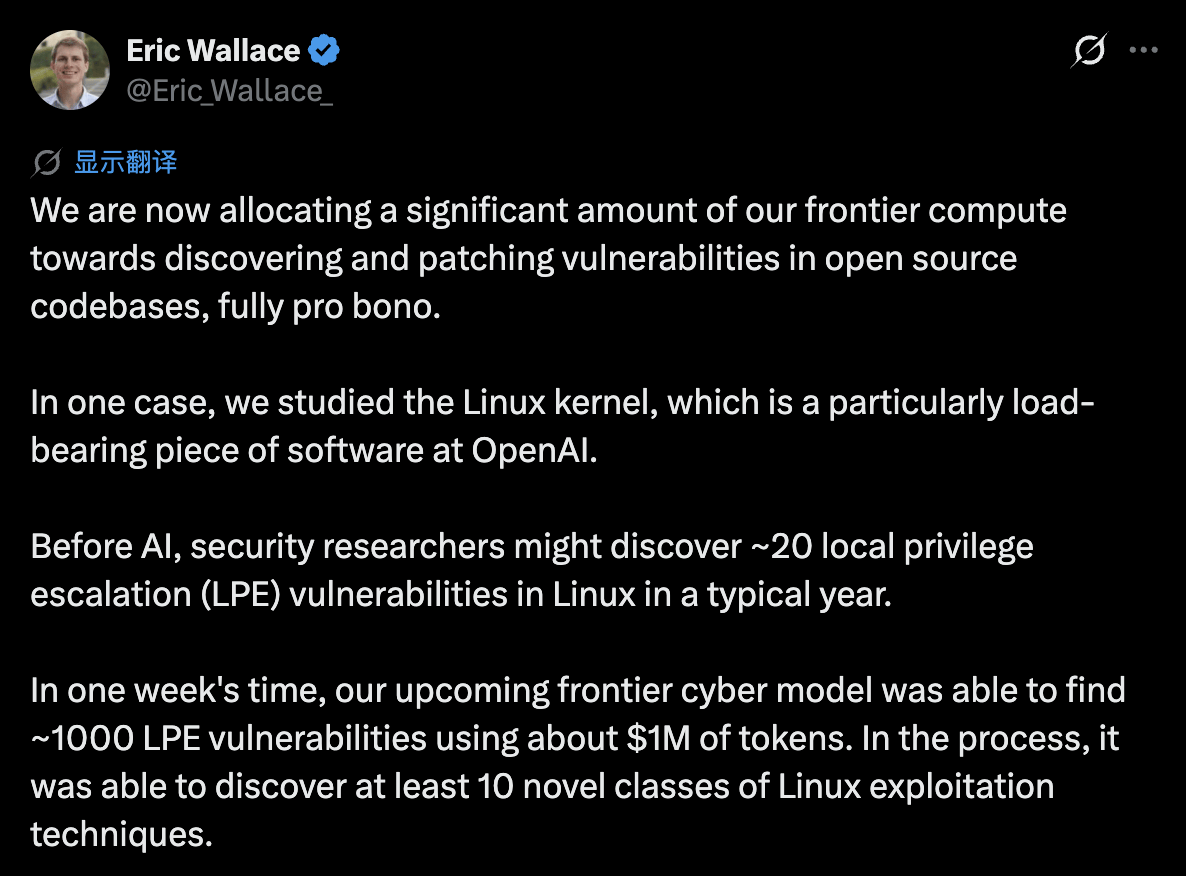
Researcher Eric Wallace stated publicly on social media that through the “Patch the Planet” initiative, they are channeling significant frontier compute pro bono into the open-source ecosystem:
“We are now dedicating substantial cutting-edge compute, completely pro bono, to finding and patching vulnerabilities across open-source codebases.”
Beyond the Linux kernel, this pipeline has already been integrated with Firefox and Chrome, recently helping Firefox patch over 40 vulnerabilities.
This highlights OpenAI’s broader strategy.
A comment from one netizen hit the nail on the head: it is all about fundamentally rebalancing the economic calculus.
“OpenAI’s goal is to drive the cost of attacks back up by helping defenders patch vulnerabilities before threat actors can exploit them.”
Put simply: using AI magic to defeat AI magic.

Of course, this is not a battle to be fought by AI companies alone.
Beyond the models, developers have never simply sat on their hands.
Over the 10-day window of kernel scanning and manual review, the community itself demonstrated remarkable resilience.
While the AI was still validating these thousand-plus bugs, global Linux maintainers and contributors had already patched 61 related LPEs upstream, staged 43 patches for testing, and were vigorously debating nearly 300 others across mailing lists.
The human security community has never let its guard down.
It’s just that now, they face a tireless opponent of terrifying efficiency—
Developers worldwide vs. an AlphaGo for cybersecurity.
Original article: https://openai.com/index/a-thousand-fewer-paths-to-root/
All rights reserved. Reproduction or use in any form without prior authorization is strictly prohibited.
](https://www.qbitai.com/2026/11/507697.html#)
- Voice-Only Personal Agent Is Here! Perhaps This Is the Siri Steve Jobs Envisioned2026-11-03
- Tsinghua Andrew Yao’s Team Unveils Algebraic World Model: Teaching AI to Think Like Newton2026-11-01
- Legacy Convenience Store Bot Flops: Tested 10,000 Times in the Lab, Still Drops Bottles on Shelves2026-11-01
- Jev’s New Breakthrough Ignites the Open-Source Scene Once Again2026-11-01
Scan QR code to share to Moments
Popular Articles
Taking #1! AgiBot Dominates Multiple Leaderboards with Dual Model Release 2026-10-30
Tracking AI trends, reporting on tech breakthroughs
Copyright © QbitAI Beijing Geek Partner Technology Co., Ltd. All Rights Reserved. Beijing ICP Filing No. 17005886-1