
Activating Only 3B Parameters: Across-the-Board Gains Across 10 Benchmarks!
Intuitive human judgments in daily life often turn into thorny challenges when transferred to robots.
In video footage, an object appearing higher on screen does not mean it occupies a higher position in 3D physical space; when the camera angle changes, a piece of furniture may look different, yet it remains the exact same object; when an object shifts across the frame, it could be moving on its own, or the camera itself might simply be rotating…
While humans distinguish these subtle spatial and state transitions in an instant, they pose formidable bottlenecks for a robot’s “embodied brain.”
Confusing object identities across changing viewpoints, misinterpreting camera motion, and misjudging task progression all lead directly to robotic execution failure.
For robots to reliably accomplish real-world tasks, models cannot stop at merely “seeing objects.” They must comprehend 3D spatial relationships, capture object state transitions, and accurately assess the current stage of a task.
Recently, the Lion Rock Artificial Intelligence Laboratory under the China Merchants Institute of Advanced Technology (CMRIAT) released an embodied reasoning vision-language model—“Yuwu™ Lion-ER-35B-A3B”. Built on a Mixture-of-Experts (MoE) architecture, the model features ~35B total parameters, activating only ~3B parameters per token.
Without significantly increasing inference overhead, the model achieved across-the-board performance gains across ten mainstream embodied benchmarks, outperforming larger-parameter models across multiple core capabilities. This charts a technical path distinct from blindly scaling training data and helps robots truly understand the 3D physical world.

How Was This Model Built?
Over the past few years, initiatives like Open X-Embodiment and DROID have steadily expanded the boundaries of real-world robotics data. However, as dataset scales grow, a critical issue becomes increasingly apparent:
More data does not equate to stronger capabilities.
Existing research indicates that within current robotics datasets, simply adjusting the training weights across different data domains can dramatically impact downstream task performance.
The core highlight of “Yuwu™ Lion-ER-35B-A3B” is not sheer parameter scaling, but rather the construction of a capability-driven embodied data engine. Departing from the conventional approach of blindly gathering massive datasets, the team reverse-engineered the pipeline around the core competencies the model must acquire, using rigorous evaluation to identify weak spots and achieve closed-loop iteration and data refinement.
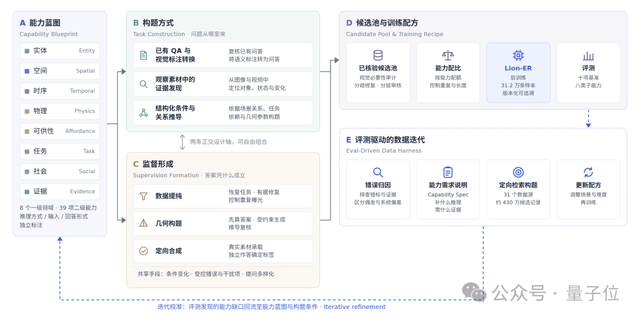 Capability-driven embodied data engine
Step 1: Clarifying What the Model Must Learn
The CMRIAT Lion Rock team mapped out a fine-grained “capability blueprint”:
They broke down embodied reasoning into 8 primary domains—Entity, Space, Temporal, Physical, Affordance, Task, Social, and Evidence—further subdivided into 39 secondary capabilities. Meanwhile, reasoning style, input format, and response format were treated as independent dimensions and labeled separately to avoid overlapping definitions caused by mixed classification criteria.
The blueprint defines not only which capabilities the model must acquire, but also the specific conditions under which these capabilities should be invoked.
Real-world tasks often demand composite capabilities. For example, determining whether an item has been placed properly requires both an understanding of task progress and spatial reasoning.
Therefore, during the blueprint design phase, the team logged primary and auxiliary capabilities separately, while isolating non-decomposable joint tasks.
During training sampling, the team balanced combinations and holdouts across different factors to prevent specific capabilities from becoming tightly coupled with a narrow set of fixed scenes, objects, or prompt styles.
Step 2: Translating Abstract Requirements into Concrete Training Problems
With a capability blueprint in hand, how do you turn it into concrete training problems?
The team called this workflow “Capability Compilation”:
Breaking down abstract capability objectives step by step into concrete parameters: “Which scenes need to be configured, how should visual observations be structured, what questions should be posed, and what evidence determines the ground-truth answer?”
Taking cross-viewpoint reasoning as an example, one must first specify the number of viewpoints provided to the model, the target objects that require cross-frame association, and the observer’s position and orientation used to establish relative direction.
Simultaneously, the source material itself undergoes strict verification: is the visual information accessible to the model sufficient to support a reliable deduction? If critical angles are missing or evidence is inadequate—forcing the answer to rely on guesswork—the sample is disqualified from the training set.
These problem formulation specifications are entirely driven by target capabilities, eliminating the need to passively wait for errors to surface during post-hoc evaluations before augmenting data.
The capability blueprint proactively plans the required coverage scope, while evaluations serve to check for gaps and pinpoint where the model remains weak.
Step 3: Ensuring Every Training Problem Is Grounded in Evidence
On the problem generation front, the team designed three combinable pathways: transforming existing QA and visual annotations, discovering evidence from observational data, and deriving questions from structured conditions and relationships. Working in concert, these three pathways translate abstract capability requirements into specific, answerable training problems.
 Schematic of the three problem generation pathways
For supervision and verification, the team deployed three complementary approaches:
- Data Distillation: In-depth cleaning and revision of existing data, rigorously screening image sequences, question references, and option-to-answer mappings to fix verifiable errors while tightly controlling repeated exposure rates.
- Geometric Problem Formulation: For assets with reliable poses, depths, and object correspondences, the team first calculates the deterministic answer and intermediate geometric relations needed for reasoning, then guides the model to generate questions and explanations constrained by these ground-truth facts.
- Targeted Synthesis: When existing supervision signals fall short, targeted QA pairs are synthesized from real images or video clips. Synthesis is strictly limited to questions and annotations; model-generated answers are never used directly as ground truth and must undergo cross-validation via independent answering or stringent human review.
 Three supervision pathways
Throughout the process, a core principle is strictly upheld: Keep difficult problems supported by evidence; discard “pseudo-difficult” problems that lack evidence.
An incorrect answer from a model is not a valid reason to discard a sample; conversely, multiple models converging on the same answer does not prove that answer is correct.
For challenging samples where models consistently fail, the team incorporated a Human-in-the-Loop verification mechanism and built a visual verification platform tailored for complex embodied tasks. By enhancing human review with multi-view comparisons, temporal playback, and key evidence annotation, reviewers can fully reconstruct visual clues and reasoning trails, preventing model capability boundaries from being misdiagnosed as data quality defects.
Step 4: Feeding Evaluation Results Directly Back into Data Iteration
With qualified training problems ready, training resources must be allocated with precision.
The supervised training set for “Yuwu™ Lion-ER-35B-A3B” contains 312,380 samples. During training, compute and sample budgets were allocated strictly according to capability demands rather than simply weighting by the raw volume of individual data sources.
Samples prioritized core embodied capabilities such as spatial geometry, multi-view correspondence, action trajectories, and task planning. The team minimized homogeneous, repetitive questions, shifting valuable training budget toward weaker reasoning categories. Every sample was tracked from candidacy and auditing to training inclusion, ensuring the training recipe remains fully traceable and adjustable.
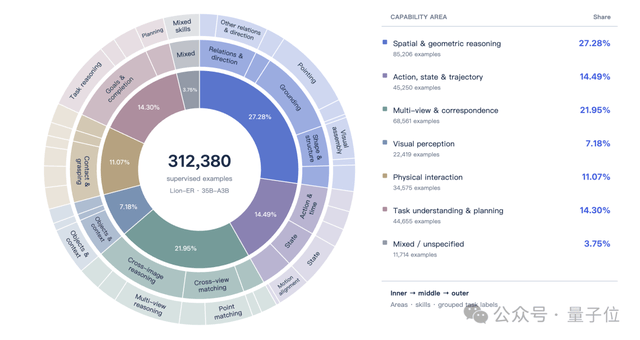 Capability composition of the 312K supervised samples
While forward design establishes comprehensive capability coverage, how can one verify whether the model has truly mastered them, and where blind spots persist?
This is where the Eval-Driven Data Harness steps in.
This is an efficient data iteration mechanism designed to pinpoint capability deficits directly from the model’s incorrect responses and translate them into actionable data production requirements for the next cycle.
Under the Harness framework, evaluation is no longer a static “report card” at the end of training; it becomes the direct starting point driving the next round of data generation.
Once an incorrect answer is detected, the system first verifies whether annotations, visual evidence, or scoring logic contain errors, distinguishing isolated slips from systematic capability weaknesses. Once a capability gap is confirmed, new material sharing the same reasoning logic across varied scenes is retrieved from a massive asset pool spanning 31 data sources and ~4.3 million records. After formulation and verification, these samples are fed back into training, closing the loop with a fresh evaluation to validate improvements.
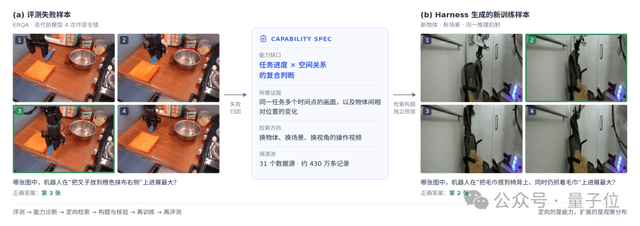 How an evaluation failure transforms into a new batch of training data
For example, to address the model’s tendency to equate 2D screen positions (up/down) with 3D spatial height, the team prioritized complex scenes featuring multi-tiered support surfaces, compelling the model to infer elevation from spatial geometry. Meanwhile, occlusions and perspective changes were introduced into left/right and front/back relationships to specifically target ambiguous edge cases.
The team also leveraged instance segmentation, depth maps, and geometric constraints to rigorously verify the physical plausibility of placement zones.
 “Higher on screen” ≠ “Higher in space”: Failure modes directly reshape data criteria for the next cycle
In short, the capability blueprint outlines target coverage, while the Eval-Driven Data Harness continuously calibrates cognitive blind spots.
Data shifts from a one-off, static supply into a dynamic asset that evolves alongside the model’s capabilities.
Activating Only ~3B Parameters: Improvements Across All Ten Benchmarks
Powered by the capability-driven data engine, “Yuwu™ Lion-ER-35B-A3B” achieved positive gains across all ten public benchmarks with an inference activation of only ~3B parameters, even surpassing larger models on several key metrics.
Evaluations uniformly adopted an avg@4 setup (averaging scores across 4 independent runs per question).
Across the ten public benchmarks, “Yuwu™ Lion-ER-35B-A3B” achieved an equal-weighted comprehensive average score of 65.29.
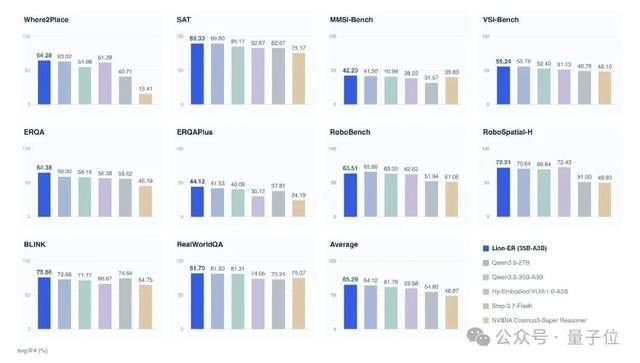 Benchmark-by-benchmark comparison bar chart; blue denotes “Yuwu™ Lion-ER-35B-A3B”
Looking at individual benchmark results:
- Where2Place (spatial placement): Scored 64.28, a 9.30-point increase over the base model;
- ERQA (embodied reasoning): Scored 64.38, a 6.19-point increase over the base model;
- SAT (spatial reasoning): Reached 89.33;
- ERQA Trajectory Understanding subcategory: Reached 68.18, surging by 12.12 points compared to the base model.
 Full results across ten benchmarks (avg@4); blue column denotes “Yuwu™ Lion-ER-35B-A3B”
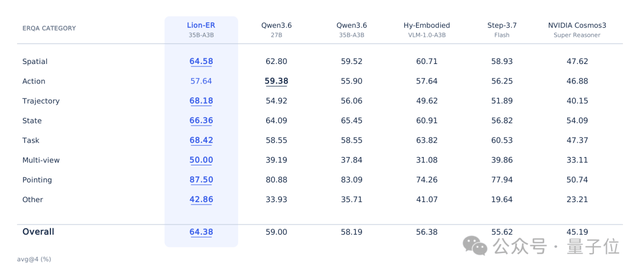 Score comparison across ERQA capability categories (avg@4); blue column denotes “Yuwu™ Lion-ER-35B-A3B”
Comprehensive evaluation results demonstrate that “Yuwu™ Lion-ER-35B-A3B” significantly outperforms the underlying base model across all ten benchmarks.
Four Public Benchmark Questions: A Direct Look at the Capability Gap
The following four evaluation cases are drawn from public test suites. For each question, “Yuwu™ Lion-ER-35B-A3B”, the base model Qwen3.6-35B-A3B, and Qwen3.6-27B were evaluated across 4 independent runs.
Question 1: Discerning Direction — Which Way Is the Camera Rotating?
Two input images are sequential captures from a robotic arm’s first-person perspective camera: the bottle shifts upward overall across the frame, and the model is asked to determine which direction the camera is rotating.
The base model answered correctly only once, while Qwen3.6-27B failed on all 4 attempts. In contrast, “Yuwu™ Lion-ER-35B-A3B” accurately captured the parallax dynamics between the two frames and correctly inferred that the camera was tilting downward, achieving a 4/4 success rate.
For robots, when relative motion occurs on screen, the primary prerequisite is disambiguating the source of motion: is the object itself moving, or is the camera orientation changing?
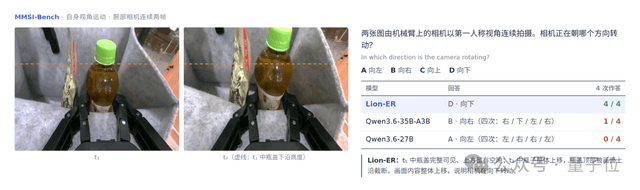 Dashed line indicates height reference: In $t_2$, the bottle shifts upward overall in the frame
Question 2: Selecting Trajectories — Which Path Completes the Task?
Four candidate motion trajectories in different colors are overlaid on the scene. The robotic arm’s task is to unplug a charger from a power strip and move it to the right side of the frame; the model must identify the correct viable trajectory.
Both comparison models were misled by the long purple arc extending to the right and made incorrect selections. While that trajectory appears to lead toward the target area, its starting point fails to make contact with the charger; without grasping the target object, subsequent operations like unplugging and placing are impossible to execute.
“Yuwu™ Lion-ER-35B-A3B” logically eliminated invalid paths one by one: the red path diverged to the left of the power strip, the purple path failed to contact the target, and the yellow path extended toward the hose in the back. Only the orange trajectory accurately reached the charger to unplug it and successfully transferred it to the designated area on the right, scoring 4/4 correct answers.
This question fundamentally tests the ability to map target intent, motion paths, and physical actions into a closed loop—not just evaluating the destination, but verifying whether the entire trajectory acts effectively upon the target object.
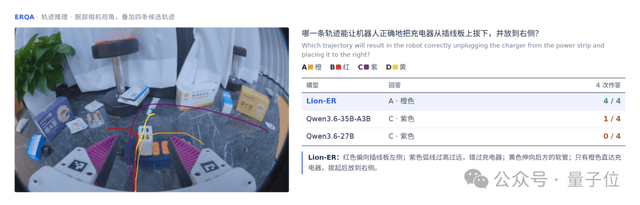 Among the four candidate trajectories, only orange accomplishes “unplug and place to the right”
Question 3: Cross-Viewpoint Reasoning — Which Side of the Observer Is the Wall Art On?
The question provides three photos taken within the same indoor environment, where a framed butterfly picture is visible only in the third photo. The model is asked to deduce which side of the photographer the picture was located on when the first photo was taken.
Answering this question requires the model to link multiple images and mentally reconstruct the 3D spatial layout. The framed art hangs on the living room wall shown in the third photo. Combining this with the other two photos reconstructs the overall spatial geometry: when capturing the first photo, the photographer was standing at the base of the stairs facing the steps, with the living room behind them. Therefore, the picture must have been located behind the observer.
Both comparison models incorrectly answered “left,” failing on all 4 attempts. “Yuwu™ Lion-ER-35B-A3B” remained accurate across all 4 inferences.
Recognizing artwork is basic visual perception; the challenge here lies in independently switching to a designated viewpoint and orientation to perform complex cross-view 3D spatial reasoning.
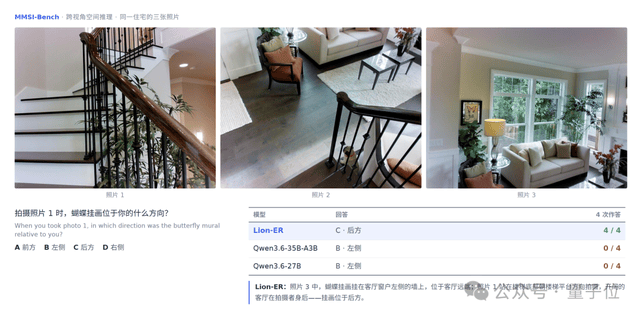 Requires stitching three photos into a “mental map,” then switching back to Photo 1’s perspective to answer
Question 4: Monitoring Progress — Is This Step Completed?
This is a robotic manipulation video snippet where the objective is to place a sushi roll from the table into a pot. The question asks: at the current video frame slice, has the initial stage—“moving to the sushi roll”—been fully executed?
The base model mistakenly judged this step as “completed” in 3 out of 4 trials, and Qwen3.6-27B suffered the same false positive half the time. “Yuwu™ Lion-ER-35B-A3B” correctly identified it as “not yet completed” in all 4 trials.
The breakthrough here lies in precisely distinguishing between two physical states: the robotic arm “approaching the sushi roll” versus “accurately positioned in place.”
Visible motion on screen does not mean a task step has been achieved. The model must closely monitor state transitions induced by motion and verify whether the target end state is truly satisfied. Misjudging progress easily leads robots to prematurely trigger subsequent action sequences, causing the entire sequential planning pipeline to collapse.
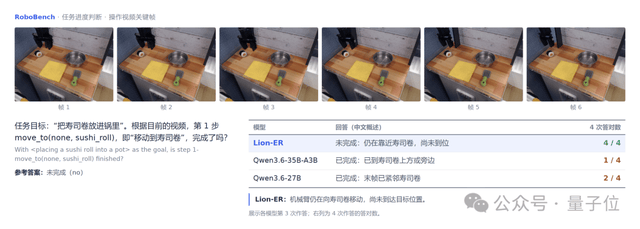 “Approaching” vs. “in position”: In the frame, it is separated by only a slight displacement
These four cases correspond to camera motion parsing, interaction trajectory planning, cross-view spatial mapping, and action progress assessment—forming the foundational pillars for robots to translate high-level natural language instructions into physical actions.
Embodied Foundation Models Must Not Only See the Frame, but Understand Physical Reality
Today, multimodal large models capable of multi-turn dialogue and general image understanding are commonplace. However, “embodied brains” that truly target the physical world and empower physical robots remain scarce.
For robots to operate robustly in real-world environments, they cannot remain confined to superficial 2D visual recognition; they must rigorously distinguish visual projections from true 3D physical space.
What “Yuwu™ Lion-ER-35B-A3B” demonstrates is not merely a set of competitive benchmark figures, but a mature, reproducible methodology:
Making capabilities the fundamental unit of data design, and turning evaluation into the direct engine of data production. From blueprint construction to data recipe tuning, from isolated benchmark hurdles to targeted sample generation, every step is characterized by clear objectives, reliable evidence, and end-to-end traceability.
Currently, model weights for “Yuwu™ Lion-ER-35B-A3B” are fully open-sourced on Hugging Face in BF16 Safetensors format, natively compatible with mainstream inference frameworks including Transformers, vLLM, and SGLang.
Developers can evaluate and adapt the model across spatial relationship understanding, scene state analysis, task progress tracking, and physical spatial constraints. Combined with specific images, videos, and operational workflows, teams can deeply explore embodied QA, intelligent scene decision-making, and robotic system integration.
The Lion Rock AI Laboratory at CMRIAT stated that the team will continue developing embodied agents, focusing on high-tier training data for tool use, multi-turn interaction mechanisms, and physical execution feedback. By tackling sequential decision-making and autonomous error recovery in long-horizon complex tasks, they aim to continually upgrade this capability-driven data engine, providing solid technical foundations for everyday robot deployment in physical environments.
Hugging Face model repository:
https://huggingface.co/cmriat/lion-ER-35B-A3B