
A 2-billion parameter (2B) model that extracts the exact fields you need from any document type, beating every frontier LLM we tested at a fraction of the cost.
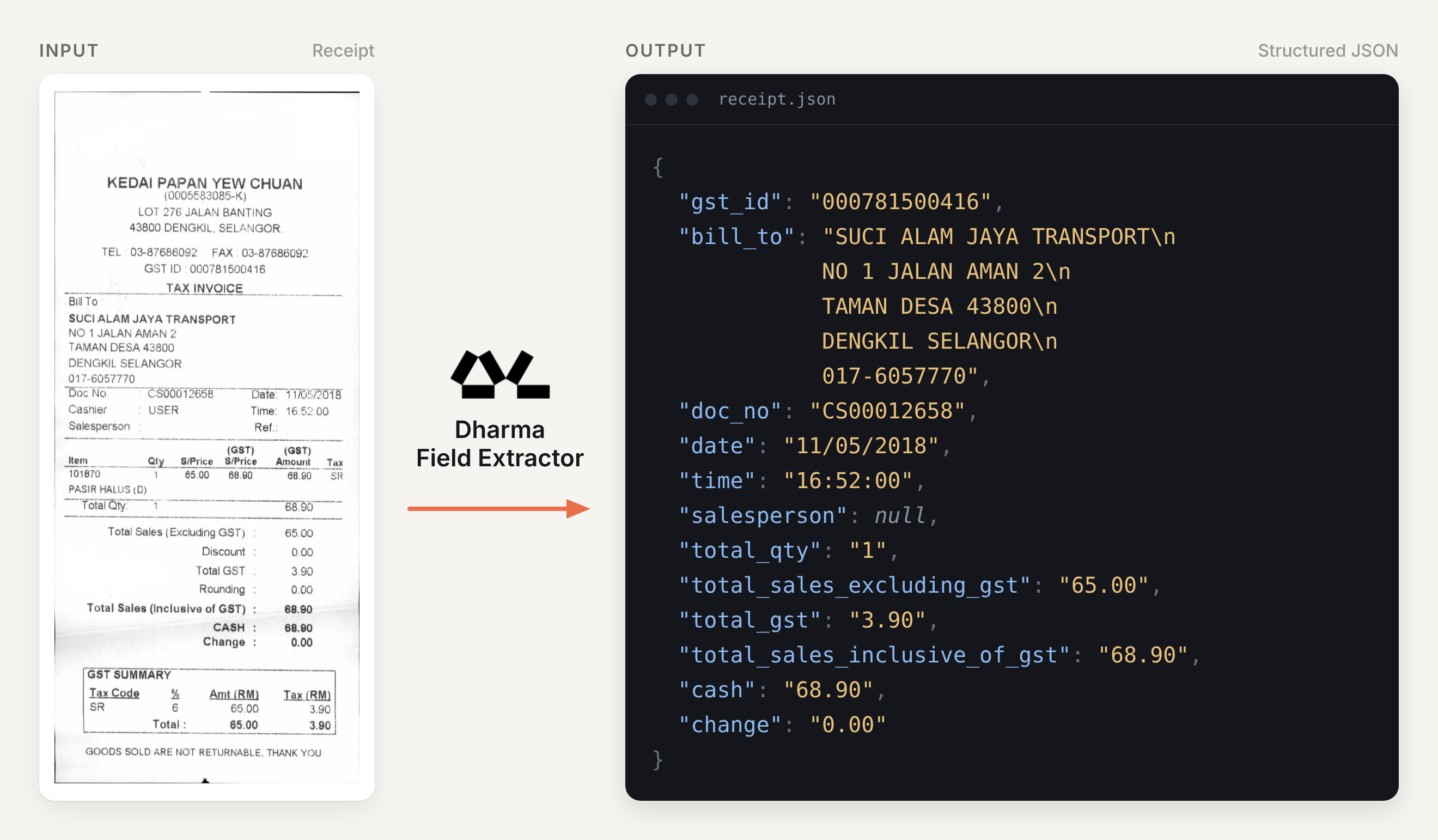 In April of this year, we released DharmaOCR-LITE, a specialized model optimized for optical character recognition (OCR) across a wide range of document types—from contracts and court filings to invoices, IDs, and forms. The paper behind the model offered a focused and rigorously verified case study in domain specialization: a smaller, purpose-trained model aligned closely with the task can outperform general-purpose frontier model APIs on specific workloads.
OCR outputs the text on a page and faithfully reconstructs its original layout. If your goal is full-document processing—such as reading a contract end-to-end or digitizing manuscripts for archival—this is exactly what you need.
In practice, however, there is an entirely different operational need: you don’t need the whole page, but rather specific fields extracted and converted into a format directly consumable by downstream systems. For example, extracting each line item on an invoice as a list; pulling patient names, ordered procedures, and dates from medical requisition forms to push straight into a scheduling system; or extracting fields from IDs to map directly to columns in an employee database.
Running raw OCR on such documents merely produces lines of text, with no indication of which string corresponds to a procedure, which is a date, or which number represents the total amount. Before that data can be written to a database, someone still has to write code to map each value to the correct field.
General-purpose frontier LLMs can handle this task today with carefully engineered prompts. But for the high-volume, high-frequency workloads that many enterprises face, paying frontier API pricing and enduring their latency for a well-defined task quickly becomes an expensive solution.
So, we built a dedicated model specifically for this. The Field Extractor takes document images and supports two modes: either extracting everything it can identify, or populating a strictly specified schema. It returns structured JSON: strongly typed, grouped field by field, with the correct nested hierarchy when documents contain multiple levels. An invoice returns line items as an ordered list with respective quantities and prices alongside the total amount. An ID card returns values directly mapped to the target database fields and their expected keys. A single model checkpoint handles all these scenarios out of the box, with no fine-tuning required for specific document types.
You can try it out for yourself here.
What the Model Does
Suppose your system receives a batch of vendor invoices every morning, and you only need to extract four fields from each to log into your records: vendor name, invoice number, due date, and total amount. The exact same logic applies to feeding medical test requisitions into a scheduling system, or contracts into a compliance workflow—where what really matters are the parties involved, contract term, liability clauses, and penalty amounts. You don’t need the entire document; you only need specific