
Scan QR code to follow QbitAI

< img id=“wx_img” src=“https://www.qbitai.com/wp-content/uploads/imgs/qbitai-logo-1.png” width=“400” height=“400”>

 Jessica 2026-11-05 00:13:23 Source: QbitAI
Even bystanders have minds of their own.
Jessica reporting from the Office
QbitAI | WeChat Official Account: QbitAI
1 million kilometers—
Roughly 2.6 times the average distance between the Earth and the Moon, and enough to circle the equator 25 times.
What does it mean for an L4 autonomous driving system to log this scale of real-world road testing?
Calculated at 150 kilometers per vehicle per day, that translates to over 6,600 consecutive days of driving. Even deploying hundreds of test vehicles on the road simultaneously would take more than two months. What’s more, complex situations on real roads rarely occur according to a testing schedule.
For a long time, this was a fundamental dilemma facing the scaling of autonomous driving. Every expansion of a fleet’s operational area and every software stack update typically comes with a vast backlog of traffic scenarios requiring validation.

Now, however, a new paradigm is replacing this time-consuming, labor-intensive real-world validation method.
Just recently, Baidu Apollo officially unveiled its brand-new world model: ApolloWorld. It uses AI to construct dynamically evolving virtual traffic environments, allowing autonomous vehicles to experience varying weather conditions, road topologies, and traffic participants across end-to-end Robotaxi trips.
An autonomous vehicle’s acceleration, deceleration, or lane changes can alter the choices of surrounding traffic participants, branching into distinct outcomes.
Wait… this sounds like an interactive game with a massive degree of freedom.
And this virtual city is already in production use.
According to reports, ApolloWorld has been deployed for the global testing and validation of Apollo Go autonomous vehicles, shifting training and validation workloads that previously required real-world roads into the cloud.
The most tangible payoff is efficiency.
According to Baidu’s published data, one day of virtual road testing in ApolloWorld equals approximately three years of continuous driving by a real test vehicle with a safety driver.
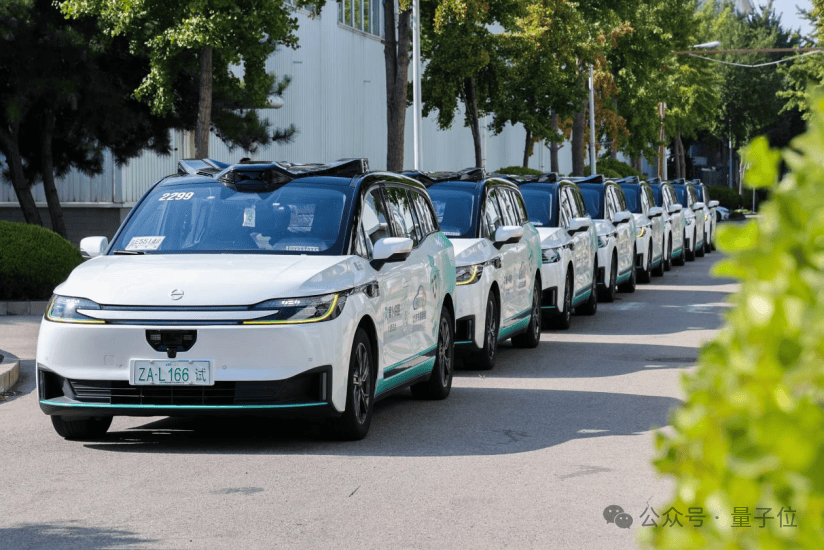
This means testing workloads that once required massive fleets, personnel, and years of accumulation can now be executed in parallel using compute clusters.
On-vehicle technology is evolving in tandem. Baidu’s next-generation L4 end-to-end model architecture has been deployed in commercial operations on a significant scale of vehicles in China, gradually phasing out legacy modular stacks.
The world model provides the virtual training and validation environment, the driving model is continuously stress-tested within it, and then it is deployed on real roads. In simple terms: AI teaching AI how to drive.
For Apollo Go, whose footprint spans 28 cities worldwide, this technology stack arrives right as its global expansion hits top gear.
As autonomous vehicles enter more cities, R&D teams must tackle increasingly diverse and complex traffic environments. Yet on real roads, the edge cases most worth studying are often the hardest to encounter.
A Virtual City Without a Script: One Day Worth Three Years
Anyone who has seen The Matrix likely remembers that program-generated universe. Whether streets, skyscrapers, vehicles, or pedestrians, it looks identical to the physical world, yet behind it runs a massive computing system.
Few expected that just over two decades later, that scripted virtual reality would leap from the screen into engineering reality.
What Baidu demonstrated with ApolloWorld is virtual cities generated for autonomous vehicle driving. The key difference: traffic participants in these virtual cities make their own decisions based on the environment.
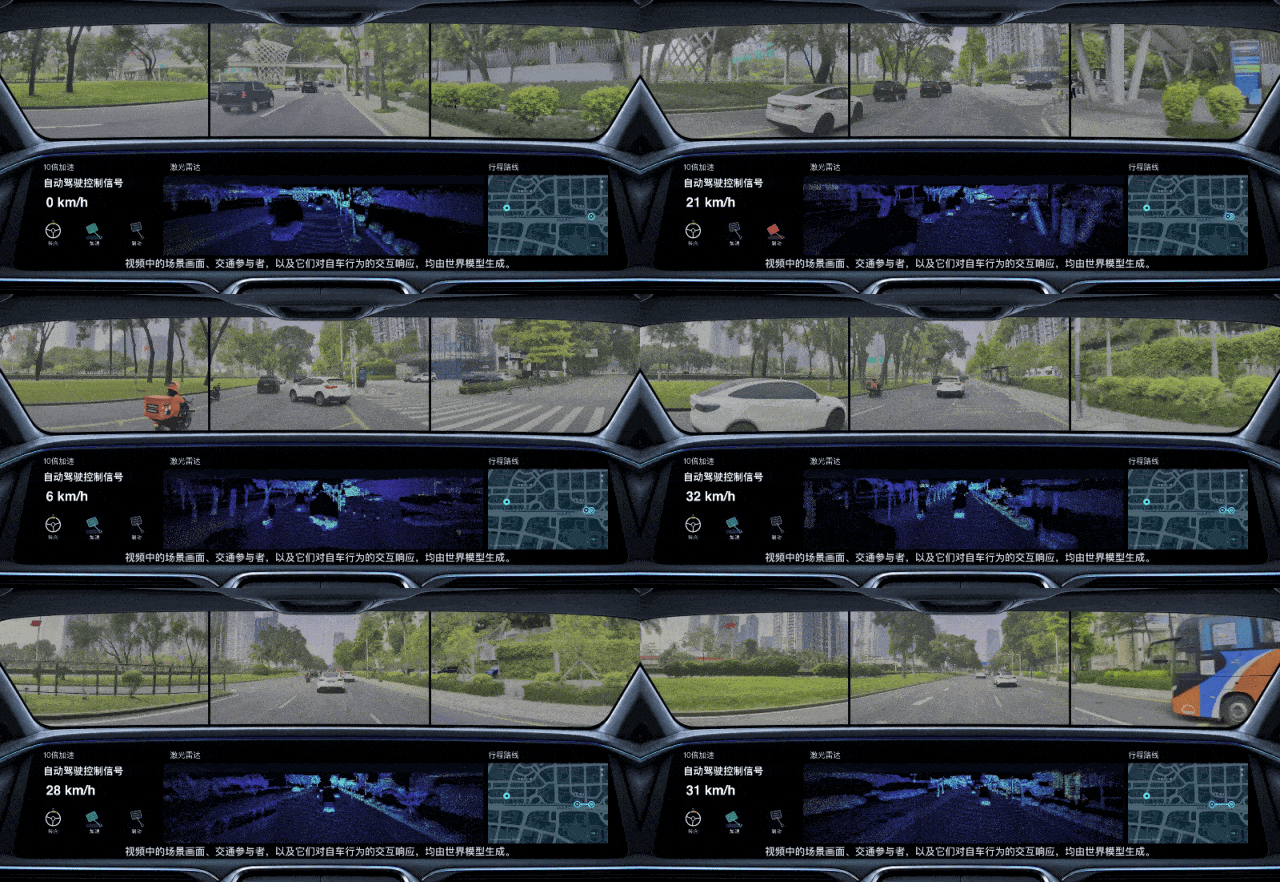
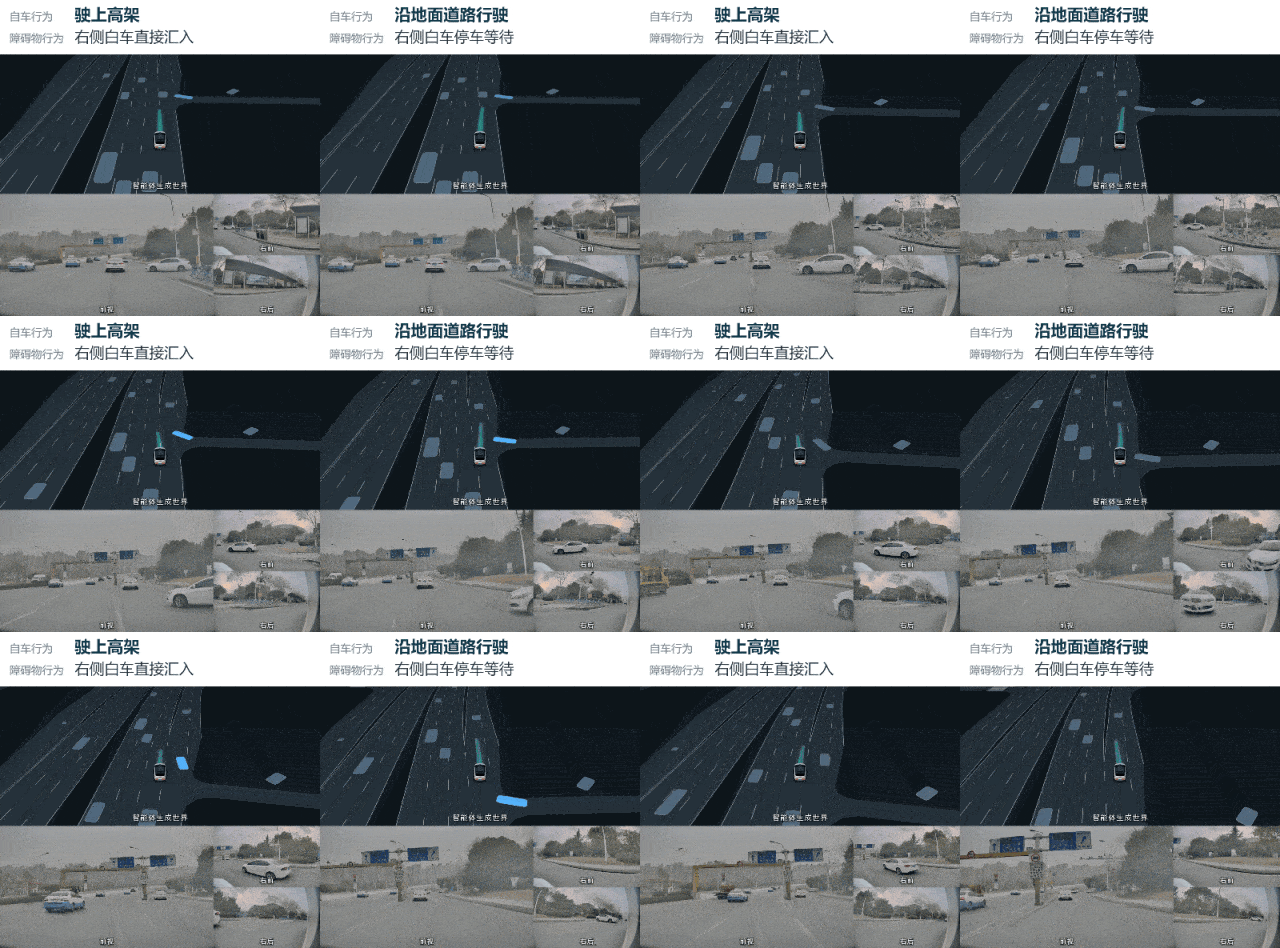
Consider an autonomous vehicle approaching an elevated highway on-ramp while a car on an adjacent side road prepares to merge into the main traffic flow.
If the autonomous vehicle continues onto the elevated highway, leaving ample space, the vehicle on the side road proceeds to merge.
However, if the autonomous vehicle shifts path and stays on the right frontage road, occupying the merging space, the other vehicle adapts its decision, slowing down and waiting:
Dr. Ze Yang, Distinguished Architect at Baidu’s Intelligent Driving Group (IDG) and Head of the World Model Team, explained that the system uses a multi-agent-driven technical architecture. Traffic participants on virtual roads—such as vehicles and pedestrians—are modeled as AI agents with decision-making and interaction capabilities.
Each agent possesses its own goals and behavioral heuristics, adjusting decisions dynamically in response to other traffic participants.
Beyond individual agents, the macro traffic state of the virtual city can be tuned on demand—such as injecting sparse, moderate, or dense traffic flows, or tuning the driving styles of surrounding vehicles to be more cautious or aggressive.
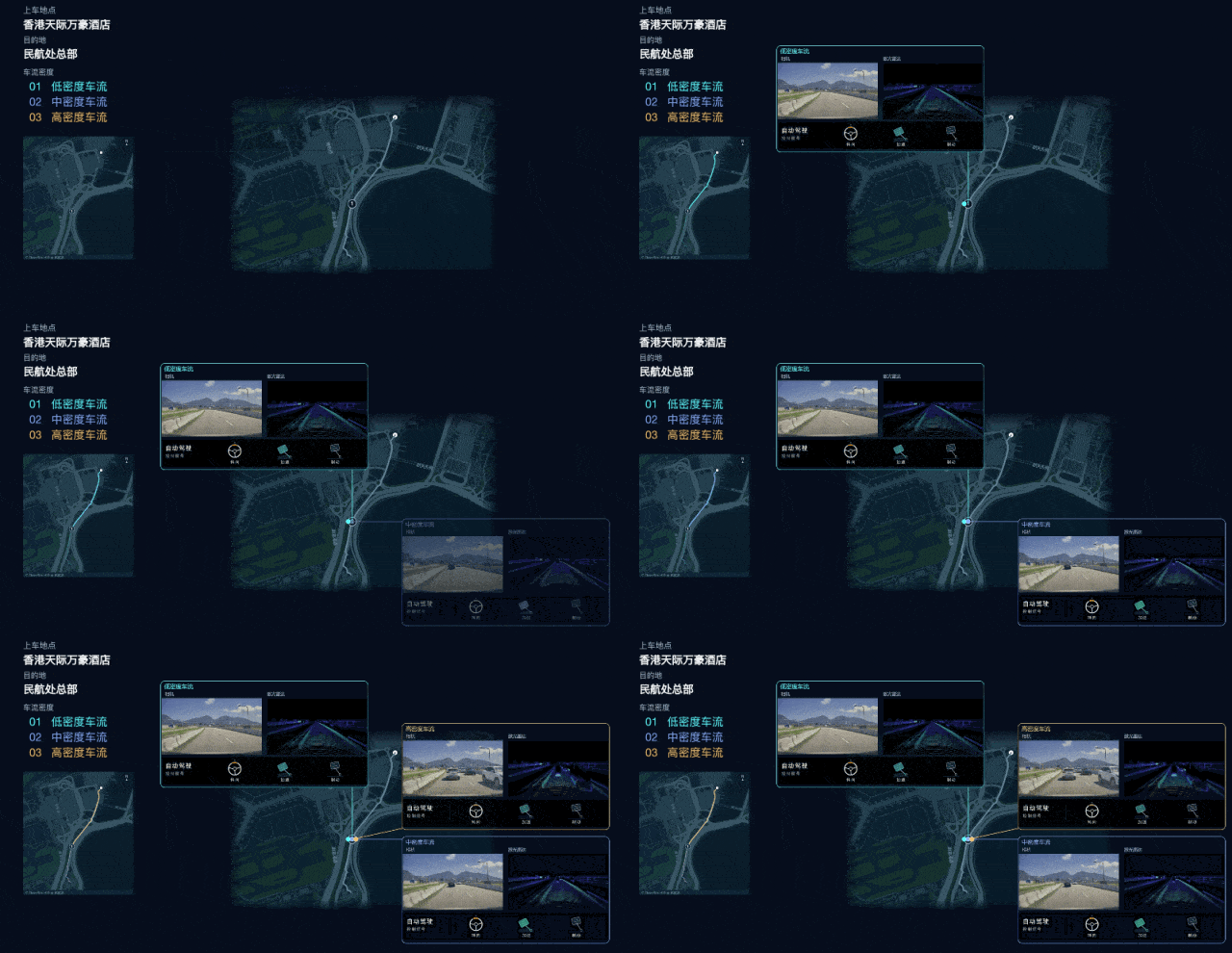
Similar edge-case interactions, which previously required autonomous vehicles to drive endlessly on roads waiting for rare conditions to emerge, can now be proactively generated inside virtual environments.
However, executing real-world Robotaxi missions requires far more than handling isolated maneuvers like lane changes or yielding.
In real life, a trip might last 20 to 30 minutes, crossing dozens of intersections.
Every decision an autonomous vehicle makes can reshape downstream traffic conditions. The vehicle must sustain driving across an evolving environment, engage with dozens of traffic participants, and deal with how upstream choices compound over the entire trip.
What ApolloWorld demonstrated is full-trip-level virtual road testing.
Across diverse operational scenarios—such as Shenzhen’s Binhai Boulevard or the vicinity of Hong Kong International Airport—multiple autonomous vehicles can depart from the same origin toward different destinations. Surrounding agent behaviors, environmental changes, and camera and LiDAR sensor data streams are generated continuously by the world model.
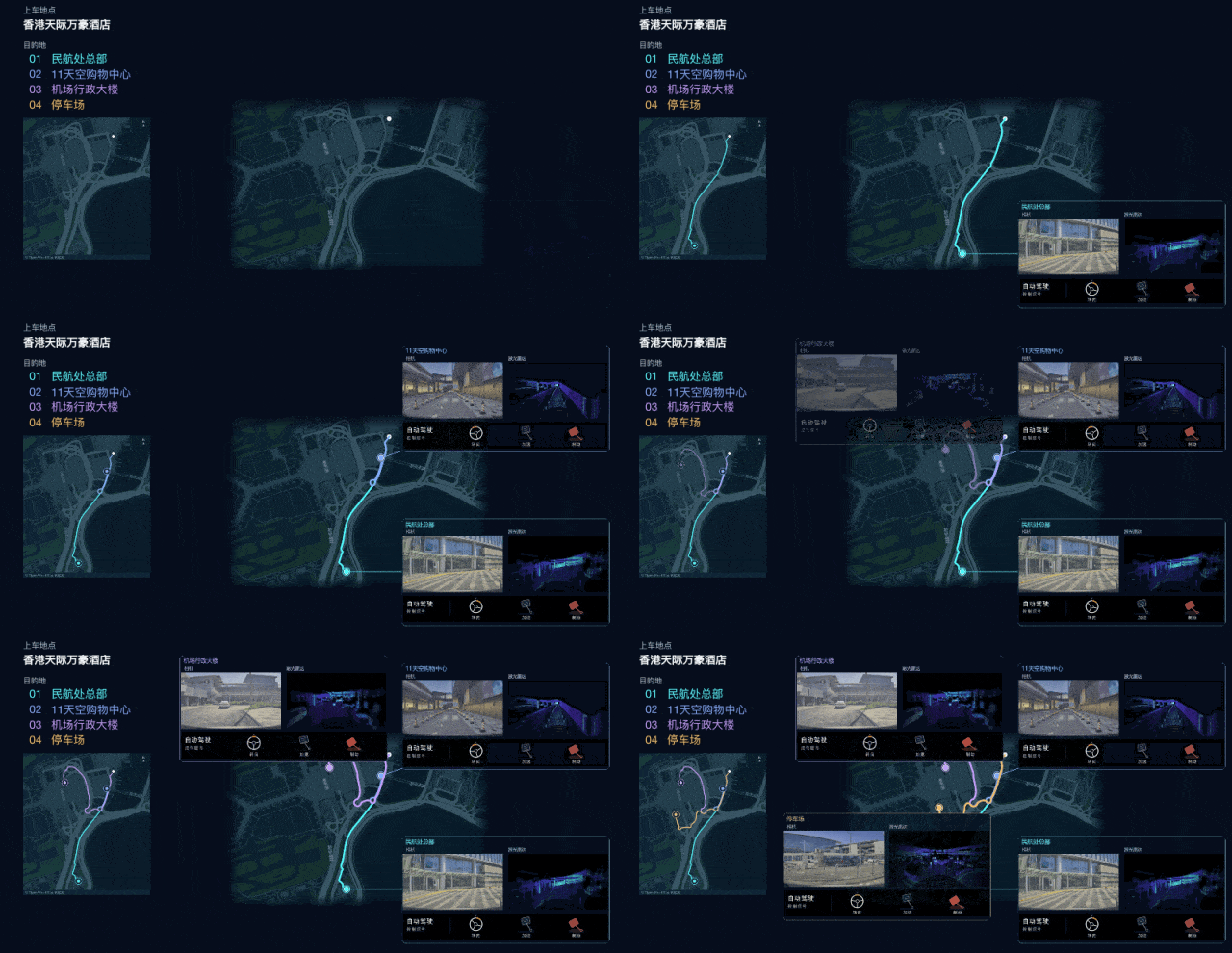
Dr. Yang pointed out that this system is powered by the orchestration of agent interaction modeling, multi-view multi-modal generation, and full-stack closed-loop driving systems.
In short: the world model predicts the next traffic state based on current environmental cues and the vehicle’s action; the driving model processes the synthetic sensor data to output steering, acceleration, or braking decisions, and feeds those control actions back into the world model.
To ensure generation speed keeps up with vehicle control loops, Baidu employs techniques like knowledge distillation to accelerate inference, enabling the virtual environment to respond in real time to vehicle dynamics.
One AI system builds the road environment and continuously introduces new driving challenges, while another AI system practices iteratively inside it—much like a coach and an athlete. In this loop, the vehicle learns to handle sustained trips across dynamic environments.
If the driving system makes an error in a given scenario, engineers can replay it with identical initial conditions, tweak the behavior of surrounding vehicles, and observe how the system performs under varied perturbations.
Unscripted, interactive, reproducible, and debuggable: these qualities turn the virtual city into an ideal proving ground for autonomous vehicles.
Yet continuous operation is only half the battle. The core question remains: what kind of world model is truly qualified to handle the training and validation of full autonomous driving?
Setting a Verifiable Standard for World Models
Simulation has always been a cornerstone of autonomous driving engineering.
Long before generative world models became an industry buzzword, engineers were accustomed to recording real-world road scenarios and replaying them in virtual environments for iterative testing.
However, this conventional pipeline had a persistent limitation.
Historically, mainstream autonomous driving simulation heavily relied on non-responsive log replay of real-world drive data.
Put simply: even if the autonomous vehicle altered its driving trajectory, surrounding vehicles would continue on their recorded tracks, and the traffic environment would not adapt.
That is where the problem lies.
Real-world driving is a continuous interactive game. When an autonomous vehicle alters its behavior, surrounding drivers adapt. If the testing environment cannot react, evaluating how the driving system actually performs in dynamic traffic becomes nearly impossible.
Generative world models resolve this exact constraint by enabling virtual agents to react dynamically to autonomous vehicle maneuvers, testing the stack inside a fluid, responsive environment.
Dr. Liang Wang, Chief Architect of Baidu’s IDG and Chairman of the IDG Technical Committee, summarizes this as “interactive generation.”
This is Baidu’s definition of a world model, grounded in the practical demands of autonomous driving.
Looking at the broader AI landscape, the term “world model” is often applied too loosely.
Models that generate photorealistic video are called world models; systems that build 3D spaces for free exploration are called world models; architectures that project continuous environmental changes based on external actions are also called world models…
While all these technologies simulate virtual spaces, their underlying capabilities sit on fundamentally different planes.
Fei-Fei Li’s team previously categorized world models into three archetypes: renderers, simulators, and planners, focusing respectively on visual synthesis, state estimation, and action planning—illustrating how wide a technical spectrum the term encompasses.
As the concept expands, its challenges become apparent. Does generating visually convincing scenes mean the model understands the laws of physics? Does rendering coherent traffic footage mean it can simulate divergent driving outcomes conditioned on agent actions?
In autonomous driving engineering, these distinctions are not mere academic semantics.
If a model cannot respond accurately to control inputs, or if its traffic dynamics violate physical mechanics, photorealism is useless for high-stakes training and validation.
Baidu’s emphasis on world model benchmarking stems directly from these practical requirements.
In Baidu’s engineering philosophy, what capabilities a world model must possess depends first and foremost on the downstream tasks it must perform. When the goal is to train driverless L4 systems, one must specify what traffic relationships the model must capture, which physical laws it must obey, and whether it can sustain long-horizon, real-time closed-loop tasks.
Define the target task, capability bounds, and engineering specifications first, then build the architecture around them. This forward-engineering methodology gave Baidu’s world model clear operational targets from day one.
This approach is grounded in harsh engineering reality.
Fei-Fei Li once characterized an autonomous car as a 2D bounding box navigating obstacles, contrasting it with embodied robots executing complex 3D manipulation.
Dr. Wang, however, believes the difficulty of autonomous driving extends far beyond raw vehicle control.
A driverless Robotaxi operates in fully open-world traffic, continuously facing dozens of independent agents with their own intents. An ordinary lane change can involve multi-vehicle game theory, intent inference, and competitive negotiations.
Even more significant than operational complexity is the shift in safety accountability.
Dr. Wang draws a parallel to the documentary Free Solo.
The film’s protagonist scales a near-vertical, 900-meter rock face. Completing the feat required years of grueling, meticulous preparation.
In Dr. Wang’s view, L2 driver assist is like climbing with a safety rope. The climber can attempt bold, flashy moves because safety redundancies exist; an L2 vehicle has a human driver ready to intervene at critical moments.
L4 driverless systems, however, are free soloing—the safety rope is gone, and the driver’s seat is completely empty.
The mechanical inputs may look similar, but the underlying risk tolerance and safety margins belong to entirely different paradigms. The unglamorous hours of repetitive testing and micro-validation ultimately shoulder complete responsibility for overall system reliability.
Having led both high-volume L2 production programs and dedicated years to pure L4 driverless architectures, Dr. Wang understands the gulf between the two firsthand.
That is why, in his view, deploying world models for L4 development demands a rigorous, unambiguous evaluation framework.
Baidu has introduced its “2+3” World Model Evaluation Framework for Physical AI.

Here, “2” refers to the foundational properties: Causality and Interactivity.
Causality requires the model to project downstream physical states logically based on prior conditions; Interactivity demands that external actions persistently reshape the environment, producing divergent, branching outcomes.
The “3” stands for Physical Accuracy, Persistence, and Real-Time Performance, measuring whether the model can execute real-world physical tasks.
No matter how visually realistic a world model looks, if its underlying physics drift, its simulation results lose engineering validity.
Rainy conditions are a prime example.
Wet surfaces change tire friction coefficients and braking distances. Raindrops introduce multi-path LiDAR reflections, injecting severe point cloud noise. If a virtual world renders visual rain while the vehicle still senses and brakes under dry asphalt conditions, the simulation loses all testing value.
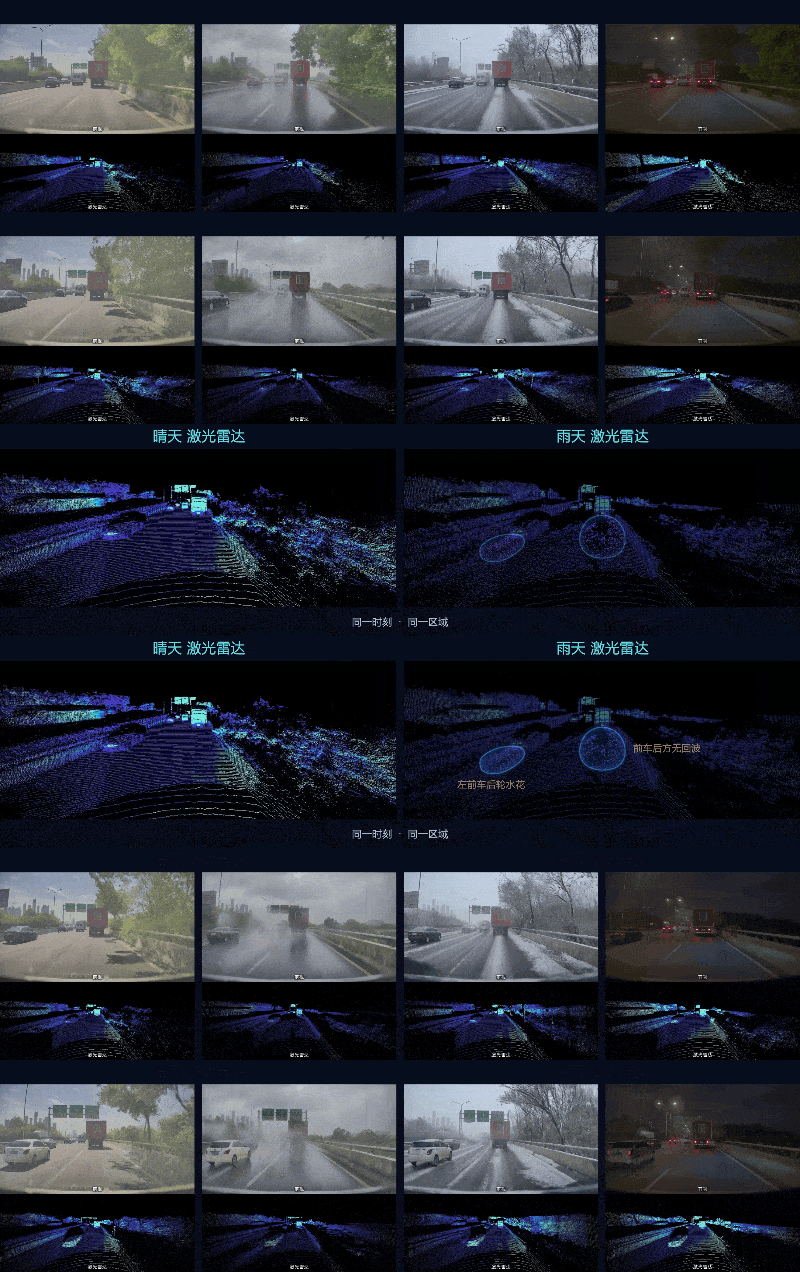
These subtle physical nuances are precisely the hardest problems to solve in world model engineering.
Dr. Wang points out that the concept of a world model is not rare—any lab can train one. The true competitive moat lies in accumulated deep engineering capability: render throughput, long-horizon memory retention, and physical fidelity.
Take LiDAR simulation: beam reflection and attenuation from airborne raindrops involve complex optical scattering. Training a world model to simulate these physical dynamics accurately is vastly harder than rendering photorealistic rainy textures on a screen.
Dr. Wang refers to this meticulous engineering tuning as “dirty work.” Proprietary moats only emerge when these granular edge cases are solved one by one.
Thus, Baidu’s “2+3” evaluation framework sets hard technical thresholds for world models entering L4 pipelines, establishing a clear engineering roadmap for how such systems must be designed and verified.
At a time when industry definitions of world models remain fractured, Baidu’s task-grounded framework demonstrates the value of its long-term focus on L4 operations.
Furthermore, a full Robotaxi trip can run for dozens of minutes. The world model must maintain spatio-temporal consistency across these extended horizons while responding instantly to vehicle dynamics.
Physical fidelity, persistence, and low latency collectively determine the engineering value of virtual testing.
Baidu’s “2+3” framework offers concrete engineering coordinates for an evolving technology aimed at production L4 tasks.
Baidu is not alone; global leaders in autonomous driving are converging on this track.
This February, Waymo officially unveiled the Waymo World Model. Adapted from Google DeepMind’s Genie 3, it modifies virtual environments based on driving actions, scene graphs, and natural language prompts, outputting synchronized camera and LiDAR data streams.
Placing the two world models side by side highlights ApolloWorld’s explicit optimization for end-to-end Robotaxi missions.

△ Compiled from public technical documentation; chart generated by AI.
In comparison: if world models are testing grounds for autonomous driving, Waymo emphasizes generating complex test questions, whereas Baidu offers an end-to-end examination infrastructure covering full operational missions.
Moreover, ApolloWorld has already integrated into Apollo Go’s production validation pipeline. Its underlying “2+3” framework imposes explicit demands on causality, interactivity, and runtime performance.
Through this approach, autonomous driving verification is decoupling from reliance on stochastic real-world traffic occurrences.
This shift introduces a new challenge: among all edge cases, which rare events are truly worth identifying, understanding, and validating repeatedly?
Rare Events: Harder to Reproduce Than Raw Mileage
Baidu shared an unusual edge-case scenario encountered during real-world fleet testing with QbitAI.
As a street sweeper passed a construction zone, its high-pressure water jet dislodged a traffic cone, sliding it straight into the path of an oncoming autonomous vehicle. Street sweepers and traffic cones are common road elements, but their intersection produced an unpredictable edge case.
Engineers could hardly script such rare combinations ahead of time. And once it occurs in the real world, reproducing it under identical physical parameters is practically impossible.
Baidu’s goal is to enable its world model to reproduce such scenarios on demand, allowing autonomous systems to test against them repeatedly.
This example illustrates an unresolved question in autonomous driving development.
Risks on real roads take infinite forms, but not every traffic situation carries equal R&D value. Rare edge cases can carry severe safety risks, while everyday friction scenarios frequently degrade dispatch efficiency and passenger comfort.
Virtual cities can generate near-infinite traffic variants, forcing a tough engineering trade-off: which scenarios deserve prioritization? That choice directly determines which simulations enter production training and validation loops.
How do you filter them?
Domain expertise and hard data.
According to Baidu’s disclosures, its commercial operations span 28 cities worldwide, delivering over 23 million passenger rides and accumulating over 350 million kilometers of driving, including more than 240 million fully driverless kilometers.
350 million kilometers is hard to visualize. To put it in perspective: a high-speed train traveling at 300 km/h would need to run continuously for 133 years to match that distance.
This data represents a decade of real-world fleet operations, embedding localized road topologies, driving behaviors, and vast experience with complex interactive scenarios.
Baidu Maps’ multi-year accumulation of road networks and geospatial intelligence also provides the underlying infrastructure for building high-fidelity virtual environments across diverse geographies.
As fleet size scales, this operational experience feeds into the world model. It is curated, structured, and projected into diverse training and stress-testing suites.
Starting from a single real-world event, engineers can perturb vehicle velocities, surrounding traffic flows, or weather parameters to analyze how the driving stack adapts. After rigorous training and validation, updated driving models are pushed to the fleet; as vehicles enter new regions, they encounter novel edge cases, closing the data flywheel.
Through this architecture, single-occurrence edge cases are transformed into reusable, iterative engineering assets.
As commercial operational data accumulates, the model receives richer training inputs; improved driving capabilities accelerate fleet deployment, unlocking even more real-world data.
The deeper the operational foundation, the higher the quality of effective training data. As world model capabilities advance, driving model iteration cycles shrink, accelerating geographic expansion.
Fleet scale and model intelligence compound each other, bringing the Scaling Law of autonomous driving into focus. Baidu’s decade-plus accumulation of autonomous driving assets is unlocking new compounding value in the world model era.
Globally, only two players have deployed next-generation end-to-end driving models to commercial driverless fleets scaling into hundreds of vehicles: Baidu and Tesla.
For Baidu, the introduction of ApolloWorld allows this production fleet infrastructure to systematically capture virtual training experience, building a compounding asset for next-generation model iteration.
The immediate operational dividend of this scale advantage is expansion velocity.
The world model allows established driving expertise to generalize across new regions without requiring ground-up validation for every operational design domain (ODD). Autonomous driving can finally shift away from city-by-city manual deployments toward scalable, highly automated rollouts.
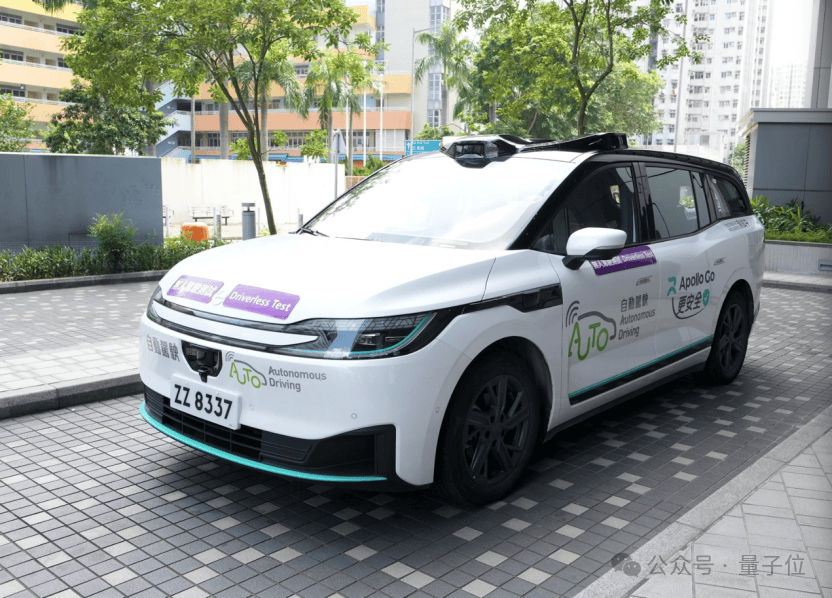
By letting proven capabilities generalize across geographies and shifting core validation workloads to the cloud, deployments in new cities can drastically minimize redundant road testing.
When technical iteration velocity translates directly into geographic rollout speed, it fundamentally shifts not just one enterprise’s operational velocity, but the expansion timeline of the entire autonomous driving industry.
Capital markets are paying close attention to these technological shifts.
This February, Waymo closed a $16 billion funding round at a post-money valuation of $126 billion, subsequently announcing the Waymo World Model. In September, AMD announced its all-stock acquisition of Fei-Fei Li’s World Labs for approximately $8.2 billion.
One company commands an industrial-scale autonomous driving operation, while the other focuses on foundational AI systems that understand, generate, and simulate the physical world. While their commercialization paths differ, both transactions underscore the strategic value of extending AI into physical reality.
Milestone breakthroughs rarely stop at the debut of an isolated technology—they redefine how an entire industry scales.
The iPhone redefined smartphones; GPT redefined AI applications. For autonomous driving, a similar watershed moment arrives when driving intelligence can be systematically adapted, scaled, and deployed to support commercial operations across dozens of cities simultaneously.
The engineering potential unlocked by world models provides autonomous driving with an actionable technical foundation, bringing the industry to its inflection point of structural transformation.
When that happens, over a decade of real-world road operations will cease to be merely past logged mileage—it will become the catalyst for the next phase of growth.
A new structural shift in autonomous driving is underway. Baidu is not merely observing this transformation; it is serving as a primary engine driving it forward.
All rights reserved. Reproduction or distribution in any form without authorization is strictly prohibited.
](https://www.qbitai.com/2026/11/507647.html#)
- Inside the IM LS8 EV: 8 Years of Chassis R&D, Battery Co-Developed by Two Giants 2026-11-03
- Free Lifetime AI with Purchase? IM LS8 EV Starts at 250k RMB! Steer-by-Wire Chassis and CATL Battery Standard 2026-10-30
- Priced at 240k RMB! Li Auto Redesigns the i6; Li Xiang: Aiming for Global Bestseller 2026-10-29
- Valued at $20B on Zero Revenue, Embodied AI’s “OpenAI” Raises Another $1B 2026-10-28
Scan QR code to share on WeChat Moments
Related Articles
Baidu Apollo Wins Bid for “Western Autonomous Driving Open Test Base” Construction Project
Lai Ke 2020-03-19
Baidu Steps Up to Support Jiyue Owners with Smart Driving and Navigation
Another EV startup collapses
Jessica 2024-12-16
Apollo Go Hits 10,000 Daily Orders, Gen-6 Vehicles Ready for Deployment! Robin Li: Robotaxis Becoming Top Commute Choice
Cumulative orders surpass 7 million
Yifan 2024-08-24
Apollo Go Prepares for International Expansion
Domestic Robotaxi rides cross 7 million
Yifan 2024-10-11
L4 Autonomous Driving Without On-Board Sensors? Tsinghua and Baidu Unveil World’s First Pure Roadside Perception Autonomous Driving Solution
A stress test for road infrastructure
Yu Yang 2021-05-14
Baidu Apollo: CTO-Level Autonomous Driving Talent Isn’t Rare—We Have About a Hundred Here
Talent systems also run on “autopilot”
Jia Haonan 2022-03-08
Trending Articles
Claiming the #1 Spot! Agibot’s Dual Models Sweep Multiple Leaderboards 2026-10-30
Tracking emerging AI trends, reporting breakthrough tech achievements
QbitAI Copyright © Beijing Geek Partner Technology Co., Ltd. Beijing ICP Filing No. 17005886-1