
Recently, PixVerse, the AI model and open platform under AIsphere, announced an in-depth partnership with OpenAI.
Recently, PixVerse, the AI model and open platform under AIsphere, announced an in-depth partnership with OpenAI. The two companies have completed a series of product integrations and jointly launched the “Prompt to Production” educational initiative for the first time. Designed for global individual creators and creative teams, this program aims to help them more efficiently turn creative concepts into finished productions through webinars and video series.
During the inaugural webinar, Tyler Ryu, an Applied AI Engineer at OpenAI, and PixVerse’s North American Marketing Lead co-demonstrated how to combine OpenAI’s frontier models and Agent capabilities with PixVerse’s multimodal generation tools within actual workflows. Professional creators from the PixVerse community also shared their real-world experiences. Moving forward, PixVerse and OpenAI will continue to deepen their collaboration across the entire creative lifecycle, empowering more creators to master AI tools with ease and refocus their energy on the art of creation itself.
Deep Product Integrations: Connecting Ideation, Generation, and Production
Today, more and more creators want AI to shoulder tedious processes so they can dedicate their time to core creative ideas. In line with this trend, PixVerse and OpenAI continue to advance their collaboration: the open platform steadily integrates OpenAI’s frontier models, and both sides have recently completed a suite of deep product integrations.
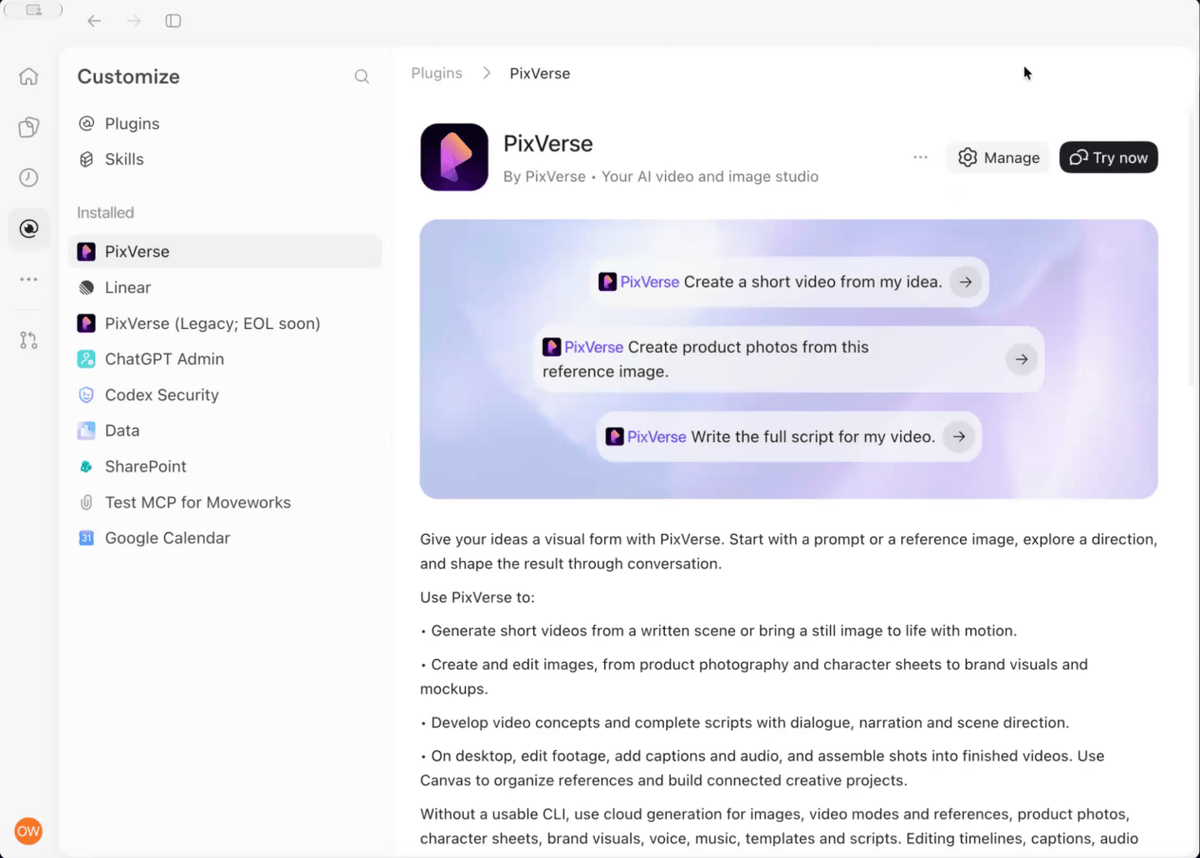
(Image: Official PixVerse Plugin for Codex)
- PixVerse Plugin: The official PixVerse plugin (PixVerse ChatGPT Plugin) now natively integrates with ChatGPT and Codex. Backed by PixVerse’s production standards and quality control systems, users can handle end-to-end generation of video, image, and audio in a one-stop workflow. In other words, creators can directly submit video assets and prompt requirements to ChatGPT, and the PixVerse plugin will assist in completing full-scale production.
- PixVerse CLI: Expands Codex into an AI content studio, centralizing calls across video, image, and audio generation while supporting the creation of reusable, standardized workflows to meet large-scale content production demands.
- Canvas Support: The PixVerse plugin now supports Canvas (the AI video project workspace). Users can centrally manage and refine creative assets within Canvas, generate and compare multiple approaches, and send approved versions directly into final production.
With this toolset, both independent creators and professional directors can execute the entire process from script concept to finished cut in a single, unified workflow—drastically cutting the back-and-forth communication costs between pre-production and production.
Video Generation is Becoming an Agent-Callable Capability
Through the aforementioned integrations of the PixVerse Plugin, PixVerse CLI, and Codex, PixVerse has packaged video generation into standardized interfaces that AI Agents can invoke directly. Consequently, without relying on graphical user interfaces, Agents can autonomously execute the entire pipeline: “understand task context -> generate creative brief -> break down storyboards -> invoke PixVerse plugin to generate video.” As PixVerse’s North American Marketing Lead explained: “Moving from manual web-based operations to native integration, video generation is evolving into a foundational capability that Agents can call on demand, rather than being confined to traditional web platforms. PixVerse aims to be the shared creative infrastructure for both humans and AI Agents.”
During the webinar, OpenAI Applied AI Engineer Tyler Ryu shared practical insights from this integration: “AI can handle 80% to 90% of the upfront prep work, but the final polish still relies on specialized video models to produce the finished piece.” In an animation showcase, he first called the PixVerse plugin to generate a walk-cycle reference video based on a character concept sketch, using the video model to extract dynamic motion assets. Next, Codex performed technical processing to retarget and bind the motion onto game character assets. Finally, natural language prompts were used for continuous fine-tuning until the desired final result was reached—all without manual adjustments of complex parameters. The entire process bypassed the need for motion capture studios, complex animation software, or frequent file imports and exports across multiple applications. This means that character animation, which once relied heavily on specialized equipment and software suites, has now been reimagined into a streamlined workflow driven by natural language interactions within Codex.
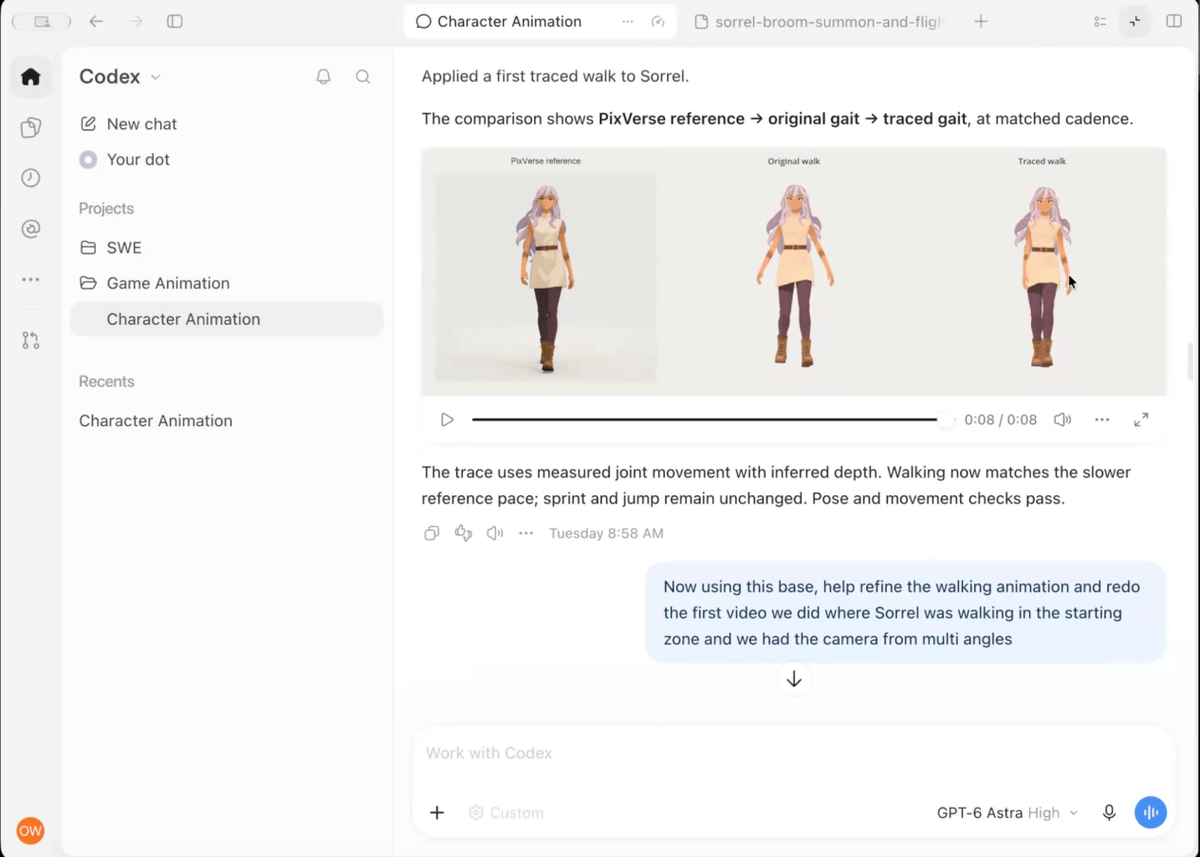
(Image: Calling the PixVerse plugin in Codex to generate a character walk-cycle reference video from a character image)
Addressing the industry-wide challenge of “visual consistency,” Tyler also offered practical advice: “Store reference images for characters and scenes together in a project folder, and explicitly prompt Codex to retrieve them prior to generation. This enables the model to reliably follow scene layouts and core details.” Outstanding creator representatives from the PixVerse community also shared actionable tips. Indonesian creator Hidayat recommended keeping reference images “few but precise”: “One front, one back, one side, and one facial close-up are plenty. There is no need to over-render details during the sketch phase. This rule works universally for characters, props, and scene construction.” Creator Aldo emphasized the importance of pipeline sequence: “Sticking to the workflow of ‘reference images first, storyboards second, and video output last’ guarantees strong consistency in faces and styling across shots. Correcting errors at the storyboard stage is vastly cheaper than tearing down and rebuilding a video from scratch.”
PixVerse’s North American Marketing Lead stated that the webinar content will be edited into a video course series and rolled out progressively, enabling creators at different stages to learn on demand and advance step-by-step. Looking ahead, PixVerse and OpenAI will continue to deepen their collaboration across the entire creative pipeline, jointly promoting the standardization and adoption of AI-driven creative workflows to help more creators turn ideas into reality with lower barriers and greater efficiency.
About AIsphere
Founded in 2023, AIsphere is a global leader in AI video foundation model development, specializing in the innovation and practical implementation of multimodal video models and real-time world models. The company pursues high-frequency iterations on underlying video generation models, consistently strengthening comprehensive capabilities across visual fidelity, spatial-temporal consistency, generalization, and controllable generation. Its proprietary PixVerse model family includes the V-series general video models, C-series vertical film and television models, and R-series general real-time world models, with core technical benchmarks ranking at the top of the industry. Currently, its international platform PixVerse, domestic “Paiwo AI” App, and open platforms serve over 170 million registered users across 177 countries and regions. In July of this year, the company closed a Series C financing round of nearly 3 billion RMB from over a dozen domestic and international institutions, including CDH Investments, Alibaba, Lollapalooza Capital (Wang Huiwen Family Office), Ivy Capital, Huiyuan Capital, Eastern Bell Capital, Mirae Asset (South Korea), Lion X Fund under OCBC, BlueFocus, CloudAlpha, and iGlobe Partners.
International users can visit the link below to learn more about PixVerse CLI & Skills: