
November 3, 2026 · Science
Zoi Tsangalidou, Ruijie (Kelly) Zhang, Sukhdeep Singh, and Michael V. LeVine
Explore scientific workflows in Google Antigravity
Designing new drugs requires curating complex data from charts, images, and literature, training predictive models, and proposing candidate molecules for synthesis—a single iteration often taking days.
Here, we show how Google Antigravity, equipped with new Cheminformatics Skills, accelerates drug discovery workflows. Using a real-world lung cancer treatment scenario as an example, an agent retrieved thousands of compounds, conducted matched molecular pair analysis, and proposed novel rigidified macrocycles complete with synthetic routes in just one hour.
Chemistry represents one of science’s richest public records—spanning millions of structures across journal articles and supplier catalogs. It offers a universal representation linking physics and mathematics closely with the life and environmental sciences. Molecules and their transformations are everywhere, shaping the world of our daily lives.
Despite decades of advancements in cheminformatics, chemists still spend considerable time wrangling data. This process is complex because molecules can be represented in a vast variety of ways: ranging from text descriptions to images or data structures. The same molecule might appear in a paper under its IUPAC name, in a patent as a Markush structure, or in a catalog as a Structure-Data File (SDF). Advanced cheminformatics systems must be able to unify these disparate sources and handle potential errors along the way. This task leaves no margin for error—altering a single atom or bond results in an entirely different compound, rendering an otherwise promising inhibitor or catalyst completely ineffective.
To enable scientists to focus on generating scientific hypotheses rather than getting bogged down in data curation, we built a set of Cheminformatics Skills for Google Antigravity, transforming the platform into a collaborative scientific workbench that gives both computational and bench chemists full access to native tools.
These skills also establish a clear division of labor: the underlying language model handles workflow orchestration, database navigation, and scientific reasoning, while deterministic chemistry tools execute molecular computations. Built upon RDKit—the foundational open-source cheminformatics toolkit developed over two decades by a global community of contributors—and combined with connectors to authoritative curated resources like ChEMBL and PubChem, the skills directly encode domain best practices into the agent’s workflow.
Rigidifying Flexible Molecules
In this technical demonstration, we highlight rigidification—a classic medicinal chemistry technique used to improve drug potency.
Drug molecules can be quite complex, often linking multiple substructures via rotatable bonds. These bonds allow molecules to twist into a multitude of three-dimensional conformations, making them “floppy” in solution. However, for a flexible molecule to bind to its target, it must lock into a single active conformation. Losing this freedom of motion incurs an entropic penalty, which weakens binding affinity and diminishes potency.
To address this challenge, medicinal chemists typically rigidify molecules by introducing new chemical bonds. Two substructures linked by a single rotatable bond can twist into numerous conformations, but adding a second bond to connect them significantly restricts how they can move in 3D space. By placing this bond in the right position, chemists can lock the molecule into the exact conformation required for target binding. Often described as “paying the entropic penalty upfront,” this strategy can substantially boost potency.
Here, we focus on a renowned success story of rigidification. The drug crizotinib is a first-generation small-molecule tyrosine kinase inhibitor (TKI) used to treat certain types of non-small cell lung cancer. In crizotinib, there are five primary rotatable bonds. Lorlatinib is a third-generation small-molecule TKI with a structure similar to crizotinib, but its ends are cyclized, reducing the effective number of rotatable bonds to zero and resulting in higher potency along with other advantages.


Collaborative Intelligence
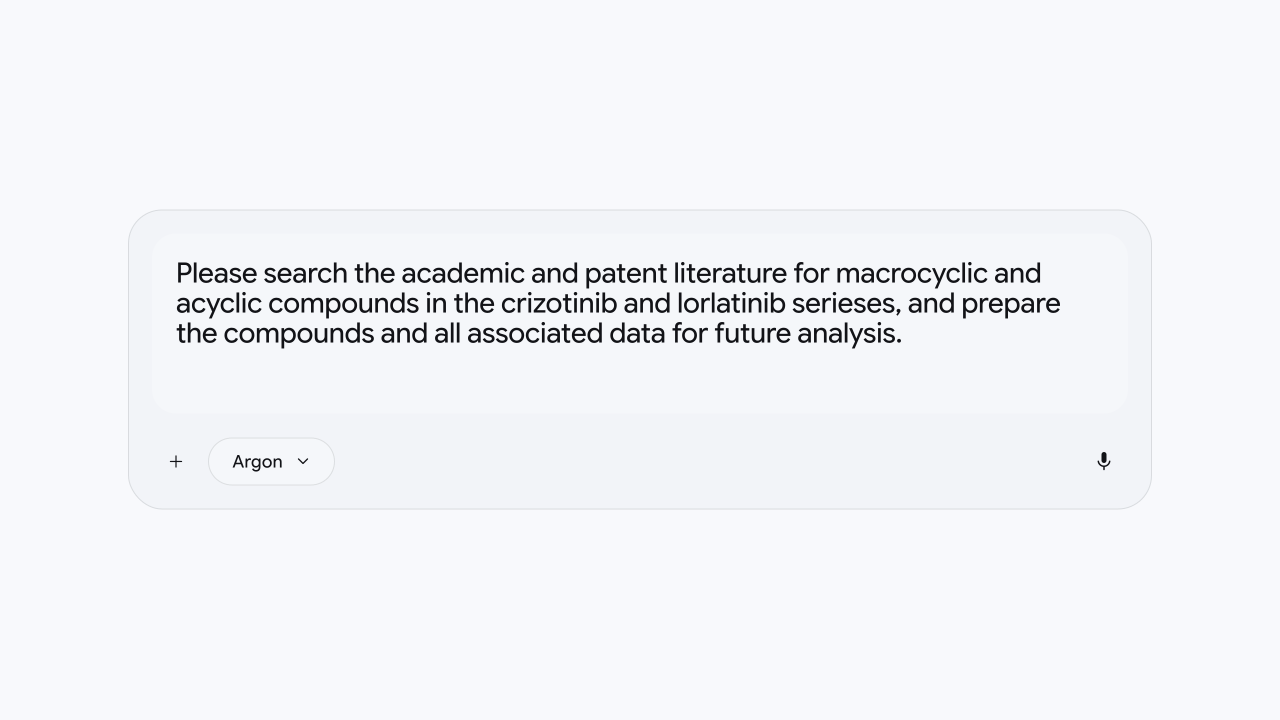
We prompt the agent to search the literature for these drugs and their analogs. With the Cheminformatics Skills in Antigravity, the agent can extract molecules from these documents, link them to reported data, and prepare the compounds for downstream analysis.
Within minutes, the agent retrieved thousands of compounds, filtered out irrelevant molecules (such as buffers and solvents), and documented their provenance in a report. The report also provided an in-depth