
Scan to follow QbitAI

< img id=“wx_img” src=“https://www.qbitai.com/wp-content/uploads/imgs/qbitai-logo-1.png” width=“400” height=“400”>

 Jay 2026-11-03 14:55:30 Source: QbitAI
Finally, a tangible starting point.
Jay reporting from the Office | QbitAI (WeChat Official Account: QbitAI)
The Siri Steve Jobs envisioned might finally be stepping into reality.
Here’s what it looks like—
First things first: an AI product with genuinely great taste has finally arrived. The UI is an absolute pleasure to look at…
But the real breakthrough is what comes next.
This voice assistant is downright surreal.
It truly feels like having a private secretary—listening to it brief you on the day’s key headlines while you sip coffee and grab a bite.
What makes it special is how human it feels. Even if you interrupt midway to delegate a task—like “help me reply to this email”—it never lapses into an awkward silence.
It’s practically Samantha straight out of the movie Her.
It’s unreal—just five years ago, you could only see scenes like this in a movie theater.
The AI arms race has dragged on for so long. Major players suffer their weekly outages like clockwork, while labs show off flashy parlor tricks—controlling Blender, dimension-folding robotics, solving Millennium Prize Problems…
Yet frankly, I never found any of that particularly thrilling.
It’s too disconnected from everyday life. For the vast majority of people, these frontier breakthroughs won’t change reality by even an inch anytime soon.
Yet after using this product on and off for nearly a week, all the romantic fantasies I once harbored about the AI era suddenly materialized.
I’d even go so far as to say—
This might be the closest thing to sci-fi yet: the AI assistant that fulfills my every romantic expectation.
Its name is Orilo.
The Awkward Reality of Personal Agents
The concept of a “Personal Agent” has been hyped to the skies lately.
Muse’s growth even briefly outpaced GPT, pushing agents from geeky productivity tools straight into the mass consumer market.
Yet honestly, most user experiences aren’t much better than the gimmicky hardware gadgets from earlier this year…
I don’t know about you, but for me, the novelty only lasted the first few days after scoring an invite code, prompting me to take the rare step of granting it notification permissions.
And then… crickets.

Typing is pure torture. Even more counterintuitive is its proactive push notification system: your pocket buzzes, you brace for an urgent WeChat message, you squeeze through a crowded subway car to yank out your phone—only to find Muse nagging you about a to-do list that should have expired ages ago…
At that moment, I was simply… speechless.
This is why I’ve long felt that every solution on the market for Personal Agents remains woefully immature.
Most Personal Agents are trapped in the exact same fatal dead end. I call it the “One Low, Two Highs”:
- Extremely Low Frequency of Use.
Booking flights or canceling streaming subscriptions sounds cool on paper. But how often do you actually run into complex tasks like that in a month?
Why would I spend minutes aligning back-and-forth with an agent for such rare chores when I could just tap through it myself?
- Extremely High Interaction Friction.
When you’re driving, doing dishes, cooking, or running, your hands and eyes are completely tied up.
When your phone buzzes then, is it realistic to stop, pull out your phone, and type back-and-forth with an AI to sort through logic?
- Extremely High Operating Costs.
Every backend LLM call in these scenarios requires complex tool-calling; every single loop burns real cash.
Scaling a consumer product on this kind of cost structure is practically a pipe dream.
Technological fundamentalism has dominated this industry for far too long. But building a personal companion isn’t won simply by packing more parameters or topping benchmarks.
The next generation of surviving agents must integrate seamlessly and frequently into everyday life, without making a sound.
Voice Is the Real Gateway
This is why Orilo resonated so deeply with me.
It found an intuitive new approach:
Voice-first.
Why do I believe voice is so crucial for consumer products?
Because it is humanity’s most natural form of interaction.
Written text was invented long after spoken language, primarily for preserving and transmitting knowledge; for daily communication, it was never strictly necessary.
Think about it: daily life is full of moments where reading text is impractical—driving, cooking, parenting…
More importantly, when people speak, they instinctively reveal far more personal context (Conversational Context).
You don’t just say “book me a ticket.” You’ll casually remark, “Book me a ticket to Shanghai next Wednesday, somewhere near the hotel I stayed at last time—oh, and keep the budget a bit tighter this round.”
That offhand context can’t be pulled from any third-party connector, yet it holds the key to truly understanding a person.
Yet that alone isn’t enough.
Voice could address countless markets; a new AI product needs a killer use case.
This brings me to Orilo’s second clever move: finding an ingenious wedge—
The morning.
This is when human information intake is at its most concentrated during the day.
You just woke up, your brain is still in a fog, and you urgently need to know what happened in the world and how your day is mapped out.
Yet at that exact moment, your hands are busy holding a toothbrush or a mug of coffee.
Orilo targets this exact pain point.
Hands-free, phone cast aside, you consume information entirely through audio.
Whenever you need to delegate something, you issue commands back to the AI using voice.
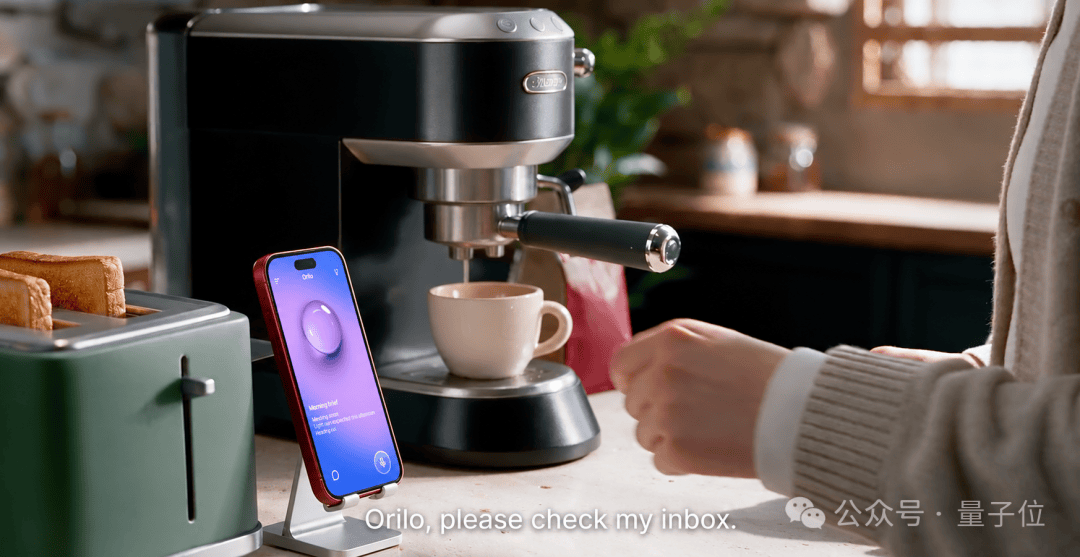
I could almost weep—finally, a team isn’t kicking back in ergonomic chairs making up imaginary user pain points.
And the UI design completely blows everything else away.
At last, no more cookie-cutter chat bubbles and screens cluttered with toolbars…
Its form is a single water droplet. Interfaced directly with the phone’s physical gyroscope, tilting your phone makes it glide across the screen like real liquid.
(P.S.: This is what consumer products should look like—ditch the corporate enterprise bloat, folks!)
In practical terms, here are the three features that won me over:
- A Morning Briefing Tailored Exclusively for You
Put simply, it’s a news digest—a feature Muse also offers.
Frankly, though, I rarely use it on Muse; it basically forces recommendations based on interest tags, which makes it just another news feed in disguise.

Orilo flips the script entirely.
It doesn’t just track what happened; it figures out what it means to you.
For instance, if you closely follow Anthropic, its long-term memory knows that rather than an IPO, you care much more about how the LLM ecosystem’s value chain is being reshaped.
So when it briefs you on the latest fundraising rounds first thing in the morning, it weaves in customized analysis aligned with your professional perspective.
It feels like an elite industry analyst standing by your bedside, sipping coffee and chatting one-on-one.
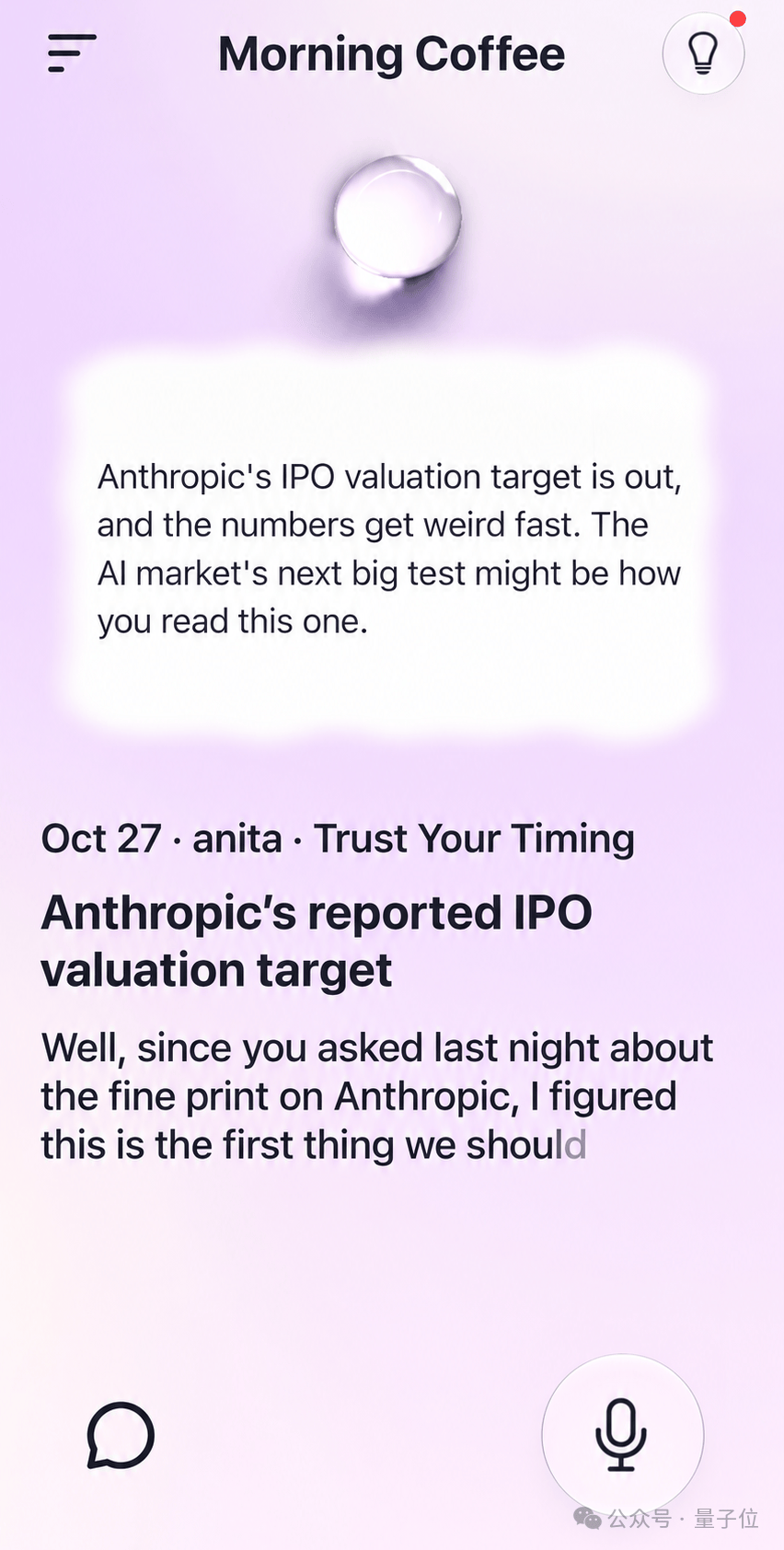
- Keeping a Relentless Eye on Long-Tail Intel
There are countless things we want to follow daily: an obscure startup, a Champions League group match, or a long-dormant podcast.
Yet human attention is strictly finite; who has the time to manually query search bars every single day?
Now, all it takes is a quick spoken request.
It stakes out information sources in the background 24/7. As soon as something stirs, it proactively briefs you at the right moment.
- Closing Action Loops with a Single Sentence
Naturally, even greater potential lies in cross-application contextual awareness.
Like other Personal Agents, Orilo provides connector integrations pre-loaded with standard plugins.
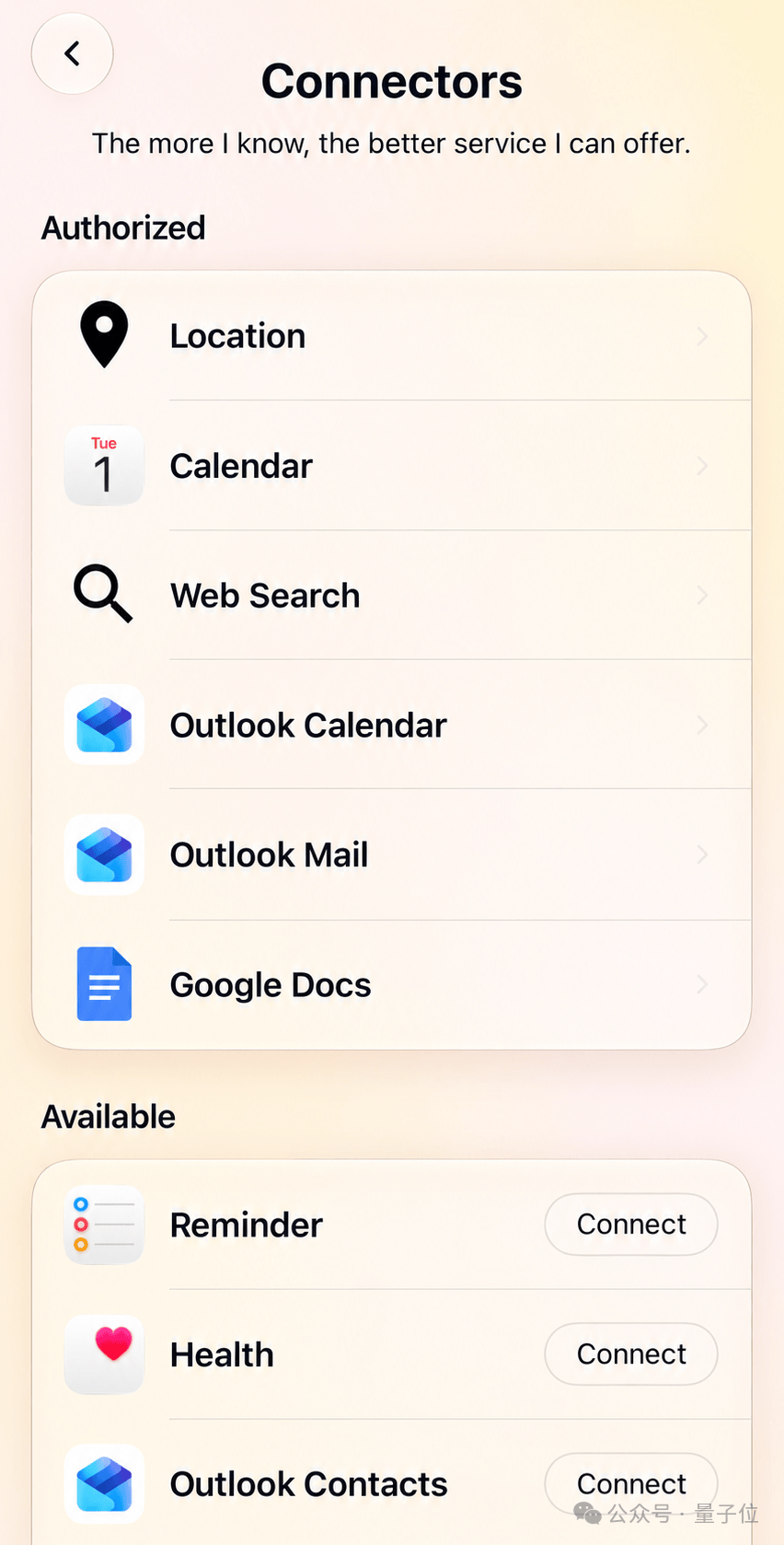
Take email as an example.
While listening to your morning digest, you suddenly remember you haven’t checked your work inbox today.
“Check my email for me.”
Orilo smoothly initiates a Tool Call, extracting the critical takeaways in two to three seconds:
Colleague A mentioned that the presentation deck for next Tuesday needs an update from you.
Proactive tracking is also supported.
For example, if your child’s school sends an email that morning announcing early dismissal at 3:00 PM, Orilo will intercept the message and naturally chime in during your morning news run:
“Your child’s school has an early dismissal today. Would you like me to add it to your calendar?”
While brushing your teeth, you mumble back:
Add it, and remind me half an hour beforehand.
Done.
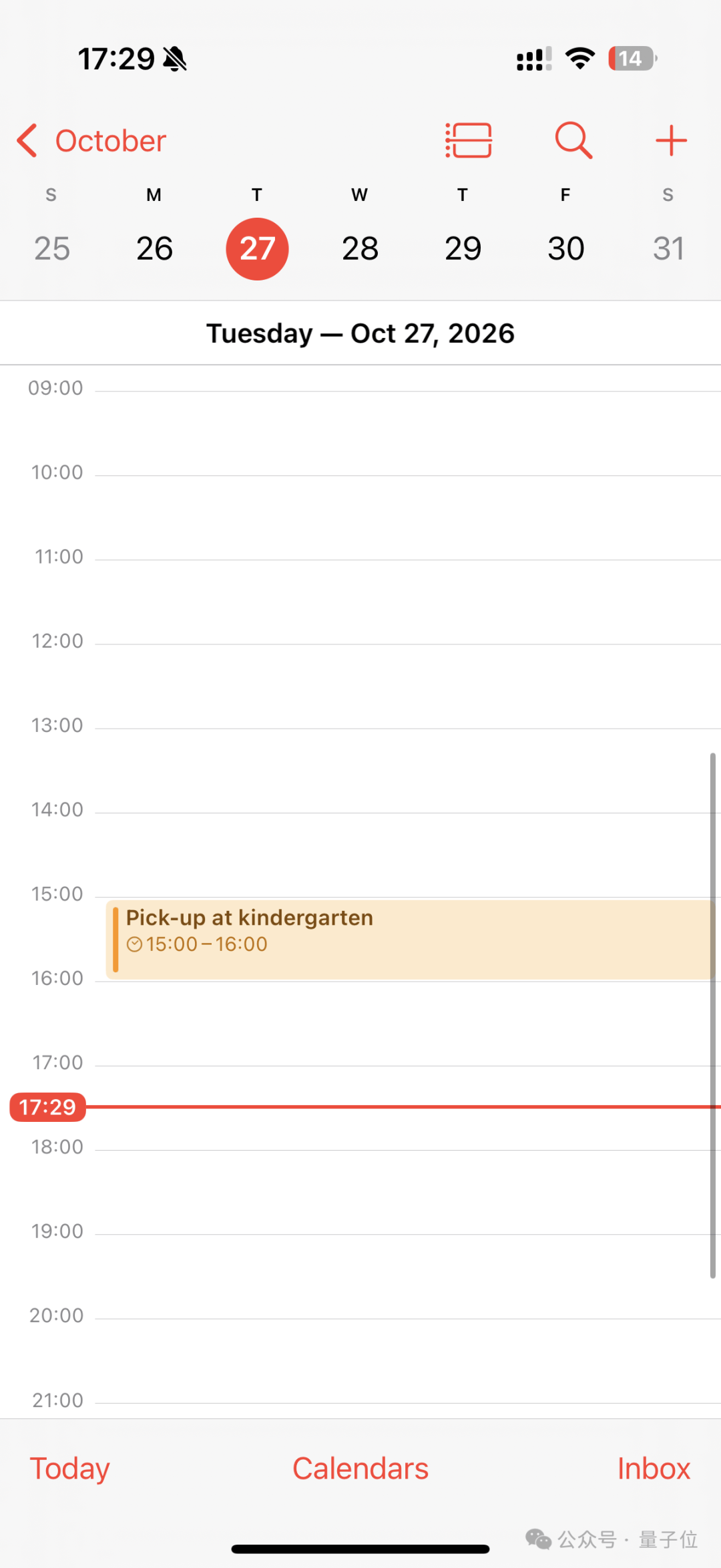
From “critical info interception” to “cross-app execution,” everything wraps up seamlessly in two sentences.
Comparing it with existing competitors paints an even clearer picture.
Ask Muse to pull up an email, and the UI often just leaves you on read with a thumbs-up emoji, disappearing for more than twenty seconds before replying.
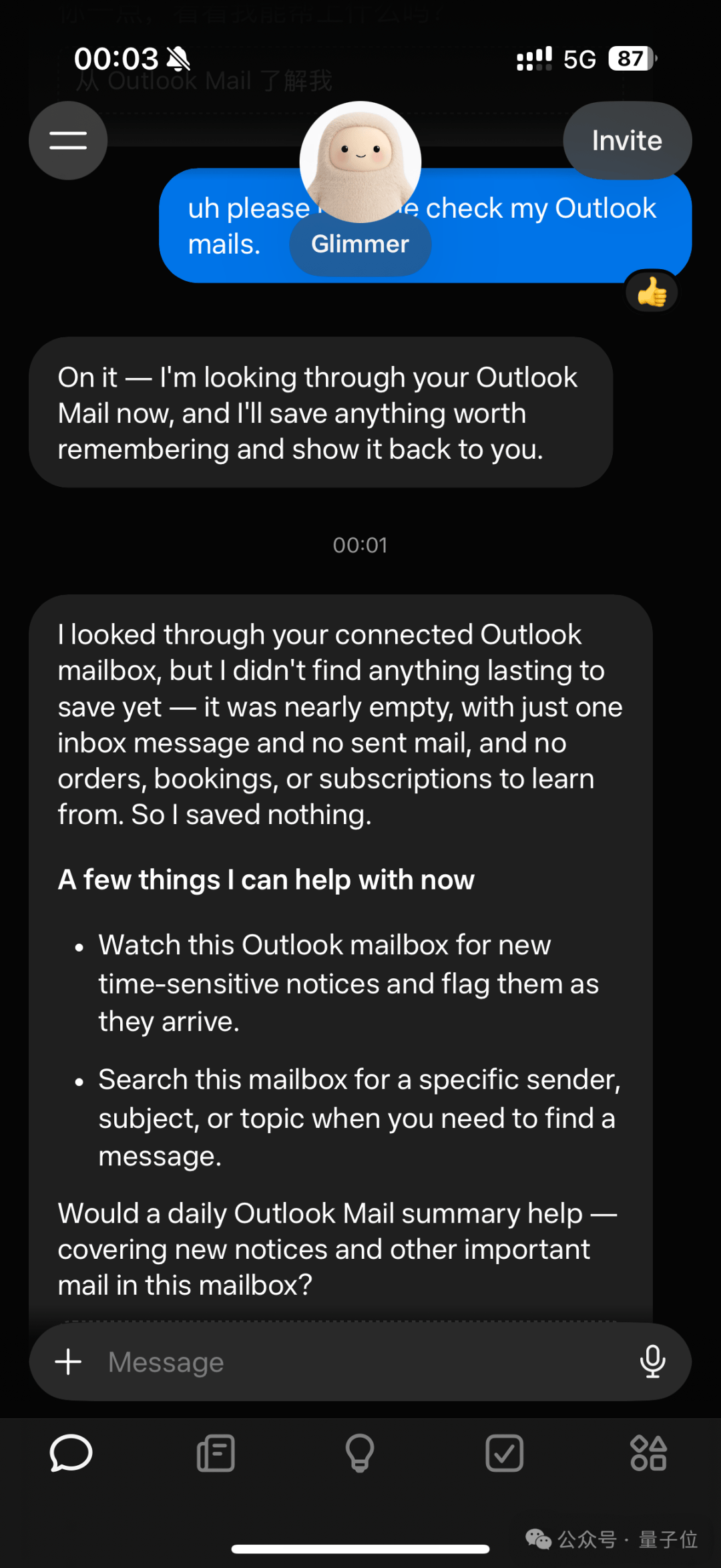
My immediate reaction was: ???
Blood pressure instantly spiked.
Of course, being a first-generation product, there is one major complaint I have to make.
Why does it only support English?! 😭
For the first time, I felt the sheer urgency of English proficiency. Only when forced into full English conversations did I realize:
I’m really just an ordinary guy who crammed a few thousand vocabulary words for an entrance exam o(╥﹏╥)o.
Being unable to speak your native tongue severely hampers communication efficiency.
Then again, this may simply come down to Chinese voice models being comparatively less mature.
How to Get AI to Speak and Act?
Beyond the user experience, let’s dive under the hood.
Why is Orilo able to maintain real-time dialogue without stumbling?
In reality, every team building voice agents has been tormented by the same physics-level roadblock: deep reasoning and ultra-low latency are inherently incompatible.
The industry is split into two primary camps:
- End-to-End Native Audio: Audio in, audio out. Blazing fast, emotionally rich and natural. Its fatal flaw, however, is poor logical reasoning; introduce a slightly complex task, and it grinds to a halt.
- Cascaded Architecture (ASR-LLM-TTS): Transcribe speech first, run it through the LLM to think, and synthesize speech at the end. The IQ is there, but latency easily starts at 1.5 to 2 seconds. That’s not a conversation; that’s shouting over a walkie-talkie.
Human-computer interaction has a brutal psychological threshold: the moment audio latency crosses 1.5 seconds without a response, the illusion that you are communicating with an intelligent entity instantly evaporates.
Orilo’s breakthrough lies in decoupling the “interaction layer” from the “execution layer” into a two-tier network architecture:
- Front-End Layer: Powered by an ultra-low-latency lightweight voice model dedicated to rapid listening and emotion capture, ensuring interruptions and replies trigger immediate responses.
- Back-End Layer: Houses a slow-thinking, high-reasoning agent that quietly reads emails, invokes APIs, and inspects calendars behind the scenes.
Many across the industry are exploring this two-tier concept—OpenAI pursued a similar direction with GPT-Live. Yet everyone tripped over the same pitfall:
While the backend spends a dozen seconds churning through tasks, what should the front-end do while staring blankly at the user?
Previously, when I asked GPT to help reply to an email, it cheerfully said “Sure!”—and then my phone sat in dead silence for two full minutes.
I was baffled: Dude, are you working or did you crash?
That prolonged void—where the conversation has halted but the action hasn’t materialized—makes for a terrible experience.
Orilo cleverly solved this through a product design trick:
It endowed the front-end voice model with the ability to “work while making small talk.”

When you ask it to schedule an event in the background, it coordinates the backend execution while continuing to chat naturally, seamlessly carrying forward the news topic you were just discussing.
There isn’t a single second of dead silence throughout the entire exchange. It mirrors a seasoned executive assistant who chats about industry gossip while typing away at their desk to book your tickets—handling both without missing a beat.
During testing, I also noticed a neat detail: when it needs a moment to think, it naturally inserts conversational fillers like “hmm…” or “uh…” to bridge the gap.
While the artificial cadence becomes noticeable after a while, it is infinitely better than being given the cold shoulder by an AI.
The numbers back this up, too.
Under the industry benchmark Full-Duplex-Bench, Orilo delivered remarkable numbers.
Its standout metric is the turn-taking latency when resuming speech after a user interruption.
Taking just 1.08 seconds, it clocked in as the fastest in the benchmark. By comparison, GPT Realtime took 1.50 seconds, while Gemini Live was a heavyweight, trailing at 2.62 seconds.
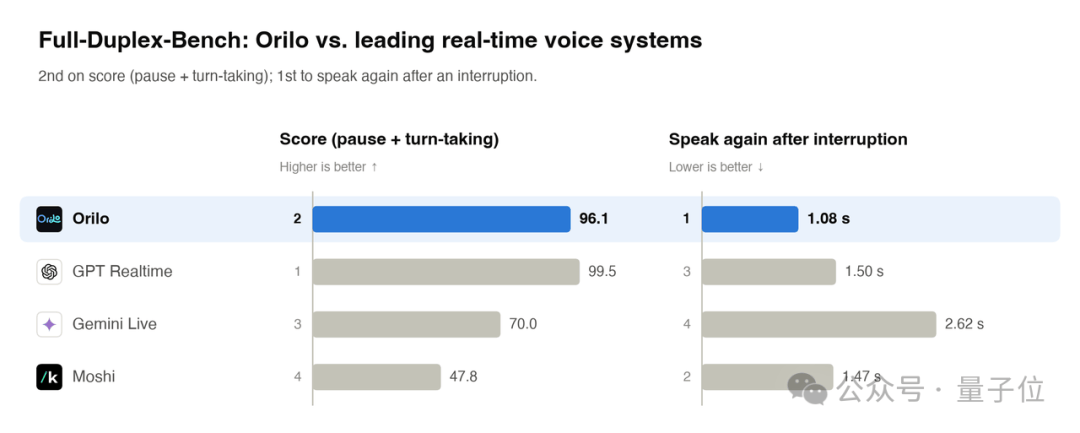
Naturally, my testing revealed that elevating the interaction experience comes at a cost.
Stitching two tiers together in pursuit of raw responsiveness sacrifices robustness.
On several occasions, the backend failed to connect with the API, yet to avoid an awkward silence, the front-end solemnly asserted that “everything is taken care of.”
When I opened my calendar—it was completely blank 😑.
Still, from a macro perspective, this architectural direction seems sound; ironing out these kinks is merely a matter of time.
Founded by a Baichuan Co-Founder
As always, looking at the team behind the product reveals an interesting story.
The founder, Jiao Ke, is a co-founder of Baichuan Intelligence.
You might remember that last year they rolled out a product called “Laifu Radio.”
Its core offering was personalized AI daily audio briefs—sharing direct lineage with Orilo.
It performed remarkably well back then, maintaining a 50% Day 2 retention rate and over 10% Day 30 retention across hundreds of thousands of users.
Incredible numbers.
Evidently, they have been focusing on the voice domain for a long time. All the clues were already there.
Back to Orilo itself—how did the idea come about?
Their experience with “Laifu” validated product-market fit around the morning routine.
Yet they soon started exploring the next step: beyond providing informational value, what else could AI + Voice achieve?
The answer is Orilo.
As Jiao Ke shared in interviews, their long-standing vision was to build an entity capable of remembering details and replying to emails—just like Samantha in Her.
Orilo’s arrival represents a premeditated paradigm shift.
We also learned that the team kicked off the Orilo project early this year.
More than six months later, the puzzle pieces have finally come together.
One More Thing
A final parting thought.
Frankly, viewed purely through the lens of lived experience, the previous generation of internet products did a rather miserable job.
They fought tooth and nail to trap users inside their walled gardens, only to bombard them with trashy ads the moment they were hooked.
Yet today, the value benchmark for the new generation of AI products seems to be shifting.
Whether it’s Claude Code, Codex, or Muse, these emerging agent modalities are doing the exact opposite—
Helping users reclaim the time once stolen by internet products.
Allowing you to return your attention to the people around you.
This was the core motivation behind Orilo’s voice-first philosophy.
It never aimed to become an omnipotent super-app portal—that isn’t the mission of an AI product—so it never wants users glued to their screens.
Say what you need; once it’s handled, it goes right to sleep.
That very restraint might be Orilo’s most precious asset.
When AI stops trying to invade our lives, it can finally become the companion you look forward to speaking with every morning—by your bedside, in your car, or in the kitchen.
Moving from “using” an app to “coexisting” with an agent.
A brand-new human-computer relationship is beginning to sprout.
In 2010, Steve Jobs acquired Siri, a startup incubated out of SRI International.
According to former Siri CEO Dag Kittlaus, Jobs personally called the next day to arrange a meeting, going on to spend three hours with the three co-founders at his Palo Alto home.
Jobs told them he wanted to build Siri directly into the iPhone.
“I want to completely reinvent the phone… you won’t ever have to tap around and type again.”
Yet as we all know, LLM technology arrived more than a decade late.
Even more regrettably, Siri never managed to catch the wave of this new AI era.
We will never know what Siri might look like today had Steve Jobs been around to guide it.

Yet with Orilo’s launch—
The visions Jobs invested in Siri all those years ago…
Finally, have a tangible starting point.
All rights reserved. Unauthorized reproduction or use in any form is strictly prohibited and subject to legal action.
](https://www.qbitai.com/2026/11/507419.html#)
- New work from Andrew Yao’s team at Tsinghua: Algebraic World Model enables AI to think like Newton2026-11-01
- Legacy convenience store robot retail initiative stumbles: Polished tens of thousands of times in the lab, still drops bottles in front of shelves2026-11-01
- New milestone from Jev ignites the open-source community once again2026-11-01
- RSI strikes big! Domestic open-source project claims global #1, 1.3B OXR reshapes OCR2026-10-30
Scan to share to Moments
Related Reading
Apple acquires AI startup Voysis to make Siri smarter
Jia Haonan 2020-04-10
Apple pushes into AI hardware, but ends up with an echo show clone? Desktop companion robot delayed until 2027…
Apple’s AI strategy centers on smart home tech
Wen Le 2025-08-14
Major leak reveals Apple AI upgrade: Siri to be reborn in iOS 18! Tim Cook redefines AI as Apple Intelligence
Nearly all native applications to be fully armed with AI
Kresi 2024-06-09
Command Siri without making a sound! Cornell Chinese-led team builds silent speech recognition necklace supporting English and Chinese
A blessing for the socially anxious
Shisan 2022-02-16
Female scientist behind Siri and Alexa passes away; she gave AI its female voice
The mother of female voice synthesis, passed away at age 74
Xiao Xiao 2020-08-24
Apple contractor leak: The Siri on your phone heard things that shouldn’t be heard
Drug deals, medical records, and intimate encounters were recorded and heard
Guo Yipu 2019-07-27
Popular Articles
Top of the charts! Agibot’s dual models dominate multiple leaderboards 2026-10-30
Tracking new AI trends, reporting breakthroughs in tech
QbitAI Copyright © Beijing Geek Partner Technology Co., Ltd. Beijing ICP Filing No. 17005886-1