
The Next Phase of AI Is a Battle Over Productivity Systems
Nearly three years into the LLM frenzy, generative AI is collectively slamming into a cold wall of commercial reality.
On one side, Silicon Valley and major research labs are locked in a relentless war over benchmark leaderboards—claiming doubled parameter counts today and boasting chart-topping multimodal metrics tomorrow. On the other side lies an awkward commercial scissors gap: the vast majority of consumer-facing AI applications are trapped in a vicious cycle where “the larger the scale, the steeper the losses.”
As the performance gap between models narrows, business models that merely wrap third-party APIs in thin shells have proven incapable of building defensible moats. Alex Mashrabov, founder of the standout overseas AI video platform Higgsfield, once asserted: “AI apps are dying from the technical vanity of in-house models; controlling traffic routing is the real moat.”
But that is only half true. Model routing addresses “invocation efficiency,” not “delivery capability.” Merely ditching vanity benchmarks and acting as a front-end traffic dispatcher cannot shield an app from eventually being bulldozed by foundation models.
Confronting this boiling-frog crisis, Dang Jinfeng, founder and CEO of Haima Cloud, offered another penetrating industry insight:
“Consumer AI struggles to make money; across the globe, only a handful of tech giants can pull it off. The only path to real monetization lies in vertical productivity scenarios. The essence of AI’s next phase isn’t divergent probabilistic generation, but deterministic system delivery. Anyone can buy models. What truly sets players apart is a ‘productivity engine’ deeply coupling compute, the Harness (Agents, context, and toolchains), and data. Without industry-specific Agents and expert workflows, AI remains nothing more than a glorified toy that spits out tokens.”
RunningHub, developed by Haima Cloud, is the concrete manifestation of this system in the AIGC domain.
According to SimilarWeb data, between March and September this year, RunningHub’s total global web traffic surged by 266%, ranking among the fastest-growing mainstream AI creation platforms during that period. In July, Wen Jian, co-founder and CTO of Haima Cloud, revealed in an interview with CCTV’s Focus Report (Jiaodian Fangtan) that the platform’s monthly token consumption had reached 9 trillion.
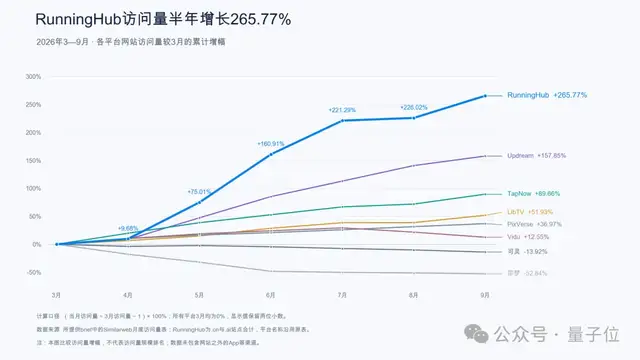
Deconstructing Haima Cloud’s technical trajectory reveals an alternative solution from a platform rooted in real-time cloud rendering: rather than stacking APIs for shallow front-end wrappers, a vertical productivity system that unites compute, toolchains, and proprietary data serves as the pivotal lever for breaking through application-layer commoditization.
Compute Dictates the Cost Floor: Costs Depend on Idle GPU Cycles, Not Just Model Pricing
At the AI application layer, discussing gross margins and commercial viability without addressing compute infrastructure is a castle in the air. Currently, most pure-play application companies on the market (including Higgsfield) operate under an asset-light model: lacking an in-house compute foundation, they rely heavily on rented third-party cloud GPUs or pass-through calls to closed-source APIs.
This leads directly to two fatal vulnerabilities: first, gross margins are at the mercy of upstream compute price fluctuations; second, during exponential spikes in commercial usage, they cannot optimize compute costs down to the physical hardware level.
In real-world audio, video, and image production pipelines, AI inference and traditional graphic rendering alternate as production workloads. 3D scenes require rendering, professional software like Blender and Unreal Engine rely heavily on GPUs, and complex video generation and super-resolution synthesis consume massive computational resources. The traditional approach of provisioning separate GPU clusters based on peak loads for inference and rendering inevitably results in peak-time queueing and off-peak idle waste.
“Therefore, cost isn’t just about whether a model is expensive; tokens are only one component of AI production costs. For image, video, and 3D production, what truly dictates unit delivery cost is whether the entire computational pipeline—from inference to rendering—runs efficiently. Going forward, AI production platforms won’t just compete on raw compute scale, but on their efficiency in organizing, scheduling, and orchestrating heterogeneous compute at scale.”
This is an economic reality that application companies without control over underlying GPUs cannot grasp—and it represents Haima Cloud’s inherent architectural moat.
Founded in 2014, Haima Cloud originated in real-time cloud rendering, providing underlying technical support for cloud gaming versions of major titles like Genshin Impact and Black Myth: Wukong. Leveraging years of GPU scheduling expertise, it was one of the earliest Chinese companies to pivot compute toward AIGC. Today, it has successfully transitioned from a cloud rendering provider into an AI productivity platform.
Over a decade of development in real-time cloud rendering, Haima Cloud has deployed 69 computing nodes globally, managing a compute pool of 6 EFLOPS. Its underlying strategy pools heterogeneous GPUs at the source, directly translating its decade of expertise in deterministic delivery and millisecond-level scheduling from cloud gaming to AI inference.
On the RunningHub platform, the same pool of GPUs handles distinct workloads—image generation, video generation, and professional rendering—across different time slots. A unified scheduling layer dynamically allocates resources in real time based on task type, model size, and latency constraints. This unified “rendering-inference convergence” scheduling drives Haima Cloud’s overall compute utilization to an astonishing 70% above the industry average.
For enterprise clients, this delivers exceptional cost-performance; for Haima Cloud itself, coupling proprietary compute with vertically post-trained models allows its gross margin to remain consistently high. In an AI price war where gross margin determines survival, this hardware-level pooling capability establishes a cost boundary that pure-play application companies cannot cross.
Bypassing the foundation model parameter race to tackle real productivity bottlenecks and bridge the last mile from model to production
As multimodal foundation models evolve, an increasingly glaring contradiction emerges: while their probabilistic generation capabilities become ever more stunning, a massive chasm still separates their raw output from the commercial delivery standards of industrial production pipelines.
When explaining the root cause, Dang Jinfeng’s answer is straightforward: In content production, the divergent nature of creative demands guarantees that foundation models will always fall short.
Large language models primarily handle convergent tasks: whether code runs or a math problem is solved correctly can be measured against clear benchmarks. In contrast, demands for images, audio, and video are inherently divergent. Aesthetics have no standard answers. When this divergence enters rigorous industrial production, it instantly surfaces as concrete engineering flaws—facial inconsistencies, style drift, lighting discrepancies, and uncontrolled camera motion.
A deeper challenge lies in creators’ highly personalized aesthetic preferences and imaginative visual effects that fall outside standard pre-training data distributions. These nuances simply cannot be accurately interpreted and reliably generated by a generic foundation model via a brief prompt.
Foundation models aim for broad generalizability, whereas cinematic-grade production demands pixel-level precision and control—an inherent capability gap between two fundamentally different goals.
Grounded in this insight, Haima Cloud made a strategic choice: forgo competing with tech giants on foundation model parameter scales, and instead concentrate all core resources on scenario-specific post-training and engineering optimization of foundation models.
Drawing on its proprietary heterogeneous GPU scheduling foundation and deep engineering expertise, Haima Cloud pursues two tracks to crack real-world scenarios and bridge the last mile from algorithms to production:
First, vertical post-training to solve enterprise delivery’s “hard engineering challenges”: Launching the RH series of specialized models tailored to overcome production bottlenecks in speed, cost, quality, and consistency.
In just 20 days this September, Haima Cloud released three proprietary RH-series scenario-specific post-trained models:
- RH Upscale Model: Breaks through conventional algorithmic limits to reconstruct skin textures, hair strands, and fabric details without structural collapse, enabling cost-effective, one-click upscaling from low resolutions to commercial-grade 4K. It ranked first in overall quality in a benchmark across 13 mainstream solutions.
- H3 Lightning: Compresses sampling steps into single digits, layered with step-skipping caching and multi-GPU parallel optimization. On RTX 6000D nodes—eliminating the need for expensive datacenter GPUs—it slashes 5-second video generation time from 6 minutes to 28.7 seconds (nearly a 12x speedup), dramatically enhancing real-time trial-and-error efficiency for professional creators. Furthermore, it runs in a multi-GPU RTX 6000D environment over standard PCIe without NVLink, making it independent of high-end datacenter GPUs so small-to-midsize teams can deploy it locally on commodity multi-GPU servers. The complete method and reproduction instructions have been open-sourced on GitHub.
- H3 RH Enhanced: Post-trained specifically for consistency across multi-shot, long-form narratives, reducing character distortion rates by over 60% in complex tasks spanning 16+ shots, with invocation costs as low as ¥0.18/second.
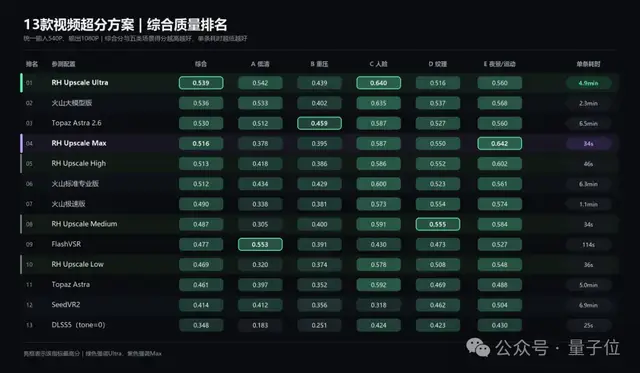
△ Across 13 evaluated configurations, RH Upscale Ultra ranked first in overall quality with a score of 0.539; Max averaged just 34 seconds to perform a 2x upscale on a 5–10 second test video.
This relentless focus on scenario execution has even earned recognition from open-source foundational creators: MiniMax is officially procuring H3 RH Enhanced through RunningHub to serve its own clients. A third-party post-trained model being adopted upstream by a foundation model vendor is exceedingly rare in today’s AI industry. This signifies that decision-making power over model invocation is rapidly shifting toward the feedback loop at the production frontline.
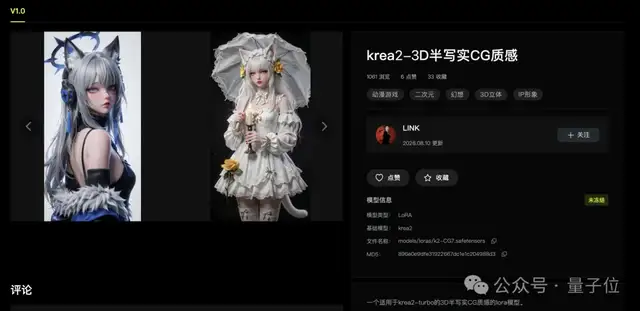
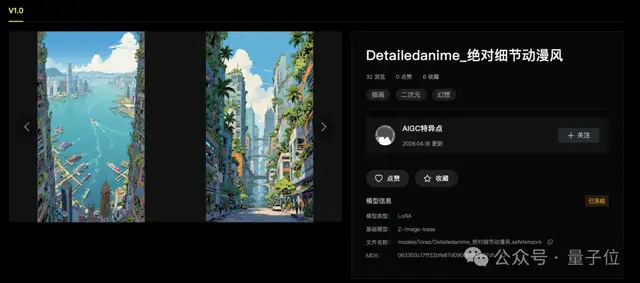
Second, establishing fine-tuning ecosystems to assetize “unquantifiable aesthetic preferences”: Beyond tackling universal technical hurdles at the platform level, Haima Cloud has spent the past two years refining a highly defensible fine-tuning framework. To address unique personal tastes, specialized art styles, and strict consistency demands that foundation models cannot grasp, Haima Cloud enables creators and enterprises to iteratively train and tune custom Checkpoint models and stylized LoRAs using their own assets, seamlessly integrating them into automated workflows for continuous reuse.
This framework crystallizes abstract aesthetic styles into “digital art assets” that AI can execute with precision. Today, RunningHub hosts a vast library of such style LoRAs, with top-tier mobile gaming studios training entire game visual systems into bespoke model matrices to achieve industrial-grade outputs ranging from concept art to finished environments.
Dang Jinfeng reflects: “We don’t train models just for the sake of having them; we do it so AI can deliver tangible results in real production environments. The AI industry doesn’t need every company building foundation models, but it does need someone who makes those models actually work. Haima Cloud doesn’t care how large a model is; we care how far it is from real-world production. The endgame of model competition is not parameter scale, but production capability.”
AI Applications Merely Wire Models to a Chatbox; AI Productivity Systems Integrate Them into the Assembly Line
Yet, rounding out model capabilities is only the table stakes—production capability is the true watershed. What defines an AI product’s competitive edge is not how many models it integrates, but whether it can orchestrate those models to deliver real-world production.
Many pure application companies globally remain stuck at the simple invocation layer: wrapping a model in a UI, a chatbox, or a basic canvas, letting users drive AI via prompts. But production is not chat, and real-world tasks can never be completed with a single prompt. Production relies on task decomposition, multi-model collaboration, tool invocation, intermediate verification, and iterative refinement to ultimately deliver outputs meeting industrial specifications.
A chatbox addresses how to use a model, whereas a production system addresses how models collaborate along an assembly line. The system responsible for organizing models, context, and production toolchains—and taking ownership of the final deliverable—is the Harness. It dictates whether AI can evolve from isolated generations to complex task execution, moving from occasional dazzling outputs to consistent, scalable industrial production capacity.
“Anyone can buy models off the shelf; what truly differentiates a product is the AI productivity system built around them,” asserts Dang Jinfeng.
Across vertical domains, the value of the Harness has been proven time and again.
In software engineering, Anthropic’s Claude Code is powered by Claude models underneath, but its abilities to read codebases, edit files, execute tests, and iteratively fix errors stem from the Harness wrapping the model. In website generation, Lovable allows users to generate fully deployable websites from a single sentence, reaching a valuation of $13.3 billion after completing a $400 million Series C funding round this August; in design, Figma, with a market capitalization of approximately $11.54 billion (as of the close on November 2), has long since built moats beyond basic drawing tools by embedding designers’ asset libraries, version histories, and collaborative workflows directly into the platform, creating formidable switching costs.
In the AIGC sector, Haima Cloud’s RunningHub represents a quintessential Harness for visual and audiovisual content production.
In the visual and audiovisual domains, the technical threshold for a Harness is substantially higher. Because the demands of visual production are exceptionally divergent, a dialogue interface alone cannot possibly deliver finished work. It requires a much longer toolchain and far deeper contextual scaffolding—ranging from LoRA fine-tuning and intricate scheduling pipelines to professional software like Blender and Unreal Engine, all underpinned by integrated rendering-and-inference compute. Every link in the chain is indispensable.
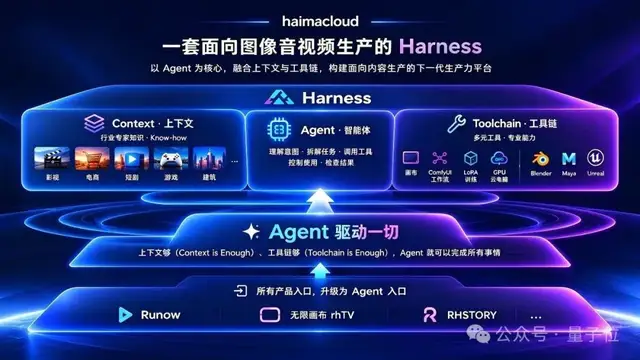
RunningHub has built precisely this type of Harness for image, audio, and video production, with products such as Runow, the infinite canvas rhTV, and RHSTORY serving as its primary vehicles. This Harness architecture comprises three core pillars:
- Agents handle intent understanding, task decomposition, tool dispatching, cost governance, and quality verification;
- Toolchains encompass canvases, ComfyUI workflows, LoRA training, cloud computers, and professional software such as Blender and Unreal Engine;
- Context provides deep domain expertise and know-how across film and television, e-commerce, short dramas, gaming, architecture, and other industries.
In Haima Cloud’s view, the future will inevitably be an era where Agents drive everything:
When context is sufficient (Context is Enough) and toolchains are complete (Toolchain is Enough), Agents can execute every phase of production.
Following this evolutionary roadmap, every interaction entry point across the platform will ultimately transform into an Agent portal.
This is first reflected in RunningHub’s dynamic model routing and intelligent orchestration. For any given request, choosing which model to run, determining call sequences, and managing budgets once required tedious user trial and error. Today, Agents take over these complex decisions. According to Haima Cloud, approximately 60% of model calls on RunningHub are now handled via intelligent dynamic routing: the Agent first identifies user intent, breaks down tasks using domain know-how context, delegates lightweight tasks to small models, and assigns heavy-duty tasks to foundation models. Workloads with distinct requirements—such as e-commerce product photos, cinematic visuals, or short comic dramas—are dispatched to the models best matched for the job.
In the new version of Runow, this capability is baked directly into the core product. When “Model Preference” is set to “Auto,” the Agent automatically invokes appropriate Skills and compatible models based on the specific task, freeing users from having to master the intricate workings of diverse models and pipelines. Consequently, final delivery quality is guaranteed while aggregate costs remain strictly controlled, preventing wasteful foundation-model compute overhead on non-critical steps.
Of course, for Agents to achieve true end-to-end delivery, two prerequisites are non-negotiable: rich context and an exhaustive toolchain.
The toolchain is what gives “hands and feet” to the foundation model’s “brain.” Different creative pipelines rely on vastly different toolchains, with cinematic production representing the absolute pinnacle of engineering complexity.
Cinematic production imposes rigorous standards on final delivery: character assets, scene composition, camera movement, and shot blocking all follow exacting specifications that multi-turn dialogs with LLMs simply cannot satisfy at scale. To solve this, Haima Cloud bridged diverse professional toolchains—canvases, LoRA training, ComfyUI workflows, and Blender, Figma, Premiere combined with Cloud PC—deeply embedding them into core AIGC production workflows to establish an industrial-grade cinematic production pipeline.
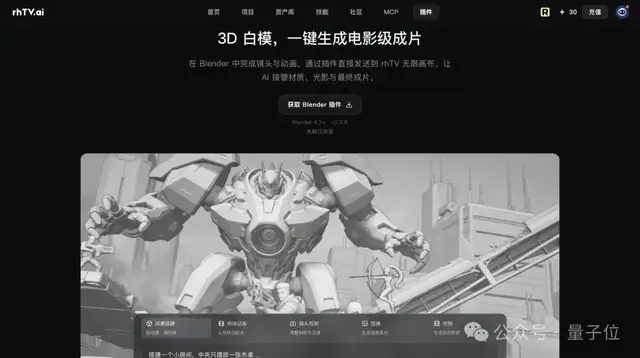
Particularly noteworthy is the innovative “Blender + Cloud PC” solution. As an industry-standard software for 3D modeling and scene composition, Blender is an indispensable pillar in professional pipelines. Most “3D director consoles” offered by other AIGC platforms are essentially lightweight toys aimed at casual users; when high-precision modeling is required, creators must repeatedly switch between the AI platform and a local Blender instance, fracturing the production pipeline.
RunningHub breaks through this bottleneck by leveraging Haima Cloud’s proprietary heterogeneous container images and application-level unified scheduling developed for its Cloud PC business. By deploying latency-sensitive, GPU-heavy professional production software like Blender directly onto edge compute nodes, Agents can invoke Blender natively and seamlessly within the RunningHub canvas.
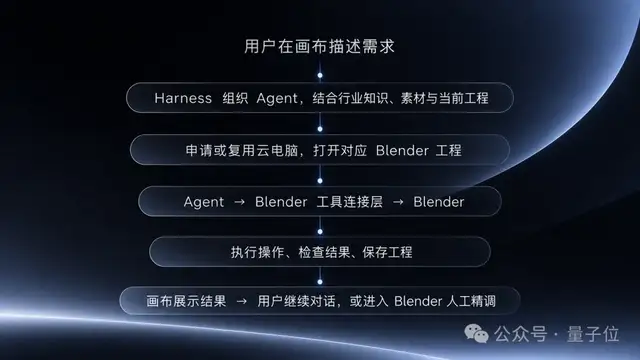
Users simply enter natural language requests on the canvas, and the Harness orchestrator drives the Agent to spin up a Blender project on the Cloud PC to execute scene assembly. If deep adjustments are required, creators can take over the identical project at any moment for manual fine-tuning.
The value of this architecture extends far beyond productivity gains. On one hand, professional creators possess budgets and a willingness to pay that dwarf consumer-tier users—a commercial disparity akin to comparing casual photo-editing app users with professional Photoshop practitioners. On the other hand, every native interaction step executed by professionals inside Blender is captured as platform-exclusive “expert trajectories.” This data continuously fuels the iterative evolution of the Agent models, creating an unassailable moat against platforms that merely provide lightweight, toy-like tools.
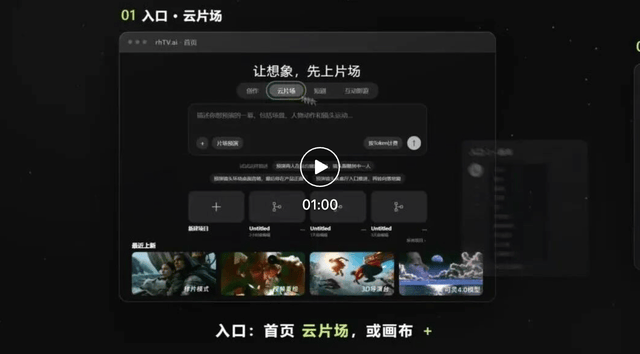
Video URL:
https://mp.weixin.qq.com/s/vJDK570WT8aoEDBwp9lKFQ
The production of cinematic-grade character assets is another prime real-world scenario.
AIGC director @Qianjin is a representative RunningHub user who has overseen end-to-end planning and production for multiple S-tier film and anime IPs, including the Song of the Youth series. An animated series he produced once failed broadcast platform review because the characters felt overly artificial and “AI-generated”—