
AI Takes Over Scheduling and Operations: Warehouses Get Smarter the More They Work
Meng Yao reporting from the Office
QbitAI | WeChat Official Account QbitAI
Embodied AI is beginning to tackle increasingly complex industrial and production environments.
While most players remain focused on isolated, single-point tasks like workstation picking or home services, one contender has set its sights on a tough nut to crack in industrializing embodied AI: smart warehousing.
Even more ambitious is their goal: to let AI take full control of warehouse scheduling and operations, achieving 24/7 unmanned autonomous runs while continuously learning and self-evolving in real-world business scenarios.
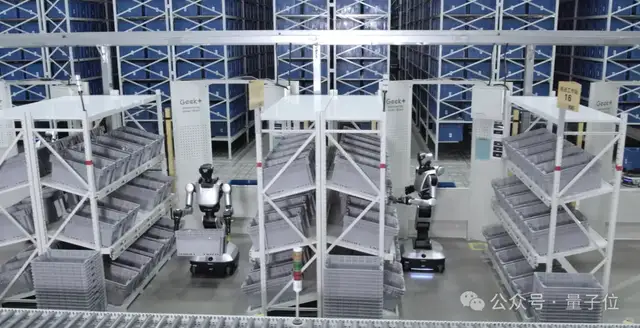
That company is Geek+, a global leader in Autonomous Mobile Robots (AMRs).
Geek+ recently unveiled its “24/7 Autonomous Smart Warehouse Initiative,” aiming straight for self-evolving smart warehouses in the era of Physical AI.
From putting embodied AI to work at single workstations to enabling entire warehouses to run autonomously, Physical AI is diving straight into the deep end of industrial deployment.
From Manual Execution to Full Management: Physical AI Enters the Deep End
As AI penetrates industrial settings, an awkward reality persists:
The higher the degree of automation in Physical AI, the more human dependency concentrates on highly uncertain, long-tail corner cases.
Over the past decade, AMRs have automated vast amounts of standardized handling and storage operations, popularizing goods-to-person (GTP) workflows. Yet, when it comes to complex picking tasks—involving tens of thousands of SKUs, constantly changing packaging materials, and irregular placements—robots still struggle.
This reveals a long-standing bottleneck in warehouse automation: optimizing efficiency in isolated stages is no longer enough to drive a warehouse-wide leap into true intelligence.
At this critical juncture, Geek+ offered its industry assessment for the next breakthrough in smart warehousing:
The key to next-generation warehouse intelligence lies in achieving 24/7 autonomous operation and continuous self-evolution, leveraging global commercial scale to turn autonomous smart warehouses into a foundational infrastructure for next-gen productivity.
Behind this assessment lies a harsh economic and technical reality facing the warehousing sector.
For warehouse operators, every additional hour of autonomous operation unlocks an extra hour of throughput free from human scheduling constraints. Particularly during night shifts and promotional peaks, sustained and dependable fulfillment directly determines supply chain agility.
More importantly, this framework allows heavy-asset automation equipment to operate at full capacity around the clock, converting night shift wages and on-site maintenance overhead into tangible net operating margins.
This requires robots not only to independently handle unseen long-tail anomalies, but also demands that the facility-wide dispatch system make autonomous decisions, self-heal disruptions, and generalize operational experience across hundreds of coordinated machines.
Only when an entire warehouse develops the autonomy to cope with uncertainty can technical intelligence truly translate into long-term, quantifiable commercial productivity.

Building on this insight, Geek+‘s “24/7 Autonomous Smart Warehouse Initiative” establishes “full-warehouse autonomy” as its core strategic direction for the next phase, laying out a three-step evolutionary roadmap:
- End-to-End Workflow Integration: Introduce embodied AI to take over complex manipulation, bridging the long-tail operations that have historically relied on manual labor.
- Strengthen Closed-Loop Intelligence: Elevate AI from isolated perception to autonomous decision-making and dynamic regulation, driving the entire facility to self-evolve through operation.
- Scale Commercial Deployment: Leverage mature global delivery and localized operations to replicate autonomous smart warehouses across diverse commercial scenarios at scale.
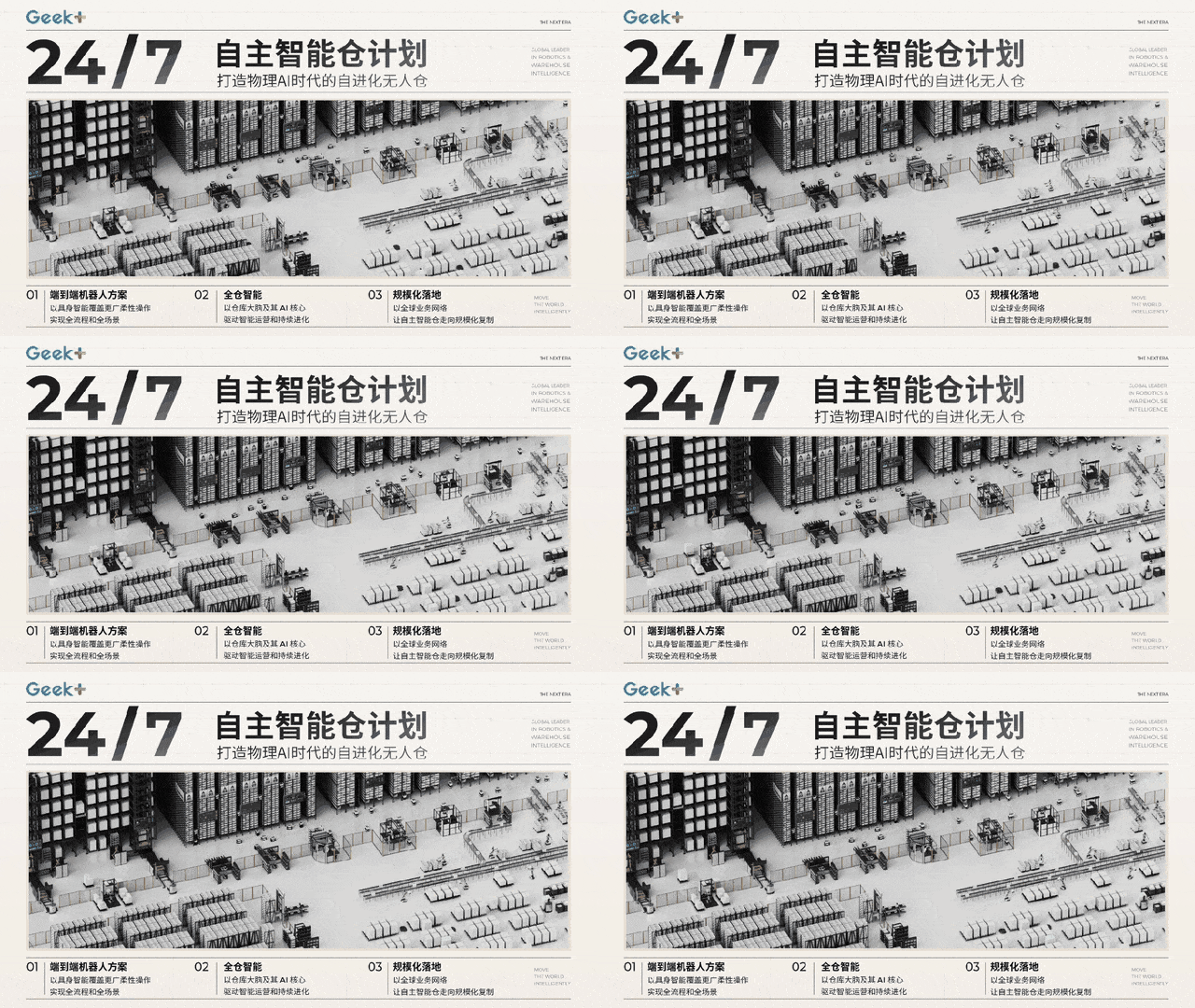
These three strategic pillars correspond precisely to the three hurdles Physical AI must overcome to achieve commercial scale: whether robots can independently master complex operations, whether the system-wide platform can achieve autonomous closed-loop dispatch, and whether the overall paradigm can be replicated across diverse environments at scale.
Today, these system-level capabilities are crystallizing from Geek+‘s decade-plus accumulation of hardware and software innovations and worldwide commercial deployments.
Embodied AI Enters the Warehouse: Hands, Feet, and Real Work
Achieving full warehouse autonomy begins with eliminating operational bottlenecks at the foundational level: enabling robots to seamlessly execute the end-to-end physical workflow and shifting warehouse automation from fragmented point solutions to an integrated, closed-loop operation.
While the capability ceiling of an individual robot dictates workstation-level throughput, whether the full operational chain can close the loop autonomously dictates the true viability of an unmanned warehouse.
Unlike standard embodied AI solutions that focus narrowly on single-robot algorithms or niche tasks, Geek+ leverages over a decade of domain expertise in industrial engineering. Its proprietary Gravity Unified Embodied AI Framework and Gravity 4D Embodied World Model directly address the challenges of autonomous robot manipulation in unstructured, complex, and dynamic environments.
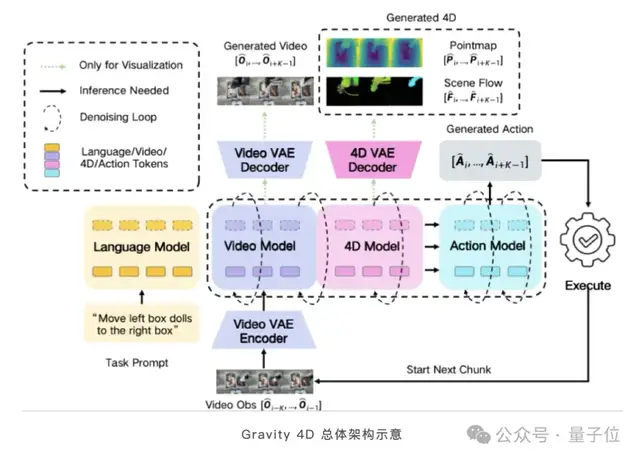
Within this architecture, the Gravity Embodied AI Framework handles task comprehension and motion planning, giving robots the deliberation to “think before acting”; the Gravity 4D World Model allows robots to accurately perceive 3D geometry, contact mechanics, and dynamic motion over time in physical space.
Combining both technologies equips robots with superior adaptability when confronting complex environments and sudden disruptions:
- Cross-Task Generalization: When encountering unfamiliar items with novel materials or irregular packaging, robots can determine optimal grasp points without requiring dedicated data collection or training.
- Dynamic Disturbance Rejection: Even if an object shifts slightly or sightlines become partially obstructed during operation, the system can replan trajectories in real time to seamlessly complete the task.
- Long-Horizon Multi-Step Execution: Autonomous decomposition, reasoning, and step-by-step execution across complex task sequences.
- Natural Language Correction: If deviations occur during execution, operators can adjust and correct strategies on the fly using natural language prompts without reprogramming.
Powered by multimodal spatial perception, long-horizon logical reasoning, 4D physical modeling, and adaptive trajectory planning, these technologies are already being injected into live warehouse operations.
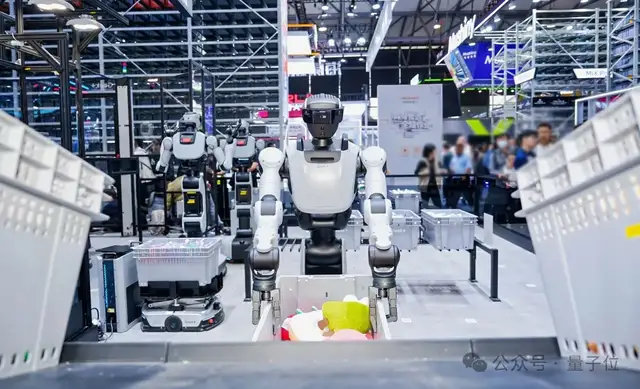
For example, Geek+‘s general-purpose humanoid robot, Gino 1, can already perform composite tasks such as mixed-case picking, material handling, and palletizing, collaborating with mobile bases to execute continuous, long-horizon picking cycles.
Simultaneously, Geek+‘s unmanned picking workstation has begun taking over put-wall sorting operations that once demanded experienced human workers. In a deployment at Schneider Electric’s Shanghai Logistics Center, the workstation demonstrated picking speeds twice that of manual labor, with a sorting accuracy exceeding 99.99%.
Beyond individual embodied robotics, Geek+‘s comprehensive AMR portfolio covers standardized turnover operations across totes, pallets, and racks. This end-to-end hardware ecosystem and rich, scenario-wide data repository provide the bedrock for whole-warehouse autonomous evolution.
Warehouse Brain at the Helm: AI Takes Over Operations for Whole-Facility Self-Evolution
Connecting individual robot tasks is only the first step. When hundreds of heterogeneous robots operate simultaneously in unstructured environments, enabling system-level self-healing and global self-regulation presents a far steeper technical challenge.
Dr. Wenzhe Tan, Vice President of Geek+‘s Systems & Software Platform, pointed out a widespread industry pain point: traditional warehouse management architectures are fragmented and operate in silos—dispatch systems focus narrowly on path optimization and deadlock prevention, execution systems fixate on order fulfillment, and analytics platforms merely generate offline reports.
While each subsystem has clearly defined local performance metrics, the absence of cross-domain coordination makes it nearly impossible to make dynamic, synergistic decisions that optimize the facility as a whole.
 △ AI-generated
Geek+‘s solution is to dismantle data silos between subsystems and engineer a “Warehouse Brain” capable of orchestrating resources warehouse-wide.
By mapping fragmented production elements—order deadlines, dynamic inventory, mobile robot fleets, robotic arm workstations—into a unified global state space, the system establishes a full closed-loop pipeline across “physical execution, data perception, and intelligent decision-making” for real-time, agile optimization from an overarching perspective.
Architecturally, the Warehouse Brain is powered by three synergistic core modules:
- IOP (Intelligent Operations Platform): Handles global perception and bottleneck identification;
- WES (Warehouse Execution System): Orchestrates cross-domain operational workflows and strategies;
- RMS (Robot Management System): Drives high-efficiency scheduling and dispatch across underlying equipment fleets.
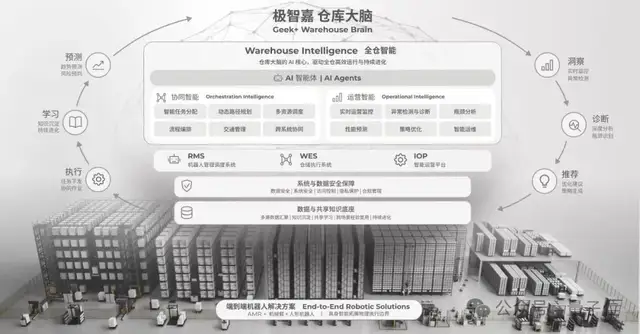
On top of this architecture, Geek+ introduced a facility-wide AI Agent framework, driving continuous self-evolution across two core dimensions:
- Collaborative Intelligence: Tightly links heterogeneous robots, auxiliary automation equipment, and operational workflows across the warehouse, dynamically reallocating tasks and scaling fleet capacity within seconds based on real-time wave order patterns.
- Operational Intelligence: Leverages reasoning-capable foundation models for continuous status monitoring and anomaly diagnosis across the entire facility, replacing passive manual intervention with autonomous system adjustments to steadily approach lights-out operations across all workflows.
The synergy between collaborative and operational intelligence allows the warehouse system to safeguard current throughput while continuously exploring the global scheduling solution space. Crucially, operational data generated after every policy adjustment feeds back into the models, creating an end-to-end data flywheel: “Insight → Diagnosis → Decision → Execution → Feedback Learning.”
The system transitions from a rigid “instruction executor” into a self-healing, adaptive “business organism,” continually evolving over long-term operations.

For concrete operational deployment, Geek+ developed three specialized AI Agents tailored to end-to-end warehouse processes:
- Monitoring Agent: Performs sub-second inspections across all warehouse metrics, pinpointing throughput bottlenecks and potential deadlock risks;
- Data Analytics Agent: Traces the root causes of bottlenecks using domain knowledge graphs and generates simulation-backed optimization strategies;
- Deployment & Configuration Agent: Autonomously fine-tunes underlying algorithmic hyperparameters and hot-deploys updated dispatch policies without downtime.
These agents incorporate Geek+‘s extensive on-site maintenance expertise and lean efficiency models, translating tribal troubleshooting know-how into quantifiable, callable, and cross-site generalizable cognitive capabilities.
In terms of dynamic control, micro-level pathing and deadlock mitigation adjust dynamically on a minute-level basis, while macro operational strategies continuously update based on day-level operational metrics. The longer a warehouse runs, the more domain data it accumulates, resulting in higher decision confidence and compounding efficiency gains.
Scaling Commercial Delivery: Answers from Global Deployments
Any technical breakthrough in smart warehousing must ultimately withstand the stringent ROI and reliability benchmarks of industrial applications.
Customer demands remain crystal clear: can the system run 24/7 without downtime, integrate seamlessly into legacy heterogeneous IT environments, and deliver clearly quantifiable marginal gains?
Backed by over a decade of deep industrial experience, Geek+ has developed robust end-to-end deployment methodologies. In terms of market performance, Geek+ has maintained the world’s #1 market share in AMRs for multiple consecutive years, with operations spanning over 40 countries and regions, serving more than 1,000 large enterprise clients, and maintaining an active installed base of over 81,000 robots.
At this year’s CeMAT trade fair, Geek+ showcased the high-density collaborative capabilities of its entire AMR lineup operating under unified AI central dispatch across an entire facility.
Addressing industry interest regarding how to evaluate “warehouse self-evolution,” Dr. Wenzhe Tan shared several core quantifiable metrics in an interview: autonomous recovery rates for long-tail anomalies, throughput stability during complex peak surges, Mean Time Between Failures (MTBF), and sub-second cold-start recovery after unplanned halts.
These measurable benchmarks highlight the underlying industrial value of the “24/7 Autonomous Smart Warehouse Initiative”:
Solidifying the tacit warehouse management knowledge scattered across veteran experts’ minds into persistent intelligence permanently embedded within the facility’s digital foundation.
For modern supply chain enterprises, heavily invested automated facilities that still depend on intensive manual supervision at key junctions suffer heavily diluted commercial returns. A smart warehouse that genuinely diagnoses, repairs, and evolves on its own ensures that every cent of capital expenditure converts into dependable, predictable, and 24/7 productivity.
Moving forward, Geek+ plans to extend its battle-tested robotic platforms, embodied algorithm frameworks, and full-facility dispatch systems from high-density warehousing into broader industrial logistics and smart manufacturing. On this path where Physical AI deeply intertwines with physical industry, the technological moat forged through deep domain expertise and commercial scale is becoming increasingly clear.