
The U.S. Census Bureau and “Super Intelligence”
November 2, 2026
Today, I was reminded of a chart created by Apollo Global Management back in September 2025—AI adoption rate trending down for large companies. Based on data collected by the U.S. Census Bureau, the chart appeared to show a slowdown in AI adoption among American businesses. At the time, I used that chart to demonstrate GPT-5’s data analysis capabilities, and later used it to test Claude’s brand-new Code Interpreter. I decided to re-run the numbers to see what had changed over the past year—and in doing so, I discovered that the Census Bureau had been swept up in the mandates of Executive Order 14434, that ridiculous “super intelligence” executive order.
First, the updated chart
Every two weeks, the U.S. Census Bureau runs the Business Trends and Outlook Survey (BTOS). Each survey goes out to 200,000 businesses selected from a total pool of 1.2 million—the respondent panel rotates, meaning any single business only fills out the survey once every twelve weeks.
New data is released every other Thursday at 10:00 AM.
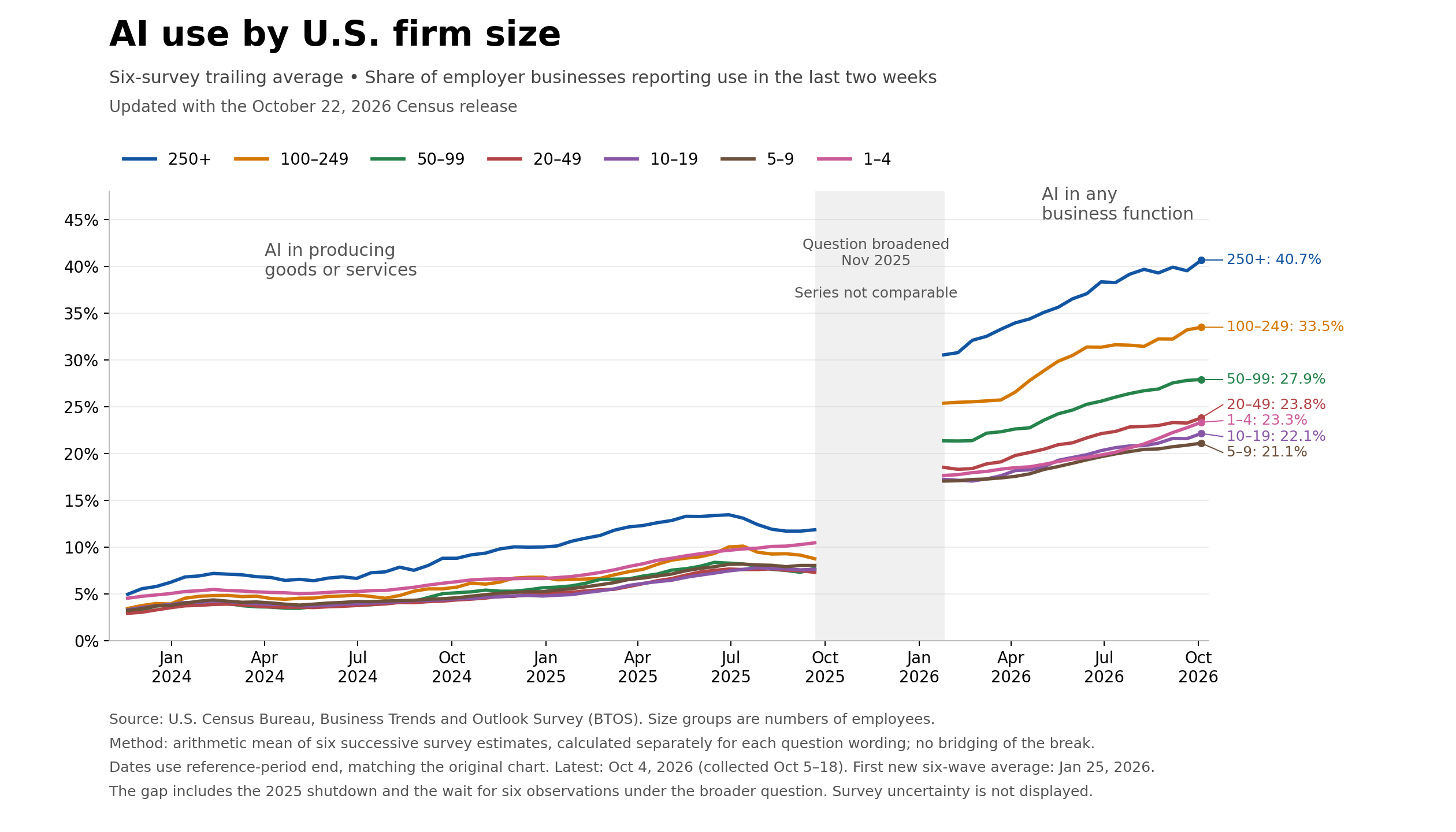
I generated an updated version of the AI adoption chart using the latest data release (published October 22, 2026) (GPT-6 Astra Extra High transcript). The updated chart reflects not only the past twelve months, but also an adjustment the Census Bureau made to the survey questions:
For comparison, here is last year’s AI adoption chart (my GPT-5 version): 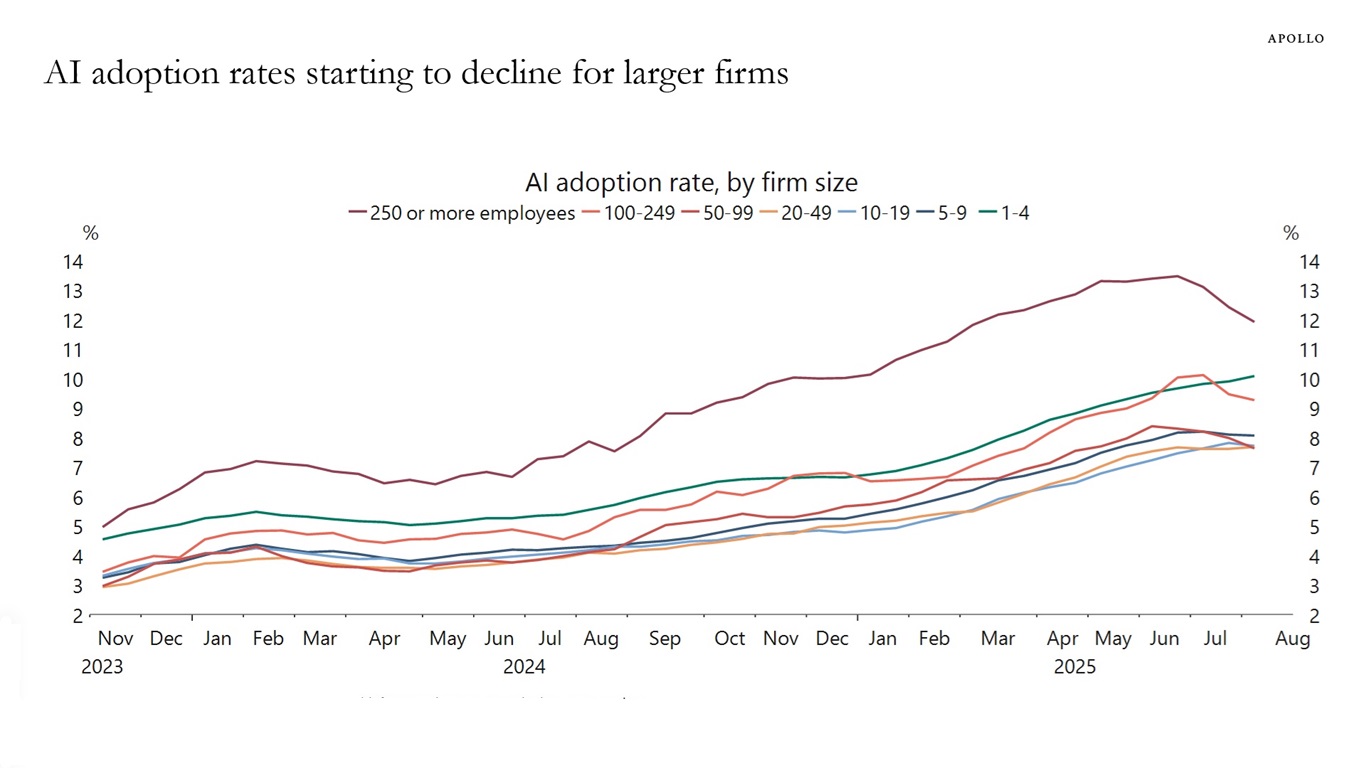
In September 2025, around 12% of the largest businesses (250+ employees) answered “yes” when asked if they used AI in “producing goods or services.”
Under the new “in any business function” wording, that same group of large businesses jumped to around 30% affirmative by February 2026, reaching roughly 40% by October 2026.
The data in the chart above comes from the “Employment size class” XLSX file, available here. Here is a copy of the file I used.
You can review the survey questionnaire documentation sent to businesses—here is my snapshot copy of the 346KB PDF.
The Question Wording Change
As the chart shows, the question asked by the Census Bureau changed significantly on November 17, 2025. Prior to that date, they asked the following (emphasis mine):
In the last two weeks, did this business use Artificial Intelligence (AI) in producing goods or services? (Examples of AI: Machine Learning, Natural Language Processing, virtual agents, voice recognition, etc.)
On December 3, 2025, the Census Bureau announced a major revision to the question. The new wording reads:
In the last two weeks, did this business use Artificial Intelligence (AI) in any of its business functions? (Examples of AI: Machine Learning, Natural Language Processing, virtual agents, voice recognition, etc.)
No longer limited to “producing goods or services”—now it’s “in any of its business functions”! That means survey results before and after November 17 are not directly comparable.
Starting October 19, 2026, They Began Asking About “Super Intelligence”
When I looked for the updated question phrasing in the latest XLSX file, I didn’t find that—instead, I found this:
In the last two weeks, did this business use Super Intelligence or SI (previously referred to as Artificial Intelligence or AI) in any of its business functions? (Examples of SI use: SI-driven data analysis; generative SI for marketing, product design, or coding; virtual SI agents for customer care; SI-driven forecasting or pricing; SI-driven computer vision for quality control, etc.)
The BTOS about page explains why:
Starting with data collection on October 19, 2026, survey question wording has been updated pursuant to Executive Order 14434.
The current data still reflects the old “Artificial Intelligence” phrasing—the first batch of results using the “Super Intelligence” wording is scheduled to be released this Thursday.
Will This Affect the Results?
The obvious open question here is whether this change in phrasing will impact the survey results.
Businesses filling out this round of the survey last saw the question twelve weeks ago, back when it was still called AI. Hopefully the new wording won’t confuse them, especially given the helpful parenthetical note: “previously referred to as Artificial Intelligence or AI.”
Still, seeing phrases like “SI-driven data analysis; generative SI for marketing, product design, or coding; virtual SI agents for customer care”—I can’t help but find it utterly absurd.