
Once Again the “Price-Performance Slayer”! Jev Co-Releases Open-Source People Search Tool: 85% Cheaper than Clay
Wen Ting, reporting from the Office
QbitAI
Jev is back with another major release, once again playing the role of “price-performance slayer”!
This time, they are taking a direct shot at people search and background research.
TypeSafe AI, the parent company behind Jev, has teamed up with agent tool platform Treg to open-source a people search tool that is 85% cheaper than Clay. It has already racked up 6,400 stars on GitHub.
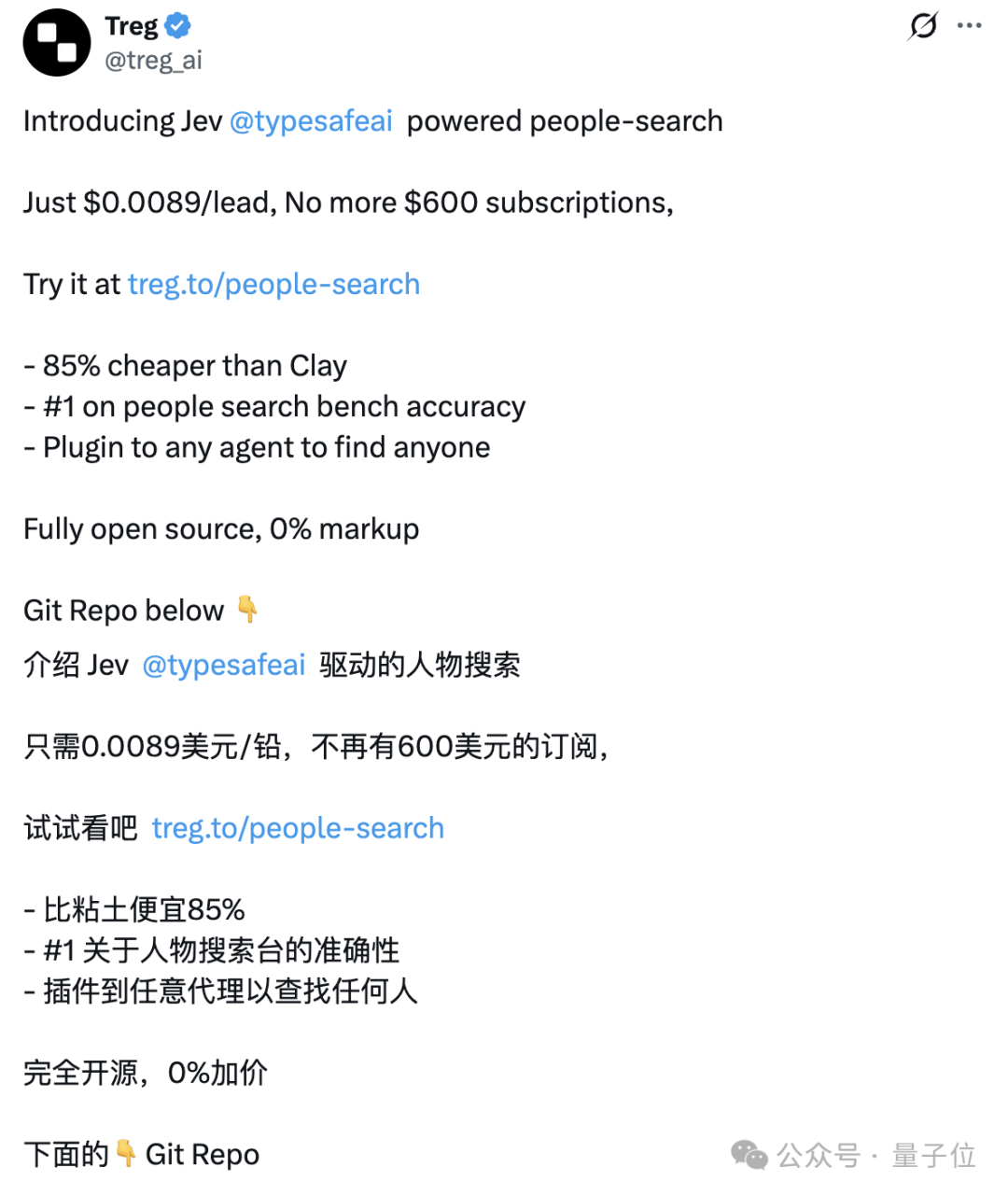
Need to track someone down on the fly? Just summon it and let it run: the minimum cost per verified, actionable lead drops to as low as $0.0089 (around 0.06 RMB).
The announcement instantly set the developer community buzzing.
One developer called it “insane” and scrambled to plug it straight into their dashboard for testing:

Others were floored by the pricing:
“Holy shit, this is crazy cheap.”

Never one to miss a meme opportunity, TypeSafe AI dropped a classic meme from the movie Taken, summing up Jev’s core capability in one punchy line:
“I will look for you, I will find you.”

It looks like the era of AI Agents tracking down people has officially arrived. (doge)
Need to Find Someone? Just Say the Word to Your Agent
Using this new tool couldn’t be simpler: just integrate Treg into your agent and describe who you are looking for.
For instance:
“Find marketing leads at post-Series B AI startups in San Francisco, and enrich them with verified work emails.”
Once the target is clear, the agent kicks off a precision search based on the configured persona:
- Task Breakdown & Initial Screening: The agent extracts constraints such as location, funding stage, industry, and job title, then calls the relevant talent databases via Treg to pull an initial pool of potential candidates.
- Jev Smart Decision Filtering: Finding names is only the first step. Next, Jev enters as the “decision gatekeeper,” evaluating each candidate against the retrieved data to verify whether they truly match the target persona, decisively filtering out false positives that look relevant on paper but don’t fit.
- Data Enrichment & Verification: After filtering, the agent uses Treg once again to invoke search, email discovery, and deliverability verification tools, enriching the profile with work history, LinkedIn URLs, and verified corporate emails.
The entire division of labor runs like clockwork: the Agent handles task comprehension and workflow orchestration, Jev tackles the critical matching and filtering decisions, and Treg handles underlying tool connectivity and data retrieval.
A fully automated people-finding assembly line is now up and running efficiently.
△ AI-generated image
In the end, what lands in the user’s hands is no longer a raw list that requires tedious manual double-checking, but a high-quality, actionable directory ready for recruitment, B2B sales prospecting, or industry research.

More importantly, this workflow doesn’t lock developers into a single closed ecosystem:
Treg supports native integration with leading developer agents like Claude Code and Codex. Developers no longer need to constantly switch back and forth between Clay, Apollo, and various email verification tools; with a single Treg API key, an agent can autonomously discover and orchestrate across thousands of supported tool interfaces.
If you already have your own accounts with providers like Hunter, you can simply bring your own API keys. If not, Treg can handle the calls on your behalf and bill per request against a prepaid balance (BYOK calls incur no additional Treg service fee).
△ AI-generated image
Workflows that once required manual digging across multiple platforms can now be entirely delegated with a single prompt. It really does capture that Liam Neeson “I will find you” energy from Taken.

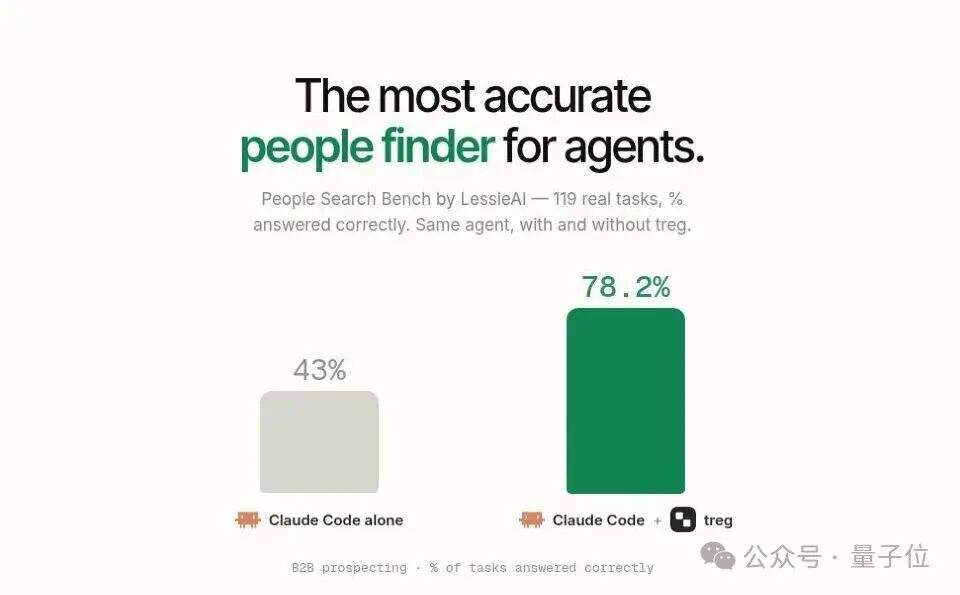
When it comes to real-world accuracy, Treg released its evaluation results on the People Search Bench.
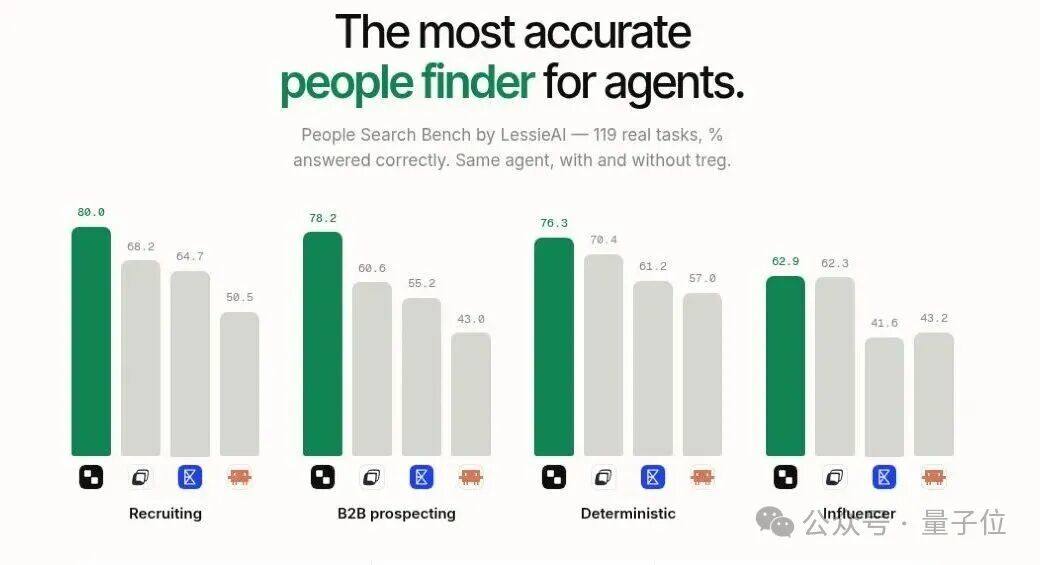
This benchmark features 119 real-world tasks spanning talent sourcing, B2B lead generation, deterministic lookup, and influencer outreach. Taking B2B sales prospecting as an example, Claude Code running standalone achieved an accuracy rate of just 43%; after integrating Treg, that figure surged to 78.2%.
Across the other three evaluation scenarios, the Treg-powered solution achieved scores of 80%, 76.3%, and 62.9%, respectively.
Impressive benchmark numbers aside, what does the actual cost-effectiveness look like in production? Let’s break down what $0.0089 really buys.
What Does $0.0089 Actually Buy You?
According to Treg’s official pricing model, as long as you provide a name, company domain, or LinkedIn URL, you can retrieve a target email for as low as $0.0089 (approx. 0.06 RMB)—and you don’t pay if no result is found.
It’s worth noting that this base price covers the lookup itself. If you need deeper email verification, comprehensive career enrichment, or real-time corporate signals, corresponding tool fees apply. Even so, the total cost represents a massive drop compared to traditional flat-rate monthly SaaS subscriptions.
To back up its cost-efficiency claims, Treg ran a side-by-side benchmark against industry leader Clay using an identical test dataset:
- Sample size: 292 people;
- Treg successfully retrieved 289 emails, of which 264 perfectly matched corporate public records, for a total cost of $1.49 (approx. 9.93 RMB);
- Clay retrieved 280 emails, with 262 exact matches, totaling $10.34 (approx. 68.94 RMB).
△ Source: Treg
With final verified hit rates essentially on par, the pricing gap is staggering:
On average, retrieving each valid email cost approximately $0.0056 with Treg versus $0.0395 with Clay—making Treg’s blended cost over 85% cheaper than Clay.
Currently, Treg is also offering every newly registered user $1 in free test credits.

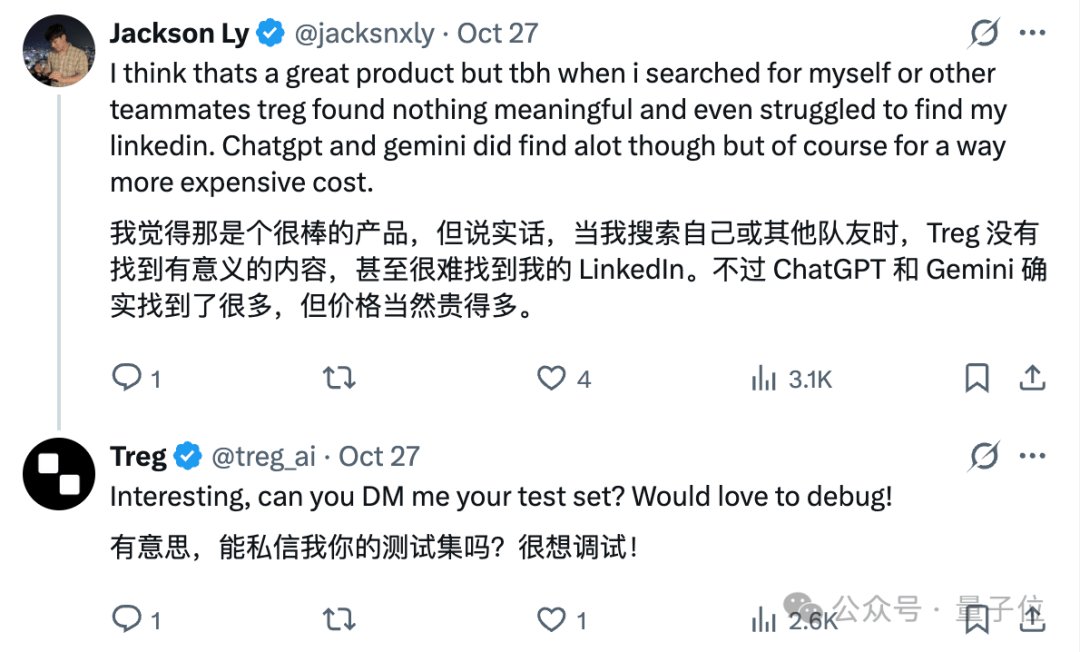
However, as early adopters started putting it through its paces, some mixed feedback regarding search accuracy surfaced in the community:
“It’s definitely cheap, but when searching for myself or my team members, Treg didn’t pull much substantive data and struggled to even index my LinkedIn page. While ChatGPT and Gemini are far more expensive, they delivered noticeably richer and more relevant results.”
The Treg team didn’t shy away from the criticism, quickly chiming in to investigate publicly in the comments:
“Can’t find it? Feel free to send over your test dataset samples, and we’ll debug and optimize it on the spot!”
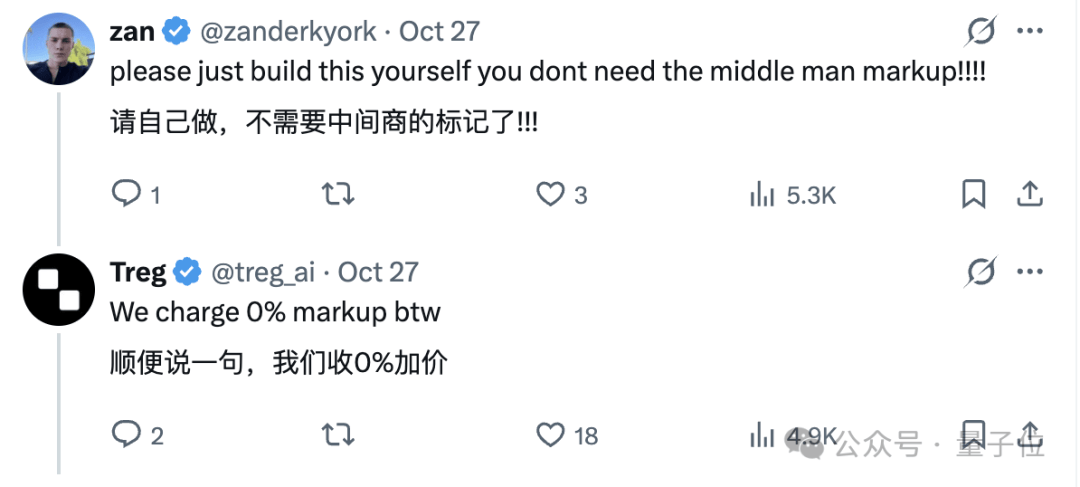
Addressing concerns from developers about whether the platform acts as an intermediary skimming a markup on third-party tools, Treg was equally forthright:
“Rest assured, we don’t take a cut or charge a middleman markup!”
At this price point, what more could you ask for? Tech bloggers and early adopters are already jumping in to run their own tests.

As to whether it’s truly a pinpoint “I will find you” or just a budget “I tried to find you,” the best way to find out is to take it for a spin yourself. (doge)
One More Thing
Ever since its decision model Jev went viral this past September, TypeSafe AI has been operating at full throttle.
Within just three days of launch, Jev’s token consumption surpassed 1 trillion; shortly after, the company announced that roughly one-third of the Fortune 500 had already integrated Jev into their stacks.
Capital markets were quick to follow: just 24 days after Jev went live, TypeSafe AI secured an $870 million Series A round, sending the company’s valuation soaring 37x straight to $7.5 billion (approx. 54.375 billion RMB), completely leaving its stealth days behind.
Close on its heels came fierce industry competition—no sooner had Jev pioneered the “decision LLM” category than tech giants like Microsoft and OpenAI rushed in with their own offerings.
Facing mounting pressure from big tech, TypeSafe AI has kept up a relentless product iteration cadence:
- On October 14, Jev 1.14.0 officially rolled out, introducing image input support, extended context windows, and new features like Box;
△ Source: TypeSafe AI Official Website
- Shortly after, they integrated deeply with Treg, seamlessly embedding Jev’s decision reasoning capabilities into real-world search and outbound lead workflows.
Navigating exploding demand, fundraising rounds, big tech rivals, and community feedback, TypeSafe AI co-founder and CEO Diogo quipped with dry humor on a recent podcast:
“I feel like an empty shell right now, constantly running around putting out fires every single day. I just want a good, solid night of sleep!”

In a single sentence, he captured the bittersweet reality of steering an AI unicorn—riding an overwhelming wave of traction while fending off tech titans and keeping production operations afloat.
Here’s hoping Diogo, while continuing to push boundaries and drop memes with the Jev team, gets to enjoy that simple, luxurious wish of a good night’s rest soon.

References:
[1] https://x.com/typesafeai/status/2114891173219500237
[2] https://github.com/superdesigndev/treg