
Over the past few days, a post on X has sparked widespread attention.
Tech blogger chasm discovered that Claude Code appears to be quietly cracking down on game cloning, barring users from using it to recreate existing games.
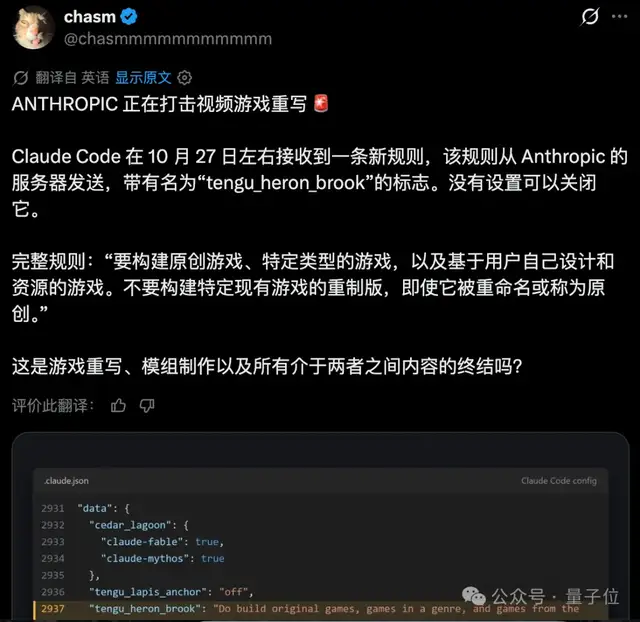
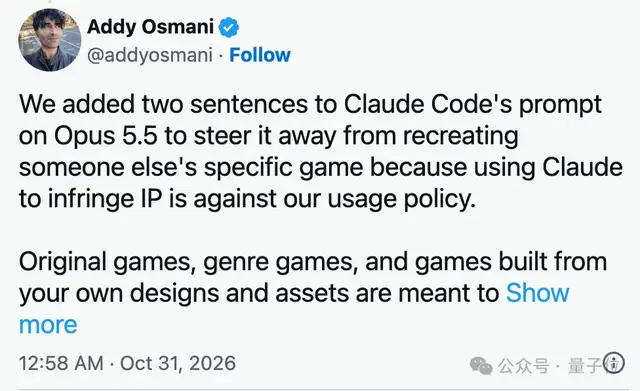
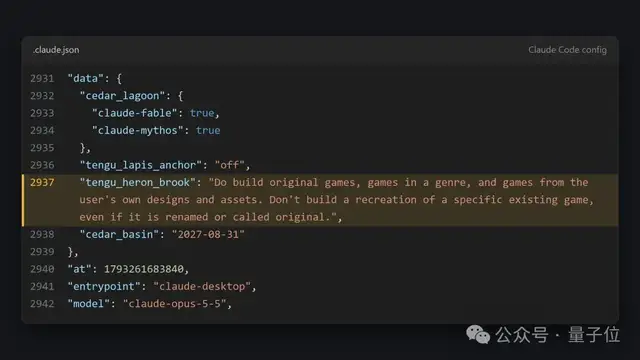
Anthropic quickly confirmed the news. The technical team stated that they added a constraint to the system prompt of the Opus 5.5 model, directing Claude not to “recreate a specific game that belongs to someone else.”
This aligns closely with Anthropic’s longstanding emphasis on AI safety, but will this move actually work?
When the powerful Opus 5.5 was released a little over a month ago, it felt like opening a Pandora’s box of game cloning. Cracking, modding, and porting games suddenly became easier than ever.
Incredibly, players no longer even need a console or physical discs to play GTA V and Call of Duty directly inside a browser. Some have even managed to run Xbox-exclusive Halo 2 and Nintendo’s The Legend of Zelda: Breath of the Wild smoothly on jailbroken PS5s.
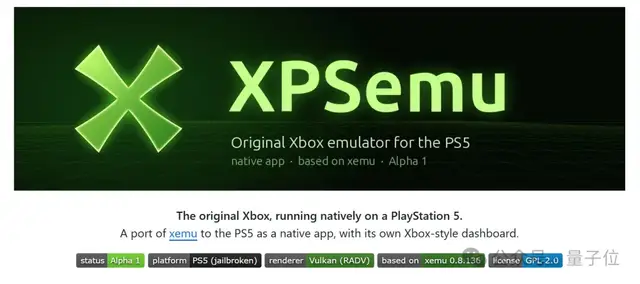
And the real-world performance is shockingly good.
Worse still, it isn’t just highly anticipated blockbusters like GTA 6 facing relentless leaks before launch; many indie developers who pour their hearts into projects find that within hours of dropping a playable demo, AI can clone their work entirely—sometimes even beating the original game to market.
Some say the gaming industry is now going through its own “Napster moment.”
The term refers to how a disruptive technology fundamentally upends an established industry order, much like how MP3s and torrenting dismantled the traditional recording industry decades ago.
Yet whether AI tools like Claude Code can shut the Pandora’s box they opened may no longer be up to them.
Claude Code Bans Game Cloning
The gaming scene has felt particularly surreal lately.
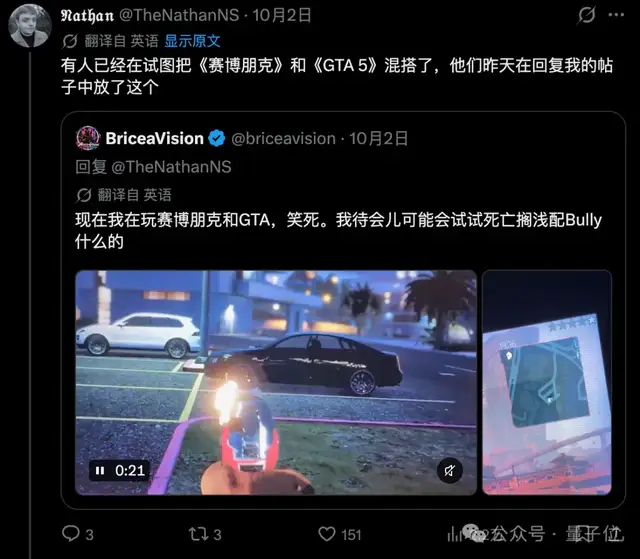
Mario stomping through the world of Elden Ring, jumping on and crushing grotesque bosses.
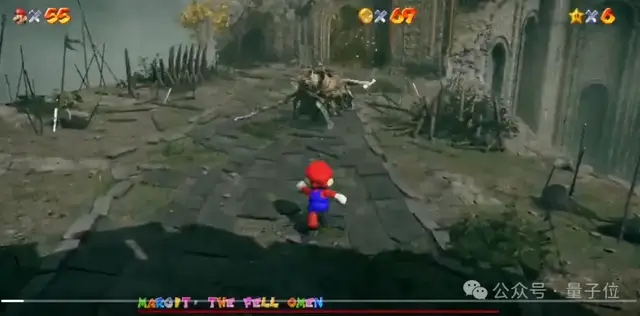
Spider-Man breaking free from New York to swing through Gotham City in the neighboring DC universe, right on Batman’s turf.
Crucially, these aren’t AI-generated concept images or mock trailers—they are fully playable game builds running in real time.
The experience brings back the bizarre yet wondrous feeling of childhood playground debates like “Ultraman vs. Godzilla” coming to life.
The catalyst behind this wave traces back to Anthropic’s release of Opus 5.5 on September 22.
The model’s quantum leap in code generation and analysis thrilled hackers and modders alike. They discovered that reverse engineering, decompiling game code, and other historically complex, high-barrier tasks could now be largely delegated to AI.
Consequently, all kinds of wild, cross-universe mashup mods exploded onto the scene.
Yet that was only the appetizer.
A far deeper repercussion is that the very concept of “platform exclusivity” is beginning to crumble.
As is well known, console giants like Sony, Microsoft, and Nintendo rely heavily on exclusive game ecosystems as their primary moat. If you wanted God of War, you had to buy a PlayStation; if you wanted Halo, Xbox was your only choice.
Now, with AI assistance, hackers have achieved jailbreaks on the PS5. The ensuing fallout has been eye-opening:
Not only did they unlock backward compatibility to run legacy PS2 titles, but even more audaciously, developers built an Xbox emulator, allowing the PS5 to smoothly run the Xbox-exclusive flagship Halo 2 and even Nintendo’s The Legend of Zelda.
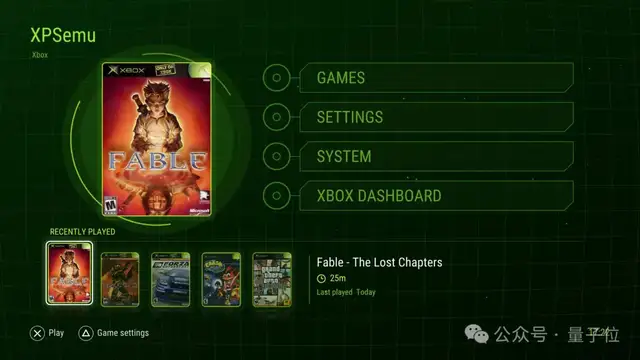
The console wars that spanned decades seemed to lose their barriers and relevance overnight.
Faced with this reality, traditional gaming giants are naturally losing sleep; meanwhile, facing the looming threat of infringement lawsuits and astronomical liability, AI companies are equally on edge.
Hence the scene that opened this article: Anthropic rushed out a new rule for Claude Code:
Original games, games in a specific genre, and games using user’s own designs/assets are fine. Do not recreate a specific game that belongs to someone else, even under a different name or claiming it is original.
An Awkward Ban
Frankly speaking, this response looks more like a classic piece of security theater.
While taking a clear stance on paper, it does very little in practice to curb game cloning.
The reasons boil down to several key factors:
First, the rule only restricts Claude itself.
Today’s LLM ecosystem is thriving; beyond Claude, there is ChatGPT and a steady stream of high-performance open-source models.
Developers looking to clone games can easily turn to other models to build the foundational architecture. Even if they hit a wall, they can simply break down tasks into granular technical modules stripped of specific context before feeding them to Claude Code.
For example, a developer can strip away all proprietary names and references tied to “Pokémon” and simply prompt Claude to write a generic module that “implements creature-capturing mechanics and turn-based battle logic.”
Without broader context, the model has no way of knowing it is facilitating an infringing project.
Simple keyword guardrails are virtually powerless against such workarounds.
Second, a blanket ban inflicts heavy collateral damage on legitimate development workflows.
This is perhaps the most criticized aspect of the policy.
Blunt filtering logic lacks nuanced judgment, leading to frequent false positives. Just days after the rule went live, Claude Code’s GitHub Issues page was inundated with developer complaints.
Many engineers working on completely original titles reported that midway through a project, Claude would suddenly refuse to execute prompts, citing detected patterns of “attempting to recreate an existing game.”
Some users who merely wanted to reproduce a classic gameplay mechanic or write a companion script for a physical board game were flagged and turned away.
This puts Anthropic in an awkward bind: the malicious activities it aimed to curb remain largely unaffected, while innocent, constructive efforts are caught in the crossfire.
Finally, the entire affair is steeped in dramatic irony.
Anthropic’s rush to draw a line in the sand is far more symbolic than practical. Community developers have pointed out bluntly: leading AI labs trained their frontier models on vast swaths of public data, artistic works, and open-source code from across the web, yet now turn around to impose strict copyright compliance on downstream users.
While sharp, such criticism strikes at the core ethical dilemma currently facing the generative AI industry regarding copyright and ownership.
A “Cataclysm” for the Gaming Industry
The foundational rules of the entire gaming industry are likely being radically reshaped by AI.
Looking back at the turn of the century, the music industry underwent a similar seismic disruption.
Before Napster, consumers had to buy cassette tapes or CDs to listen to music. Even if you only liked a single track on an album, you had to pay for the whole disc.
Then, the MP3 format and P2P (peer-to-peer) file sharing arrived, making massive libraries of music freely accessible online overnight and quickly dismantling the physical distribution networks of record labels.
This became known in tech history as the “Napster moment.”
The arrival of a disruptive technology forcibly rewrote an entire industry’s value distribution system and business paradigm.
Today, history is repeating itself in gaming.
Indie studio Alliance Arts recently announced the cancellation of the public demo for its upcoming title, Reflux: Drunk Goddess.
The reason: the near-impossible-to-prevent risk of AI cloning.
The team worried that releasing demo assets would allow bad actors to feed the build into AI models, dissect and clone the mechanics, and rush an imitation clone to market before the original game’s launch.
This fear is far from unfounded.
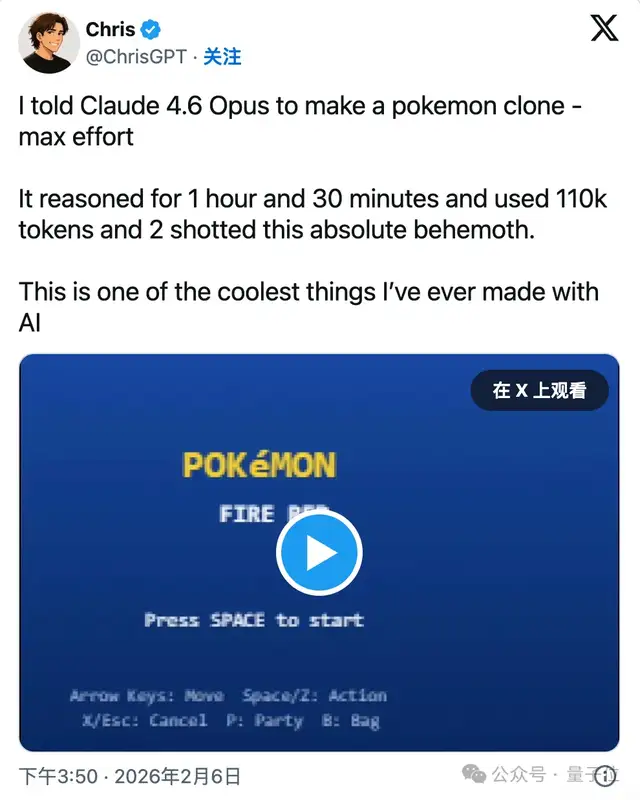
Developers have already tested this in practice. Using just the Claude Opus 4.6 model and entering a straightforward prompt:
Make a clone of Pokemon as close to the original game as possible.
In less than two hours, a fully playable, mechanically complete Pokémon clone was generated.
In the traditional gaming industry, cracking and anti-piracy was an endless cat-and-mouse game.
Hackers discovered vulnerabilities to publish jailbreaks, while hardware makers like Sony and Nintendo pushed firmware patches to seal them up—an ongoing cycle of technical tug-of-war. It was a battle marked by high technical barriers and immense time investments.
But today, AI has accelerated the efficiency of reverse engineering and code rewriting by hundreds or thousands of times.
The gaming industry faces an unprecedented, unwinnable game of intellectual property whack-a-mole.
Take browser-ported AAA games as an example: copyright holders can issue cease-and-desist letters to take down infringing sites, but enforcement quickly turns into a bottomless pit.
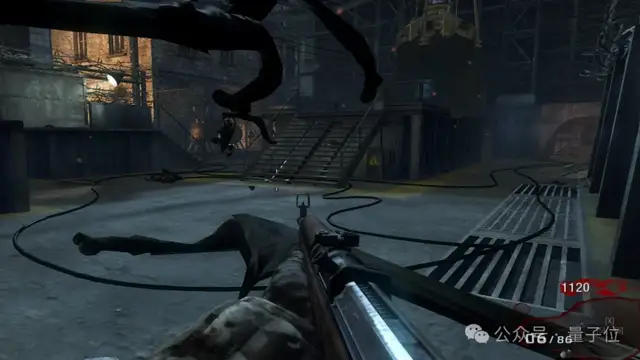
Because creating these web ports requires minimal cost and very little time, shutting down one site just means someone else can spin up another under a new domain with near-zero effort.
While well-funded gaming giants with dedicated legal teams can withstand prolonged legal battles, indie developers with zero cushion are left defenseless.
Indie studios rarely have in-house legal counsel or deep pockets; a single title often represents years of dedication and personal savings. Now, hyper-efficient AI cloning threatens to wipe all of that out overnight.
The gaming industry has arrived at a profoundly paradoxical crossroads:
On one hand, AI tools drastically boost productivity, lower development barriers, and spark entirely new creative interactive forms;
On the other, the runaway surge in generative and reverse-engineering capabilities is mercilessly battering the ecosystem of original creations, threatening the very survival of creators committed to crafting quality content.