
Enabling AI to Think Like Newton
The ambition of “making AI think like Newton” has finally reached a major breakthrough.
A research team led by Andrew Chi-Chih Yao and Yang Yuan at Tsinghua University has unveiled a groundbreaking achievement: the Algebraic World Model (AWM).
The AI community has long pondered a fundamental question:
If an AI were fed only human knowledge prior to Newton’s discovery of universal gravitation, could it independently derive the law of gravity?
In reality, such hypotheses are often hampered by training data contamination, making it exceedingly difficult to verify whether an AI can observe, experiment, and discover completely from scratch in an unconditioned world.
Now, the Algebraic World Model provides a radically new solution: enabling AI to understand the objective world strictly through pure observation and experimentation is becoming truly feasible.
Does AI Playing Games Resemble Tycho Stargazing?
ARC-AGI-3 is currently one of the definitive benchmarks for cutting-edge models to showcase their logical reasoning capabilities. Its defining feature: no predefined rules, no explicit goals.
Everything relies entirely on the model’s autonomous exploration.
For instance, GPT Astra, paired with the Provider Adapter framework, once achieved an astonishing score of 99.9% on this benchmark.
During gameplay, the model autonomously summarized game mechanics into a series of symbolic rules.
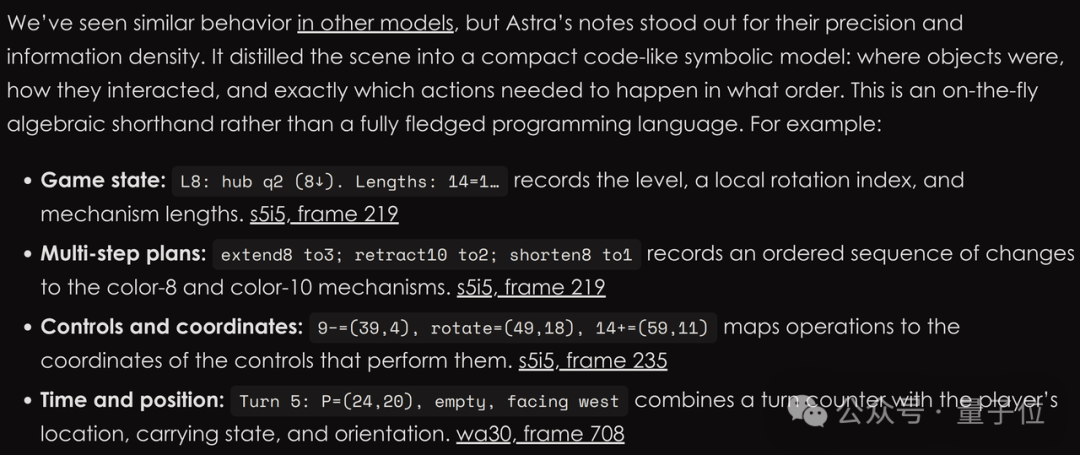
These rules are dense, information-rich, and far more accurate than traditional approaches.
Fundamentally, however, this record resembles Tycho Brahe’s astronomical observation logs.
As Kepler’s mentor, the astronomer Tycho spent decades accumulating vast and remarkably precise planetary orbit data. Yet, his work remained confined to recording phenomena.
The one who truly decoded the three laws of planetary motion from mountains of data—reaching the underlying physical truth—was Kepler.
The rules summarized by Astra are, in essence, Tycho’s manuscripts that have yet to leap into Kepler’s laws. They meticulously describe surface phenomena, but fail to abstract the underlying mechanics that govern the mini-system.
The Persistent Trap of “Hallucination”
What are the risks of lingering at the level of surface observations?
Researchers modified a task designated as sc25, intentionally setting the initial step limit to a value that is theoretically impossible to solve.
For example, in level 4, where the theoretical optimal solution requires at least 19 steps, the test imposed a strict limit of 18 steps.
Faced with this deadlock, Astra conceded failure after 8 attempts and asserted: level clearance with 18 steps is impossible, estimating that at least 22 steps would be needed to win.
Not only did it fail to deduce the correct lower bound of 19 steps, but it also produced a heavily skewed, incorrect estimate (22 steps).
This is by no means an isolated case. Across 12 controlled experiments, leading frontier models (such as GPT-6 Astra and Claude Opus 5.5) correctly identified a task as “unsolvable” only 5 times, and in 4 of those instances, their proposed minimum viable steps remained incorrect.
In a virtual game, this kind of hallucination merely affects task completion. But if deployed in real-world AI agents, the flaw of “deeming a task infeasible while providing incorrect causal attribution” can easily lead to catastrophic decision-making errors.
A truly ideal agent, when confronted with an infeasible task, should articulate precisely why it is impossible and define the exact critical threshold (e.g., “The goal becomes achievable if the step limit is increased by just 1”).
As evidence shows, intuitive trial-and-error and empirical induction alone are not enough.
The Power of Algebra
What is the path forward?
The Tsinghua team’s answer lies in harnessing the structured power of mathematical algebra: the Algebraic World Model (AWM).
The model abstracts all objects, relations, and rules within the game into a formalized “algebraic world,” then leverages the advanced mathematical abstraction capabilities of large models to construct a bottom-up, systematic understanding of that world.
Its core deductive pipeline consists of three primary steps:
- Explore: Through autonomous probing actions, observations of surface phenomena are written into executable Python code, forming preliminary “empirical hypotheses.”
- Refine: By continuously assimilating dynamic feedback, the model validates and refines these hypotheses, generalizing and abstracting them into more universal entities and rules.
- Prove: Rules are formalized using the Lean 4 interactive theorem prover, translating them into rigorous mathematical propositions suitable for automated machine verification.
In short, this mechanism elevates AI from pure intuitive trial-and-error to formalized modeling and mathematical verification.
How does it perform in practice?
When faced with the aforementioned unsolvable level, Opus 5.5 integrated with AWM required just two attempts to formally prove that the level was impossible under the current constraints, while correctly determining that adding just 1 step would suffice for a solution.
Beyond rigorously proving “impossible” scenarios, AWM’s overall game-clearing performance is equally remarkable: across the full ARC-AGI-3 test suite, Opus 5 powered by AWM solved all 183 levels (a 99.9% score rate), with an average action step count of only 43% of the human benchmark, setting a new efficiency record for the benchmark.
What is the underlying principle behind AWM?
In modern mathematics, algebraic geometry leverages algebraic equations to uncover geometric structures, while algebraic topology applies algebraic tools to analyze the connectivity and hole structures of spaces.
“Algebraicizing” continuous spaces and geometric forms often unlocks deep problems that intuitive observation fails to solve. Mathematicians developed algebraic geometry and algebraic topology because those represent the domain of pure mathematics.
Now, empowered by AI, AWM extends this methodology to uncharted game environments, interactive settings, and even the physical world: capturing patterns through exploration, refining structures from patterns, and employing rigorous algebraic machinery to comprehend the structure itself.
Thinking Like Newton
This framework aligns seamlessly with the historical trajectory of science.
From universal gravitation to Maxwell’s equations and general relativity, the core progression of modern science has remained consistent: distilling axiomatic systems from intricate natural phenomena and employing mathematics as the universal language to describe the underlying laws of the cosmos.
What AWM explores is precisely how to endow AI with this paradigm-level capacity for abstraction.
To achieve formal deduction, the model draws upon category theory, an abstract branch of mathematics often dubbed “the mathematics of mathematics.” Category theory does not focus on isolated mathematical branches, but rather on shared structures and mappings across disparate mathematical systems.
AWM primarily utilizes two foundational tools from category theory: Projective Limit and Inductive Limit, corresponding to two complementary mechanisms in the cognitive process:
- Constructing Definitions (Projective Limit): Composing several existing concepts and their relational mappings to collectively define a novel concept—fundamentally an act of conceptual decomposition and reconstruction.
- Abstracting Commonality (Inductive Limit): Identifying invariant structures across diverse entities and subsuming them into higher-dimensional abstract frameworks—fundamentally an act of conceptual generalization and specialization.
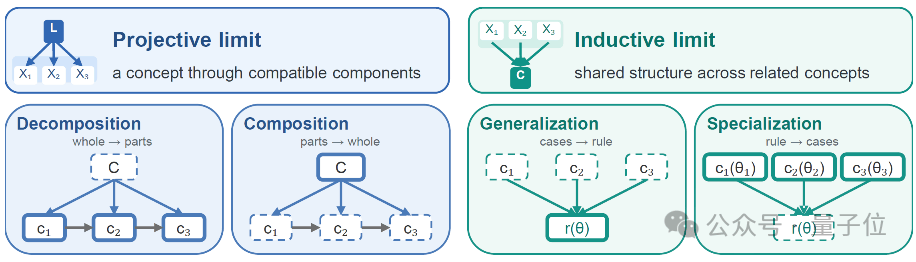
Through bidirectional, alternating iterations, AWM progressively refines initial, coarse Python code hypotheses into a compact, complete, and self-consistent formal system, ultimately yielding a world model capable of closed-loop deduction and machine verification.
This mirrors Newton’s thought process when confronting immense astronomical observations and experimental data: genuine scientific leaps emerge from distilling core variables like “force” and “mass” from complex phenomena, constructing a rigorous theoretical framework capable of self-deduction and falsification.
What AWM grants AI is precisely this structured capacity for scientific abstraction.
It is worth noting that this system also has its boundaries: any proof is grounded strictly in the currently “observed sample space.” If initial exploration lacks sufficient coverage and overlooks critical states, the conclusions generated by the system will constitute only locally valid models.
Therefore, building a truly general cognitive closed loop still requires adhering to the classical scientific method:
Observe → Hypothesize → Experiment → Abstract → Prove → Re-observe
Authors
The research team behind this breakthrough is equally noteworthy.
The paper is co-first-authored by two undergraduate researchers:
Guancheng Pan from Zhejiang University (currently conducting research at Tsinghua University);
and Qixin Tan, a student from the Yao Class at Tsinghua University.
The advising team is led by two distinguished scholars:
Yang Yuan, Associate Professor at the Institute for Interdisciplinary Information Sciences (IIIS) and the School of Artificial Intelligence at Tsinghua University, who also serves as Director of the Center for Embodied AI and Intelligent Manufacturing at Shanghai Qi Zhi Institute.
Andrew Chi-Chih Yao, Turing Award laureate (2000), Academician of the Chinese Academy of Sciences, and currently Dean of the Institute for Interdisciplinary Information Sciences and Dean of the School of Artificial Intelligence at Tsinghua University. He is also a Kyoto Prize laureate (2021), a Foreign Associate of the US National Academy of Sciences, and an International Honorary Member of the American Academy of Arts and Sciences.
- Project Page: https://ephemeral6.github.io/awm-site/
- Paper: http://arxiv.org/abs/2610.40503