
Arca’s Head of AI discusses persistent memory, the advantages of a custom harness, and multi-day agentic workflows.
Oct 31 · 26 min read
At this month’s AI Engineer New York conference, we sat down for an in-depth conversation with Aman Singh, Lead AI Engineer at Arca, an “AI-native” wealth management firm.
We learned that while agents handle the vast majority of the company’s back-office work, the system is built with strict guardrails to ensure final decisions rest with human advisors. The goal is for AI to orchestrate the process; as Singh aptly put it: “More often, the agent is prompting the human, rather than the human prompting the agent.”
Arca recently closed a $48.5 million funding round led by General Catalyst, with participation from Index Ventures and Venrock.
Singh explained that a defining trait of applying AI to financial services is that it usually involves long-horizon work—even if it isn’t necessarily long-running. In his AIE talk, Singh pointed out that Arca’s agentic tasks can take up to ten days to complete. As he described it: “It’s stop-and-go, involving multiple actors, multiple decision points, and multiple handoffs.”
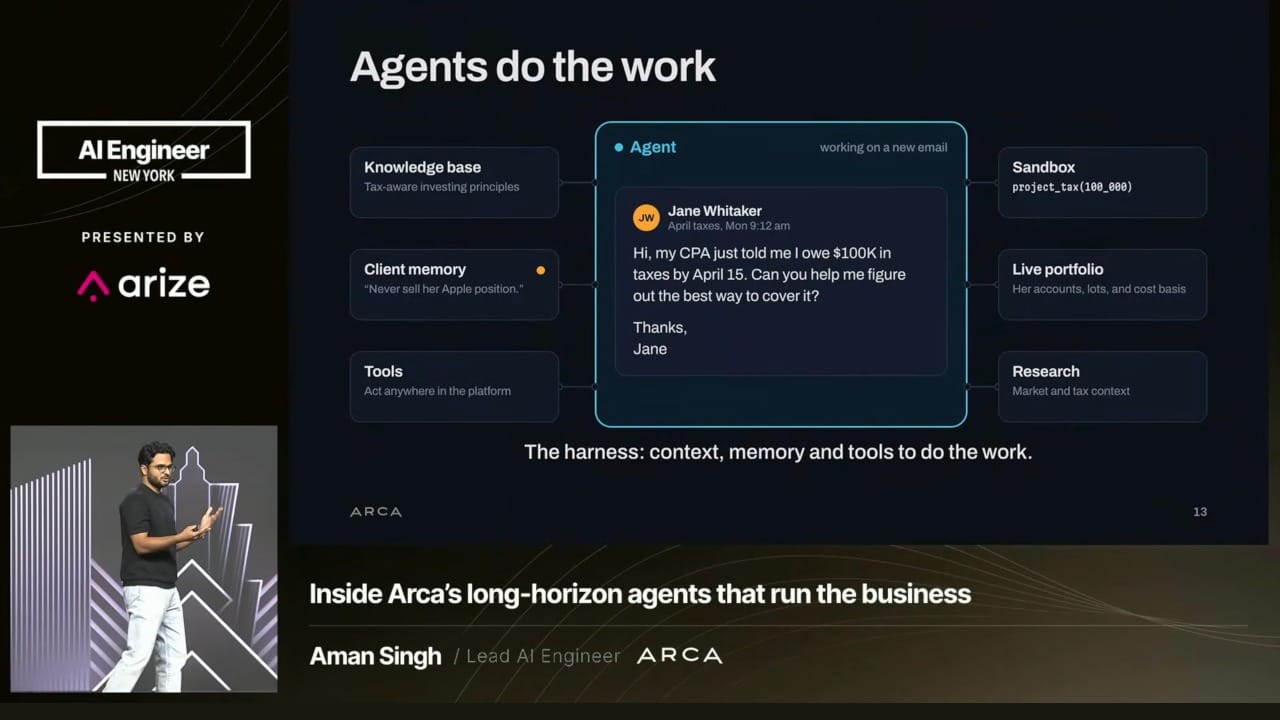
For this reason, Arca engineered an in-house memory system.
“So we maintain a persistent record for every single client,” Singh said during the podcast discussion. “What has happened so far? What are we following up on next? What needs immediate attention over the coming days, and what are we tracking over the long run? Which human is responsible for what action? All of this is tracked by our memory system, and our agents are continuously feeding data into it.”
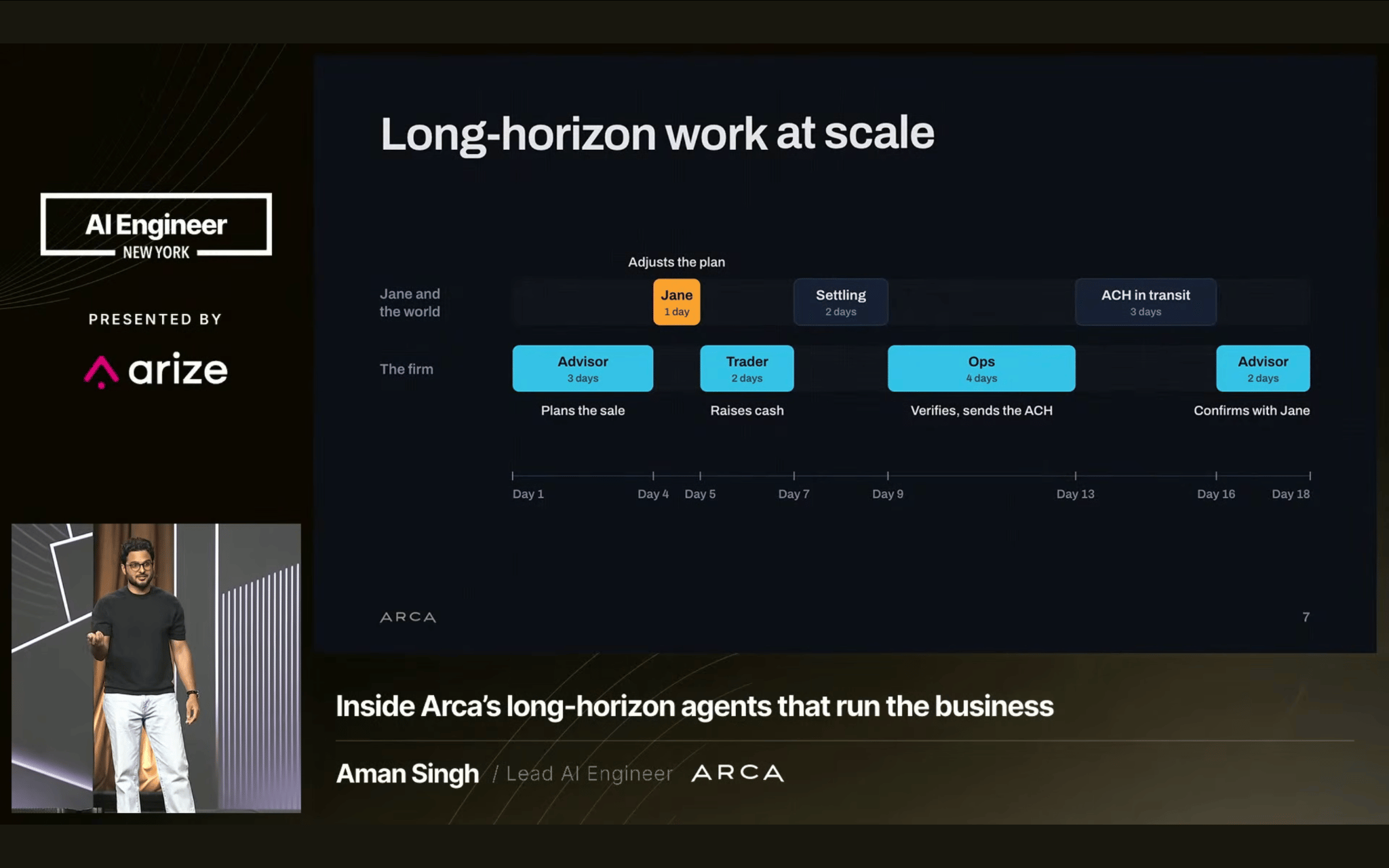
Arca leverages models from frontier labs like Anthropic and OpenAI, with Claude serving as its primary model provider. The company built its own harness, capable of dynamically selecting the best model for a specific task based on internal benchmarks.
Owning a custom harness rather than relying on a managed agent framework also means that Arca retains the flexibility to swap model providers whenever necessary.
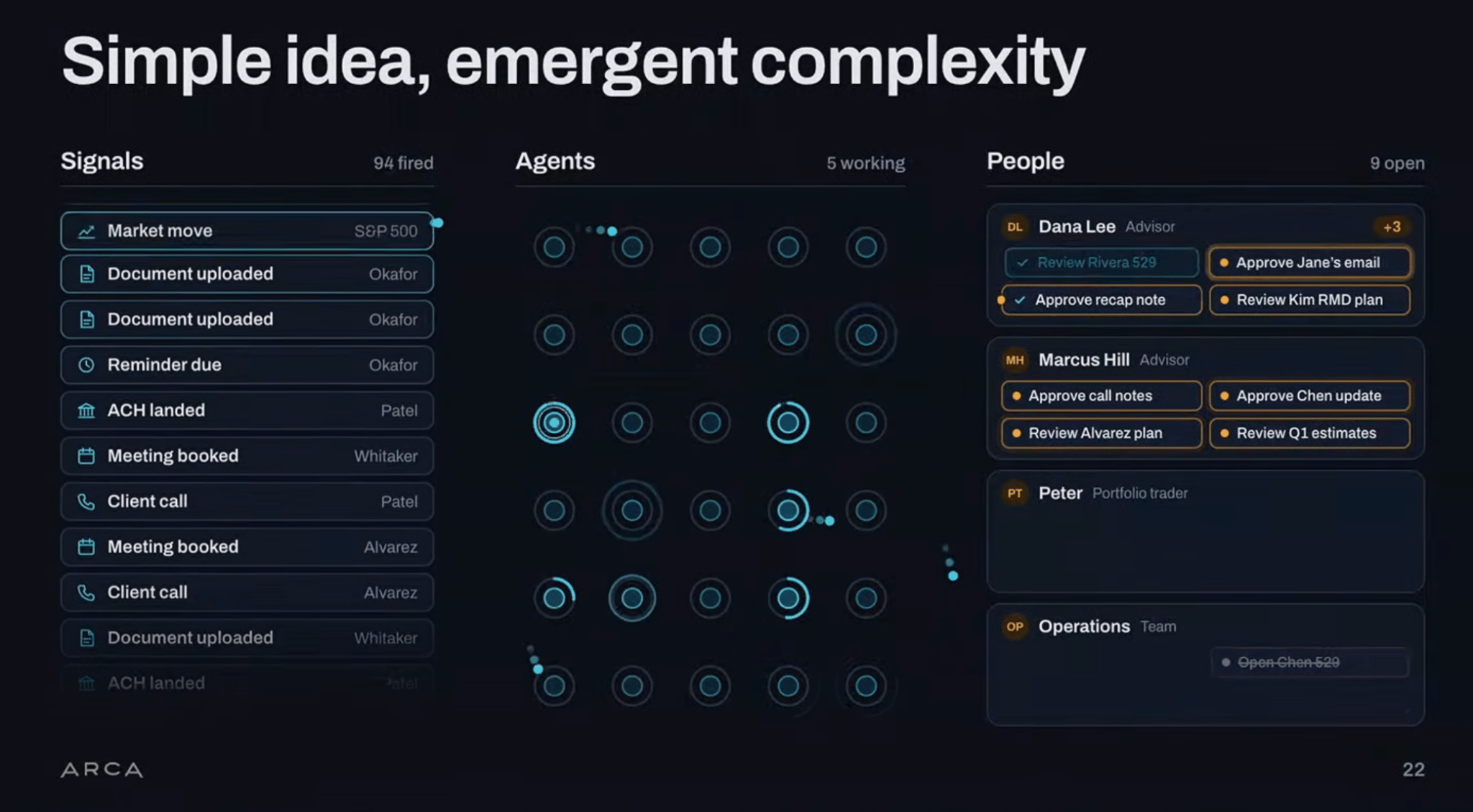
Safety is naturally paramount in financial services. Singh emphasized that while agents shoulder a massive amount of work, the agent’s role is strictly limited to analysis and proposing solutions. Executing trades and moving any funds remain exclusively in the hands of human advisors.
“All of our safety constraints are completely deterministic,” he said. “They completely strip final decision-making authority away from the agent.”
In other words, agents can autonomously invoke certain tools and execute tasks—but never actions that introduce client risk. Arca also runs validation checks against known AI vulnerabilities, such as prompt injection.
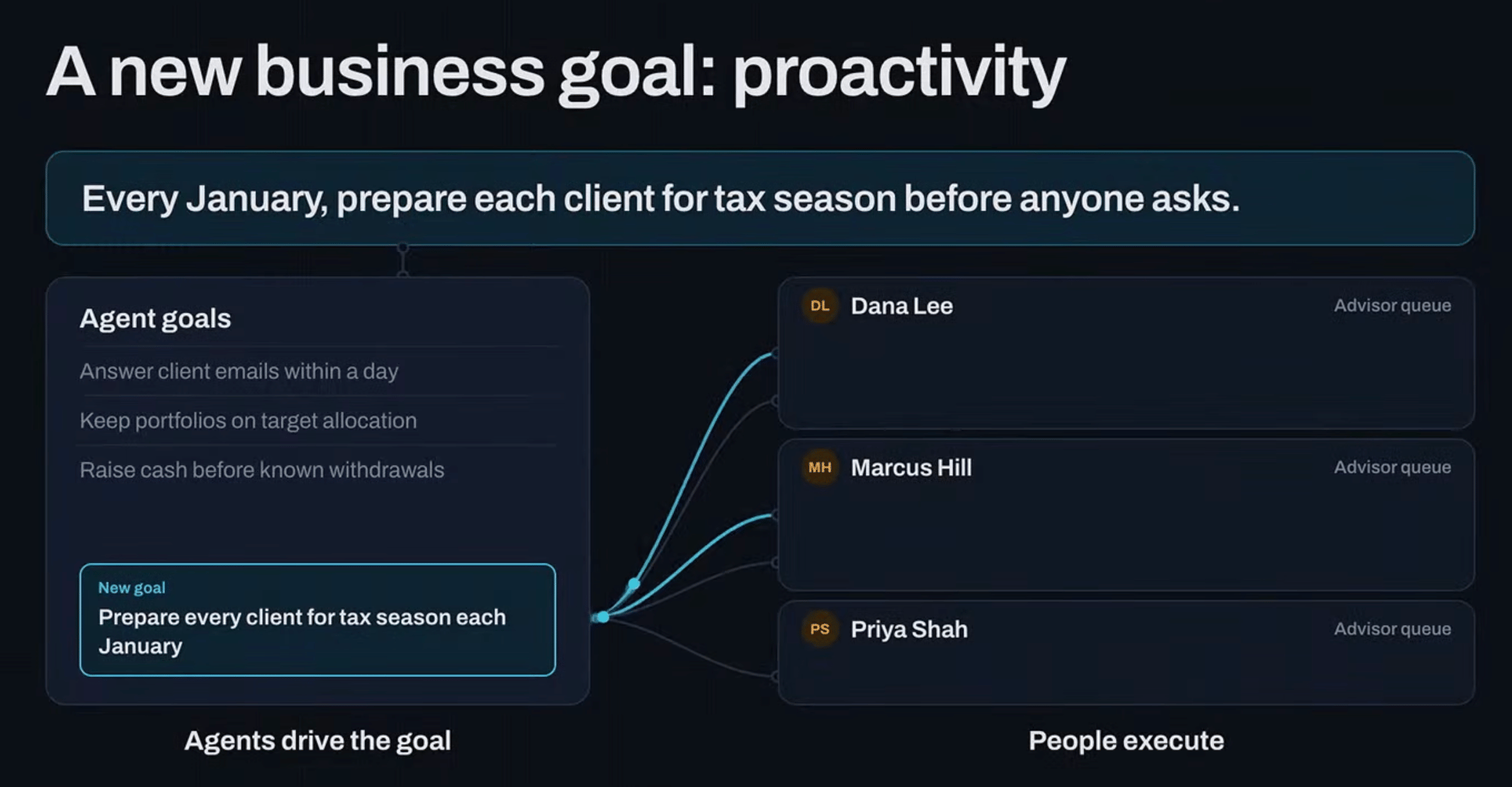
Arca’s agents do not run in sandboxes themselves, but they do use sandboxes for compute. Singh explained that they take extra precautions when dealing with sensitive data.
“We built a system to ensure that code running inside the sandbox can access our data safely,” he stated. “We designed a mechanism that translates the code it [the agent] writes into a strict, expected format, discards the raw code, and puts guardrails around that format before it ever hits our backend. That way, we allow agents to query our data via code, meaning they can aggregate, munge, and process data on the fly to generate deliverables like financial planning proposals.”
Another compelling workflow Arca put into production involves leveraging advisor feedback alongside agent execution traces to refine the harness. They deploy a “meta-agent” to analyze all of this data and suggest continuous improvements to the harness itself.