
After Sweeping #1 Across Three Ascend Leaderboards
Jin Lei reporting from Off-Beat Park
QbitAI | Public Account
No source code. No papers. Built entirely from scratch.
Just this morning, ForgeKernel—a fully autonomous AI agent requiring zero human intervention—boosted the execution speed of DeepSeek’s latest core kernel by 9.8%, live in front of an online audience and without any reference to DeepSeek’s original implementation!

The entire public livestream took just 22.5 hours—an extraordinarily short timeframe for low-level kernel development—quickly drawing widespread attention and engagement from across the industry:

Specifically, this demonstration showcased an agent optimizing DeepSeek-V4.1’s core FlashMLA Prefill kernel from the ground up on NVIDIA B200 hardware, ultimately surpassing the baseline.
FlashMLA is DeepSeek’s open-source library of high-performance attention kernels, also deeply integrated into DeepInfer, the inference framework newly open-sourced on October 20. Crafted by an industry-renowned, top-tier infrastructure team, it stands as the pinnacle of human hand-crafted kernel engineering.
Yet, as noted, the AI was given nothing more than the mathematical definition of the kernel and target hardware constraints. It had to start from a clean slate, tuning step by step through autonomous iteration and evolution.
Over the course of those 22.5 hours, every code refactor and every performance swing were displayed clearly in real time on the stream:
- The first iteration passed correctness verification, but took 1,834 microseconds per execution—a relatively inefficient starting point;
- In under 4 hours, execution latency had plummeted to 593 microseconds—a 67.6% drop, closing in on nearly 90% of the industry’s best implementations from scratch;
- Around the 7-hour mark, the system achieved a crucial architectural breakthrough, outpacing its own earlier versions and surpassing the hand-crafted FlashMLA baseline for the first time;
- Around 9:00 AM, the livestream came to a successful close. The final generated kernel clocked in at 472 microseconds, outperforming FlashMLA’s 518 microseconds by 9.8%.
Across the entire optimization run, the system executed 42 iterative cycles, yielding 32 evolutionary versions, all while consuming just a single B200 GPU and roughly 22 GPU hours. The total lines of code contributed by human engineers throughout the process: 0.
The gold standard of hand-crafted kernel performance was shattered by a kernel generated end-to-end without a single line written by a human.
So, what kind of agent is this?
It is ForgeKernel, an automated kernel generation system developed by ModelBest. Following the conclusion of the livestream, the ModelBest Evolution Lab, in collaboration with the OpenBMB community, officially announced that it would be open-sourced.

Notably, this livestream was not ForgeKernel’s debut. Just days earlier, it had already made waves with an exceptional competitive track record.
Sweeping Three First-Place Spots on Domestic Compute
On October 27, Ascend CANN officially recognized ForgeKernel in a public post:
The system had simultaneously taken the #1 spot across three major CANNBench hardware leaderboards: 950DT, 950PR, and A3!
Each leaderboard corresponds to a distinct Ascend hardware platform, and each performance benchmark carries immense engineering value.
First, the 950DT leaderboard—the one with the most immediate commercial and economic implications.

ForgeKernel claimed the top spot with a score of 4,010.75, leading second place by 27.8%. Its baseline speedup reached 1.533×, roughly 1.43 times that of the runner-up.
This implies that for the same hardware investment, available system compute increases by nearly 50%, potentially cutting compute procurement and deployment costs in half.
What makes this leaderboard especially notable is that the 950DT is a next-generation architecture whose kernel ecosystem is still in its infancy. Manual software adaptation typically demands prolonged engineering cycles; ForgeKernel delivered rapid, high-efficiency adaptation right out of the gate.
This proves that even during the early window of a new hardware release, AI can rapidly produce high-quality kernels—drastically shrinking the lengthy lag that historically stretches between chip tape-out and mature software enablement.
The 950PR leaderboard saw the fiercest competition, with the top three entries all delivering baseline speedups exceeding 1.3×:

ForgeKernel took first place with 4,165.94 points, delivering a baseline speedup of 1.638×—roughly 1.18 times that of the runner-up.
Finally, the A3 leaderboard covers the widely deployed Ascend 910C.
ForgeKernel had already claimed top honors on the A3 hardware board when CANNBench v1.1 closed on October 15. Following the release of v2.0, the system firmly defended its #1 ranking with a current total score of 4,341.16 and a baseline speedup of 1.898×—roughly 1.22 times that of second place.

In this public livestream, ForgeKernel ran on NVIDIA B200 hardware backed by the mature CUDA ecosystem, which embodies decades of human domain expertise. In the CANN benchmarks, it operated against the Ascend architecture, with its completely independent hardware/software stacks and toolchains.
Despite facing two vastly different ecosystems, ForgeKernel topped the leaderboards on both platforms using the exact same underlying architecture.
How did it pull this off?
A Self-Taught, Self-Evolving System
How fast a model runs on hardware depends fundamentally on its low-level compute kernels.
Even with the same model architecture and physical silicon, swapping in a more efficient set of kernels yields massive gains in throughput and latency.
Historically, high-performance kernel development has relied heavily on seasoned engineers manually tuning code line by line—an effort marked by long development cycles and an exceptionally high technical barrier to entry. CUDA’s formidable moat was built on years of accumulated human expertise. Every time a domestic compute platform launches a new architecture, or every time a novel model structure emerges, engineers have to rewrite these kernels from scratch.
The supply of human domain experts simply cannot keep pace with the exponential evolution of models and hardware.
Where does the breakthrough lie?
On October 27, the ForgeKernel team, in collaboration with Tsinghua University and other institutions, released a paper on arXiv titled JustGoal: With Only a Goal, the AI Baseline Is Above the Expert Kernels.
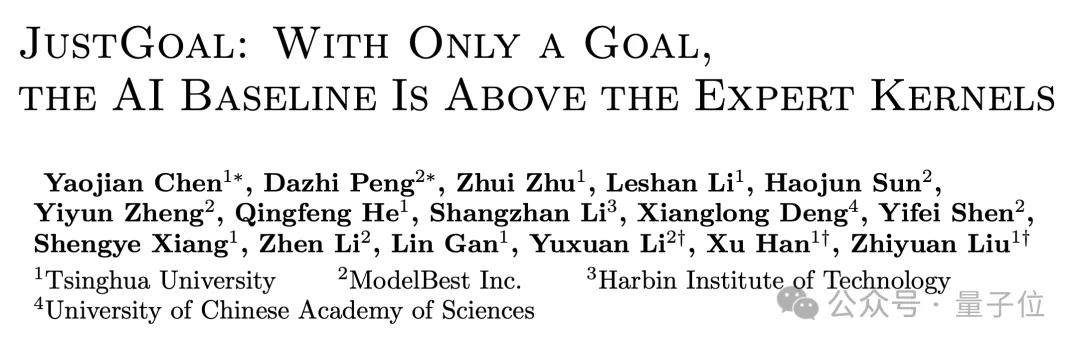
The study proposes a paradigm shift: provide the model with nothing more than the final performance optimization goal—no specialized kernel heuristics, no rigid engineering pipelines—and let the model autonomously discover the implementation path. Experimental results show that on the B200 platform, kernels generated autonomously by the model outperformed human-maintained open-source high-performance libraries in 8 out of 10 benchmark tasks.
When the researchers evaluated the same model using KDA-0.5, a specialized framework co-developed by Song Han’s team at MIT, its average performance on single-configuration optimization tasks was only 0.95× that of JustGoal. This suggests that kernel optimization is increasingly reliant on the model’s native general reasoning and evolutionary capabilities; hardcoded expert rules and templates can actually end up holding it back.
Naturally, a purely “goal-oriented” approach has limitations: while LLMs excel at micro-level code tuning, they struggle with global architectural design and often converge prematurely on local optima within the first few iterations, getting stuck tweaking existing templates. Building on the theoretical foundations of JustGoal, ForgeKernel implemented targeted system-level innovations to resolve this bottleneck.
Its core engine rests on three pillars:
- Static-Dynamic Decoupling: Separates architectural-level design from low-level execution, abstracting high-level architectures into phased milestones to break down complexity step by step;
- Empirical Knowledge Accumulation: Stores verified hardware tuning insights into a global knowledge base, enabling cross-kernel transfer and reuse;
- Adversarial Iteration: Uses the best-performing version from the previous iteration as the new baseline opponent, driving fully automated self-play evolutionary loops.
These three mechanisms were on full display during the livestream:
ForgeKernel steadily surpassed its own preceding versions before decisively overtaking the hand-optimized FlashMLA baseline.
During the late-stage deep tuning phase, the system autonomously identified that sudden bursts of Q-matrix loads were contending for bandwidth against KV data movement. It proactively applied microarchitectural flow control to the Q fetch cadence, unlocking an additional 2.4% performance boost—a deep hardware-software optimization that historically would have required a seasoned systems performance expert.
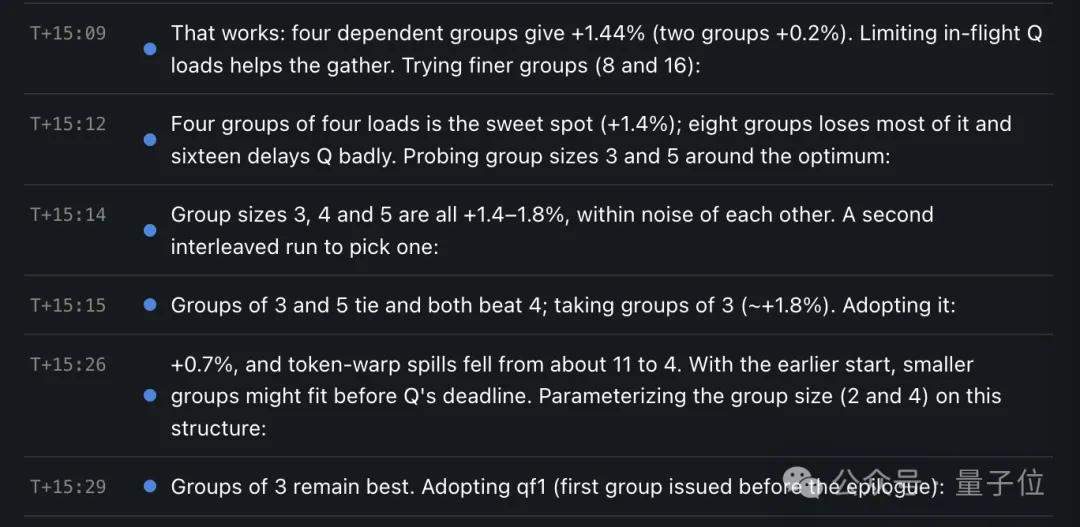
△ Agent execution logs from the ForgeKernel Live stream
Across a broader evaluation suite spanning 29 benchmark kernel comparisons, ForgeKernel matched or surpassed human expert implementations in 24 cases. When tested against the 7 strongest public kernels produced by three other top-tier agent systems, ForgeKernel matched or exceeded all of them across the board.
Crucially, these performance gains transfer seamlessly across different domestic hardware platforms because ForgeKernel’s underlying architecture is not tightly coupled to any single chip.
While low-level kernel code must inevitably adapt to the specific microarchitectural quirks of a given processor, ForgeKernel’s optimization search paradigm remains completely general, without hardcoding any architecture-specific pipelines. Porting from NVIDIA to Ascend merely requires swapping the low-level profiling probe from NCU to msprof. The agent dynamically learns and internalizes the target chip’s microarchitectural profile through live, empirical probing on hardware.
This enables ForgeKernel to migrate across different domestic chips rapidly and cost-effectively, eliminating the need to spend months rebuilding software enablement stacks whenever a new generation of domestic silicon arrives.
Delivering Tangible Business Value
At today’s scale of AI infrastructure, what does a 1% speedup in low-level kernels really mean?
According to Gartner’s latest forecasts, global spending on AI infrastructure is projected to reach approximately $1.48 trillion by 2026. At that scale, every 1% improvement in compute efficiency translates to roughly $14.8 billion in saved hardware and energy costs.
For domestic AI hardware, this impact is particularly profound.
NVIDIA’s CUDA ecosystem has been honed by human engineers for well over a decade, offering an extensive library of mature, high-performance kernels where remaining physical margins are narrow. By contrast, domestic compute ecosystems are still fleshing out their kernel libraries; many operators have yet to undergo exhaustive optimization, leaving substantial headroom for AI-driven performance leaps.
While tuning model training frameworks with the system, the ForgeKernel team observed that the same optimization paradigm yielding 5%–10% gains on NVIDIA hardware delivered 20%–30% system-level speedups on domestic chips. This means ForgeKernel can rapidly eliminate the efficiency gaps of domestic chips in both training and inference workloads, accelerating software parity with top-tier international ecosystems.
When the marginal cost of code generation approaches zero, hyper-customization that was once economically non-viable due to engineering costs—such as building a fully customized kernel suite for a single model architecture or a single hardware SKU—becomes thoroughly practical.
Today, these kernels that surpass human experts are moving out of benchmarks and into production environments.
High-performance kernels generated by ForgeKernel have already been integrated into production training pipelines, successfully passing long-run stability validation at the MiniCPM5-1B scale across both domestic chips and NVIDIA platforms.
In this ongoing restructuring of compute infrastructure, an important trend is unfolding: high-performance LLMs, exemplified by DeepSeek-V4.1, are taking over kernel generation and end-to-end compilation tuning, while these AI-generated kernels run reliably on domestic compute platforms.
A closed-loop paradigm of “domestic models authoring kernels, running on domestic chips” is rapidly materializing.
This is more than a breakthrough in kernel engineering; it is an industrial manifestation of Recursive Self-Improvement (RSI): the primary actors in AI engineering and infrastructure tuning are shifting from human developers to the models themselves.
As Li Yuxuan, Chief Scientist at the ModelBest Evolution Lab, pointed out, because code provides built-in determinism that can be tested and validated automatically, engineering deployment reaches an evolutionary closed loop far sooner than pure theoretical research:
In the past, breakthrough kernels like FlashAttention, which demand sweeping overhauls of dataflows and hardware pipelines, took experienced engineering teams months or even half a year per architectural leap. Under our current workflow, an AI tuning loop that outpaces top human implementations can close in as little as two days.
With ForgeKernel fully open-sourced, this automated kernel generation methodology will serve as shared public infrastructure, unlocking unprecedented engineering velocity for chipmakers and model builders alike.
Historically, the toughest barrier for domestic chips chasing leading ecosystems was never theoretical raw TOPS, but the massive kernel and software moat constructed by legions of CUDA software engineers over more than a decade. Under the self-evolving agent paradigm, barriers erected by brute-force human labor are crumbling, replaced by end-to-end automated search that solves for optimal hardware-software co-design directly.
As “domestic models authoring kernels, running on domestic chips” establishes itself as the new paradigm in low-level systems engineering, the primary driver of software development is undergoing a fundamental shift. This does not mean human experts are being sidelined; rather, their roles are being structurally elevated:
Engineers are evolving from code craftsmen hand-tuning assembly and low-level logic into systems architects tasked with designing simulation environments, defining self-evolution objectives, and building validation metrics.
As human-AI collaboration transitions into autonomous AI authoring guided by high-level human oversight, the gap between domestic chips being merely functional and truly performant is being closed by AI—measured not in years, but in hours.