
Performance Reviews for Robots? Zhiyuan Introduces “Worken,” a New Metric for Physical AI
Running performance reviews on robots doing manual labor has officially become a reality.
At this year’s Innovation Day, Peng Zhihui (widely known as Zhihui Jun), Co-founder, President, and CTO of Zhiyuan, unveiled “Worken,” a new physical AI measurement unit designed to quantify robots’ effective intelligent working hours.
Zhiyuan also formulated a performance calculation for Worken:
Worken = Active Robot Count × Autonomous Operating Hours × Output Efficiency Ratio
Here, the active robot count reflects deployment scale; autonomous operating hours evaluate whether the robot can work continuously without human intervention; and the output efficiency ratio measures actual operational productivity. This establishes a definitive, quantitative benchmark for robot performance in real-world environments.

Yet Zhiyuan’s announcements went far beyond setting performance metrics.
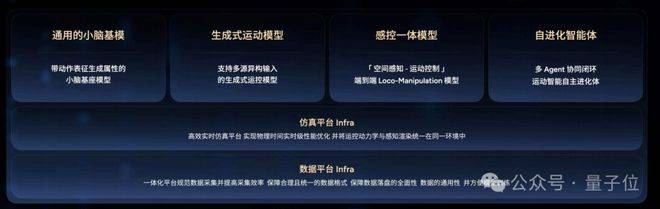
Focusing on how robots can deliver tangible value, Zhiyuan unveiled a series of technological breakthroughs across foundation models, hardware embodiments, and operating systems at this Innovation Day—comprehensively solidifying core embodied AI capabilities across motion, manipulation, and interaction.
On the model front, the embodied foundation model GO-3 Preview has topped three major embodied AI evaluation benchmarks, while the multimodal interaction model WITA-OMNI took first place across four authoritative benchmarks.
In a post-event interview, Zhihui Jun remarked: “Rolling 10,000 units off the production line is merely a victory for manufacturing; getting 10,000 units on the job is the true triumph of physical AI.”
To ensure robots consistently deliver acceptable performance, a mathematical formula alone is far from sufficient. Zhiyuan’s newly unveiled models, hardware embodiments, and operating system outline a comprehensive technological roadmap to bring Worken into reality.
From Models to Hardware Embodiments: What Did Zhiyuan Announce?
At this Innovation Day, Zhiyuan launched its next-generation embodied foundation model, GO-3 Preview, and its omni-modal end-to-end interaction model, WITA-OMNI.
These two models target the core pillars of robotic operations:
- GO-3 Preview focuses on manipulation intelligence, helping robots understand tasks, generate actions, and execute fine-grained operations;
- WITA-OMNI focuses on interaction intelligence, enabling robots to comprehend human intent, respond dynamically, and engage in natural communication across real-world environments through speech, facial expressions, and physical gestures.
Simultaneously, Zhiyuan continues to drive comprehensive upgrades across locomotion intelligence, hardware architectures, and operating systems.
Models push the ceiling of intelligence, physical embodiments and OS integrate and coordinate these capabilities, and real-world deployment verifies whether these technologies can perform reliably on the front lines. Together, these form Zhiyuan’s closed-loop “Tri-Intelligence” strategy: interaction intelligence, locomotion intelligence, and manipulation intelligence.
Manipulation Intelligence
In the field of manipulation intelligence, Zhiyuan’s embodied foundation model GO-3 Preview secured first place across three authoritative embodied AI benchmarks—RoboDojo, RoboTwin, and RoboColiseum—achieving a clean sweep across all three leaderboards.
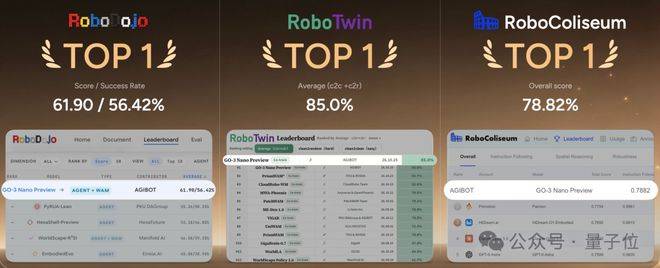
Reportedly, GO-3 Preview is built on the embodied-native WRAM architecture (World Reasoning Action Model), integrating task comprehension, logical reasoning, future state prediction, and action generation.
When executing precision operations, a robot must not only grasp the task objective and plan motion trajectories, but also anticipate the physical state transitions triggered by its actions. WRAM unifies these stages into a cohesive learning framework, significantly enhancing the model’s ability to handle complex tasks.
During pre-training, propelled by joint model and data scaling, GO-3 Preview demonstrated superior task transfer and complex skill adaptation, excelling particularly in zero-shot and few-shot generalization.
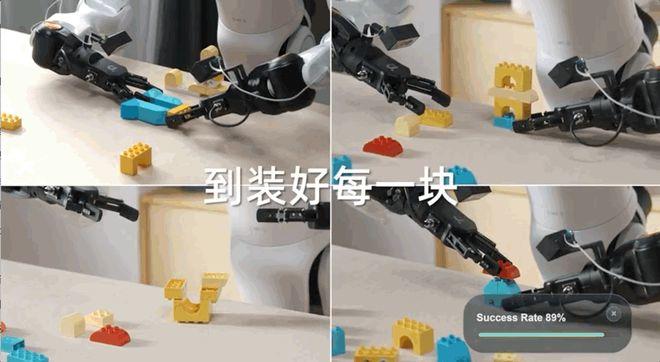
In live demonstrations, a robot powered by a fine-tuned GO-3 Preview smoothly performed high-precision operations such as picking, aligning, and inserting Lego bricks, autonomously completing assembly tasks orchestrated by an intelligent Agent.
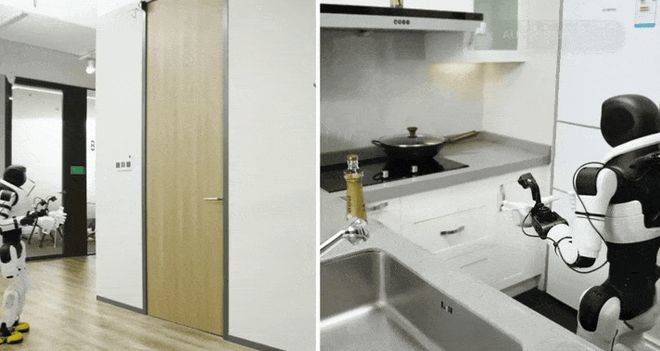
Furthermore, the model supports cross-embodiment transfer. When deployed on the bipedal humanoid robot X2, it seamlessly executed complex tasks like opening doors with both hands and kneeling to retrieve objects.
However, compared to controlled laboratory settings, real-world object placements and spatial layouts vary unpredictably. Pre-training alone cannot cover all edge cases.
To tackle this, Zhiyuan developed the post-training system Genie Evolver, closely combining hundreds of physical robots, physics simulation environments, and world models to build a high-fidelity “training ground.”
Once robots are deployed on the job, the embodied agent framework Genie Master takes over task planning and exception recovery, translating production disturbances and errors into reusable operational experience.
From general pre-training and sim-to-real post-training to operational experience accumulation on actual assembly lines, this closed-loop architecture fundamentally differentiates embodied robots from traditional automation equipment.
Interaction Intelligence
If GO-3 focuses on how robots work efficiently, WITA-OMNI concentrates on how robots interact naturally with humans.
As Zhiyuan’s latest interactive foundation model, WITA-OMNI topped four authoritative benchmarks: Daily-Omni, TimeLens-Bench, EmbSpatialBench, and MMAU.

WITA-OMNI integrates input audio, visual, and textual cues with output speech, facial expressions, and physical gestures within a unified model for multimodal collaborative modeling, endowing robots with the ability to listen, see, speak, and move simultaneously.
In open public settings like hotels and tourist attractions, noisy and dynamic environments require the robot to accurately identify who is speaking, determine whether their utterance is complete, and recognize the ideal timing to chime in.
Notably, WITA-OMNI eliminates the traditional wake-word requirement.
By synthesizing spatial sound localization, voiceprint recognition, facial orientation, and lip movement, the model identifies conversational partners while leveraging gaze direction and vocal tone to accurately seize interaction opportunities. Even while moving objects or performing tasks, the robot can carry on smooth, uninterrupted conversations.

Architecturally, WITA-OMNI employs a dual-system (fast and slow) collaborative design:
- Front-end Interaction Engine: Handles millisecond-level real-time perception and conversational responses;
- Back-end Background Agent: Handles deep reasoning, long-horizon planning, tool use, and complex task decomposition.
When faced with challenging queries, the back end conducts deep computations while the front end maintains fluid dialogue and reports progress in real time. Users can interrupt, add requirements, or refine task instructions at any moment.
During the live demo, Xiong Yan, Partner, Co-President, and President of Interactive Business at Zhiyuan, fired off a rapid series of questions, and the WITA-OMNI-powered robot answered each effortlessly. When asked “Who is the most handsome person at Zhiyuan?”, it offered a witty and sharp reply.
According to official figures, WITA-OMNI boasts an average response latency of approximately 600 ms, with peak response times dropping to around 400 ms—closely matching the rhythm of human face-to-face dialogue.
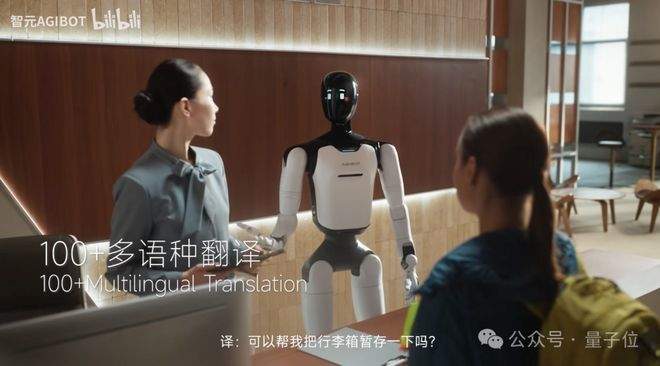
In terms of multilingual capabilities, WITA-OMNI understands over 100 languages and various regional dialects, supports output in 29 languages and 7 dialects, and supports fully offline, on-device local interactions.
Another highlight is the Intelligent FaceUI.
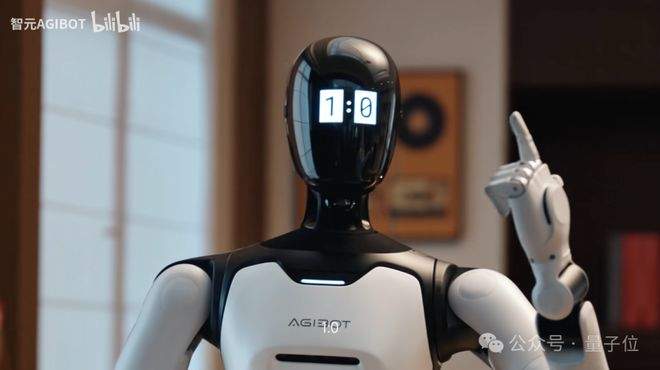
When users pose abstract or educational questions (e.g., “Explain the Pythagorean theorem”), the robot can render real-time dynamic charts and explanatory diagrams on its facial display. Compared to pure voice output, combining visuals with speech dramatically improves the clarity of information delivery.
Zhiyuan plans to complete full-scenario deployment across China by December 2026, launch an international version in Europe in January 2027, and roll out global coverage by March 2027.
Locomotion Intelligence
Beyond manipulation and interaction, continuous iteration in motion control is equally critical to the real-world deployment of embodied AI.
Unveiled at Innovation Day, the AGILE General Motion Intelligence Framework integrates environmental perception, terrain understanding, whole-body motion control, and coordinated upper- and lower-limb manipulation into a unified perception-action closed loop.
Leveraging a self-evolving architecture, basic locomotion intelligence has evolved from traditional open-loop motion control into spatially aware, self-adaptive locomotion intelligence, better addressing the demands of complex, unstructured deployment environments.
When encountering dynamic pedestrian flows, multi-person collaborative environments, or accidental collisions, the robot can adjust its posture and trajectory in real time based on environmental disturbances, balancing operational cadence with intrinsic safety.
New Architecture and New Hardware Embodiments
In the industry’s early days, robotic systems typically focused on isolated intelligence modules. Later, the prevailing architecture separated the three intelligences—running locomotion, interaction, and manipulation control logic on separate computing boards.
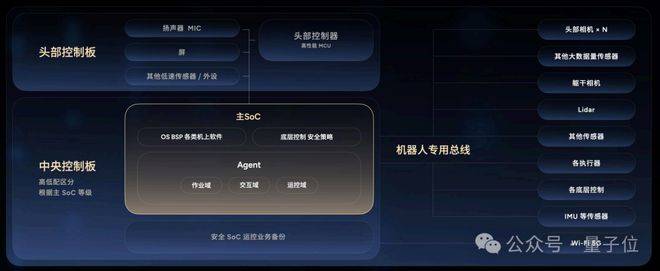
Zhiyuan unveiled its third-generation hardware architecture, AHA3, consolidating locomotion, interaction, and manipulation intelligence onto a single unified computing and control platform.
By orchestrating resources through a single high-performance SoC, AHA3 unifies all three intelligences into one. Official data indicates that this architecture reduces the physical volume of the core computing unit by 50% while improving overall system response speed by 90%.
The deployment of intelligent algorithms ultimately hinges on highly reliable physical execution.
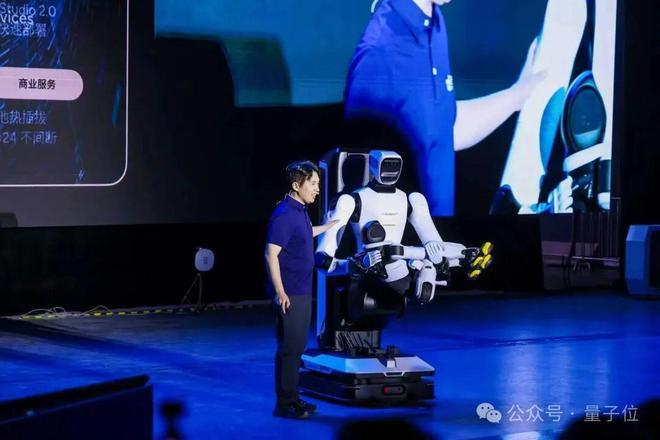
At the event, Zhiyuan introduced the Genie G2 Max, a safety-certified embodied robot tailored for heavy-load industrial scenarios.
The robot features a payload capacity of 20 kg per arm and a peak dual-arm capacity of 50 kg. Equipped with dual 7-DoF force-controlled arms, industrial-grade safety protection mechanisms, and a dual hot-swappable battery design, it is fully built to withstand high-intensity, continuous industrial operations over extended periods.
Also making their debut were the world’s first subdermal joint liquid cooling system and a next-generation dexterous hand portfolio, further strengthening the reliability of critical actuators and core hardware infrastructure.
Unified Scheduling of Hardware and Software with an Embodied-Native OS
As algorithmic models and physical mechanisms grow exponentially in complexity, coordinating heterogeneous hardware, low-level drivers, and high-level AI applications has become a central engineering hurdle for embodied AI deployment.
Zhiyuan’s answer is Lingqu OS 1.0, an embodied-native operating system.
The operating system spans the entire lifecycle from building and deployment to runtime. Downward, it standardizes hardware interfaces and device abstraction; upward, it provides a unified runtime environment for locomotion, manipulation, and interaction intelligence. It has already undergone industrial-grade engineering verification on mass-production models.
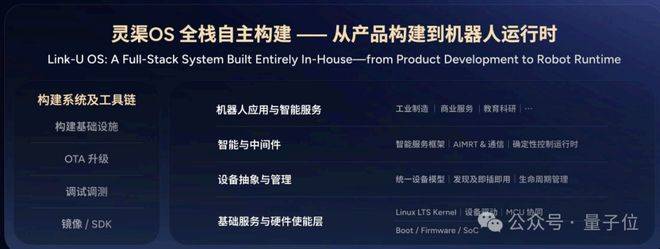
Zhiyuan highlighted that Lingqu OS primarily resolves the ecosystem adaptation challenges of heterogeneous hardware.
The system introduces a standardized hardware abstraction framework that supports plug-and-play integration for over 100 types of sensors and actuators across 15 major categories, while maintaining broad compatibility with mainstream heterogeneous compute platforms across the industry—drastically slashing secondary hardware adaptation costs.
Another core breakthrough lies in its hard real-time capabilities.
When managing high-frequency motion control, an operating system must deliver both throughput and deterministic latency, minimizing timing jitter to ensure physical actuators strictly follow algorithmic instructions.
Lingqu OS implements deep deterministic latency optimizations across the entire stack, keeping end-to-end latency jitter strictly within 4 microseconds under high-frequency 1000 Hz real-time workloads.

Additionally, Lingqu OS provides a standardized intelligent service framework. In addition to supporting mainstream LLM inference engines, it encapsulates standard system services into reusable, modularized skills. Developers can directly invoke pre-built skills to quickly assemble high-level embodied applications without constantly delving into low-level driver code.
On the ecosystem front, Zhiyuan announced that Lingqu OS 1.0 will fully embrace open source.
By the end of this year, Zhiyuan will officially open-source Lingqu OS 1.0 and donate the project to the OpenAtom Foundation. The release will include 200 million lines of production-tested core code and over 5,000 ecosystem software packages, accompanied by end-to-end build toolchains and pre-integrated mainstream embodied AI open-source components.
Turning On-Paper Specs into KPIs: A Review of Real-World Industrial Track Records
No matter how comprehensive a technical architecture looks on paper, the ultimate benchmark remains long-term operational viability on actual production lines.
Currently, Zhiyuan’s robots have launched large-scale pilot deployments across industrial manufacturing, commercial retail, and cultural tourism services, with each domain prioritizing distinct metrics.
In industrial manufacturing, production lines focus strictly on task accuracy, cycle time, and fault-free operational stability.
Partnering with Longcheer, a global leading consumer electronics ODM, Zhiyuan built the world’s first 3C electronics production line fully powered by embodied AI. The line entered volume production in March 2026 and has operated continuously and reliably for over seven months as of this Innovation Day.
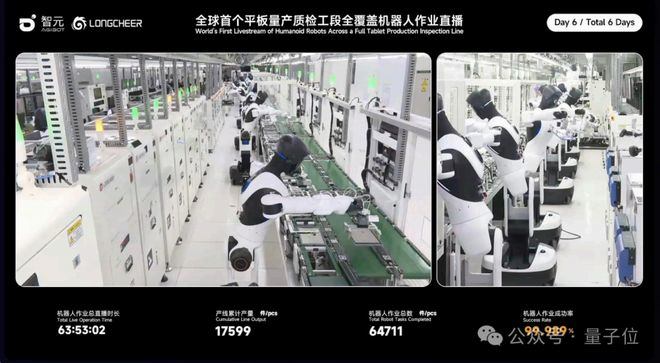
During a recent six-day live stream of the entire line, deployed robots performed more than 64,824 assembly operations, assembling 17,625 tablet computers with a per-station operational success rate of 99.99%. The average cycle time per unit was 22 seconds, essentially matching the productivity of skilled factory workers.
In commercial retail, evaluations center on multi-turn intent comprehension and non-standardized conversational interactions.
At ASD’s offline smart retail stores, 100 Lingxi X2 robots were deployed as shopping assistants, driving cumulative sales of 2.23 million RMB within three days.
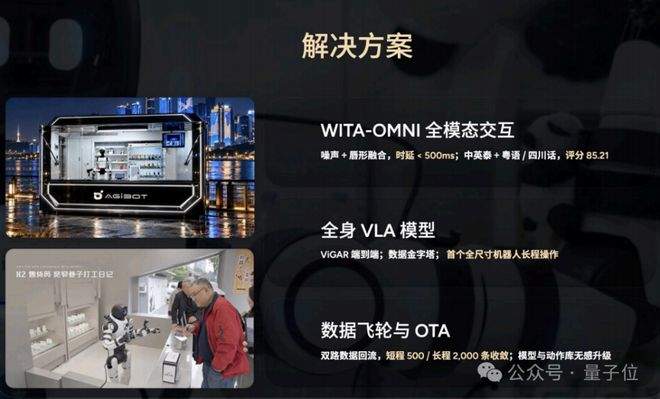
In cultural tourism and hospitality, systems must comfortably handle dense foot traffic, high ambient noise, and multilingual interactions while maintaining high-intensity continuous daytime operations.
Hengqin Chimelong Spaceship has deployed nearly 500 robots across more than 100 service points, handling guided tours, educational exhibits, and interactive performances, serving an average of approximately 10,000 visitors per day during the National Day Golden Week. In the “Whale Wonder” exhibition zone, robots powered by WITA-OMNI generate real-time diagrams and visual explanations based on visitor inquiries.

The October Worken operations dashboard unveiled at the main forum highlighted live operational data across Longcheer manufacturing lines, the Guangzhou Metro transit hub, Hengqin Chimelong tourism resort, and ASD smart stores.
Moving past the early rush of demo-driven hype, the embodied AI industry is finally welcoming a clear, actionable quantitative evaluation framework across deployment scale, uninterrupted autonomous runtime, and yield efficiency.
Worken represents an exploration along this path toward industrial quantification.
Just as tokens became the foundational unit for measuring compute workloads, model throughput, and commercial billing in the LLM era, Worken seeks to establish a commercial benchmark anchored to real-world productivity in physical AI. It pushes industry competition away from flashy spec sheets and conceptual demos back to the core question: Can robots deliver stable, sustained productive value in real-world environments?
From foundation models and physical hardware embodiments to an embodied-native operating system, Zhiyuan’s comprehensive hardware-software overhaul is fundamentally built around Worken—ensuring that the technological dividends of embodied AI convert into tangible working hours with maximum efficiency.
Long-term exploratory research remains indispensable, and not every cutting-edge breakthrough must yield immediate billable hours. Yet the ultimate winner in the embodied AI marathon will inevitably be determined by who can deliver sustained, reliable, and continuous productivity on the front lines of real-world operations.