
Enabling Robots to Teach One Another
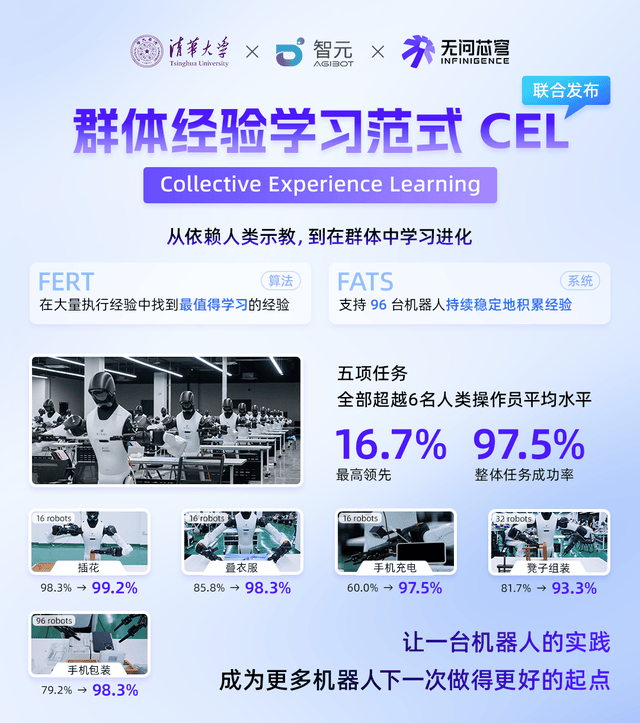
Recently, Tsinghua University, Infinence, and AgiBot jointly introduced a new paradigm called Collective Experience Learning (CEL), successfully validating it at scale across a cluster of 96 real-world physical robots. CEL frees robots from relying solely on human demonstrations by allowing them to learn from the successes of their peers: whenever an individual robot encounters an obstacle while performing a task, it can retrieve solutions from the collective past experiences of its peers to continuously iterate and refine its own capabilities. By accumulating and sharing experiences, robot fleets can co-evolve through ongoing practice, opening up a new technological frontier for the autonomous iteration and large-scale deployment of embodied AI robots.
1. Enabling Robots to Teach One Another: A New Paradigm for Large-Scale Robotics
As embodied AI transitions from research laboratories into the physical world, robots encounter increasingly complex operational environments. Imbuing them with superior generalization capabilities fundamentally depends on the continuous accumulation of real-world interaction data. Currently, the prevailing industry approach remains heavily reliant on human demonstration: either expert operators must repeatedly demonstrate trajectories, or human interventions are required to manually correct errors whenever a robot fails.
This paradigm faces a critical, unavoidable bottleneck: while robots can be rapidly deployed by the hundreds or thousands, experienced human teleoperators remain a scarce resource that cannot scale in tandem. This supply-demand mismatch has become a major roadblock hindering the commercial scaling of embodied AI.
The core insight behind CEL is to fundamentally shift who robots learn from—moving away from human-centric demonstrations toward peer-to-peer mutual learning among robots. Useful experiences gathered by any single robot during exploration are instantly converted into shared, reusable collective assets for the entire fleet. Consequently, robots no longer need to passively wait for human guidance; they can evolve autonomously by tapping into this continuously expanding shared pool of experience.
As the robot cluster scales up, the collective experience repository grows richer. Paired with a unified learning mechanism that continuously refines control policies, the fleet enters a virtuous evolutionary loop: the more they work, the smarter and more capable they become.
2. Collaborative Learning Across Nearly 100 Robots: Task Success Rates Outperform Human Averages Across the Board
Rigorous real-world evaluations have further validated the practical efficacy of CEL.
The experimental evaluation covered five complex tasks across both domestic service and industrial production environments: flower arranging, laundry folding, plugging in phone chargers, stool assembly, and phone packaging. The results were particularly striking: across 600 cumulative evaluation trials, two robots that did not participate in pre-training made only 15 errors, achieving an overall success rate of 97.5%—surpassing the average performance of six professional human operators across all five tasks.
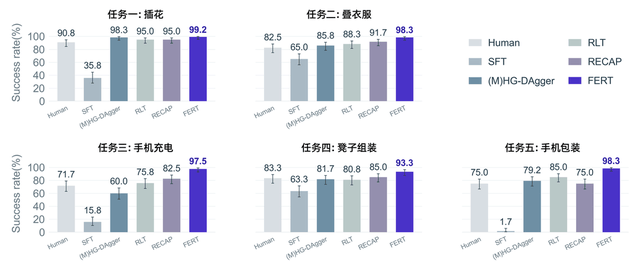
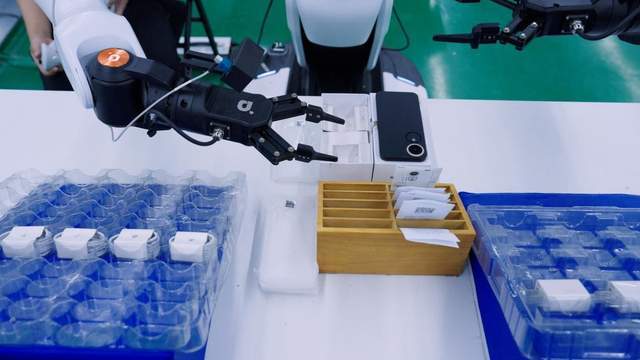
Among these, “phone packaging” is a complex industrial assembly task involving multiple long-horizon steps. After optimization via CEL, the robots’ success rate on this task surged from 79.2% to 98.3%, with only 2 failures across 120 consecutive trials. This demonstrates that policies learned through CEL are not only capable of mastering complex, long-horizon tasks, but also deliver the high stability demanded by industrial standards.
The experiments also validated a powerful scaling effect: as the training cluster expanded from 16 to 96 robots, the overall task success rate climbed in tandem from 86.7% to 98.3%. This confirms that within the same physical training timeframe, a larger cluster of robot nodes yields a richer pool of high-quality real-world interactions. This directly translates into continuous algorithmic gains, accelerating the collective intelligence of the entire fleet.
3. Anchored by a Resilient, Fault-Tolerant System: Unlocking the Closed-Loop of Continual Learning
The real-world success of CEL stems from the synergistic combination of a solid underlying systems foundation and innovative higher-level algorithms.
At the systems level, the team built the Fault-tolerant Asynchronous Training System (FATS) on top of RLinf, an open-source framework for large-scale reinforcement learning. FATS ensures stable, continuous, and collaborative training across nearly 100 robots in real-world environments. The system centrally orchestrates physical robots and computing resources: once an individual robot completes a task, it immediately streams back its trajectory and experience data without needing to wait for synchronization from other nodes. The cloud-based training system can then continuously update policy models on these incoming incremental data streams. Meanwhile, to withstand the unpredictable network jitter, node dropouts, and hardware failures typical of real-world environments, FATS incorporates highly robust fault-tolerance mechanisms—ensuring that even if individual units temporarily disconnect, the broader cluster continues operating uninterrupted. In physical trials with 96 robots, the cluster logged a total of 9,834 task execution episodes. Although 22 robots encountered 30 abnormal events during this period, downtime accounted for a mere 1.3% of total operational time, providing strong evidence of the system’s engineering robustness in large-scale physical interaction settings.
At the algorithmic level, the team proposed the Failure-guided Experience Retrieval and Tuning (FERT) algorithm to guide precise policy updates. In conventional manipulation tasks, a single trajectory often spans several minutes and thousands of discrete action steps, yet the terminal evaluation feedback is typically a sparse binary signal (success or failure). This low information density makes it difficult to pinpoint exactly where an action went wrong. The FERT algorithm creates a closed value loop from both data categories: extracting optimal paradigms from successful experiences while pinpointing root causes from failure cases. When a robot encounters an obstacle, the algorithm quickly queries the historical repository of successful runs based on the current context, retrieves a high-confidence valid trajectory, and uses it as an anchor for targeted fine-tuning—enabling fine-grained capability iteration.
4. Industry-Academia Synergy: Charting a Scalable Path for Embodied AI
The key to industrializing embodied AI is far more than teaching robots individual, isolated skills. The Collective Experience Learning paradigm jointly introduced by Tsinghua University, Infinence, and AgiBot establishes a transformative path forward: transitioning from localized tuning of single robots to the continuous evolution of swarm intelligence.
The significance of this milestone extends beyond pure technical breakthroughs.
First, it effectively dismantles the human demonstration bottleneck that has long constrained the scaling of embodied AI. Previously, improving a robot’s generalization and capabilities relied heavily on prolonged teleoperation and manual correction by expert operators—a human labor pool that fundamentally cannot keep pace with the exponential scaling of industrial hardware. By establishing a mutual learning mechanism among robots, CEL completely flips this dynamic: as the cluster grows, experience accumulates faster and iteration efficiency surges, converting human labor bottlenecks into a self-reinforcing scaling dividend.
Second, this achievement stands as a benchmark for deep industry-academia collaboration. Tsinghua University tackled foundational theoretical mechanisms, Infinence engineered the high-performance AI infrastructure foundation, and AgiBot contributed advanced full-stack robot hardware and real-world industrial scenarios. Together, this tri-party collaboration bridged the gap between academic research papers and factory floor deployment, grounding cutting-edge algorithms firmly in physical reality.
This milestone not only validates an algorithmic framework, but also successfully establishes a continuous virtuous cycle: real-world scenarios generate experience, collective learning consolidates capability, and scaled deployment enriches the scenario. As this technical pipeline matures, it will provide a reusable evolutionary blueprint for an even wider range of manufacturing and service domains.
When robots are no longer isolated execution endpoints, but an interconnected, co-evolving collective of peers, large-scale deployment ceases to be the final destination of algorithmic delivery—it becomes the starting line for autonomous swarm intelligence. This marks a profound paradigm shift in how robots learn, delivering a tangible breakthrough in propelling embodied AI from experimental proof-of-concept into industrial-scale adoption.