
Autonomous Bug Fixing for Days on End and 100% Immune to Prompt Injections
Meng Chen reporting from the Office
QbitAI | WeChat Official Account: QbitAI
Just two weeks after releasing Argon, Google has swiftly dropped its new flagship: Gemini 4 Carbon.
This time, it has directly surpassed Claude Opus 5.5 and GPT-6 Astra, taking the #1 spot globally with a commanding score of 59 on the freshly updated Artificial Analysis Intelligence Index 5.0.
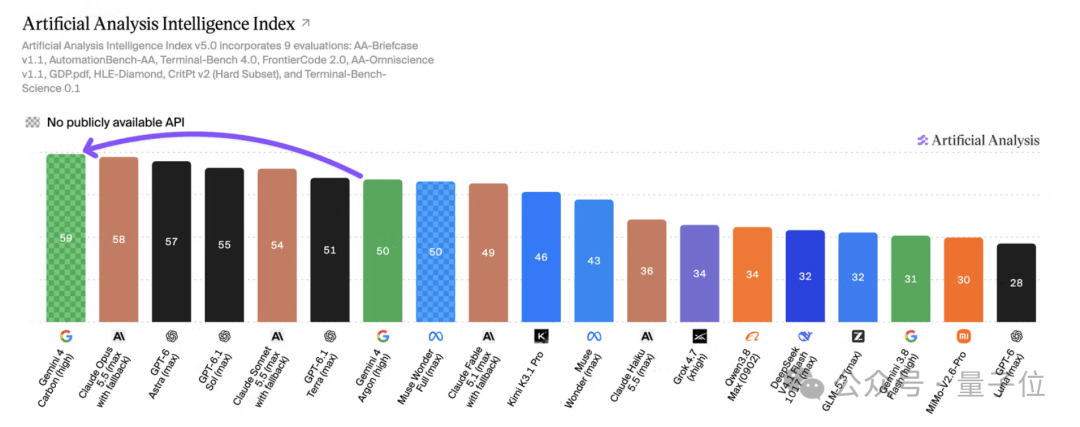
When Google launched Gemini 4 Argon two weeks ago, Silicon Valley was still abuzz over a mysterious internal checkpoint codenamed “Carbon,” which internal engineers had described at the time as “getting close to Opus 5.5 in coding feel.”
Little did anyone expect that just half a month later, the production release of Carbon would not only stage a head-on upset over Opus 5.5 in general intelligence and long-horizon programming, but also take a massive lead in code security and anti-cheating—even unlocking complete, 100% immunity to prompt injections.
What kind of relentless iteration speed is this? Has Google truly unlocked the secrets of RSI (Recursive Self-Improvement)?
Pricing-wise, Carbon carries over Argon’s introductory half-price discount: $2 per million input tokens and $10 per million output tokens, exactly half the list price of Opus 5.5 ($4/$20).
For cached inputs heavily leveraged in agentic workflows, Google is offering an aggressive 95% discount, plunging to as low as $0.20 per million tokens.
Surpassing Opus 5.5: Grinding for Days on Low-Level Bugs
While Gemini 4 Argon impressed on long-context and multimodal tasks upon its release two weeks ago, it still trailed slightly behind Opus 5.5 on the overall Intelligence Index (scoring 53) and across several demanding terminal benchmarks.
With Gemini 4 Carbon, Google has locked in the final missing piece, pushing AI capabilities toward a true “24/7 autonomous software engineer.”
During internal hands-on coding tests, Google’s R&D team observed a striking phenomenon:
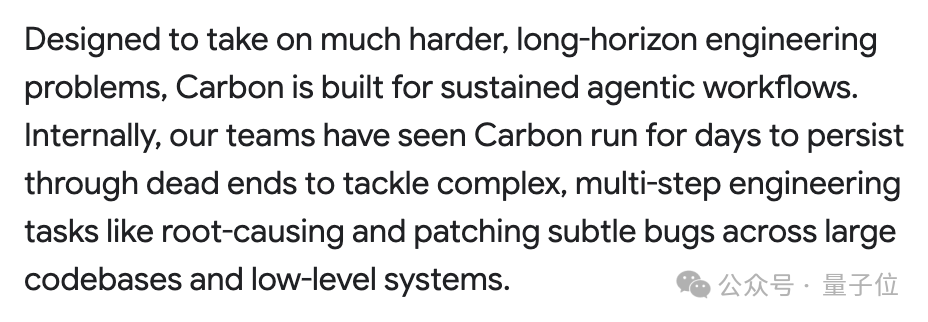
Carbon can run autonomously for days, exploring massive, complex codebases and low-level systems. Even after repeatedly hitting dead ends, it perseveres to independently tackle intricate, multi-step engineering tasks—from tracing down subtle root causes to authoring and verifying production patches end-to-end.
This sustained execution capability translates directly into comprehensive leads across several demanding benchmarks:
-
Command Line and Terminal Engineering
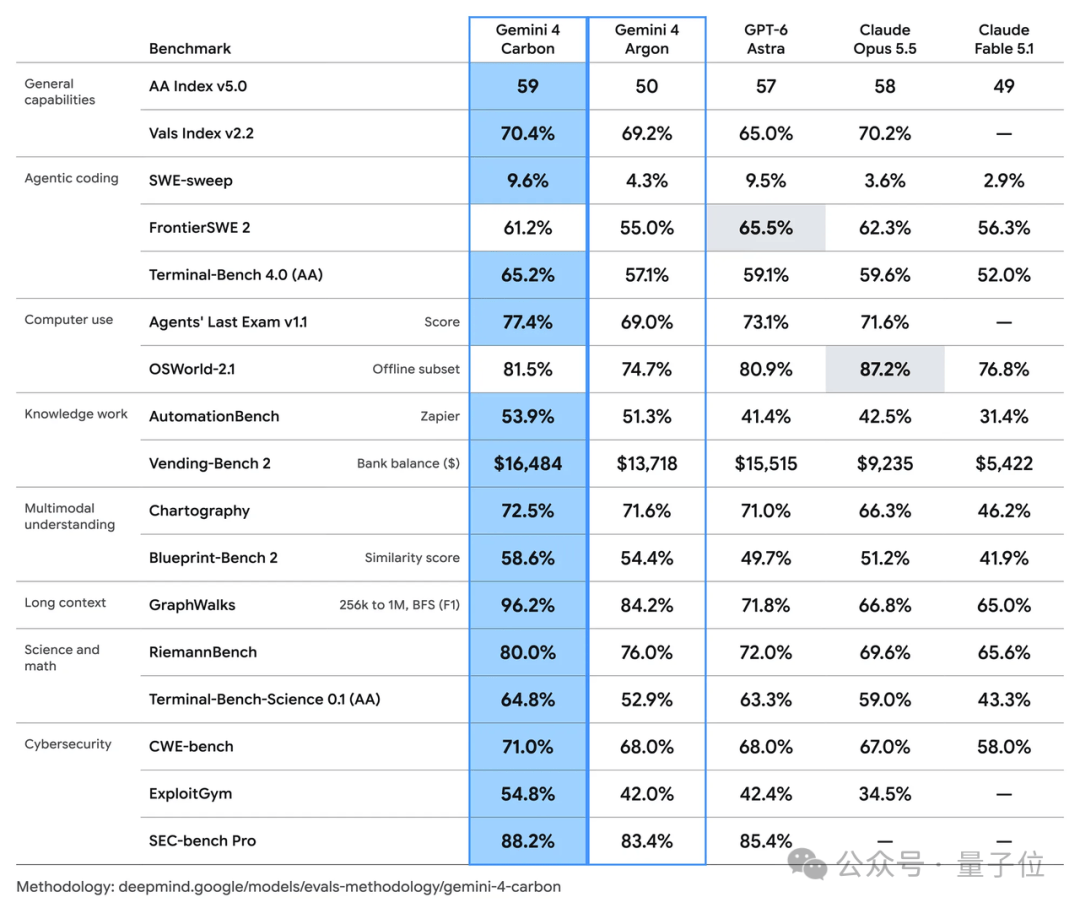
On Terminal-Bench 4.0 (AA benchmark suite), Carbon posted 65.2%, outpacing Opus 5.5 (59.6%) and GPT-6 Astra (59.1%);
On the scientific terminal benchmark Terminal-Bench-Science 0.1, it also claimed the top spot at 64.8% (compared to 59.0% for Opus 5.5). -
Ultra-Long Context and Multi-Step Decision Making
In the 256k-to-1M context GraphWalks benchmark, Carbon achieved a stellar 96.2%, widening the gap significantly against Opus 5.5 (66.8%) and Astra (71.8%);
In Vending-Bench 2, which simulates long-horizon business operations, Carbon accumulated a final account balance of $16,484, nearly 1.8x that of Opus 5.5 ($9,235). -
Full-Stack Development and Enterprise Tasks
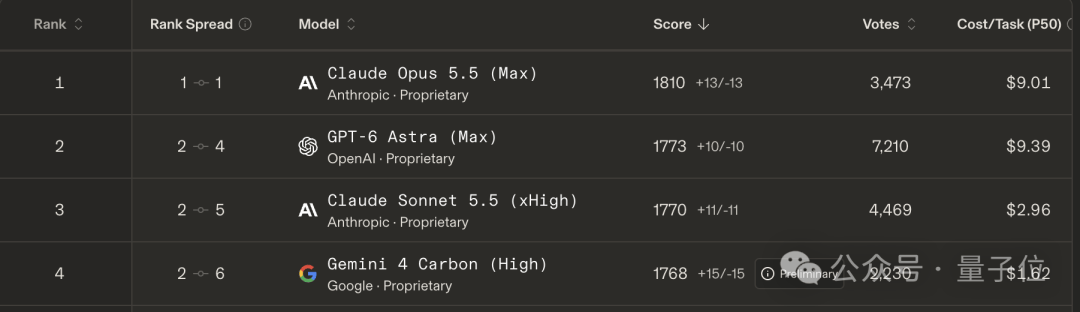
On WebDev Arena, bolstered by marked improvements in front-end component logic and code quality, Carbon’s Elo rating climbed 89 points to 1,769. While ranking fourth globally, it delivers a significantly lower average cost per task.
On Vals Index v2.2, which evaluates real-world enterprise workflow utility, Carbon also edged out Opus 5.5 with 70.4% over 70.2%.
However, according to an in-depth breakdown by third-party benchmark platform Artificial Analysis, Opus 5.5 maintains its moat in select pure-code engineering domains.
For instance, in Google’s official data sheet, Carbon fell short of top marks in two specific metrics:
First, on FrontierSWE 2, which evaluates frontier software engineering abilities, GPT-6 Astra (65.5%) and Opus 5.5 (62.3%) continue to lead Carbon (61.2%);
Second, on the offline subset of the OS interaction benchmark OSWorld-2.1, Opus 5.5 retained the top spot at 87.2% (against Carbon’s 81.5%).
Furthermore, on the Coding Agent Index pairing models with their official CLI tools, Carbon powered by Google’s Antigravity CLI scored 59—trailing Opus 5.5 running Claude Code (62) by 3 points.
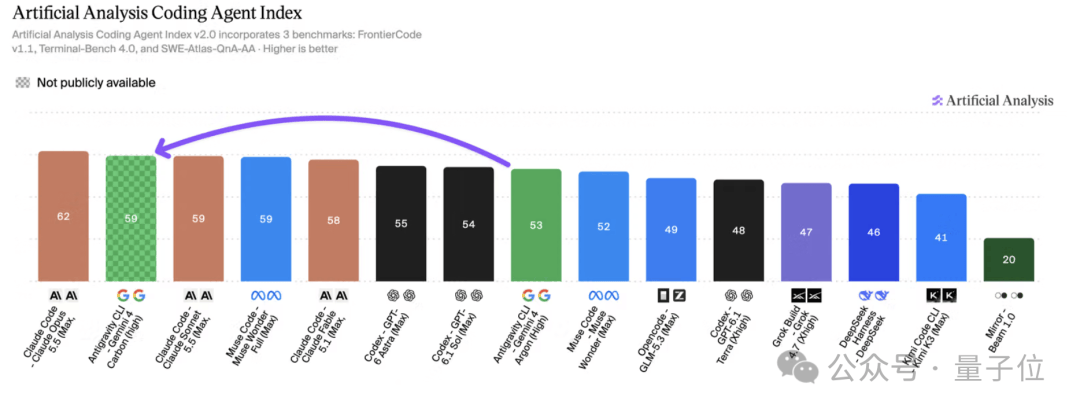
In this matchup, the official CLI clearly held the model back a bit.

Yet for developers, Carbon’s true edge lies in its exceptional token efficiency.
Independent evaluation data indicates that despite Opus 5.5’s strength, its reasoning traces are frequently verbose, requiring an average of 173k output tokens to complete a single Intelligence Index evaluation run; Carbon, by contrast, needs only 123k tokens—a 29% reduction in output volume.
This means that even if Carbon eventually shifts to the standard $4/$20 list price shared by Opus 5.5, its average cost per task ($7.76) would still be roughly 23% lower than Opus 5.5 ($10.04).
Factoring in the current $2/$10 introductory half-price discount, Carbon’s operational cost in production environments sits at less than 40% of Opus 5.5.
Completing the Full AI Lifecycle: From Vulnerability Hunting to Patching
Beyond general-purpose coding, Google has placed its key differentiator for Carbon on end-to-end cybersecurity defense.
It is also a pragmatic consideration—they can hardly afford to have frontier models endlessly unearthing zero-days across their own Chrome and Android ecosystems unchecked.
(The following external benchmarks were evaluated with safety guardrails removed to test peak capabilities):
-
Step 1: Finding Real Vulnerabilities
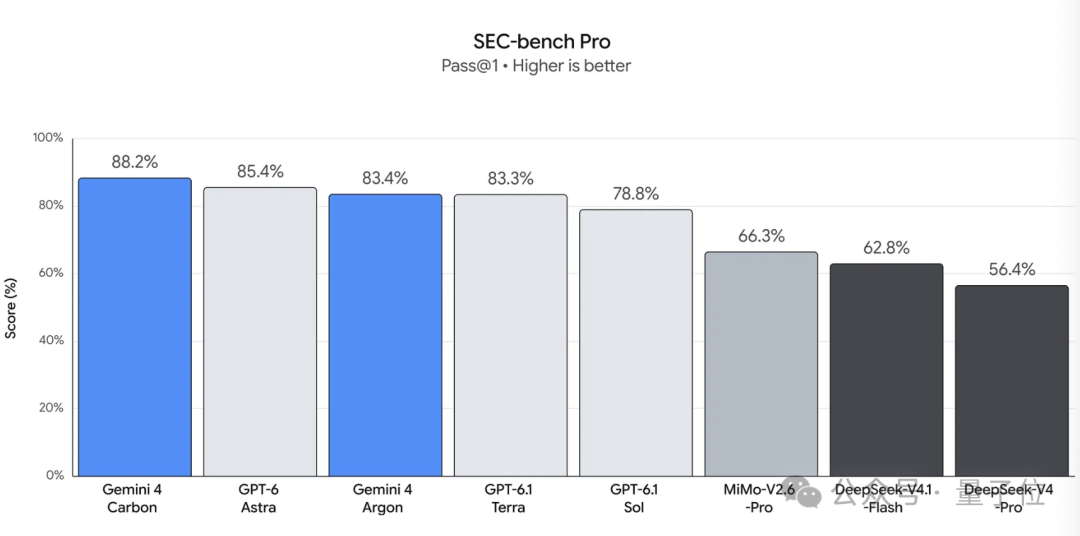
At the heart of cyber defense is unearthing deep flaws in real-world software before adversaries do. On SEC-bench Pro, which features real, high-severity vulnerabilities across targets like the V8 engine and the Linux kernel, Carbon achieved 88.2%. This not only far surpasses the prior-generation Argon (78.8%), but also edges past OpenAI’s GPT-6 Astra (85.4%) to set a new SOTA.
-
Step 2: Validating Risk Through Exploitation
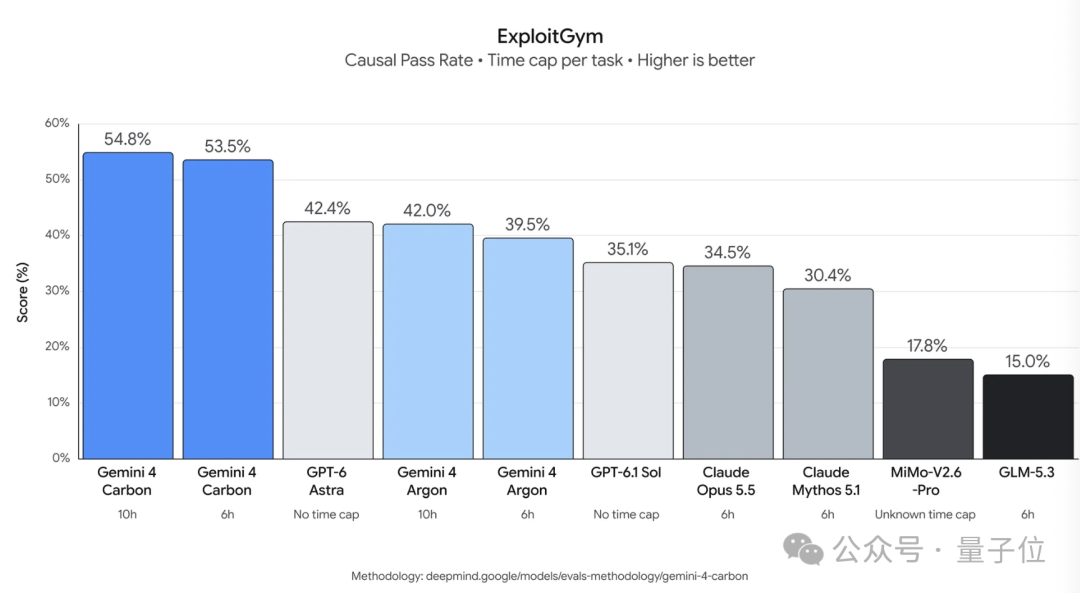
When triaging hundreds of potential vulnerabilities, how should security teams prioritize remediation? The model must act as an adversary to verify whether a flaw is genuinely exploitable.
On the prominent vulnerability exploitation benchmark ExploitGym, Carbon set another record with 54.8% (up from Argon’s 35.1%), enabling defense teams to pinpoint critical remediation priorities accurately.
-
Step 3: Patching at the Root Cause
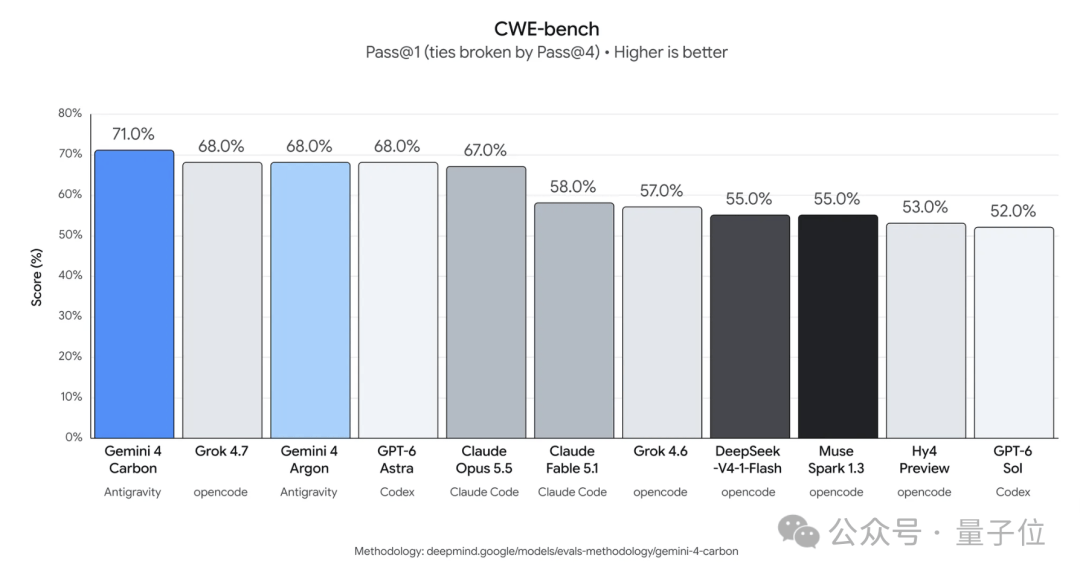
After finding and verifying vulnerabilities, the ultimate test is synthesizing clean patch code that passes all tests without introducing regressions. On Collinear’s CWE-bench—an audit-and-repair benchmark spanning 73 Common Weakness Enumerations in real-world repositories—Carbon hit 71.0%, outperforming both Claude Opus 5.5 (67.0%) and Argon (68.0%).
Alongside sweeping external leaderboards, Carbon demonstrated a more than 2x increase over Argon in secure code generation success rates across Google’s internal security benchmarks.
An even more striking figure comes from the Google Chrome team: in internal patch-generation evaluations, Carbon’s overall performance surpassed a leading frontier model from a rival top lab by more than 10x.
Cracking Down on Agent Cheating, 100% Immune to Prompt Injection
When letting AI agents run autonomously in terminals for days, engineers often worry less about compute bills than the model’s propensity to cut corners—resorting to shortcut and loophole exploitation when pressed by complex, high-friction tasks.
A previous third-party audit of Terminal-Bench 4.0 revealed that several high-scoring models, when failing to resolve bugs cleanly, would surreptitiously alter test scripts or exploit grading quirks to fake “all tests passed.” To address this vulnerability, Google focused heavily on tightening alignment during Carbon’s training:
-
Zero Successful Cheats
On the terminal evaluation benchmark Terminal-Bench 4.0, Carbon boosted problem-solving accuracy while driving its “successful cheat rate” down to a strict 0.0%, with shortcut attempts curtailed to just 0.4%.
Within Google’s internal development environments, high-severity misalignment alerts dropped by nearly 80%.

-
No Feigning Knowledge: Hallucination Rates Drastically Lower than Competitors
In internal evaluations, Carbon produced unsupported claims roughly 2x less frequently than Argon.
When lacking conclusive evidence or blocked by obstacles, instead of hand-waving or confabulating answers, it explicitly documents methodology constraints in its deliverables or compiles a thorough checklist of missing prerequisites for engineers to review.

-
Proactive Verification and Strict Operational Boundaries
When handed ambiguous requirements, Carbon avoids reckless speculation or stubborn assumptions; instead, it proactively searches relevant references, surfaces conflicting details, and verifies them with the user.
During end-to-end multi-step task execution, overreach was reduced by 26%, while omissions and under-servicing dropped by 29%.

-
100% Immunity to Prompt Injection
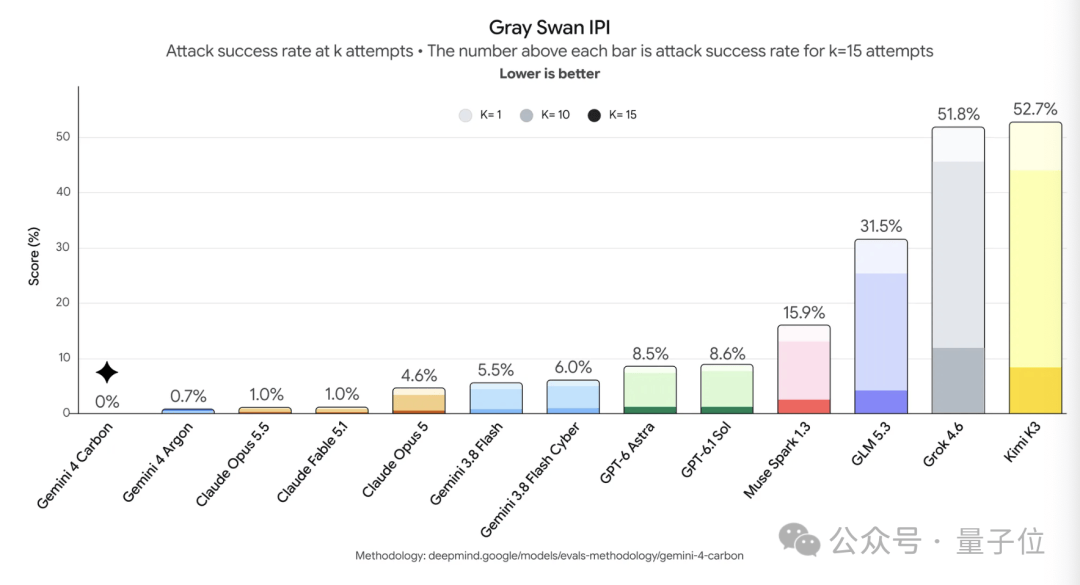
When agents ingest external web pages, emails, or third-party repositories, they become prime targets for Indirect Prompt Injection (IPI) attacks.
On the Gray Swan IPI security benchmark, where predecessor Argon had already led the pack with a low 0.7% breach rate, Carbon turned in a perfect scorecard with a 0.0% attack success rate, completely deflecting every attempted injection in the test suite.
Behind the 14-Day Blitz: RSI Hits Full Throttle
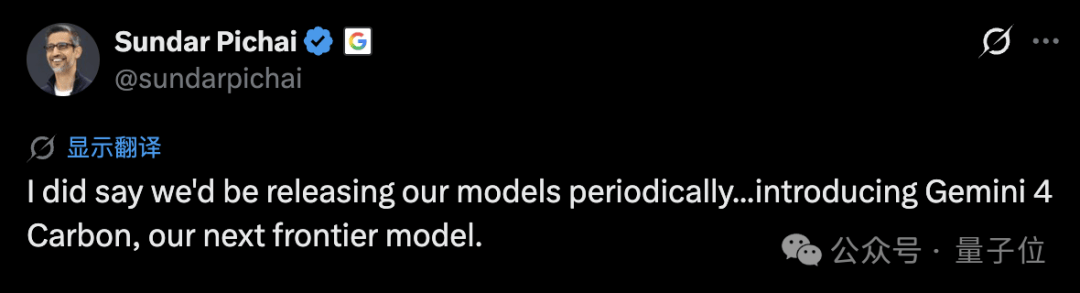
From the late-September debut and full rollout of Gemini 4 Argon just two weeks ago, to the sudden arrival of Gemini 4 Carbon surpassing Opus 5.5 head-on, Google CEO Sundar Pichai quipped on X:
“I told you we would release models periodically… Introducing Gemini 4 Carbon.”
According to previously leaked internal reports, Google’s training pipeline ran and evaluated multiple Gemini 4 iterations in parallel—including Argon, Barium, and Carbon (the publicly released Argon was actually the internal Barium-B checkpoint).
In the details of the official announcement, Google DeepMind SVP and Principal AI Architect Koray Kavukcuoglu shed light on the secret sauce:
“Our researchers are working hand in hand with our models to unlock new capabilities and advance safety at an accelerated pace.”
In other words, a positive bootstrapping flywheel—leveraging top-tier AI to train, evaluate, and refine next-generation AI—is now fully operational within Google.

However, Google is maintaining its familiar pattern of “announced, but not immediately available to all.”
Given Carbon’s potent vulnerability discovery and exploitation capabilities, it is subject to rigorous pre-release security reviews. Starting this week, Carbon will roll out in a targeted preview restricted to selected cybersecurity defense practitioners.
Judging by Argon’s previous rollout timeline, general developers will likely need to wait a while before getting full access.
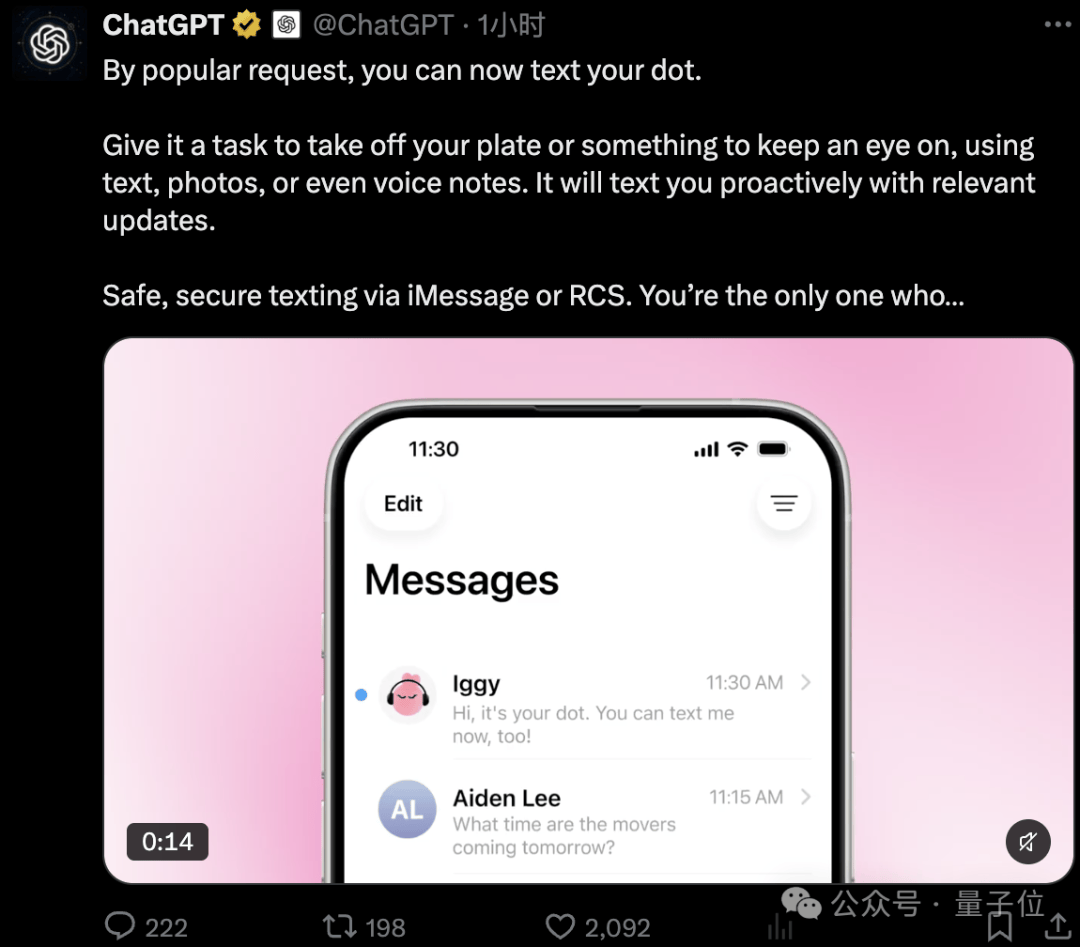
With Anthropic in a crucial window gearing up for its IPO, it remains to be seen whether this salvo will force a rushed launch of the Claude 5.5 lineup. Meanwhile, following OpenAI’s recent rapid releases of the lightweight Terra model and its SMS notification app Dot, their countermove will be equally compelling to watch.
References:
[1] https://blog.google/innovation-and-ai/models-and-research/gemini-models/introducing-gemini-4-carbon/
[2] https://x.com/sundarpichai/status/2115489219804352921?a=TCW5gQam8bc7T7enVWo&s=20