
Going Head-to-Head with H200 and Thor T5000
Jin Lei reporting from Shanghai
I’d call them a true heavyweight contender in China’s domestic chip industry.
Here is what happened.
A domestic chip company pitted its GPU directly against NVIDIA’s H200 in a live, real-world benchmark showdown right on stage.
Even more hardcore: the test prompts were not prepared in advance. Instead, members of the live audience were chosen at random to come up with prompts on the spot.
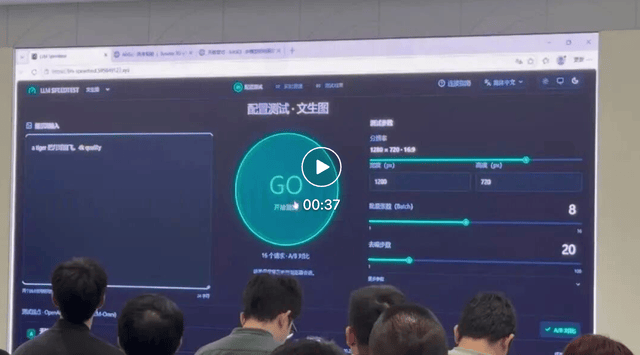
For instance, in a text-to-image test, an audience member submitted the prompt: “A tiger kicking away the moon”:
Video URL:
https://mp.weixin.qq.com/s/Non20tfUB860KjNQkW3LZQ
The results showed the domestic GPU taking the lead: generation took just 95.6 seconds, compared to 112 seconds on the NVIDIA H200.
And that wasn’t all.
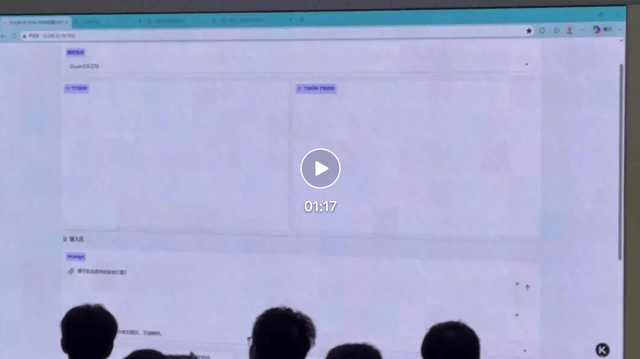
While the test above ran in a cloud environment, the company then brought out a palm-sized silver device and pitted it directly against NVIDIA’s robotics computing platform, the Jetson Thor T5000, under completely offline edge conditions.
The prompt was again chosen at random by the audience: “Who wins in a one-on-one fight between a lion and a tiger?”
Video URL:
https://mp.weixin.qq.com/s/Non20tfUB860KjNQkW3LZQ
To the naked eye, the domestic device’s inference response was noticeably faster than that of the Thor T5000.
This domestic chipmaker is Iluvatar CoreX.
The chip that outpaced the H200 in the cloud is its flagship Tiangai 300; the one beating the Thor at the edge is its edge-computing offering, the Tongyang TY1200.
At the same event, Iluvatar CoreX also introduced the Iluvatar Smart Computing Software Stack, anchored around the philosophy of “using AI to develop AI.”
Industry observers following Iluvatar CoreX might remember: in January this year, just two weeks after ringing the opening bell for its IPO, the company launched four Tongyang edge products at once, with the TY1000 already outperforming NVIDIA’s AGX Orin in live benchmarks.
On that same day, Iluvatar CoreX unveiled a four-generation product architecture roadmap: the first stop was the Tianshu architecture, designed to surpass Hopper, with subsequent targets set against Blackwell and Rubin.
Just over nine months later, Iluvatar CoreX delivered on its promise right on schedule.
The Tiangai 300 is built on the Tianshu architecture, directly taking on the Hopper family’s flagship H200; on the edge, the benchmark target was upgraded from Orin to the far more capable Thor.
When asked why they launched simultaneously across three fronts—cloud, software stack, and edge—Iluvatar CoreX explained the core logic:
The cloud generates intelligence, the software stack accelerates adaptation and optimizes performance, and the edge brings intelligence to life in real-world physical settings such as factories, laboratories, and hospitals.
In Iluvatar CoreX’s view, only when these three gears mesh tightly together can they deliver what the company defines as high-quality compute—compute that is high-efficiency, predictable, and sustainable.
Below is an in-depth breakdown of the live benchmarks.
Tiangai 300: Taking on the H200 with Real-World Benchmark Results
First, let’s look at the cloud flagship: the Tiangai 300.
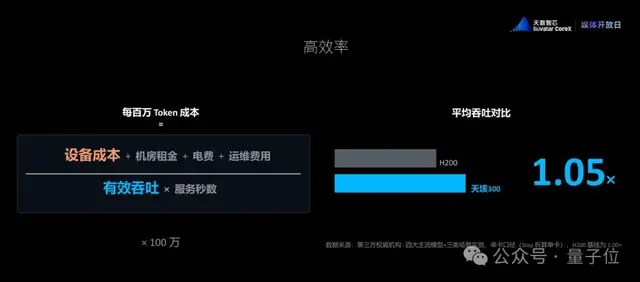
This chip was not making its debut. Back in July, an authoritative third-party evaluation organization put the Tiangai 300 through comprehensive testing across four mainstream large language models and three representative application scenarios.
Under the classic Prefill-Decoding (PD) disaggregated deployment architecture, the normalized per-GPU end-to-end throughput of the Tiangai 300 reached 1.05x that of the H200.
Notably, this test did not measure theoretical peak compute; instead, it measured the real-world token generation throughput across the entire inference pipeline from prompt to completion.
Iluvatar CoreX stated that this makes the Tiangai 300 the first domestic general-purpose GPU to match the H200 in real-world performance benchmarks.
As a general-purpose GPU, the Tiangai 300 delivers robust capabilities across both training and inference.
First, inference performance.
For modern large language models, long-context handling is a crucial hurdle to clear. Tianyi Shan, Head of AI and Accelerated Computing at Iluvatar CoreX, shared a vivid analogy on stage:
On a couple’s tenth anniversary, if the woman asks the man what his most unforgettable moments were over the past decade, he won’t replay all 3,650 days from start to finish. What flashes through his mind are usually just a handful of defining moments.
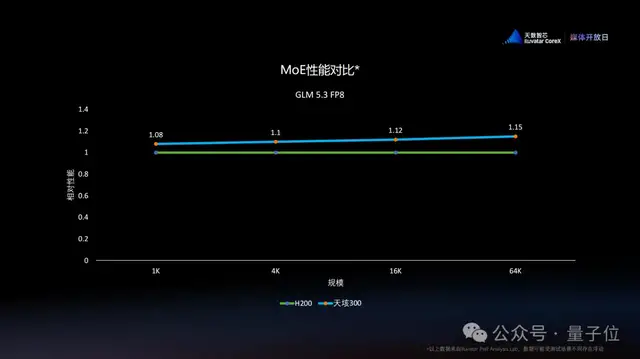
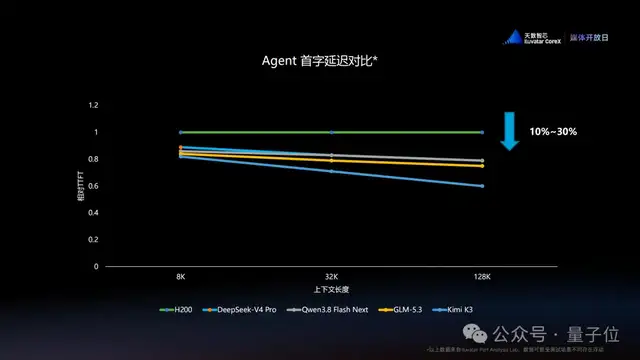
This is precisely the core role of Attention, and the Tiangai 300 has been specifically optimized for it. Benchmark data shows that under a 64K context window running GLM-5.3, its MoE throughput reached 1.15x that of the H200; in 8K to 128K long-context scenarios, Time to First Token (TTFT) for Agents was reduced by 10% to 30% compared to the H200.
Next, training performance.
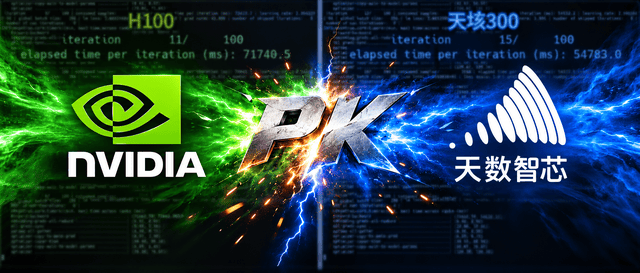
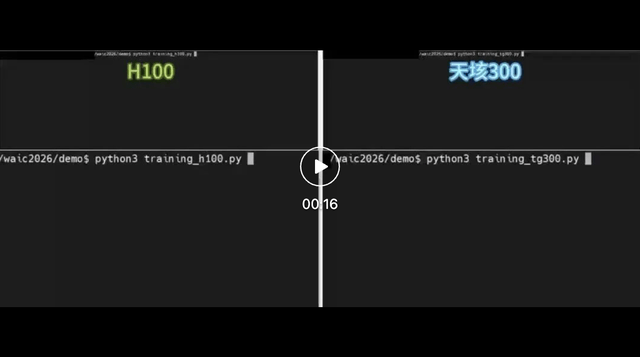
In an 8-GPU FP8 training run with Qwen3-32B, the effective per-GPU throughput of the Tiangai 300 reached 1.33x that of the H100. A 100x-speed screen recording of the command-line interface showed the Tiangai 300 crossing the designated step threshold first while the H100 was still running.
Video URL:
https://mp.weixin.qq.com/s/Non20tfUB860KjNQkW3LZQ
Beyond conventional pre-training, the Tiangai 300 also excels at reinforcement learning workloads, which represent the dominant post-training technical route for top-tier foundation models today.
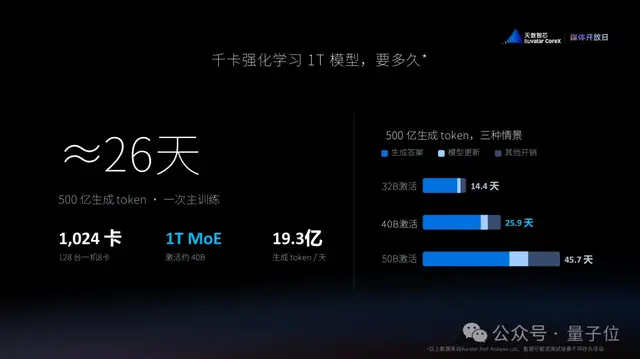
According to engineering estimates from Iluvatar CoreX, a cluster of 1,024 Tiangai 300 GPUs can complete a full round of reinforcement learning training on an MoE model with 1T total parameters and 40B activated parameters in roughly 26 days—aligning cleanly with the typical monthly iteration cadence of foundation model developers.
Beyond inference and training, the Tiangai 300 also offers a tailored solution for the increasingly prominent buildout of Token Factories.
In building a Token Factory, hardware equipment accounts for roughly 75% to 80% of total capital expenditure. Since fixed hardware investments are difficult to compress, higher per-GPU output and smoother runtime stability are the keys to driving down marginal cost per token.
On throughput efficiency, the aforementioned 1.05x advantage speaks for itself. On operational stability, the metric that matters most is step-time variance:
Under full load, the step-time variance of the Tiangai 300 was just 0.43%, compared to 0.76% for the control Hopper solution. This means that even under prolonged, ultra-high workloads, the Tiangai 300 maintains exceptionally consistent performance output.
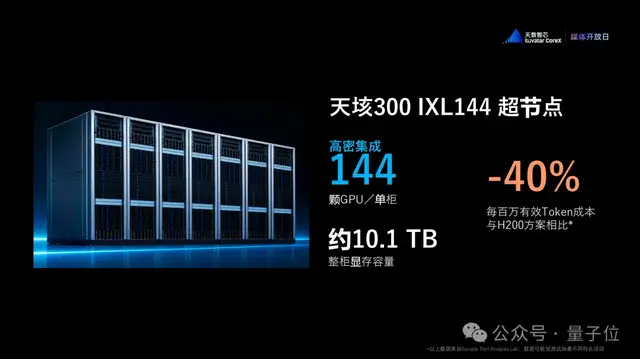
For hyperscale cluster deployments, Iluvatar CoreX introduced the IXL144 Supernode.
This architecture packs 144 GPUs into a single standard rack with an aggregated VRAM capacity of roughly 10.1 TB, making it the industry’s densest single-rack GPU supernode to date. According to official estimates, compared to an equivalent H200 deployment, this architecture can reduce the cost per million effective tokens by around 40%.
Beyond raw single-card performance, the openness of the Tiangai 300 ecosystem is equally noteworthy.
The Tiangai 300 not only supports hybrid heterogeneous training alongside NVIDIA H100 and H200 GPUs, but can also collaborate with silicon from other chip vendors.
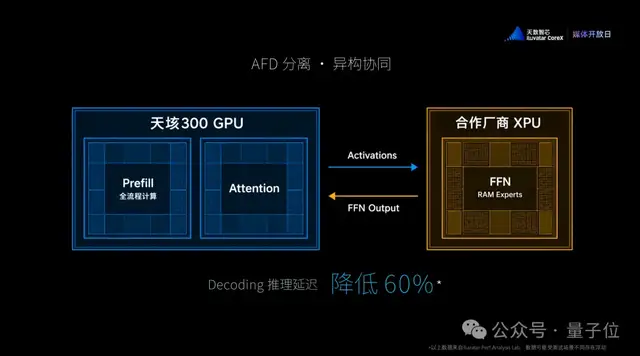
During the live demonstration, Iluvatar CoreX ran China’s first heterogeneous GPU + XPU disaggregated Attention-FFD (AFD) deployment: the Tiangai 300 handled Prefill and Attention compute, while a partner vendor’s XPU handled FFN compute, slashing decoding inference latency by 60% in real-world benchmarks.
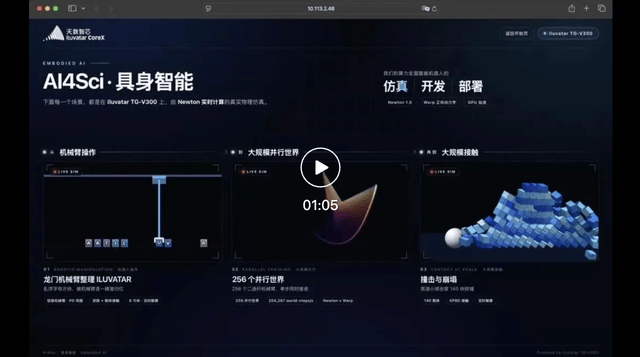
Beyond LLM benchmarks, the stage also featured an even more demanding demonstration of physical simulation. In Tianyi Shan’s view, AI extends far beyond Transformers, and compute hardware must never become a bottleneck for exploring foundational algorithms. To illustrate this, three simulation cases were presented:
First, a single Tiangai 300 performed real-time simulation of a gantry crane, calculating slider friction, hoisting velocity, and dynamic force loads in real time directly on the chip;
Second, 256 sets of double-pendulum linkage mechanisms were hooked up to a single model for reinforcement learning, creating 256 parallel virtual environments running simultaneous trial-and-error runs—a workload placing extreme demands on the GPU’s parallel compute capabilities;
Finally, a dense slider collision simulation: 140 sliders collided and transferred force loads among one another, requiring the chip to calculate full dynamic simulations across all sliders synchronously with every impact.
Video URL:
https://mp.weixin.qq.com/s/Non20tfUB860KjNQkW3LZQ
While these physical simulations may look like simple animations on the surface, they form the essential bedrock of virtual training that embodied robots must undergo before entering the physical world.
Tongyang TY1200: 300T Dense Compute, Outperforming the Thor T5000
Turning our attention to the edge.
As mentioned earlier, the direct competitor for the Tongyang TY1200 this time is NVIDIA’s Jetson Thor T5000.
Yuanying Song, Head of Tongyang Product Marketing at Iluvatar CoreX, noted that the Thor T5000 is NVIDIA’s flagship edge computing platform, boasting an official specification of 2,070 TFLOPS (FP4 sparse). By comparison, the TY1200 specifies 300 TOPS, and that figure represents dense compute.
Looking strictly at paper specifications, the TY1200 appears at a disadvantage; Song acknowledged that normalized nominal metrics for the TY1200 are indeed lower than Thor’s.
However, real-world workload benchmarks told a completely different story: running the large language model Qwen3.8-27B, the TY1200 reached 138% of the Thor T5000’s performance; in the MoE-based Qwen3.6-35B-A3B test, it reached 110%.
Even more notable was its performance on NVIDIA’s open-source world model, Cosmos: on Cosmos-R2-2B, the TY1200 delivered 158% of the Thor’s throughput; on Cosmos-R2-8B, this lead expanded further to 180%.
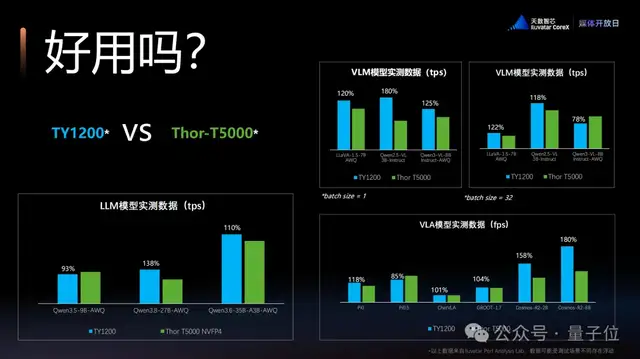
This indicates that the TY1200 has taken the lead in the edge world model arena championed by NVIDIA itself.
Beyond synthetic benchmarks, the stage showcased three live tasks running on a standalone TY1200 unit:
The first was local edge video generation: using an audience-suggested prompt, the TY1200 generated video locally using the open-source MiniMax H3 video generation model in a completely offline environment without internet access.
After roughly 6 minutes, the unit output a 5-second, 1056×608 high-definition video clip.
While 6 minutes is slower than a cloud cluster, on-device edge execution eliminates cloud queuing latency and unpredictable API costs, enabling entirely offline, cost-free generation.
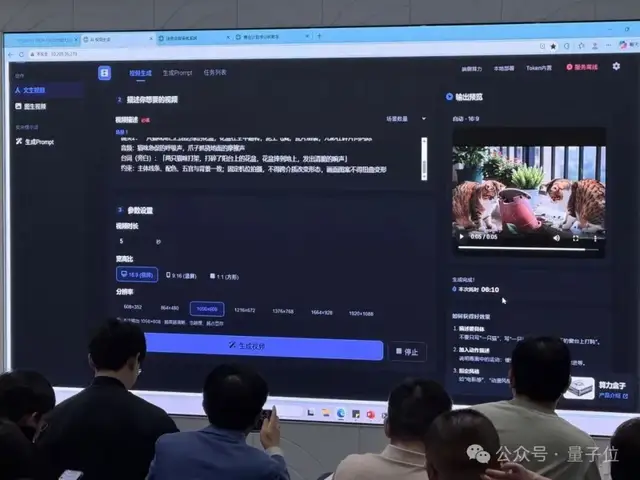
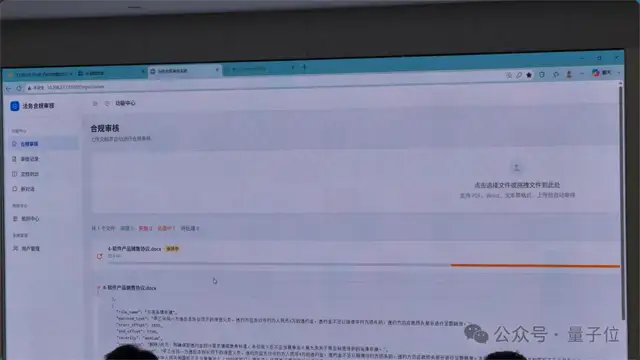
The second task was intelligent contract review.
After ingesting a 10,000-word software procurement agreement, the TY1200 identified high-, medium-, and low-tier legal and compliance risks within two minutes, appending specific statutory citations and internal corporate compliance provisions for each point.
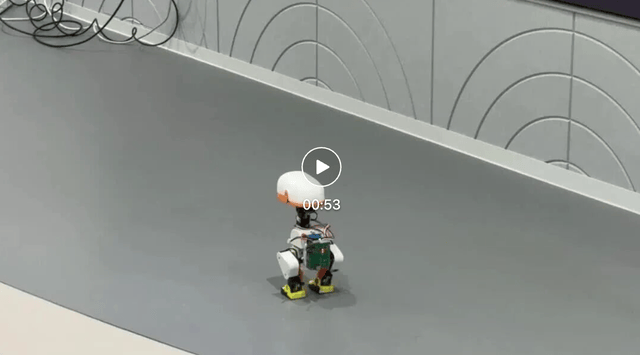
The third task targeted physical embodied robotics—the MicroDuck (a miniature bipedal robotic duck).
According to Song, similar demonstrations previously required cloud supercomputing clusters to handle prior training; Iluvatar CoreX, however, consolidated the entire pipeline—from simulation training and virtual validation to physical control deployment—onto a single standalone TY1200 device.
To accomplish this, the TY1200 ran a MuJoCo-Warp GPU-accelerated physics simulation environment for the first time on domestic edge computing silicon.
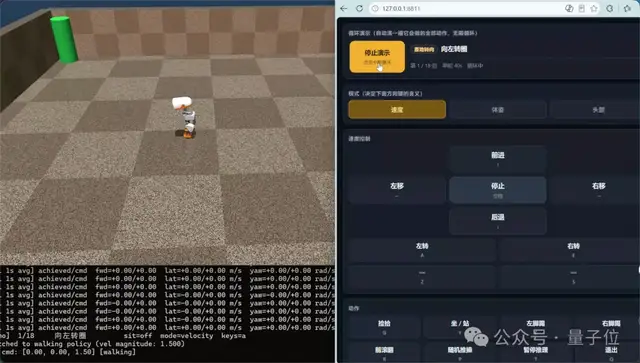
Song revealed that the team had only three or four days to adapt the model once they received the physical hardware, and it had not even completed an end-to-end dry run during internal testing.
Yet during the live demo, after a brief wobble and a single fall, the bipedal robotic duck managed to stand back up autonomously and walk stably, delivering a live demonstration that exceeded all expectations.
Video URL:
https://mp.weixin.qq.com/s/Non20tfUB860KjNQkW3LZQ
Beyond MicroDuck, the Tongyang series has already seen numerous real-world deployments across embodied AI:
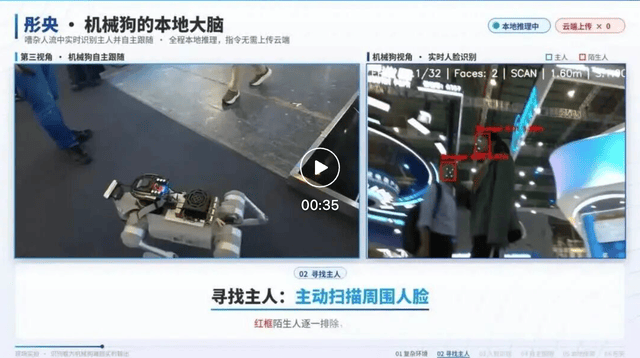
At the China International Industry Fair two weeks ago, a quadruped robot dog powered by the TY1000 module was demonstrated publicly: running without human remote control, it relied entirely on on-device compute for real-time facial recognition and tracking, with zero telemetry or data transmitted back to the cloud.
Video URL:
https://mp.weixin.qq.com/s/Non20tfUB860KjNQkW3LZQ
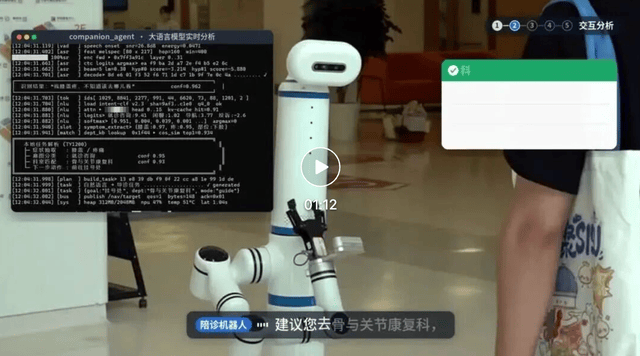
Meanwhile, a hospital companion robot powered by the TY1200 has been deployed at Shanghai Yangzhi Rehabilitation Hospital (Shanghai Sunshine Rehabilitation Center). Visually impaired patients can verbally request appointment registrations, and the robot guides them autonomously while sensing and navigating around obstacles in real time.
Video URL:
https://mp.weixin.qq.com/s/Non20tfUB860KjNQkW3LZQ
Wrapping up the session, Song also unveiled the roadmap for their next-generation flagship edge platform, the TY2000, which will bump nominal compute capacity to 600 TOPS. As he summarized:
When a cloud GPU maker steps into the edge space, the goal isn’t just to make chips smaller—it’s to push full compute capabilities all the way downstream.
Empowering Every Developer with the Expertise of Senior Engineers
Even as hardware specifications continue to break barriers, developer experience and usability remain the primary bottlenecks for ecosystem adoption.
Jiasheng Shi, Vice President and Head of Software Development at Iluvatar CoreX, shared a telling analogy on stage:
Back in the DOS era, playing classics like The Legend of Sword and Fairy or Rich Man 3 meant constantly tweaking complex IRQ interrupts and conventional memory configs just to get the games to boot.
In his view, today’s AI cloud infrastructure echoes that DOS dilemma: heterogeneous CPUs, disparate interconnect topologies, and intricate operating system environments frequently stall developers at every turn.
To tackle this, Iluvatar CoreX chose to integrate AI throughout its software infrastructure stack.
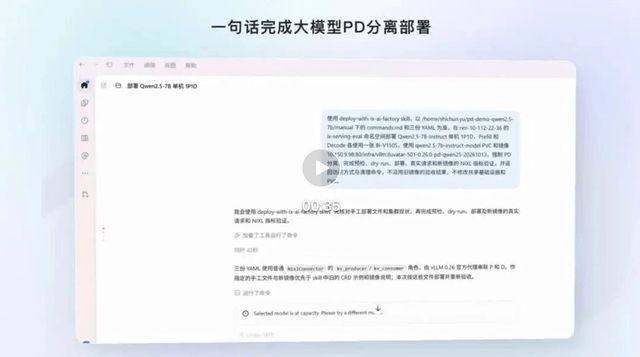
The next-generation Iluvatar Smart Computing Software Stack embraces an Agentic AI architecture. It abstracts engineering optimization workflows gathered across hundreds of enterprise client deployments into a suite of modular “Skills.” Developers simply specify business objectives and define constraints; the Agent handles the subsequent configuration autonomously, prompting the developer only for final sign-off at critical checkpoints.
Video URL:
https://mp.weixin.qq.com/s/Non20tfUB860KjNQkW3LZQ
Take environment setup and bringing up a PD-disaggregated cluster as an example: manual configuration typically takes upwards of an hour, but with Agent collaboration, the entire pipeline completes automatically in under 10 minutes, cutting human involvement down from dozens of steps to a single confirmation click.
Compute performance tuning has also been handed over to intelligent automation.
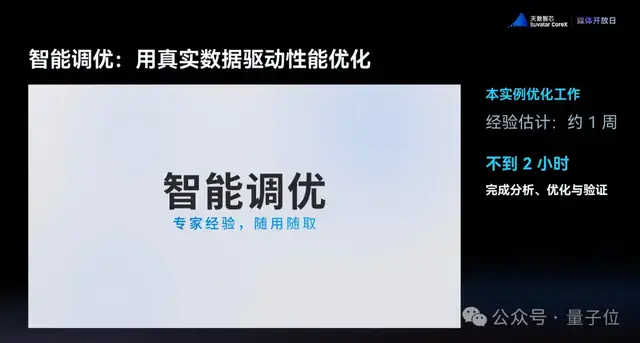
The Agent autonomously invokes Iluvatar CoreX’s built-in profiling utilities, pinpoints compute bottlenecks, synthesizes optimization policies, and initiates closed-loop validation. In one foundation model tuning run, an engineering task that previously took a full week was wrapped up in just two hours through this automated “analyze-optimize-verify” loop, nearly doubling runtime performance.
In custom operator development, Iluvatar CoreX has also become the first domestic GPGPU vendor to deeply integrate the FlyDSL compilation framework, empowering AI models to autonomously generate, compile, validate, and tune low-level operator code.
During adaptation and optimization for a mainstream deep learning model, an engineering workload originally estimated at 10 person-days took less than two hours with Agent assistance. Both computational precision and throughput hit delivery criteria, while compilation wait times plummeted by more than 90%.
