
How to Build Agents with Diffusion Models
Mind blown! Even when following the AI frontier every single day, keeping up with the rapid pace of developments feels almost impossible.
Who would have thought that diffusion models—long seen exclusively as tools for generating images and videos—can now write code, build web pages, call tools, and act as autonomous agents!
Just recently, Diffusion Intelligence released its all-new diffusion language model—Clover-35B-A3B-Preview.
Although it carries “diffusion” in its name, hands-on experience shows that whether it is writing code, interacting with web pages, calling external tools, or generating HTML, the workflow feels virtually identical to the LLMs we already know so well.
My immediate impression after trying it out can be summed up in one word: “fast.”
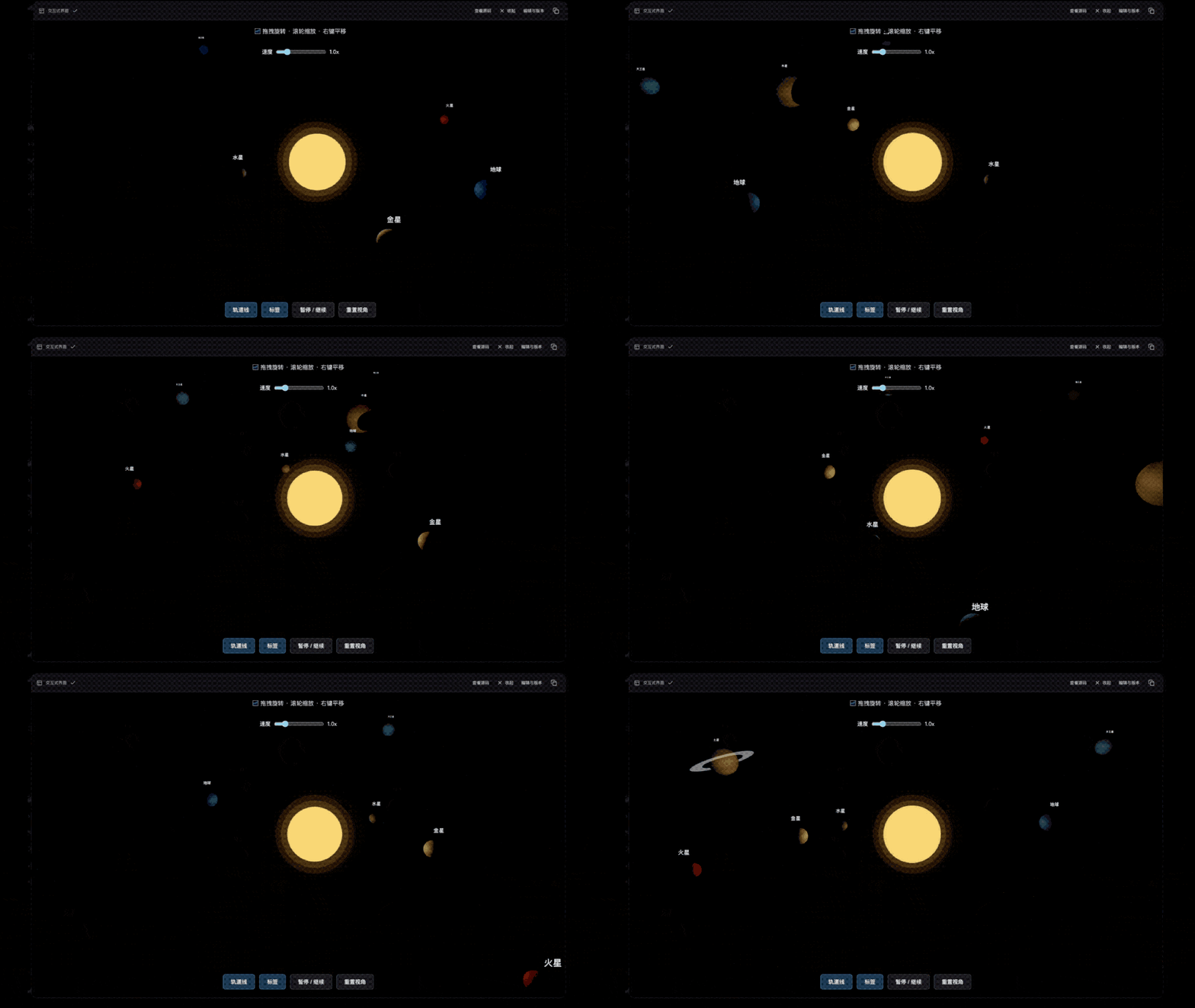
For example, when tasked with creating a solar system simulator, Clover reasoned for just about one second, and within the next 4 to 5 seconds, a fully interactive solar system simulator was ready.
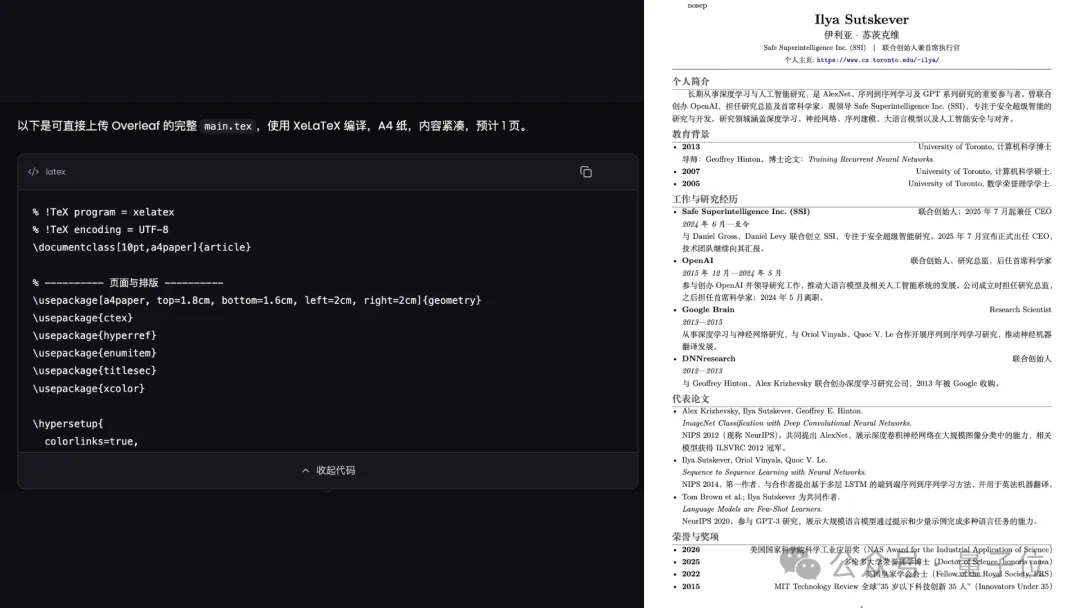
In another test, I fed it a mess of unstructured resume details and asked it to format them into LaTeX code; it knocked it out effortlessly in just about ten seconds.
Anyone who has used GPT-style models knows the pain of staring at a “thinking…” indicator during a prolonged wait. This also explains why Jev, which focuses on rapid decision-making, has garnered so much attention lately.
Speaking of Jev, Clover went head-to-head with it on speed.
Across 49 tasks in the WindTunnel web agent benchmark (with 3 attempts per task), Clover achieved a median execution time of just 1.52 seconds, compared to 3.21 seconds for the Jev + Mercury 2.5 pairing—slashing latency by more than half.
Clover also came out on top in task success rate, achieving 98.6% versus 95.9%.
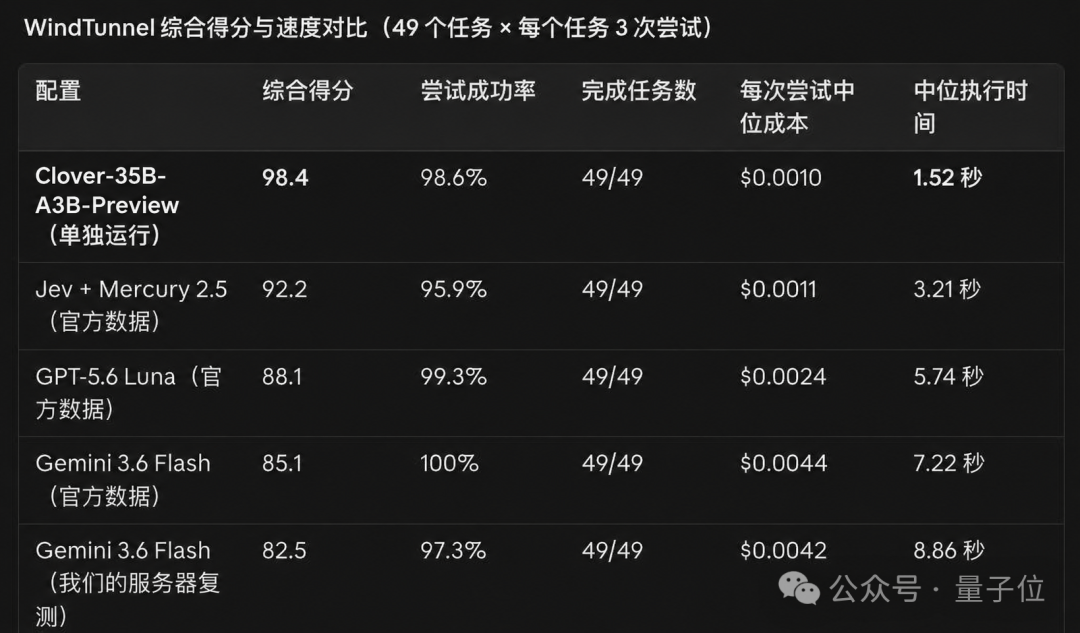
Compared to Gemini in the same benchmark table, its execution speed is several times faster.
Traditional autoregressive models are definitely feeling the pressure now.
A Diffusion Model That Excels at Agent Tasks
Looking under the hood, Clover-35B-A3B-Preview adopts a Mixture of Experts (MoE) architecture with a total of 35 billion parameters and approximately 3 billion active parameters per token, featuring native support for a reasoning/thinking mode.
This milestone scales the team’s diffusion language models from the earlier Dream 7B (7 billion parameters) straight up to a massive 35 billion parameters.
More importantly, despite the substantial increase in parameter size, Clover’s inference speed took no hit—outperforming autoregressive models of comparable scale across the board.

Beyond generating interactive pages and basic code, official demos showed Clover handling complex workflows, generating WebUIs, and executing various agent tasks.
Powered by WebMCP, Clover can execute a six-step pipeline in sequence—covering invoice generation, course registration, total calculation, event status checks, and fetching customer and invoice details.
In head-to-head demos, Clover not only completed tasks flawlessly but also significantly outpaced Gemini 3.6 Flash in execution speed.
In an e-commerce scenario, Clover accurately followed instructions to locate a specific style of black T-shirt in size L, added it to the cart, auto-filled guest checkout information, and completed the entire test checkout flow.
The execution stability demonstrated in such sequential tasks is arguably the most impressive breakthrough of this release.
Historically, while diffusion language models offered speed advantages through parallel generation, they struggled with stability in agent workflows. They frequently suffered from tool-calling formatting errors, got stuck in loops retrying the same step, or failed to dynamically adapt actions based on environmental feedback.
Clover’s core advancement lies in its reliability across multi-step operations: consistently executing tool calls, accurately parsing feedback, and steadily driving actions forward until goals are met.
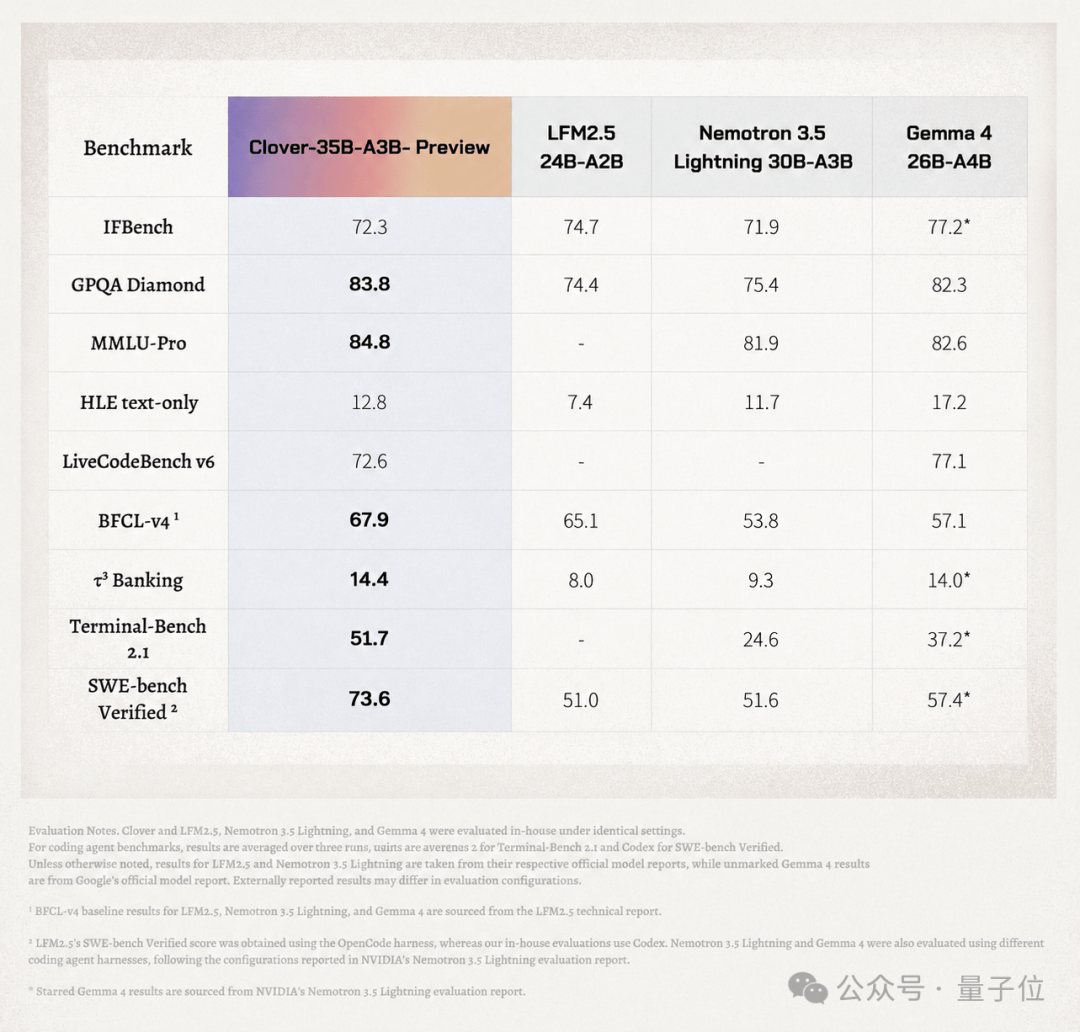
In quantitative benchmarks, official data shows that Clover achieved impressive scores of 65.3 on τ³ Overall and 67.9 on BFCL-v4—both leading the pack in tool-use evaluations.
Source: Diffusion Intelligence
Beyond agent tasks, let’s look at its code generation capabilities.
In this test, Clover again took only a dozen or so seconds to build a well-structured, highly interactive personal agent web UI.

On authoritative coding benchmarks, Clover also delivered standout results:
It scored 73.6 on SWE-bench Verified (measuring real-world repository issue-solving) and 51.7 on Terminal-Bench 2.1 (evaluating terminal task execution).
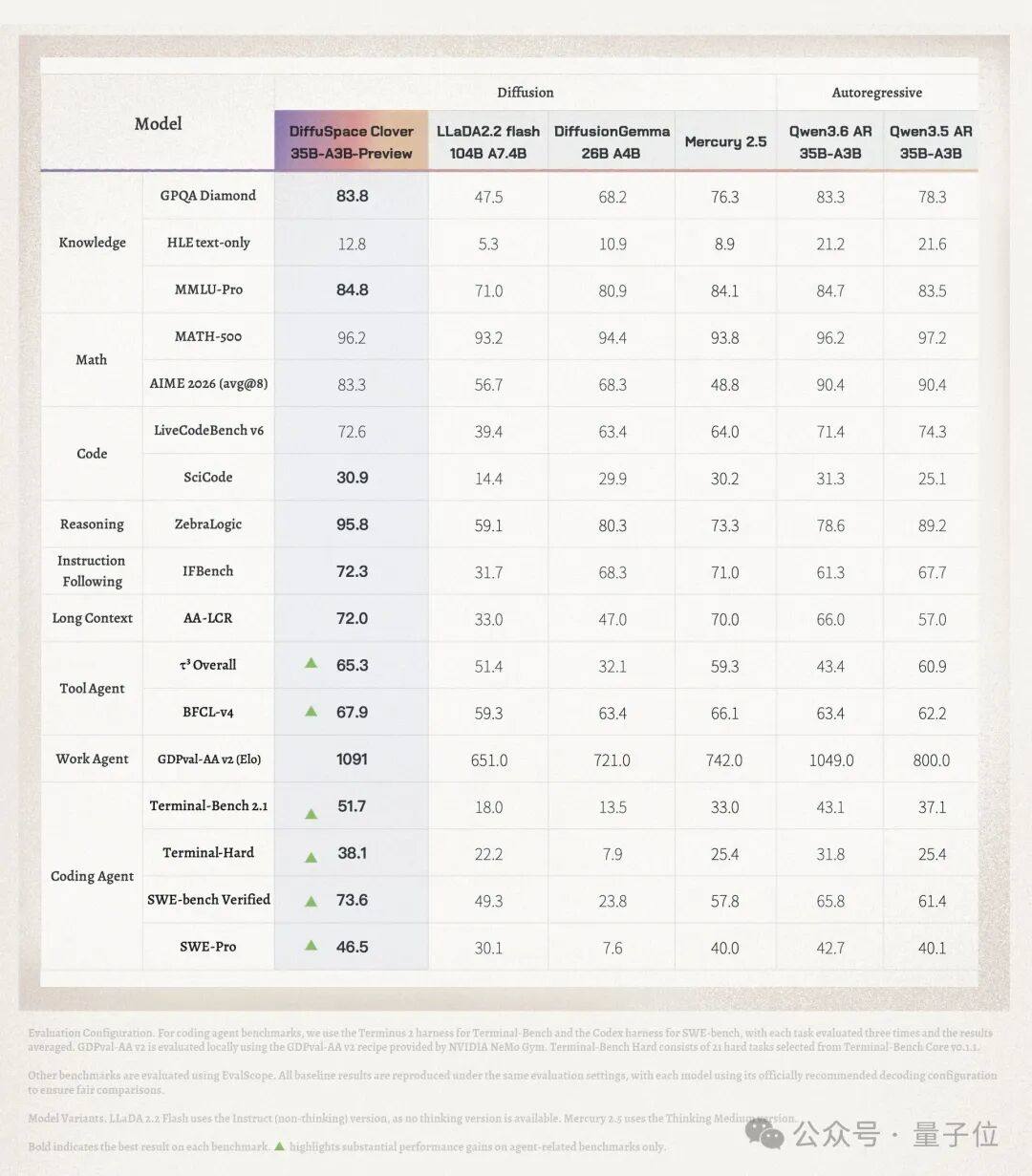
Source: Diffusion Intelligence
From interactive UI generation and toolchain integration to end-to-end business workflows and core code evaluations, Clover proves that a diffusion language model can handle tasks traditionally reserved for mainstream autoregressive agents.
This naturally raises a core question: how does the diffusion mechanism—historically associated with image denoising and generation—actually generate text and write code when applied to language models?
Diffusion Language Models: How Do They Work?
Standard autoregressive (AR) models work by predicting the next token step by step based on prior context—essentially playing a sequential game of “word association.”
Here, a token can be thought of as the fundamental building block the model uses to process text.
Unlike the serial, word-by-word generation of autoregressive models, diffusion language models operate on a fundamentally different mechanism: multiple positions update simultaneously, progressively forming the final text through iterative denoising steps.
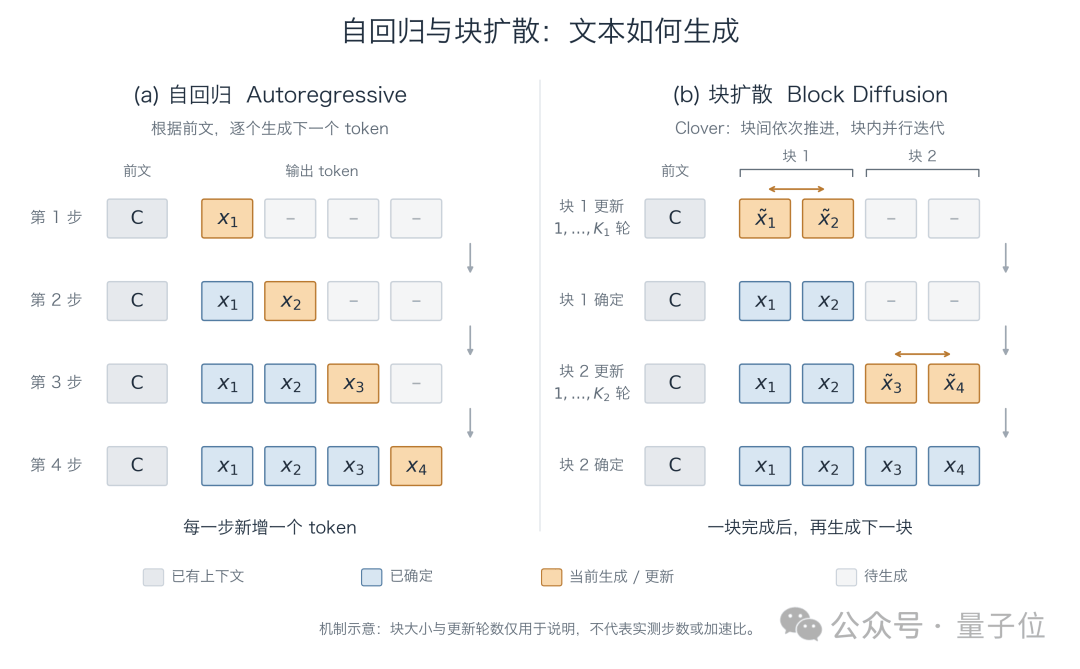
Source: AI-generated
In language tasks, diffusion denoising can be viewed as gradually recovering and refining masked or randomly perturbed tokens into coherent words and sentences that fit the surrounding context.
Specifically, Clover uses “Block Diffusion”: the content to be generated is divided into multiple blocks. Blocks progress sequentially, while tokens within each block are computed in parallel with bidirectional attention.
This design allows a single inference step to advance generation across multiple positions at once, effectively mitigating the latency bottleneck inherent in traditional sequential generation.
However, parallel generation does not mean a high-quality result can be produced in a single step.
Diffusion models typically require multiple denoising iterations to converge. Too few iterations can leave the output half-baked; too many iterations cause computational costs to soar.
Moreover, in complex coding and agent environments, the context window expands rapidly with every interaction. User prompts, prior actions, and tool outputs directly inform subsequent decisions, making the efficient storage and retrieval of historical context a critical performance bottleneck.
Clover’s solution is to decouple historical context retrieval from active content generation.
Built around block diffusion, the model re-engineers a Gated Delta Network (GDN): the extended context of previously generated tokens is dynamically compressed into continuously updated hidden states for fast retrieval, while the active block leverages bidirectional attention so tokens within it can cross-reference and adjust simultaneously.
At the same time, Clover integrates historical memory retrieval as an independent feature unit directly into the attention mechanism of the current tokens, enabling the model to learn how to balance past context against present generation weights. It also introduces a learnable block size calibration mechanism to prevent historical context from being diluted when blocks are too large.
This architectural overhaul aims to strike an optimal balance among parallel generation throughput, long-context retention, and compute efficiency—forming the technical backbone that allows Clover to extend diffusion language models into advanced coding and agent workflows.
Beyond Clover, diffusion language models have attracted widespread attention across academia and industry over the past two years, largely due to two core advantages over autoregressive models:
- Parallel Generation Efficiency: Enabling concurrent generation across multiple positions breaks through the token-by-token latency barrier, unlocking immense throughput potential for agent workflows that demand frequent code generation and multi-turn tool invocations.
- Bidirectional Global Context Collaboration: Tokens can reference both preceding and succeeding context throughout generation. This bidirectional modeling allows multiple positions to adjust synchronously during iterative denoising, paving the way for capturing and resolving deep semantic dependencies.
Today, both academia and industry are actively pursuing this technical frontier:
Kaiming He co-authored ELF this year, exploring language generation within continuous embedding spaces; Google introduced DiffusionGemma to test the practical viability of parallel text generation; and several tech enterprises are actively developing diffusion language models tailored for code generation.
While technical implementations differ, the shared goal is to turn this novel generative paradigm into tangible performance gains. The true significance of Clover’s release lies in bringing this technology straight into production-style scenarios—code generation, tool use, and multi-step agent workflows.
From DiffuSeq to Clover: What’s Next for Diffusion Intelligence?
Looking back at the team behind Clover: Diffusion Intelligence.
Diffusion Intelligence was co-founded by Professor Lingpeng Kong of the University of Hong Kong alongside PhD students Shansan Gong and Jiacheng Ye. The team’s research in diffusion language models traces back to 2022.
Back then, they proposed DiffuSeq, pioneering the use of diffusion mechanisms for Seq2Seq tasks—generating target sequences end-to-end conditioned on source text.
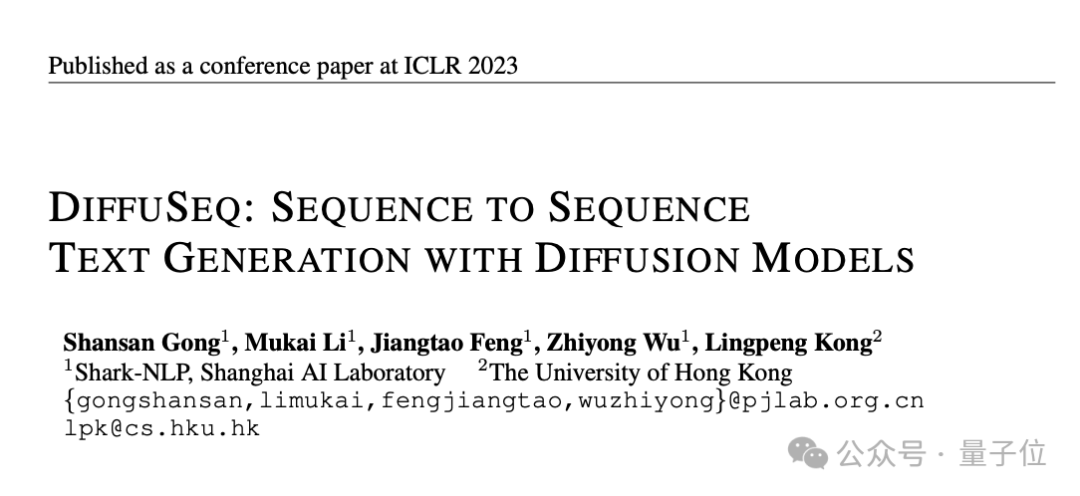
At the time, the key technical challenge they overcame was adapting diffusion algorithms—originally designed for continuous data like images—to discrete natural language tasks.
In April 2025, core team members introduced Dream 7B, scaling diffusion language model parameters up to 7 billion.
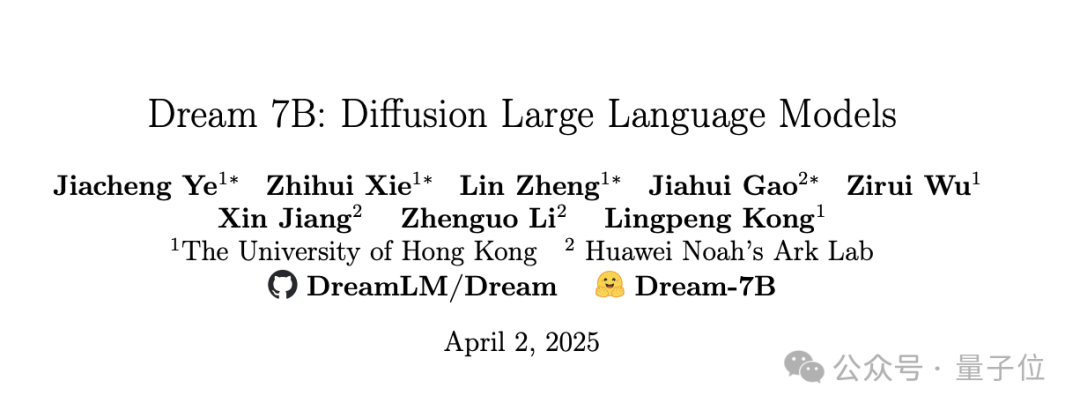
Experimental results demonstrated that Dream 7B matched equivalent-sized autoregressive models across general tasks, mathematical reasoning, and code generation, while displaying strong macro-planning capabilities and flexible, non-causal generation order.
With Clover, the team achieved not only an exponential leap in model scale, but also shifted its core focus squarely toward coding, API tool calling, and executing long-horizon tasks.
The overarching technical trajectory has evolved from “how to generate coherent text with diffusion models” to “how to execute complex, multi-faceted tasks both quickly and reliably.”
The team is currently extending this architecture toward multimodal capabilities and edge computing:
According to official disclosures, an upcoming multimodal version of Clover will deeply integrate diffusion language models with visual comprehension and physical action generation, with ongoing adaptation for on-device deployment. The team is also collaborating closely with Acrab on software-hardware co-design and low-level system optimizations tailored for edge environments.
Looking ahead, the team plans to explore ultra-large scale diffusion models, continually improve stability in long-horizon planning, and accelerate on-device adoption through operator-level inference optimizations, quantization, and deployment tuning.
Reflecting on the new paradigm introduced by Clover, it invites us to reconsider human cognition itself:
When we think, do we generate ideas linearly word by word like an autoregressive model, or do we first sketch a rough global outline in our minds and refine the details iteratively?
Is the human brain closer to autoregression—or diffusion?
Try it here:
[1] https://diffuspace.ai/register