
How I Built the Most AI-Integrated Company on Earth. Don’t let the clickbait title deter you—in this post, Jacob Sansbury walks through how they built Spawn, offering a deep look into what’s currently possible with agentic engineering using frontier models.
Spawn is a massively multiplayer environment where players can reshape the world simply by prompting Savi, an in-game AI agent.
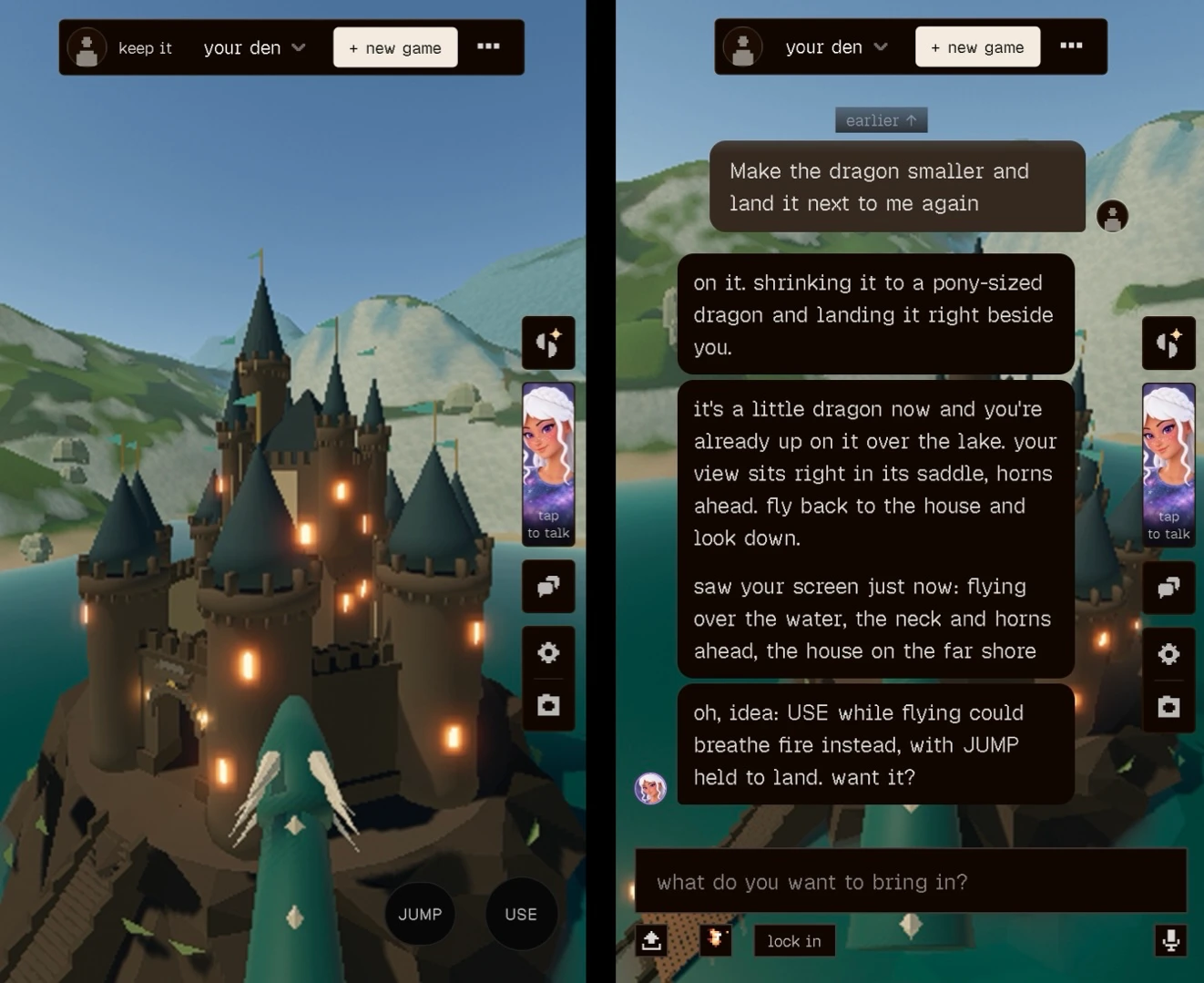
I tried it on my phone for a few minutes. With nothing but prompts, I generated a castle, conjured a dragon, and hopped on its back to fly around the grounds.
According to Jacob, Spawn is now being developed autonomously by a swarm of Fable-powered agents, with token costs alone topping $3 million per month:
Our agents ship directly to production on an hourly cadence, which means they read every single error, bug report, and runtime metric themselves. Roughly 60% of our work originates from production errors, bug reports filed by Savi (the AI you use to build games inside Spawn), anomaly detections in the logs, or feature requests.
Savi files her own bugs. When a user runs into a bug, or when Savi encounters one in the product, she logs it. That feeds straight into an agent, which decides whether it’s a real bug that needs fixing, something we won’t fix, or an intentional design decision that requires human input. Typically, this turns into a code change that ships to that specific user within an hour, accompanied by a notification sent right inside the same chat interface.
This takes continuous deployment to an absolute extreme:
A loop this tight only works if it never stops, which is why we treat any hour without a production release as a SEV-0—our highest severity incident tier. Unshipped changes pile up, existing production issues linger longer, and the feedback loop slows down. An agent’s context window can only hold a few hours of working memory, so shipping faster actually helps it stay coherent. […]
We can roll back a bad change in under 30 seconds, surgically reverting only what broke without touching anything else. When a monitoring or log alert triggers, it spins up or wakes the agent responsible for that incident, and we regularly break things on purpose to ensure these recovery pathways actually work.
Reading this article made my eyebrows raise at least a dozen times. It’s hard to imagine this development paradigm working for software with zero tolerance for error and catastrophic stakes, but for games, it seems shockingly effective.
Jacob notes that it was Fable 5 (and subsequently 5.1) that made this level of autonomy feasible. Opus 5.5 didn’t quite cut it for them; and when they tried using GPT-6 Astra to apply fixes based on a security audit, it took down the entire product:
Everything was disabled and flagged to be re-enabled once security remediations were complete. Astra had audited the entire product and decided to “make it secure” by simply shutting off every insecure feature across the board.
It’s extreme experiments like this that make me so excited about game development—it serves as the ultimate testing ground for pushing the boundaries of modern coding agents.