I previously wrote that November 2025 was the inflection point for coding agents—the moment when Opus 4.5 and GPT-5.1 crossed a threshold, turning their respective code agents into reliable, daily workhorses for software engineers. I believe we hit another inflection point in October 2026, and this time it’s for vibe coding computer games.
- Tree Appreciator
- Emberwick
- Battle Drones
- Pumpkin Farmer, aka Quarter Sun Cove
- Four times as insulting
- What happens if someone actually puts the work in?
- You should build a game!
Claude Opus 5.5, in particular, shows remarkable improvements across several areas needed to build engaging games:
- 3D modeling
- Music generation (see Scrimshaw Jukebox)
- Game design (!)
That last one is especially crucial. As seen in my earlier experiments, models have been capable of producing things that look like games for quite a while now. The hard part has always been making something that is genuinely fun.
Game design is a profound discipline. I wouldn’t pretend to be an expert in it—I know just enough about it as a craft to hold deep respect for it. Crafting a novel, engaging gameplay loop that challenges players at just the right level of difficulty and offers a satisfying learning curve is a subtle art. I used to think models simply couldn’t pull this off.
Then, I tried telling Claude Opus 5.5: “Make it a LOT more fun”… and it actually did.
Over the past few weeks, I’ve vibe-coded (by the classic definition of the term—without looking at a single line of code) four games that I genuinely enjoy playing.
Last weekend I attended Foo Camp in Berkeley and ran into several people who had similar experiences. Making fun games has become shockingly easy. The new challenge is coming up with novel, delightful game ideas that wouldn’t have existed without AI assistance.
I haven’t done an exhaustive comparison yet, but my current impression is that GPT-6 Astra is just a hair behind. It’s entirely capable of building a game, but its grasp of what makes something “fun” still lags behind Opus 5.5. I expect OpenAI will close that gap by the end of the year.
Here are the four projects that convinced me that LLMs can now build genuinely fun games with minimal guidance. All four games are built with HTML and JavaScript and run entirely in the browser.
Tree Appreciator
The smallest yet genuinely delightful game I discovered is Tree Appreciator. I built it using the regular Claude chat interface—without even needing Claude Code.
I made this on a whim while we were driving along Skyline Boulevard, admiring the trees along the way. My prompt was:
Make a game in three.js called "Tree appreciator"—it will show two procedurally generated trees, and the mechanic is to appreciate them and spot the differences between them. Think deeply about how to make it both fun and visually beautiful.
I found that prompting models to use three.js works surprisingly well. While Claude doesn’t have a built-in image generation model, it is fully capable of building rich, full-color 3D models that look and feel fantastic.
This game required zero iteration or follow-up prompting—it was a complete game in a single shot. It handed right back to me a charming, mobile-friendly spot-the-difference game. You can play it here. Here is the chat transcript that generated it.
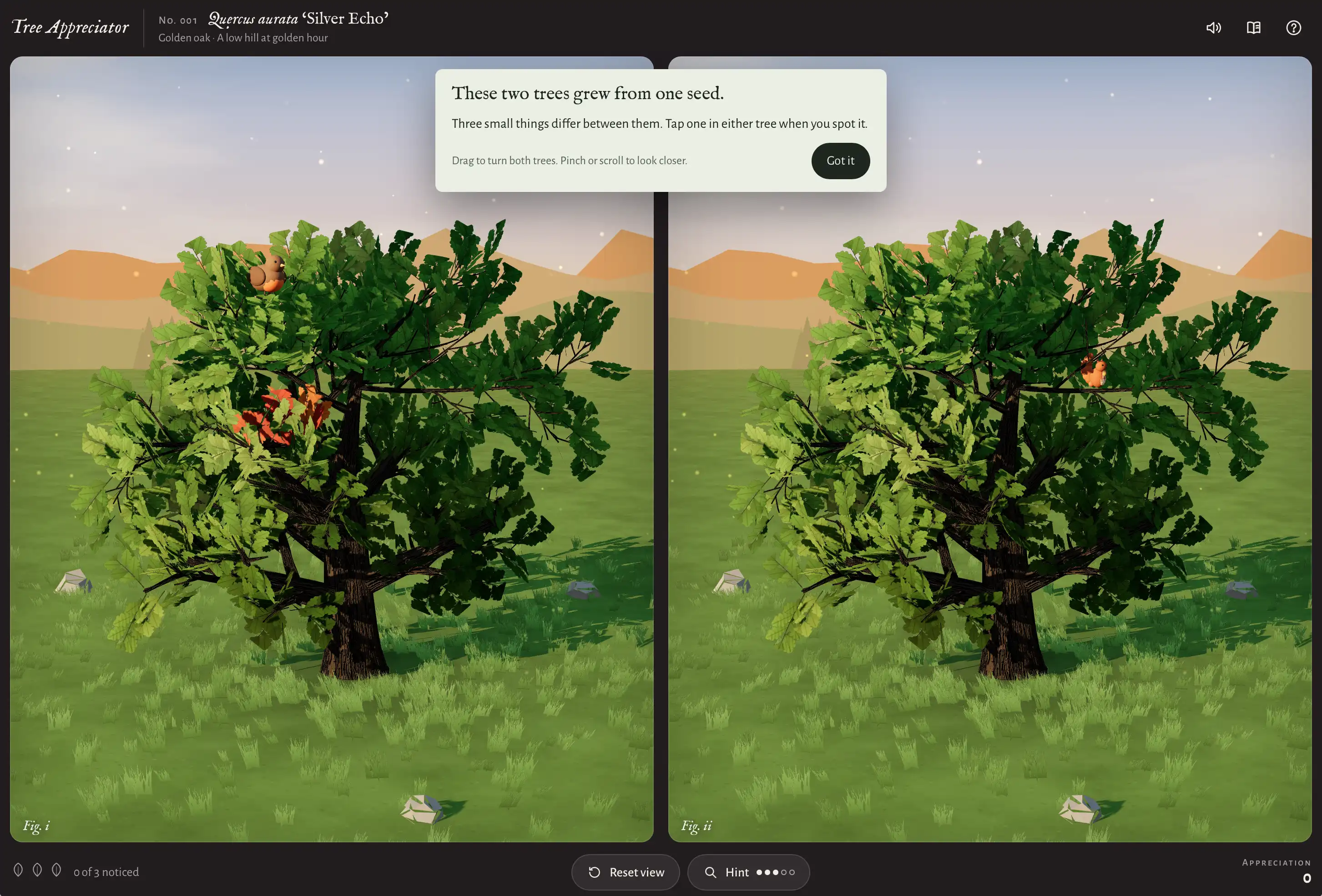
It’s deeply relaxing. The visuals are delightful, and collecting completed trees in the “Compendium” offers a cozy sense of accomplishment.
Emberwick
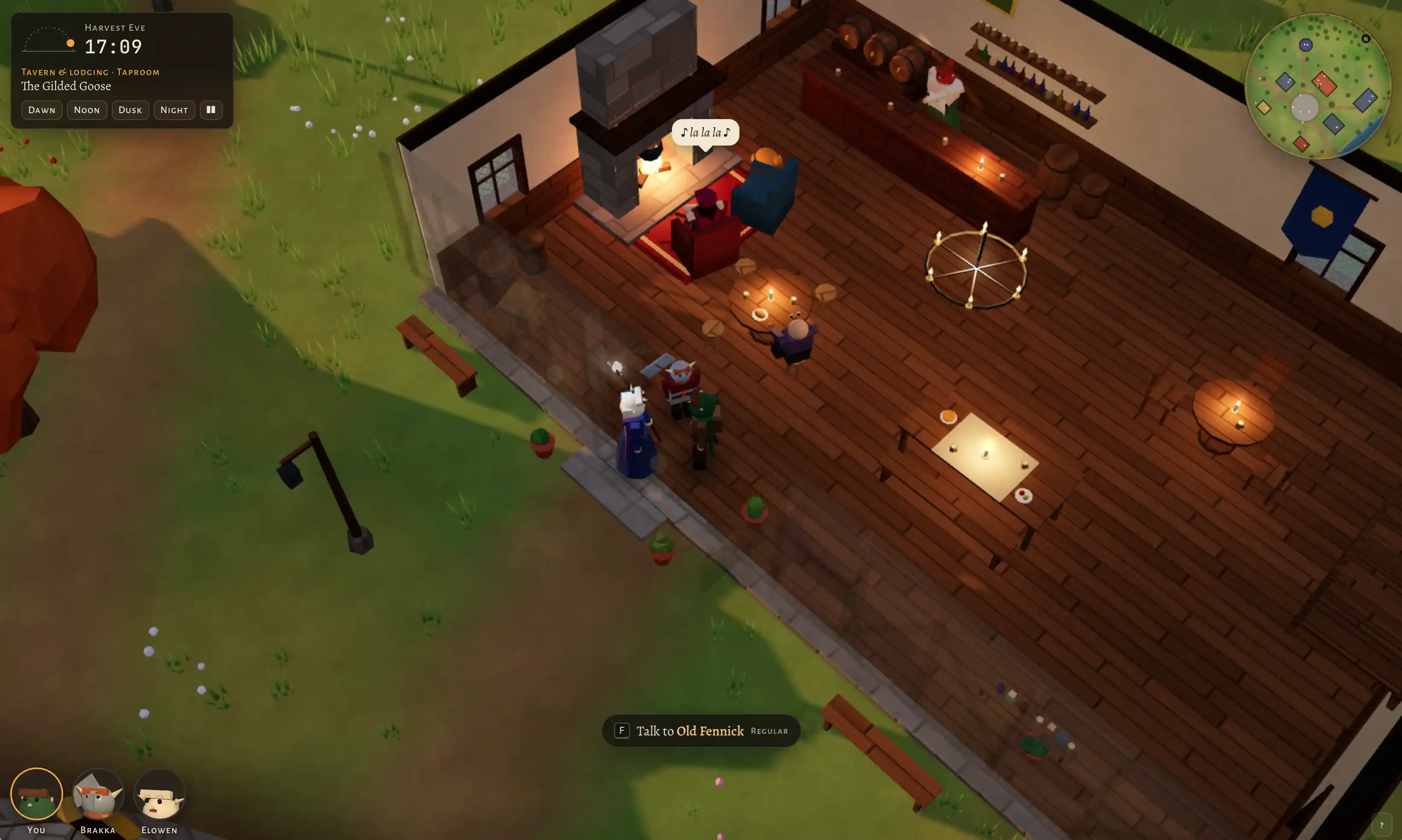
This was a more ambitious project, also built using standard Claude chat. Initially, I set out to prototype a top-down fantasy RPG engine:
Build a demo game engine in three.js for a top-down (isometric/tilted angle) RPG where the player moves through a world with one or two companions. Create a fantasy village scene, demonstrate walking around outside, and show how walls between the player and the camera become transparent when the player enters a building so the user can see what's happening inside
Add some NPCs, plenty of furniture, and different types of buildings (some with a second floor)—be creative and make it look great
Here is the initial version. It worked astonishingly well!